 This article has a talk page!
This page details pre-release information and/or media for Dragon Warrior II (NES).

|
To do:
|
Development Timeline#
1986
- April - Planning for Dragon Quest II begins.1
- July - Development starts.
- November - Main programming is mostly completed.
- November 11 - Weekly Shōnen Jump Issue 50 announces that the game will be released in late December.
- November-December - The game's release is delayed due to difficulty balance issues. Extensive adjustments of difficulty balance and item locations are made during this time.
- Mid-December - Game is finished and shipped to Nintendo for eventual release.
1987
- January 26 - Dragon Quest II is released in Japan.
1990
- December - Dragon Warrior II is released in the US.
Original Location of Cannock Castle#
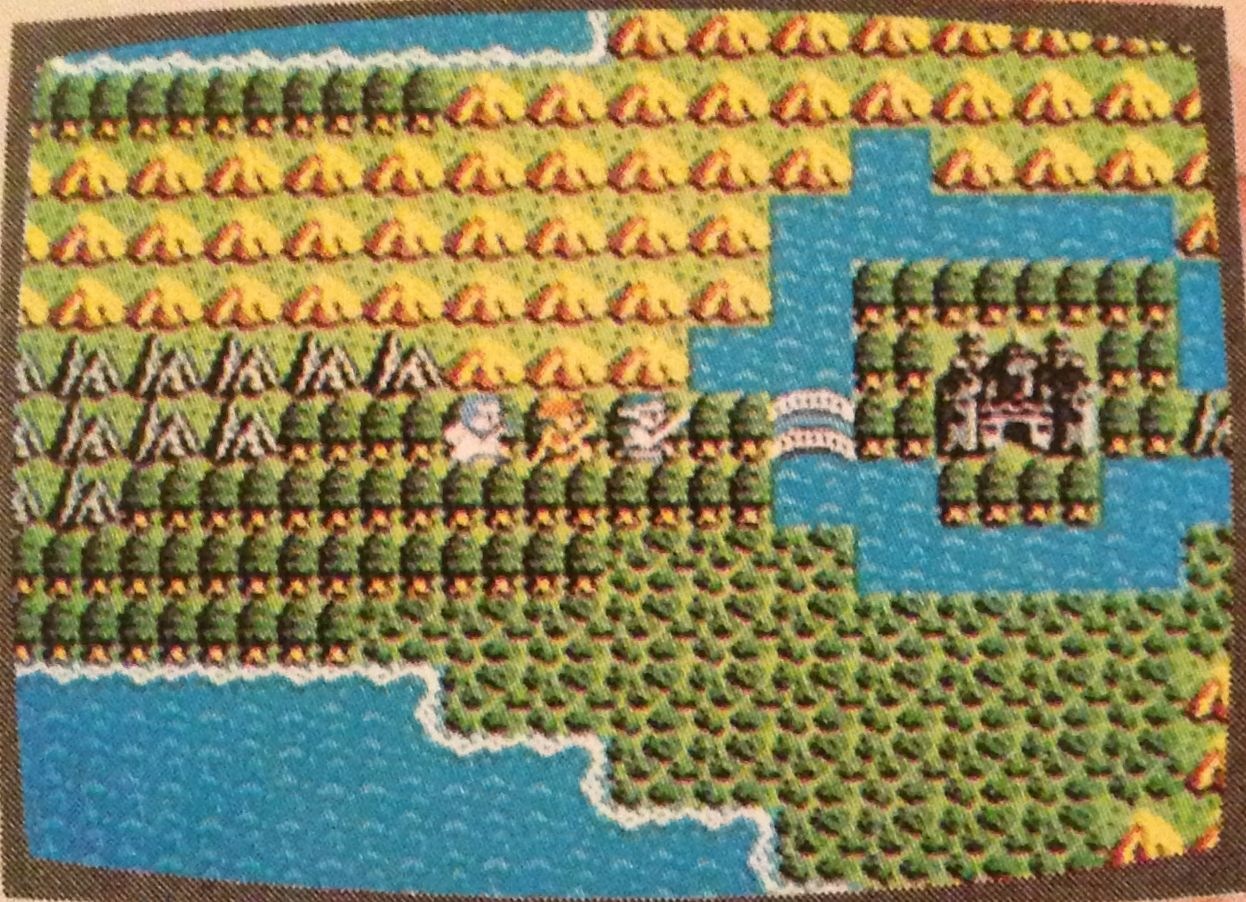
According to Yuji Horii, Cannock was originally located far northeast of the starting castle instead of northwest. However, this made it too difficult to progress, since it was too far from Leftwynne Village. The Prince of Midenhall cannot use any spells, and carrying medical herbs and going to the nearest inn would have been a necessity, so Cannock was moved to be closer. This made the lake around Cannock's former location rather meaningless, so the Lake Cave was moved to Cannock's former position.2
A screencap of this early location is on the back cover of the vinyl printing of Suite Dragon Quest II -Gods of the Evil Spirits-.3
Cut Cutscenes#
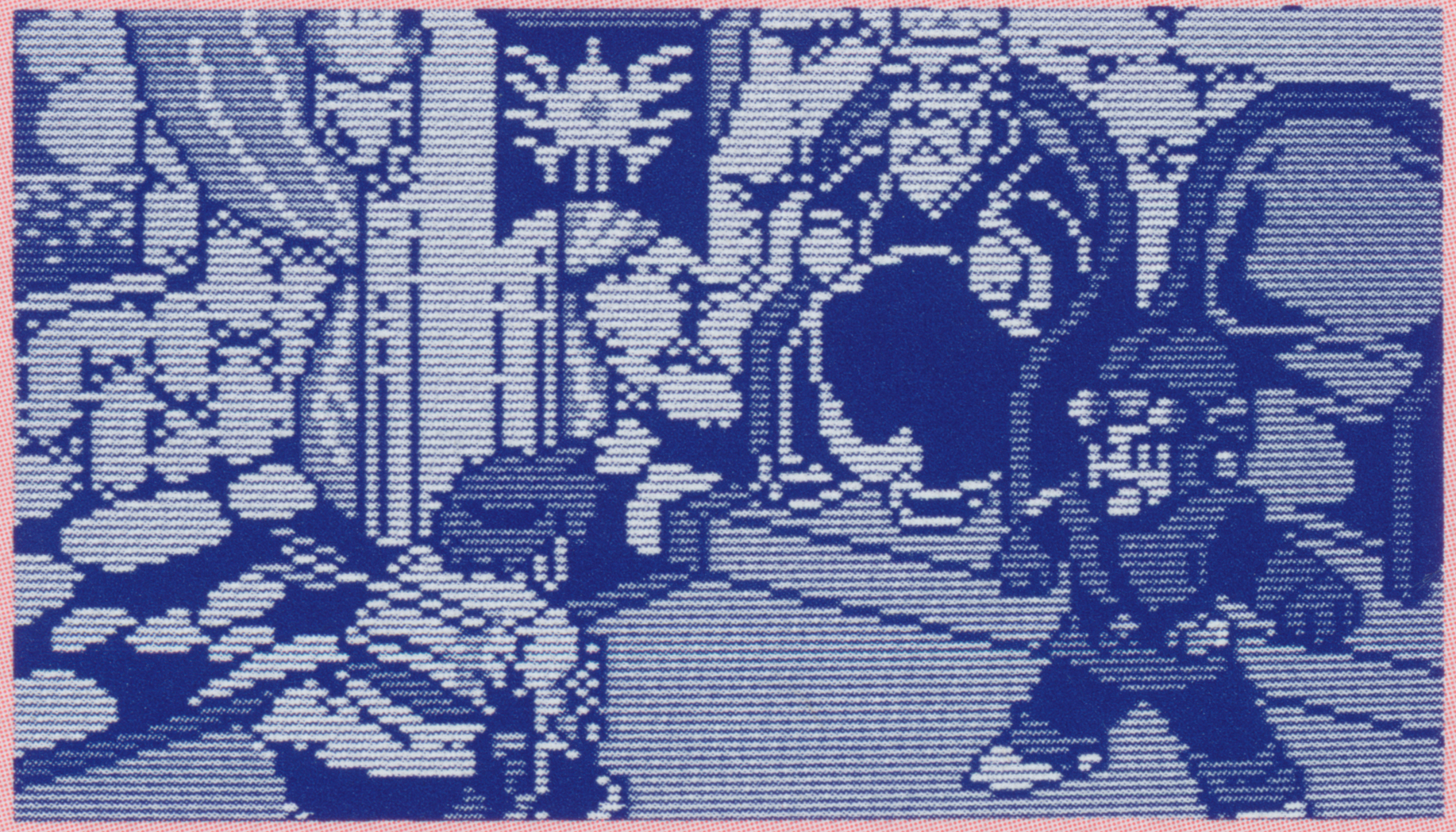
The game was intended to have cutscenes, but they were cut for memory. It was also intended on having, like the MSX version, an animation for if the princess wore the Skimpy Swimsuit.
A screencap of a cutscene involving the wounded Moonbrooke soldier and the King and Prince of Midenhall ended up in the manual, albeit in monochrome.
Early Title Screen#
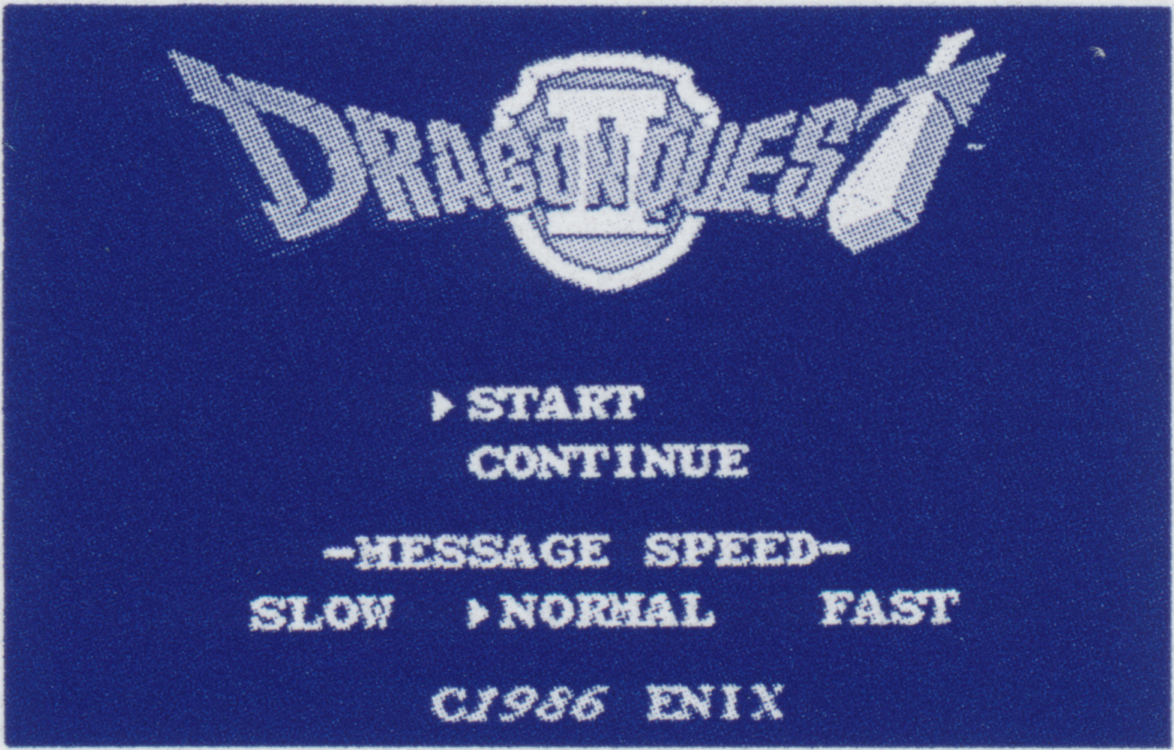
Present in the manual of the original Japanese version.
|
Pre-release |
Final (Japan) |
|---|---|
|

|
- The text is the same style as in the first game. The final modified it a tad.
- The copyright symbol is absent, instead using a standard C, likely as a placeholder.
- The copyright date is 1986. According to Yuji Horii, the game was originally supposed to be released in November of that year.
Weekly Shonen Jump #050, November 11 1986#
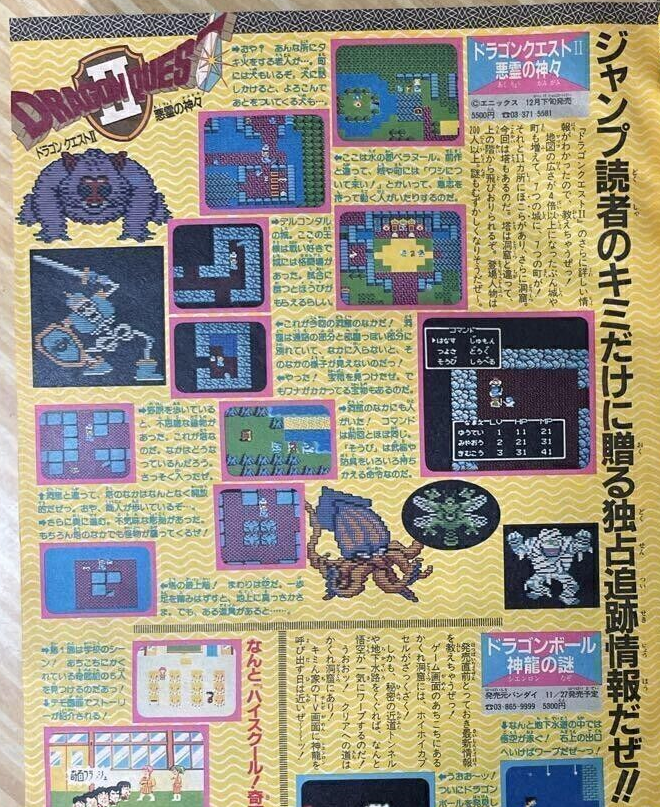
A preview of the game. The text on the top right reveals that the game was scheduled for a December 1986 release. There are many differences with the final version:
- On the top screenshot of Hamlin: both the Princess of Moonbroke and the dog can be seen together, something that can also be witnessed in some of the later Famitsu previews, but which cannot be achieved in the final version. It is mentioned that the dog follows the player if talked to, a behaviour which matches with final before the Princess is uncursed. It is unclear whether the set piece was not in place yet or if the player was given all 3 characters solely for testing purposes.
- Below are 3 screenshots of the Lake Cave: on the left, the chest is located one tile below its final position. On the right: an NPC can be found in a wide room, absent from the final version.
- In the middle: an overworld screenshot of the Tower of Wind, the overworld layout around the tower differs from final.
- On the bottom left: the top of the Tower of the Moon, again an NPC can be found whereas there is none in the final. The chest from final is also missing though the player could have already picked it up.
- In the middle of the page: pixel art for the enemy King Squid, which ended up being cut from the game before re-appearing in Dragon Quest III.
Famicom Tsūshin #013, December 16 1986#
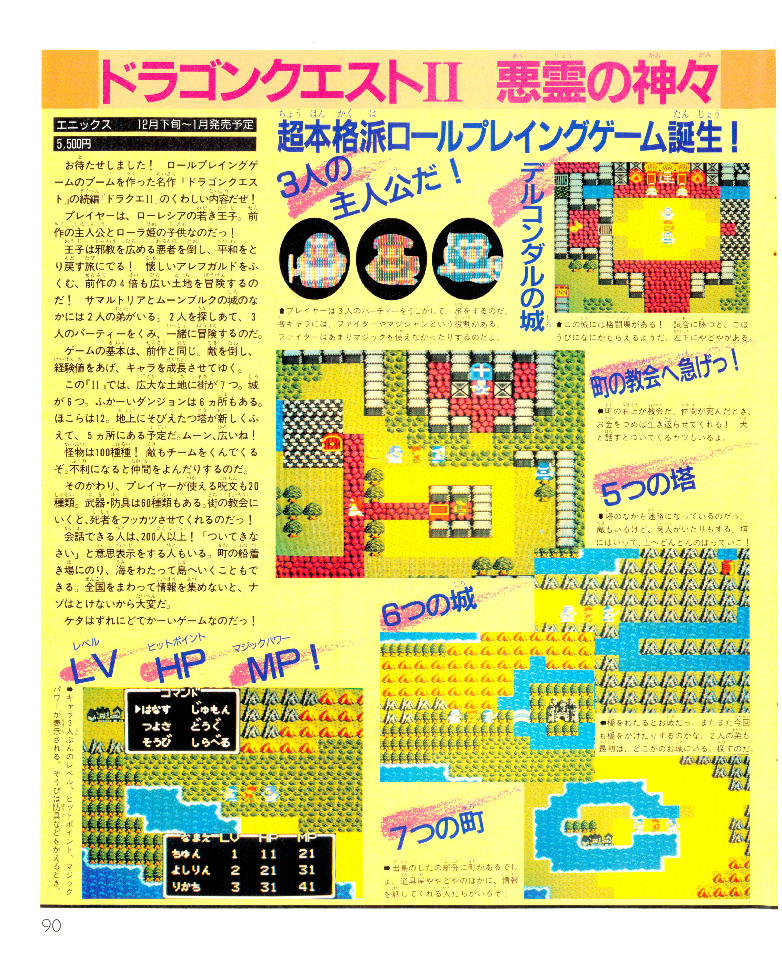
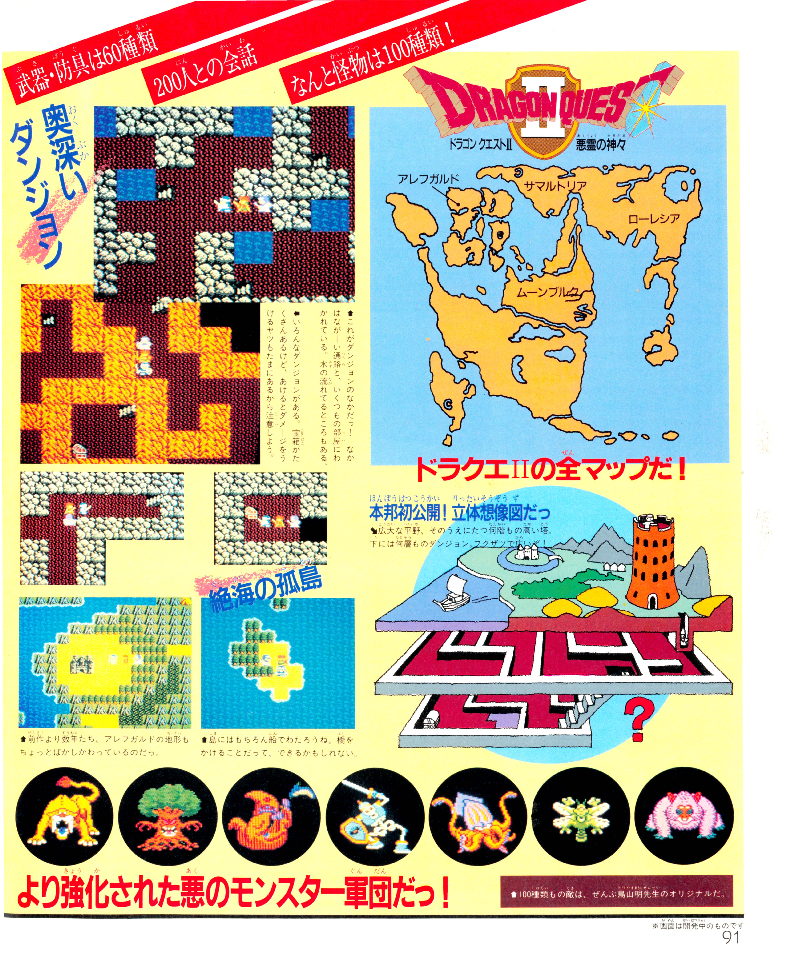
A preview of the game, 5 weeks before release. There are many differences with the final version. In the middle of the page: another source of the screenshot showing the early location of Cannock castle.
Preview |
Mock-Up |
Final |
|---|---|---|
 |
 |
|
 |
 |
 |

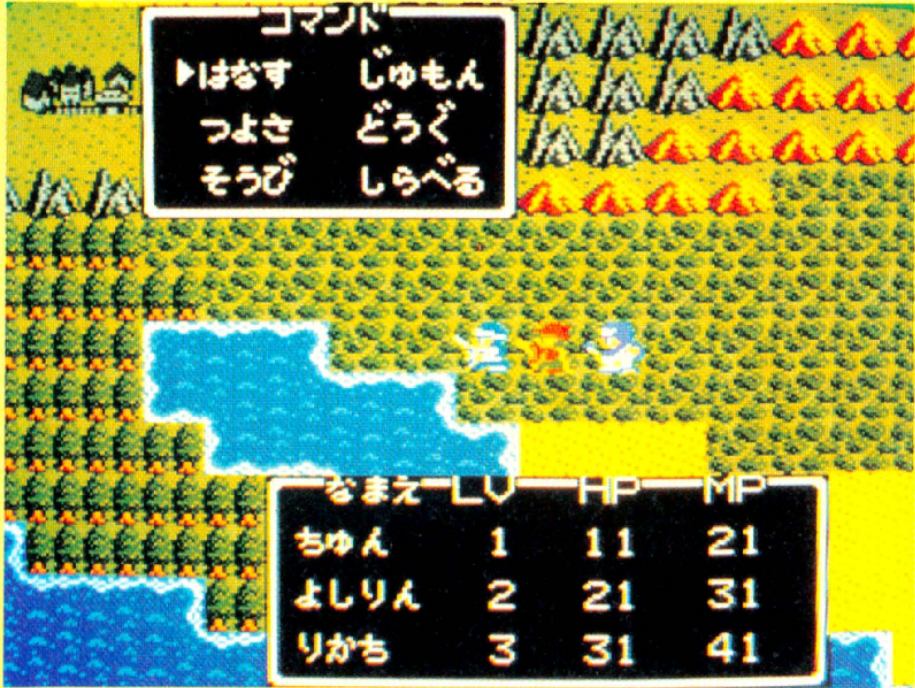
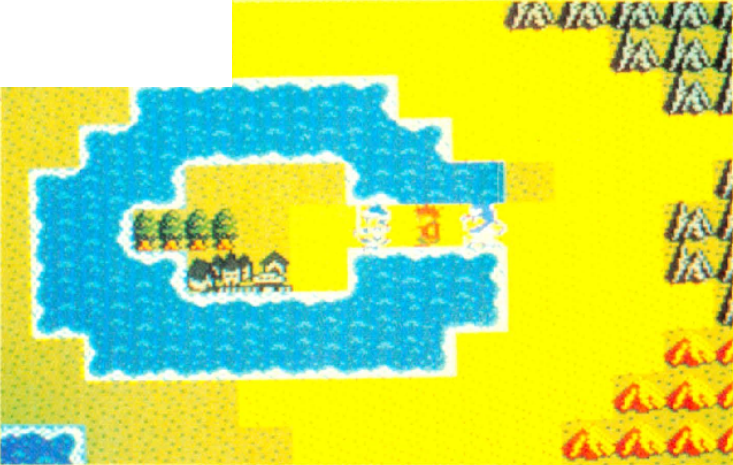
The overworld layout around Leftwyne and Beran differ, most notably the swamp around Leftwyne is missing and there are more mountains east of Beran.
Preview |
Final |
|---|---|
 |
 |
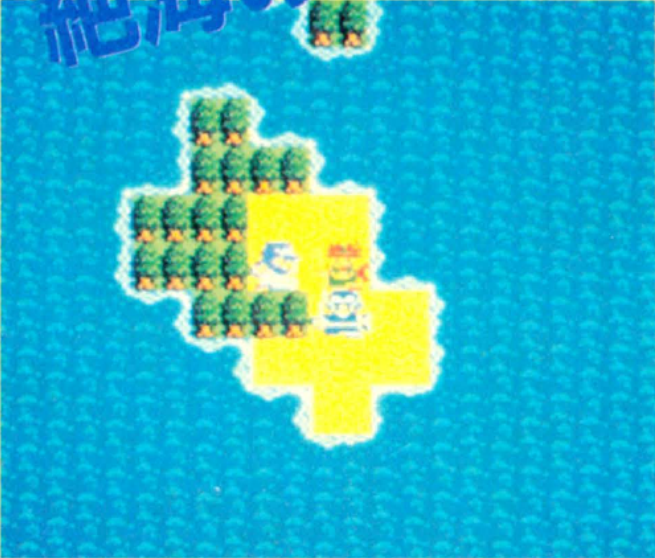
The nameless island south of the starting continent is missing its swamp tiles.
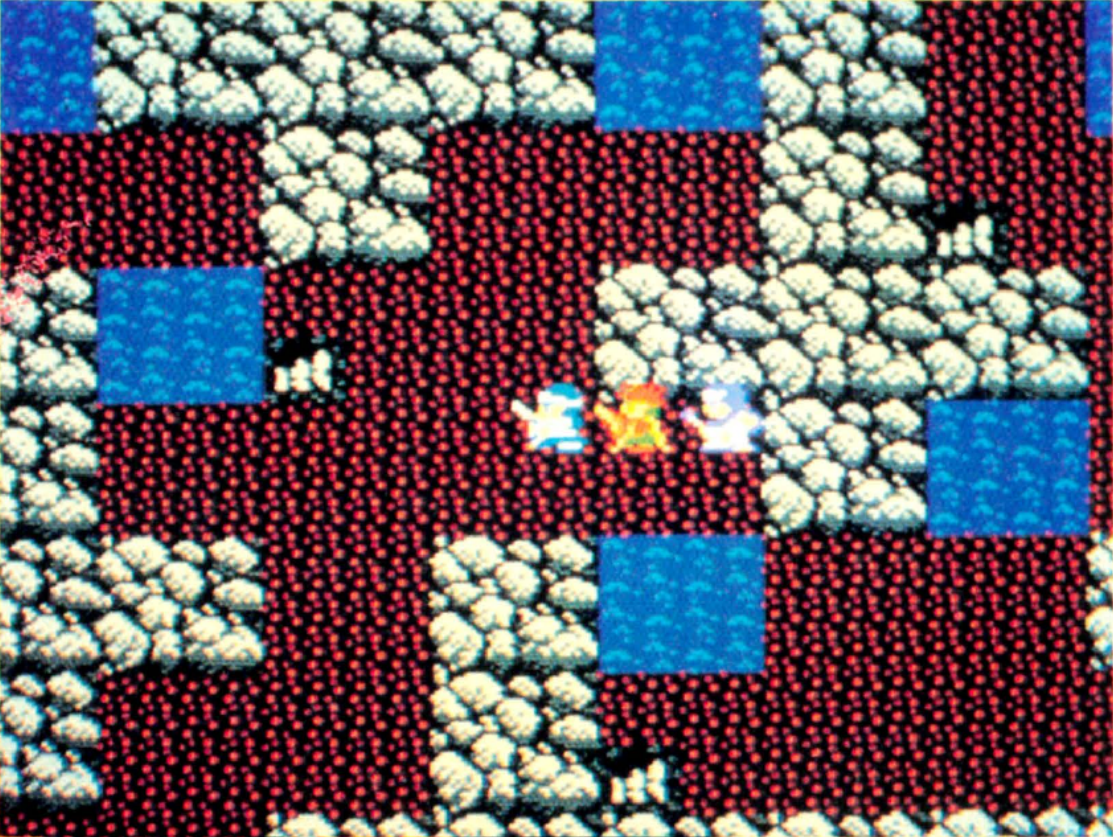
An unknown dungeon layout. The captions mention a cave under the sea with many layers, the only dungeon fitting that description in the final is the Undersea Cave, but it is filled with lava rather than the water from the preview.
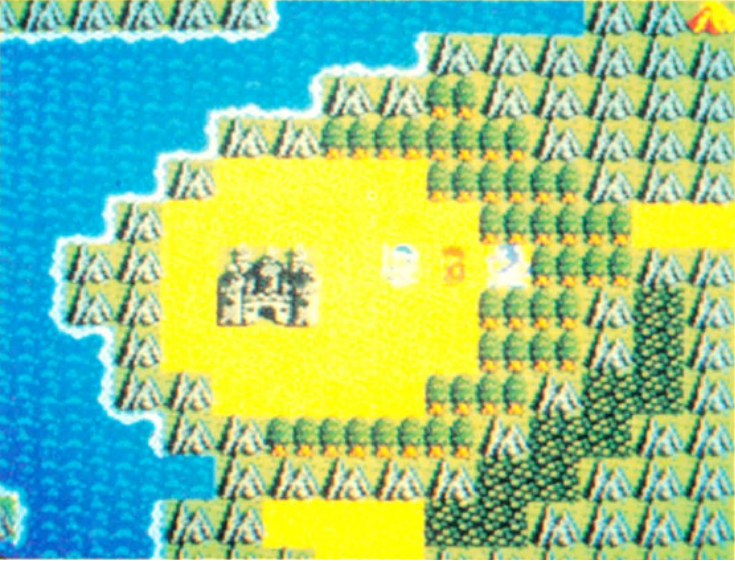
An unknown overworld location. According to the captions it is the land of Alefgard which has changed a lot since the first game. In the final the continent closely matches the first game.
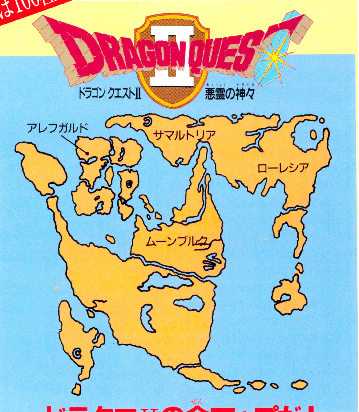
The world map differs from the final version most notably in the center continent, which in the preview consists of two continents separated by a narrow sea path.


Famicom Tsūshin #014, December 26 1986#
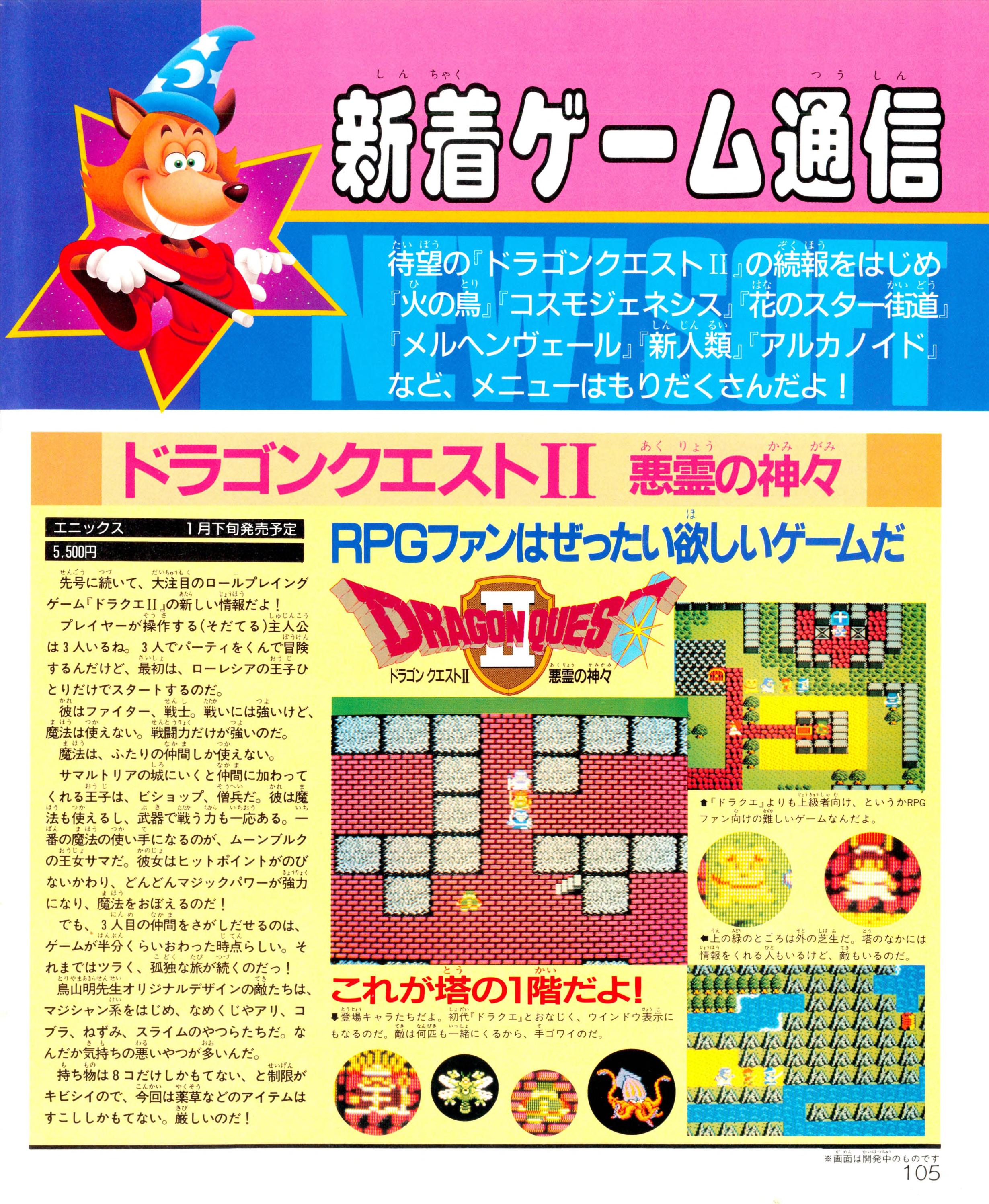
A preview of the game.
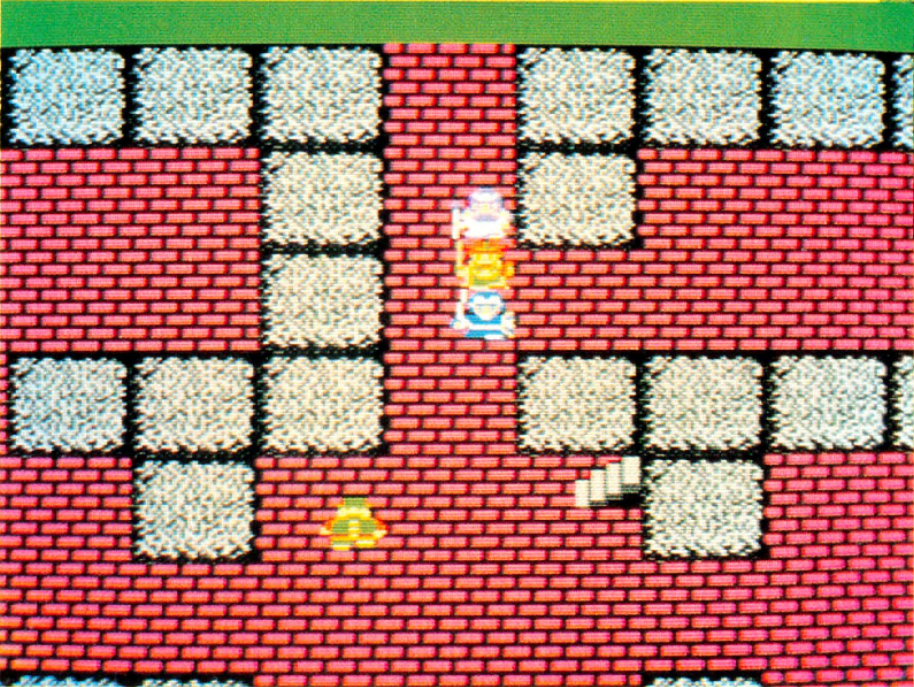
A NPC can be seen whereas there is noone to be found on this floor in the final version.
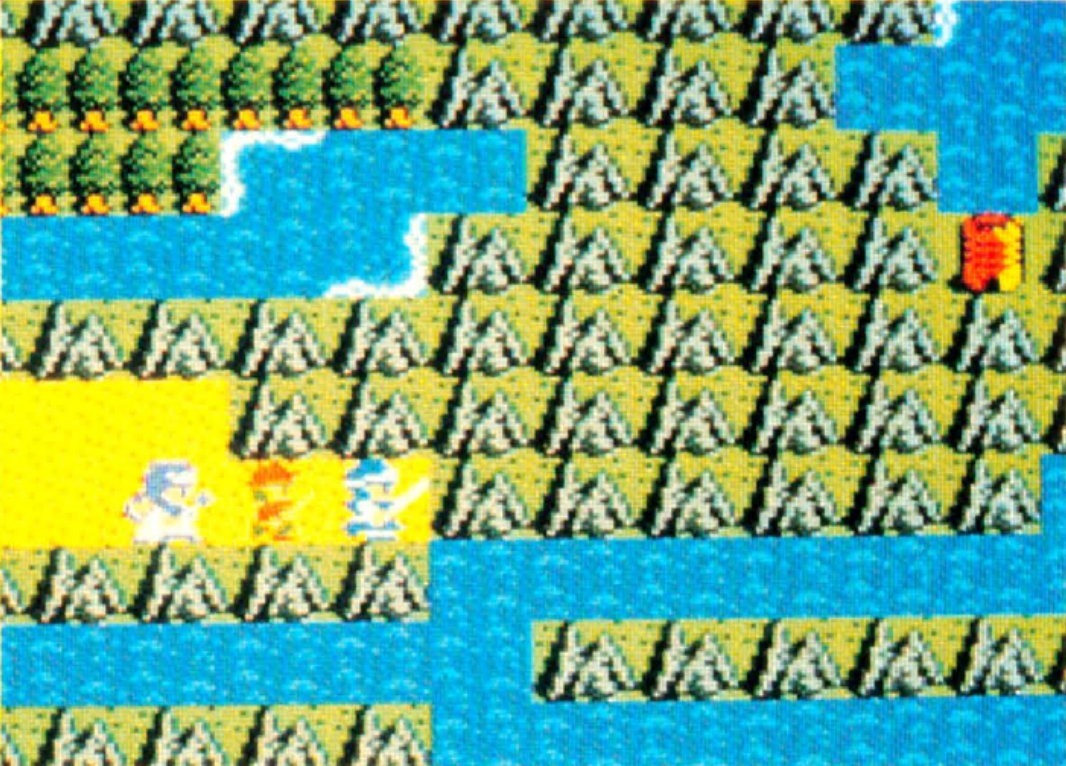
A better version of a screenshot that could be seen in the previous issue. No such overworld layout exists in the final version.
Famicom Tsūshin #015, January 1987#
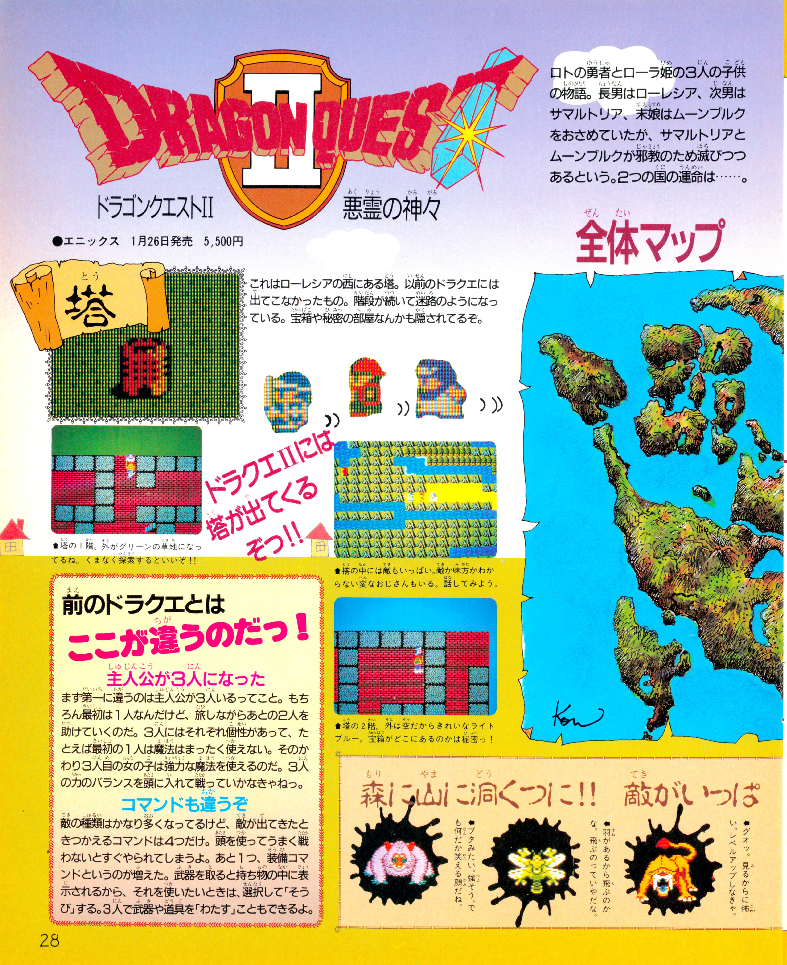
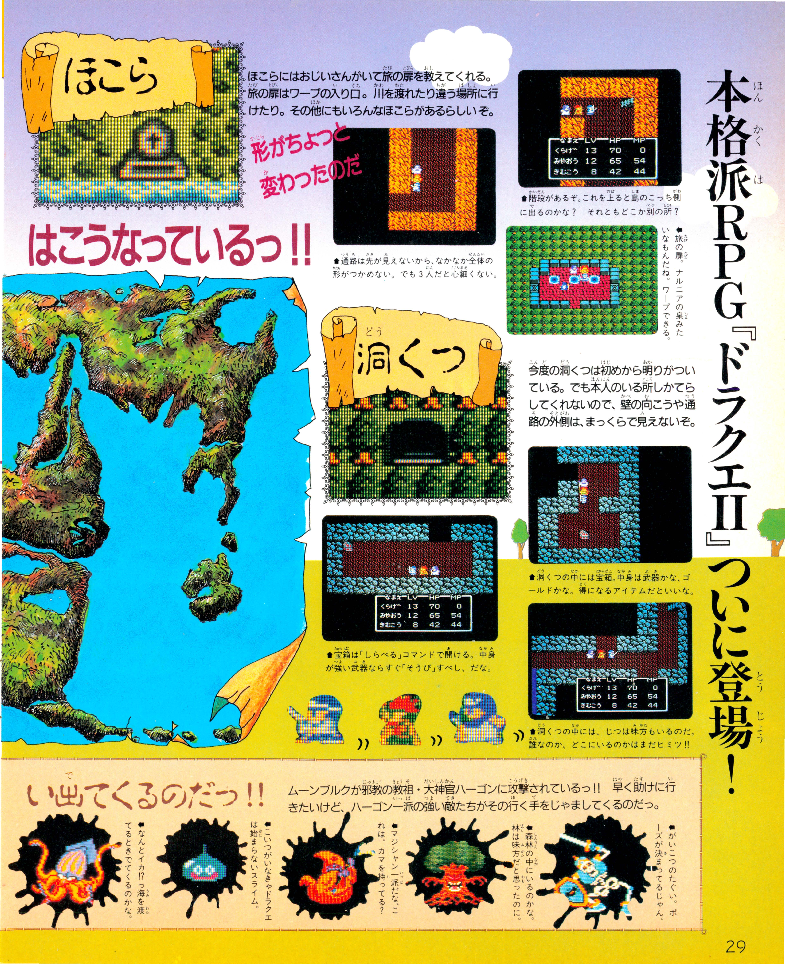
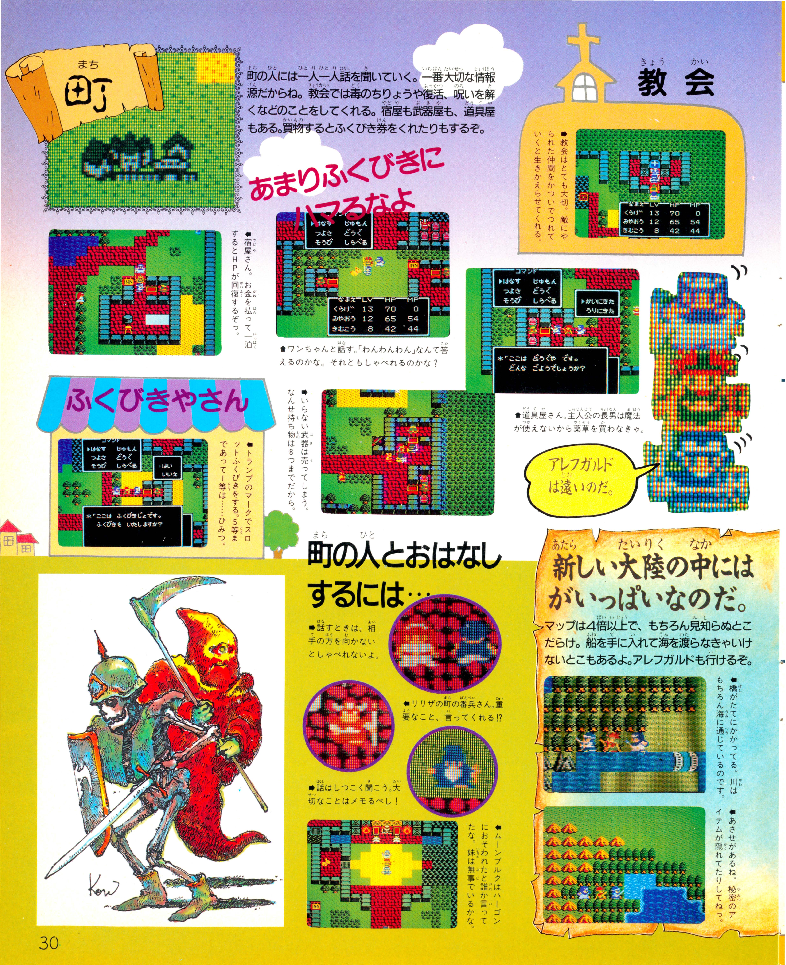
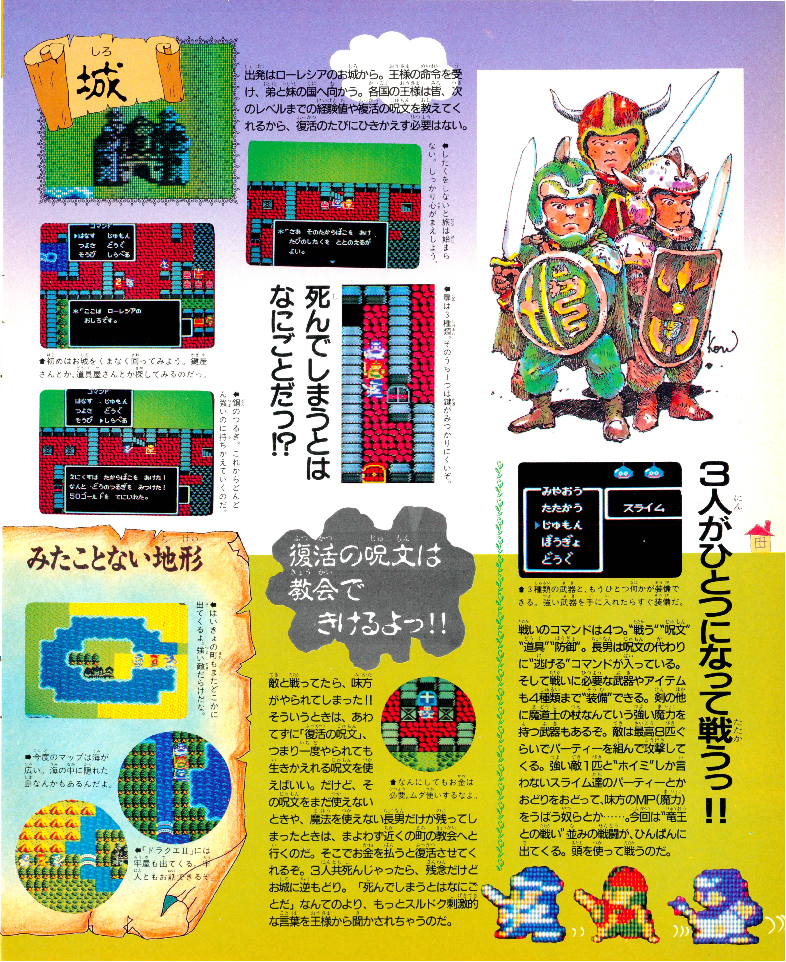
In the center: another version of the world map, matching the one from issue #013 but with more details.
On the last page, a cropped version of the early location of Cannock castle as seen above.
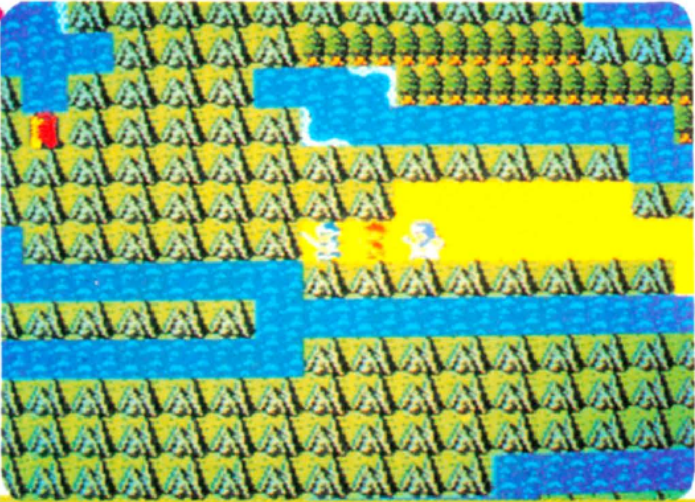
Another version of the unknown overworld layout seen in issue #013 and issue #014 with more of the surrounding area visible, however the screenshot appears to be mirrored. The captions reveal a bit more this time and seem to indicate that this would be an early location of the Tower of Wind, though it is unclear how the player would reach it. This would make of the sea and mountain below it the sea path between the two parts of the middle continent before they became one continent, as seen on the world maps found in this issue and in issue #013. However, the other version of the overworld layout around the Tower of the Wind which can be seen in the Shonen Jump preview contradicts this.
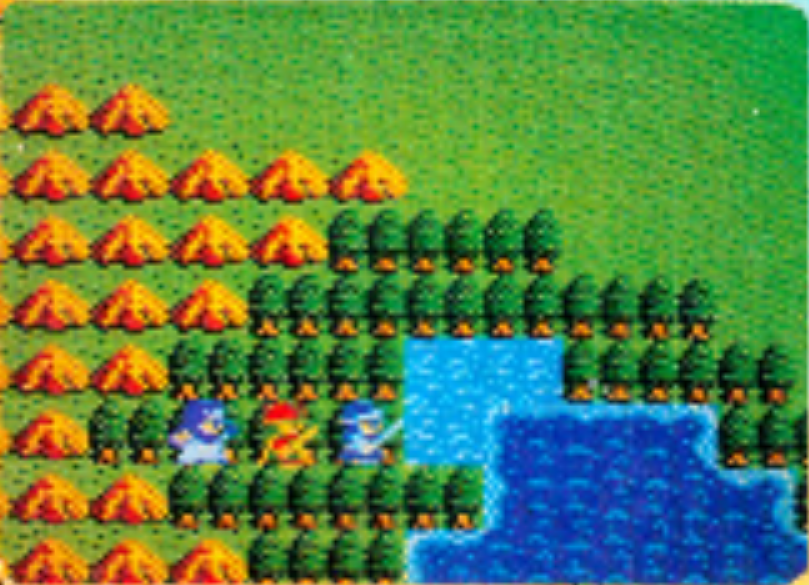
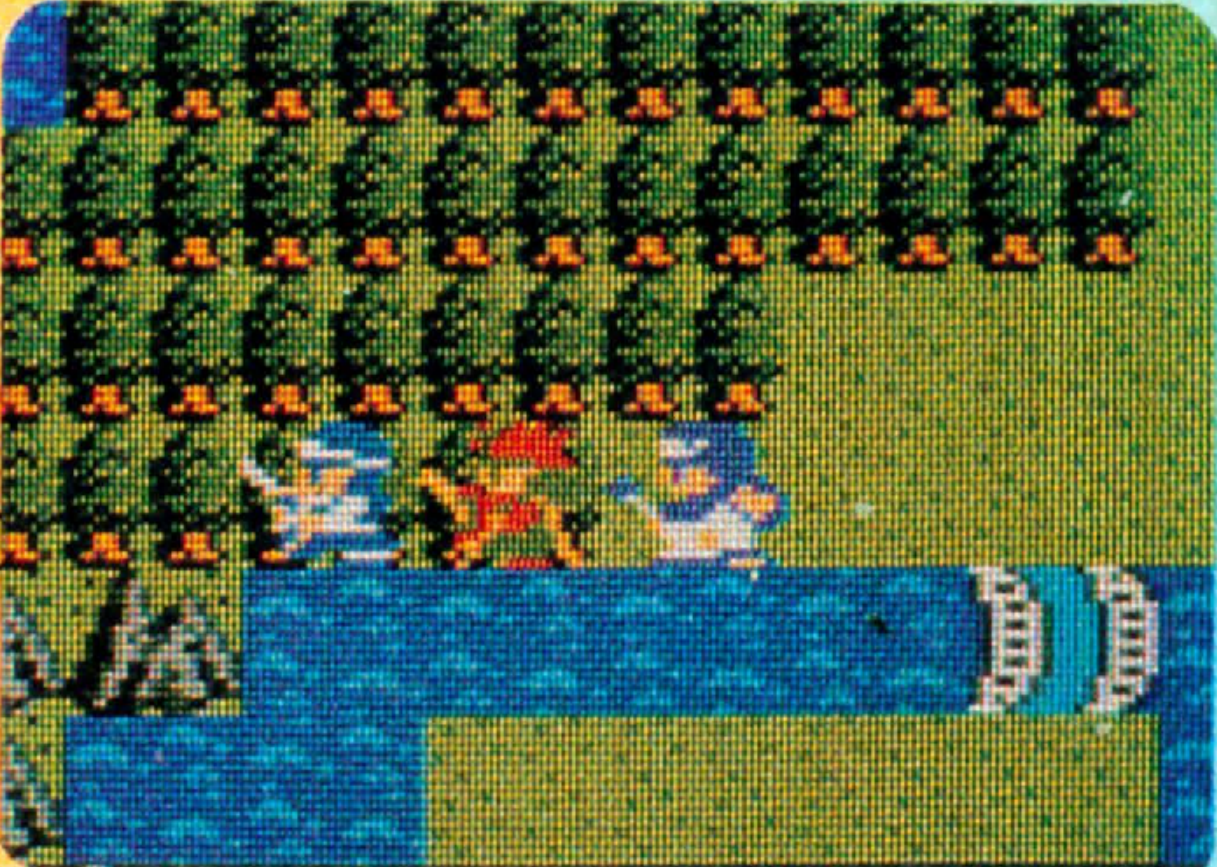
Two more unknown overworld locations, these layouts do not exist in the final version.
Famicom Tsūshin #021, April 17, 1987 - Making Of Interview, Part 1#

|
'...But what does it mean?' |
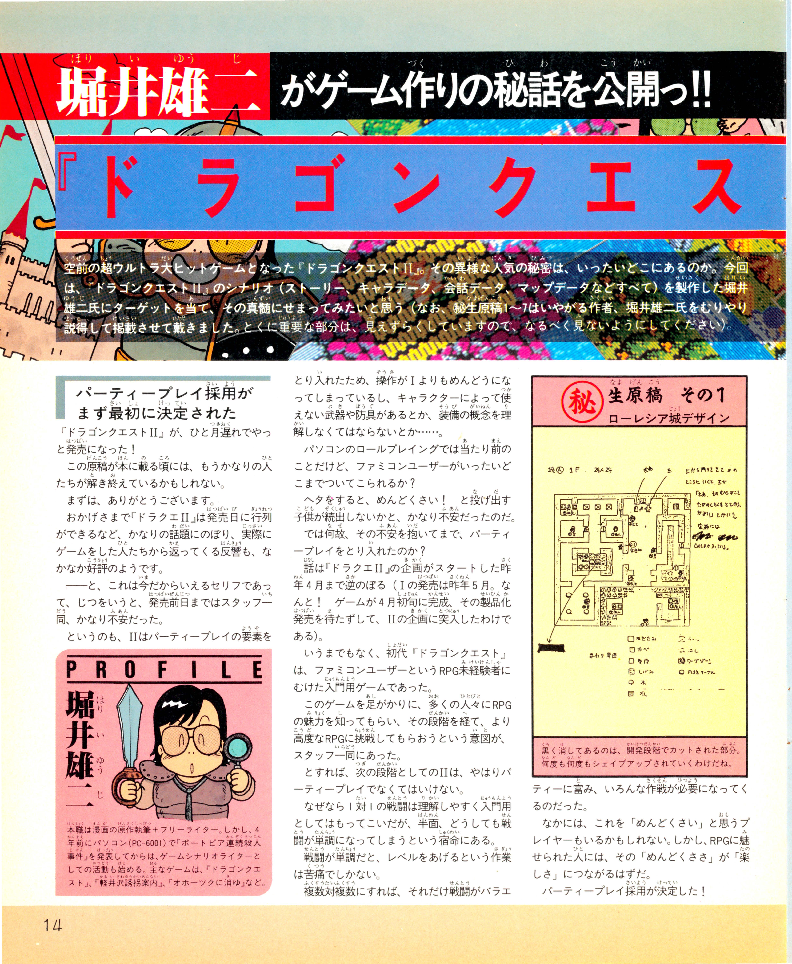
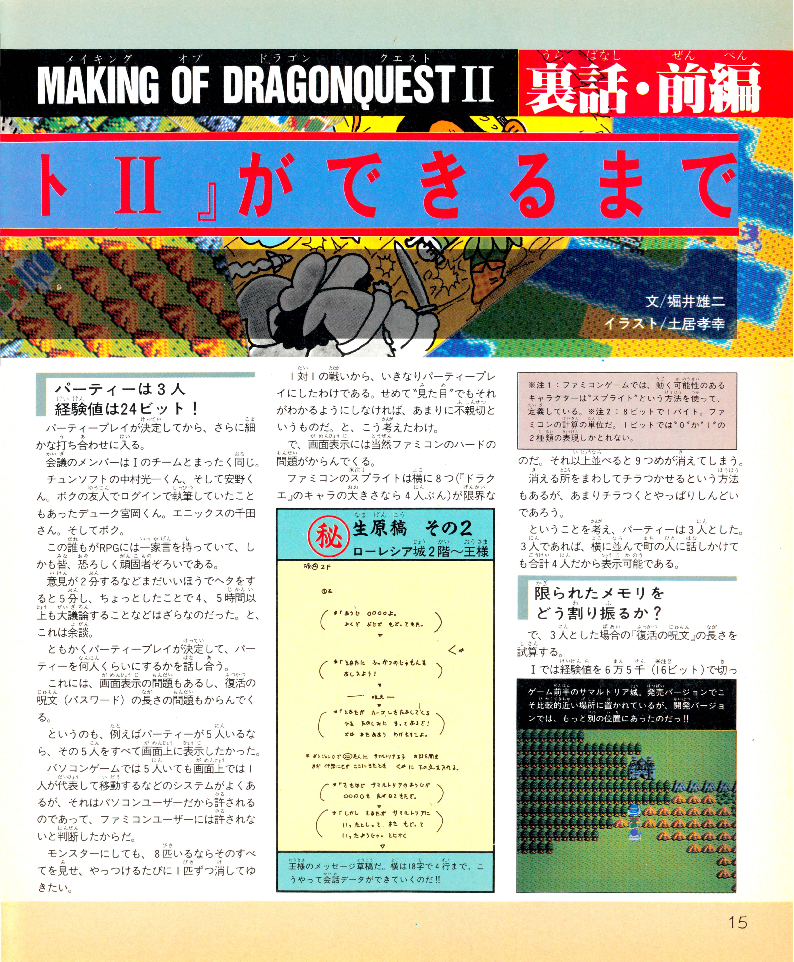
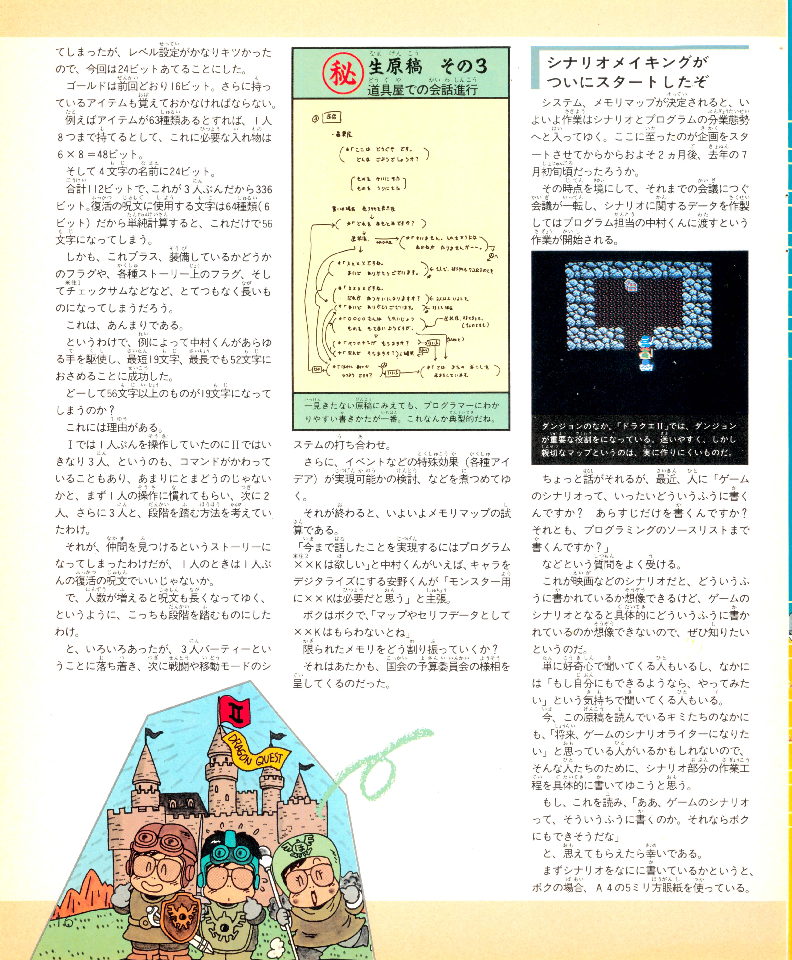
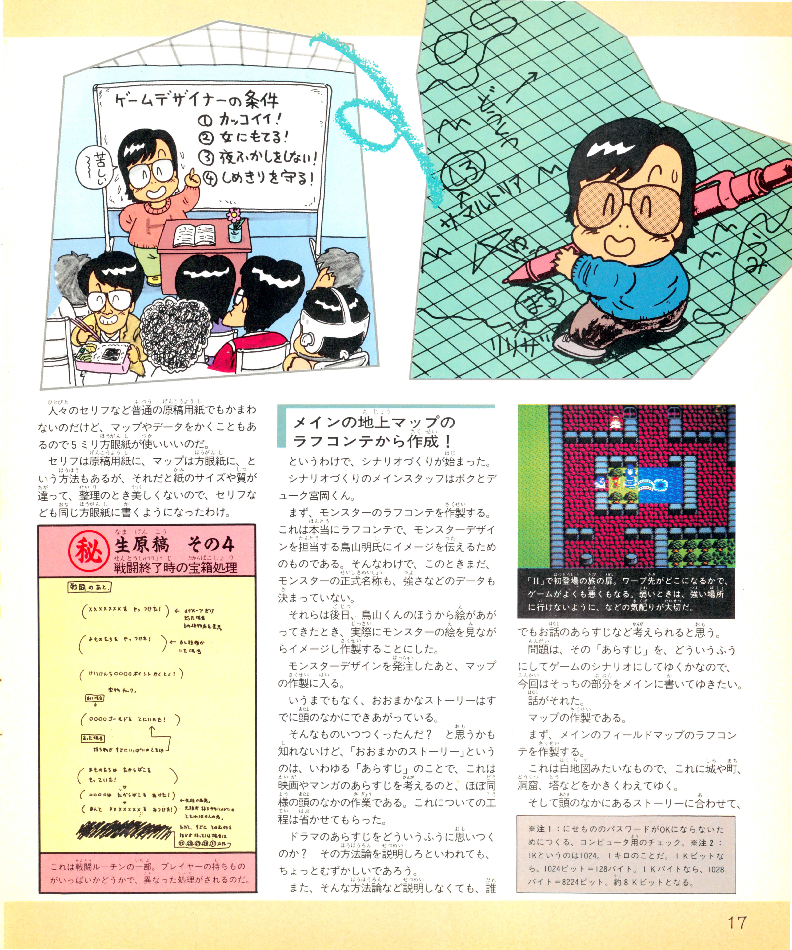
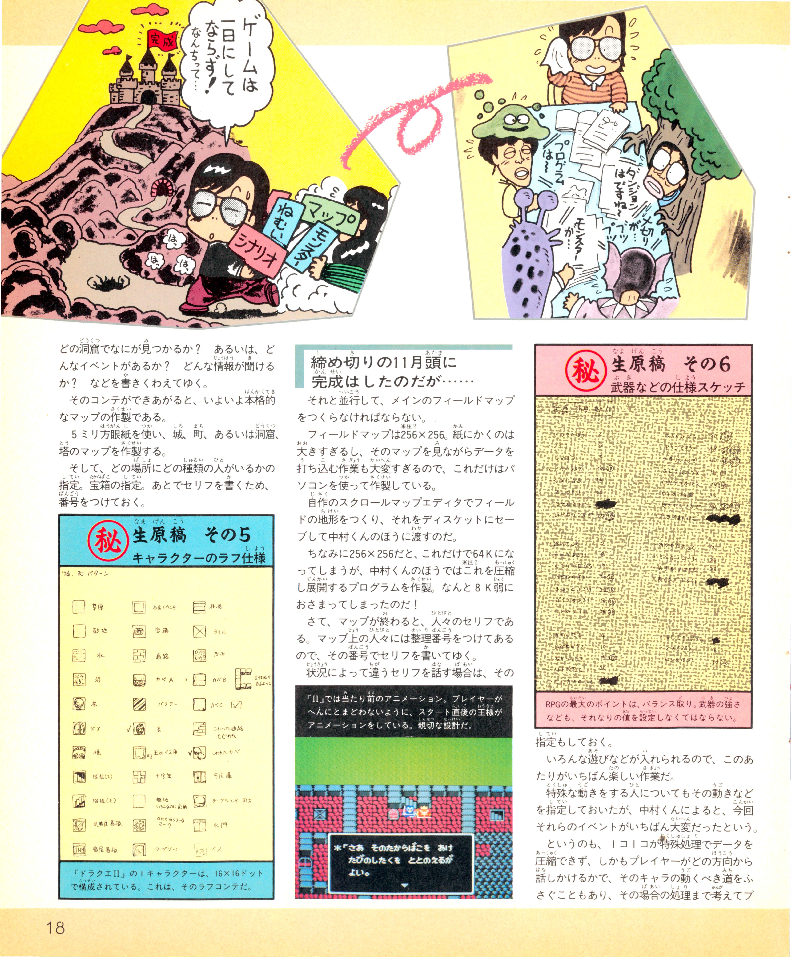
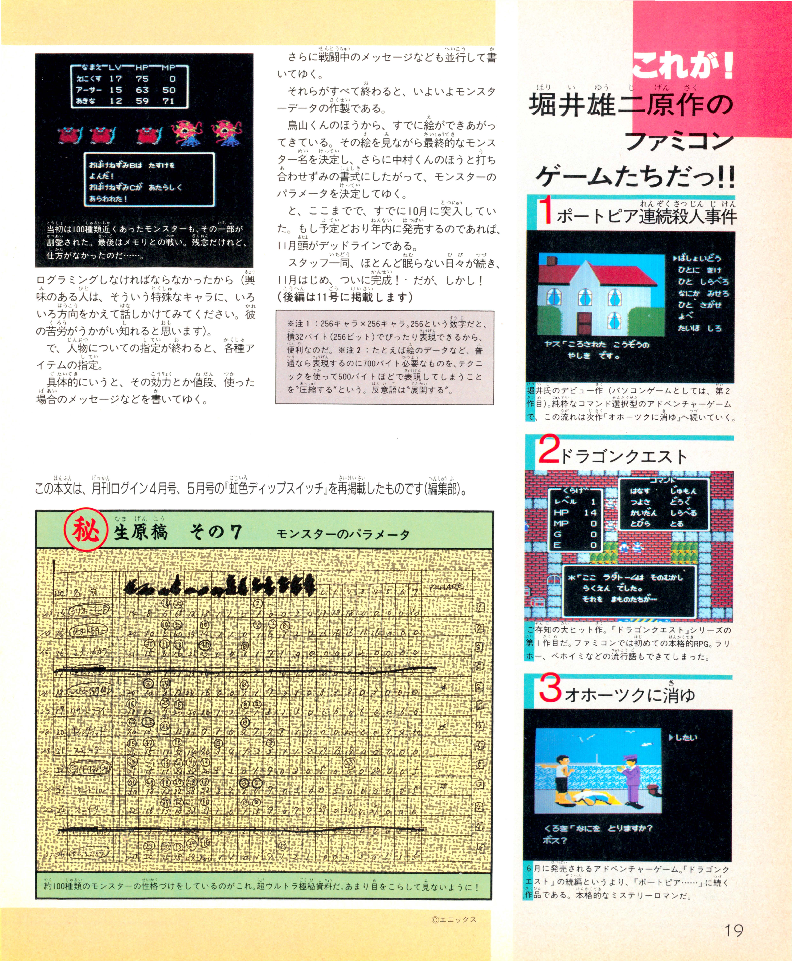
The first part of an interview of Yujii Hori on the making of Dragon Quest II, several design documents are included.
Famicom Tsūshin #027, November 7, 1987 - Making Of Interview, Part 2#
|
|
To do: |
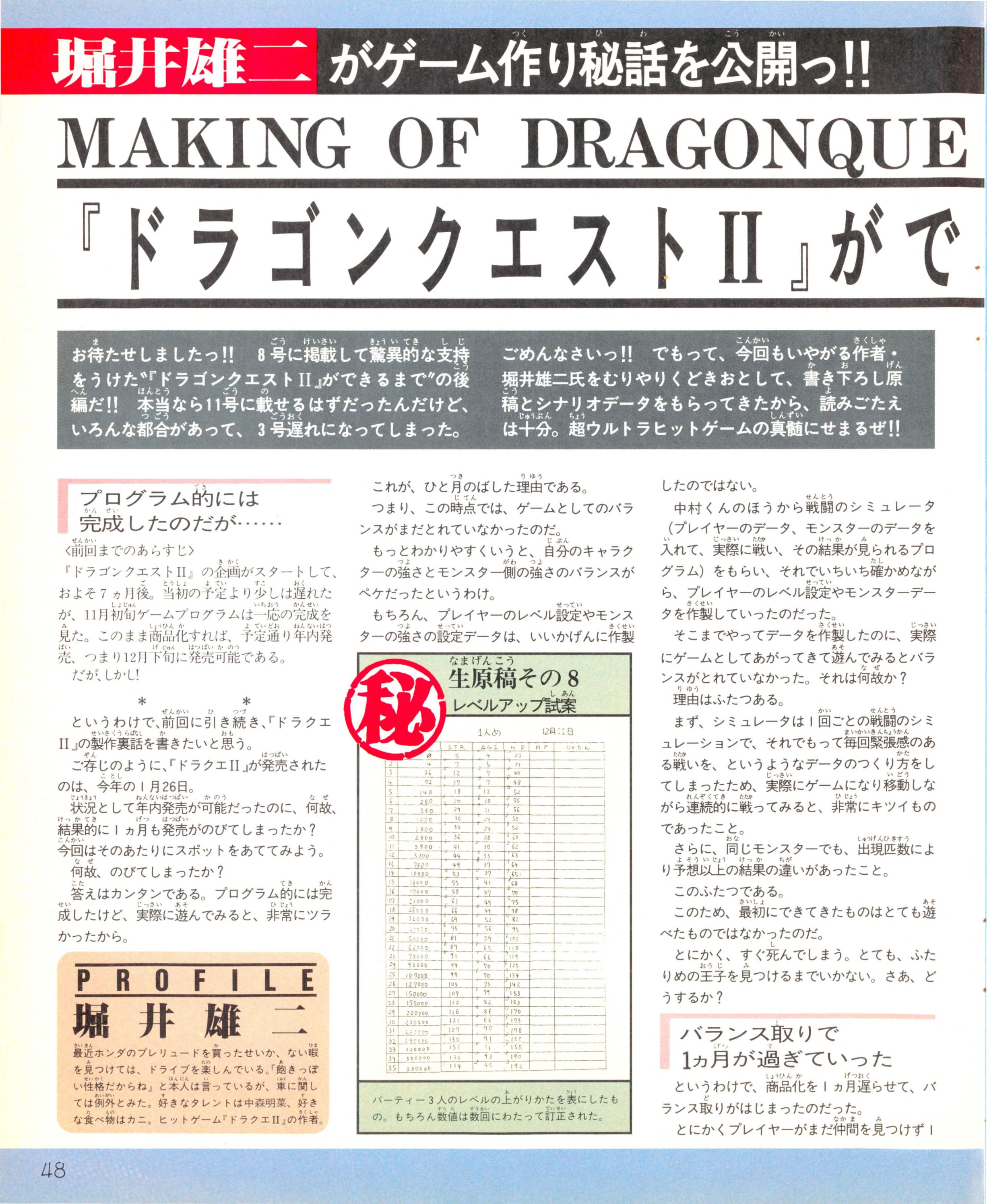
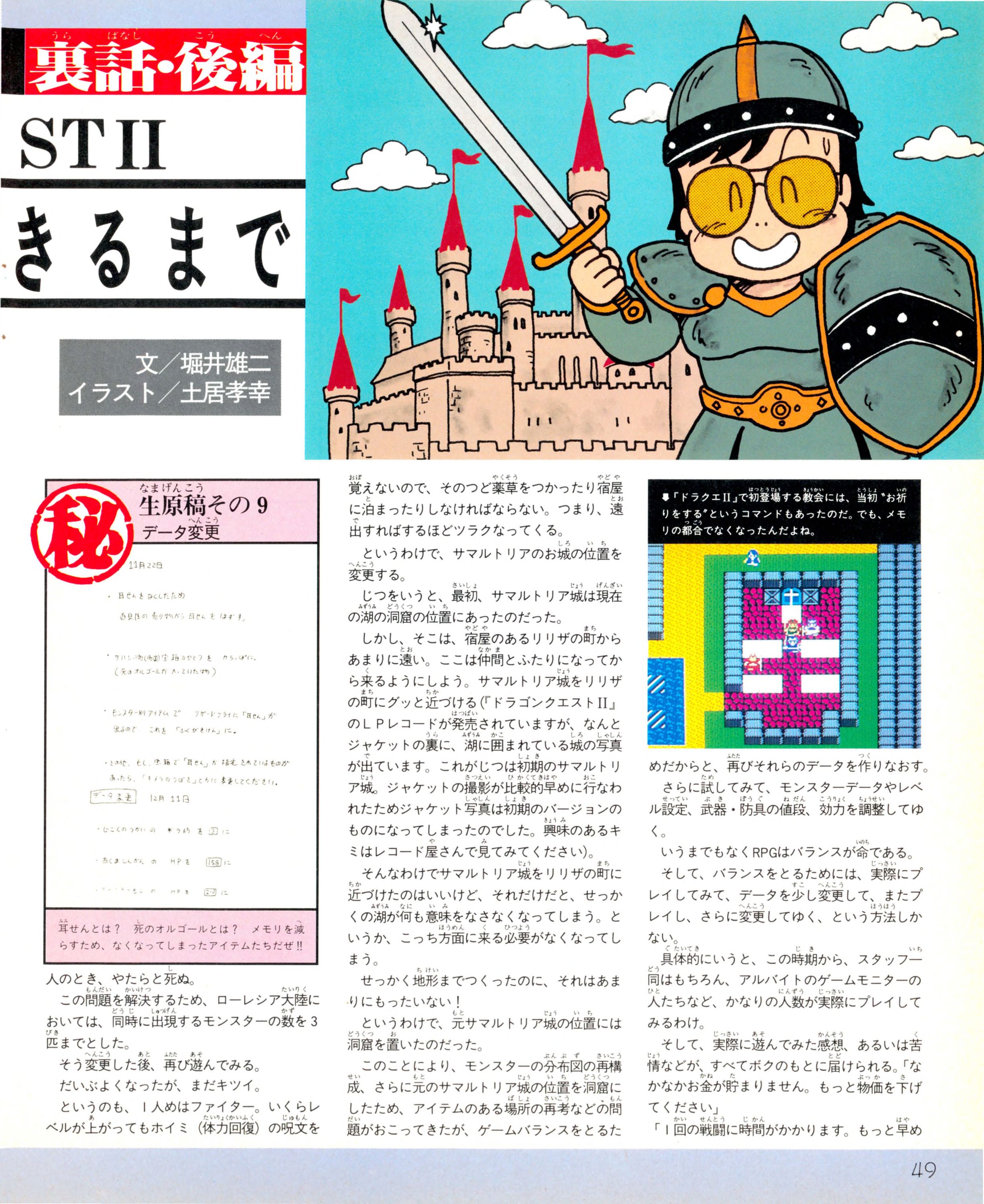
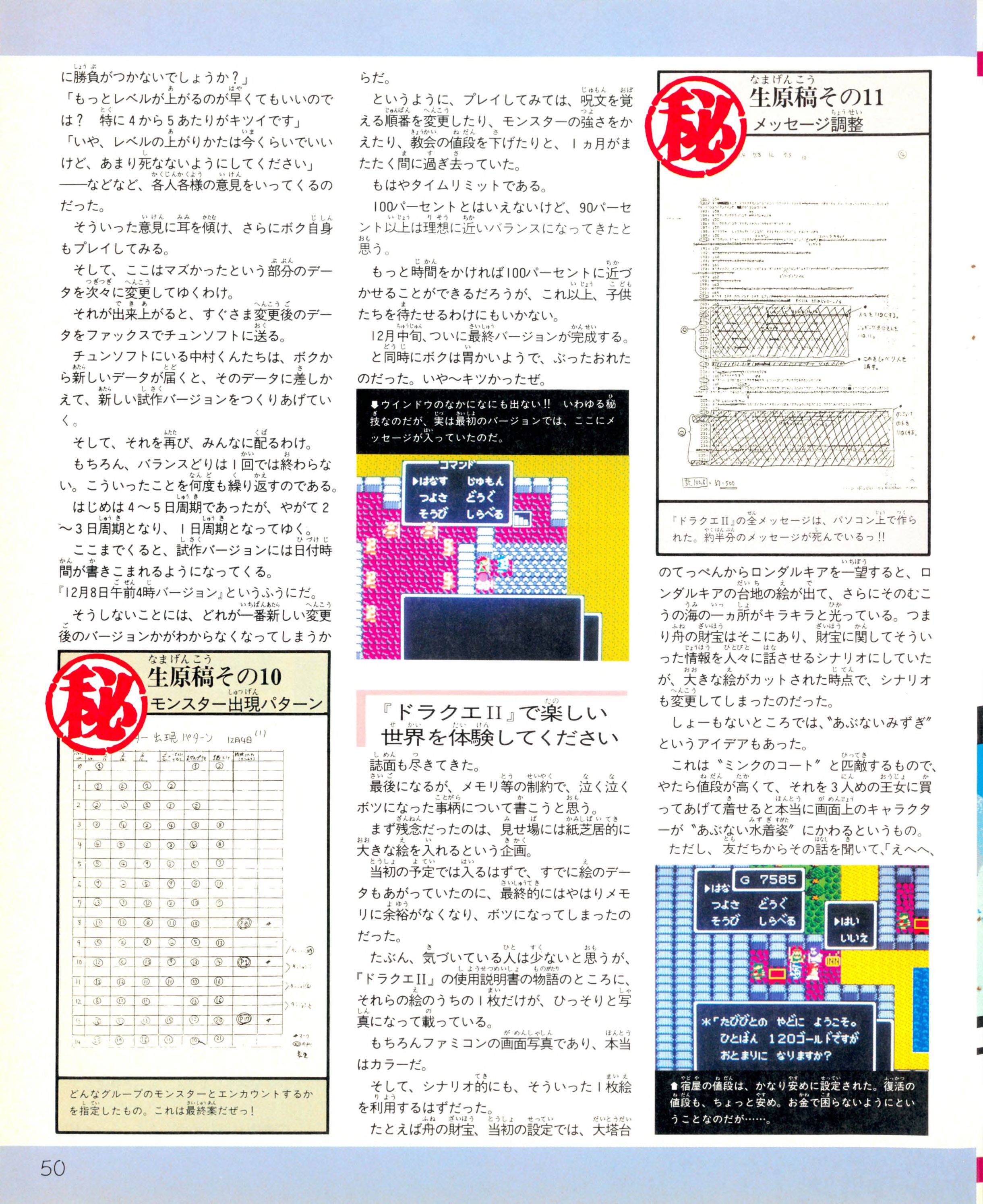
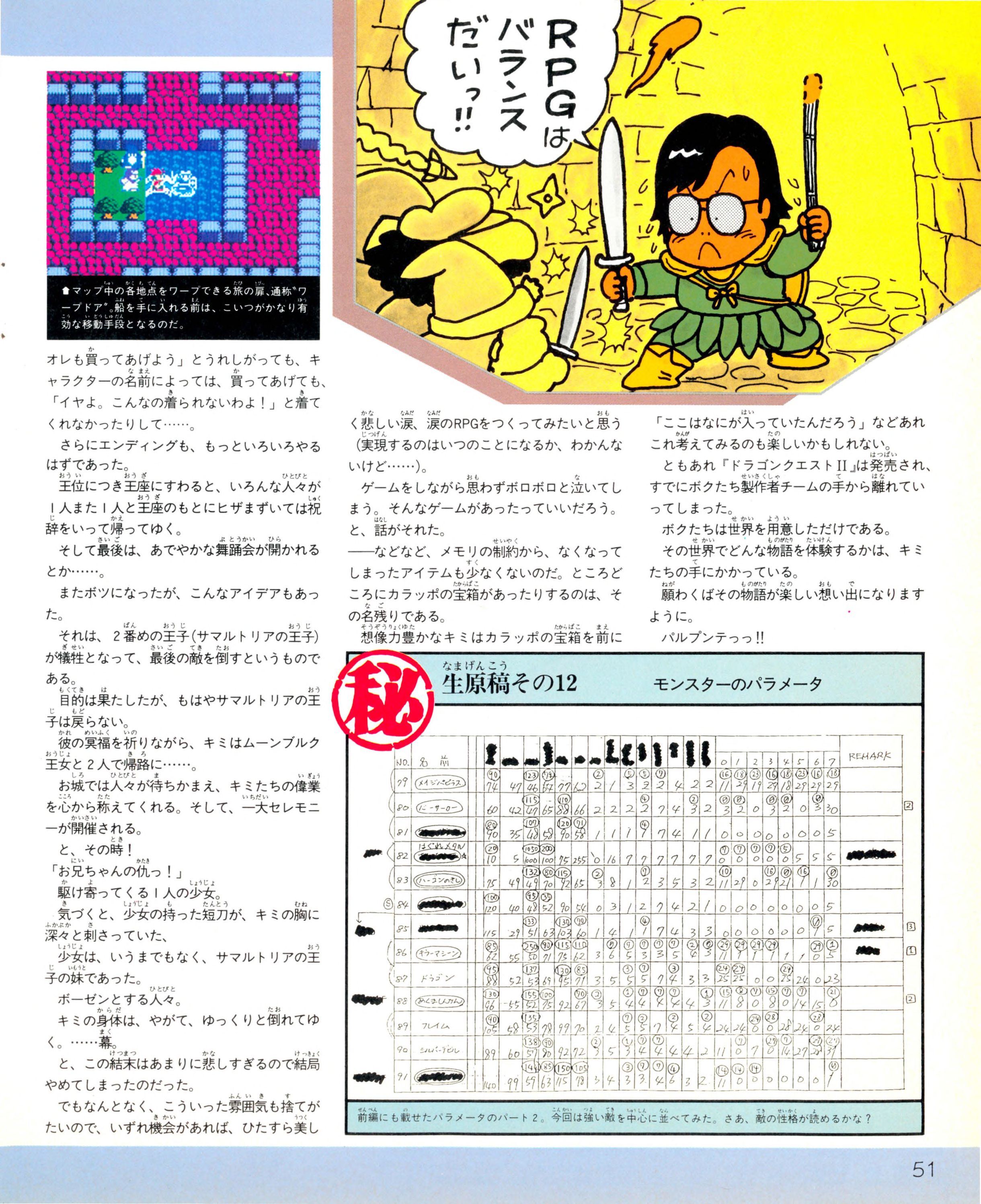
The second part of the making-of interview. Unlike the first part, this one was translated by SHMUPLATIONS. Several game screenshots and design documents are included:
- On the first page: the statistics of the Prince of Mindenhall for each level. The data matches the final version; however, it ends at level 35 versus 50 in the final game.
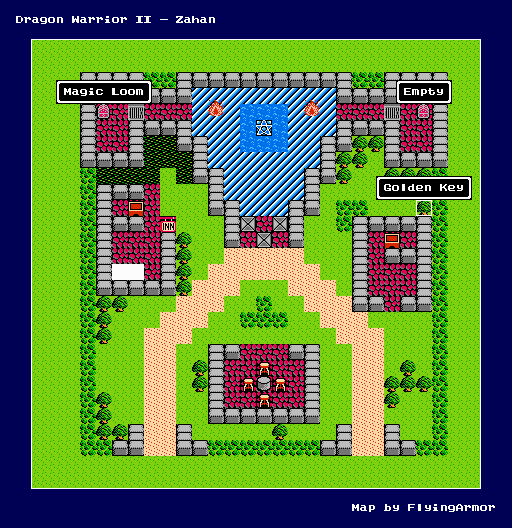
- On the second page the design document is a set of instructions presumably for a programmer. It mentions several items that were cut from final and reveals that the Music Box was to be found in the town of Zahan, since the interview mentions that some empty chest(s) in the game used to contain cut items we can easily infer that the empty chest in the north east of the town used to contain the Music Box. Further below it is mentioned that the Ear Plugs could also be acquired in a chest and that it was asked to be replaced by a Chimera Wing or "something similar".
- The screenshot on the second page shows the church in Welgarth, however the priest is missing. The note above the screenshot mentions that actions pertaining to the church were once achieved via the use of a "Pray" command.
- On the third page there is a screenshot of Middenhall Castle during the ending and pertains to cut text.
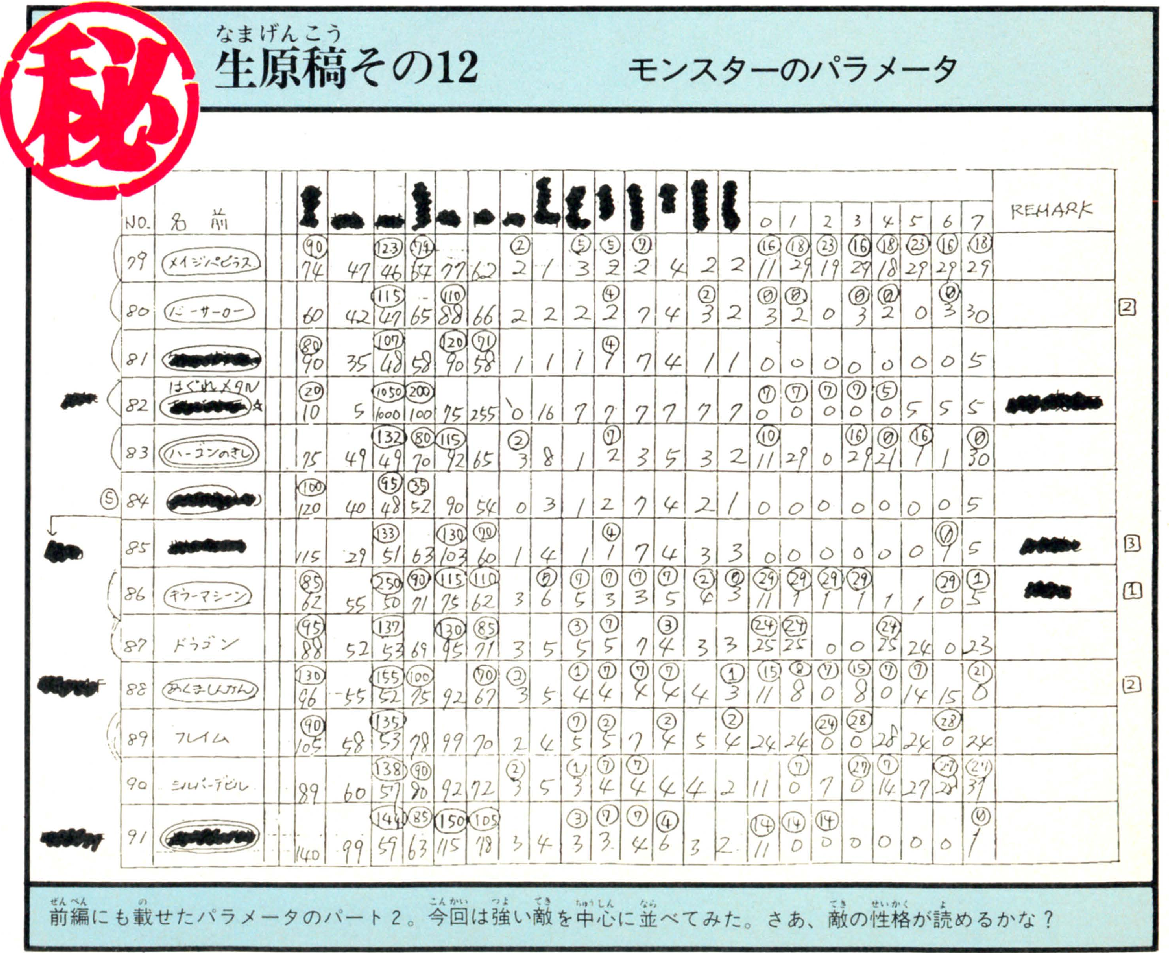
On the fourth page is a list of enemies with their different stats and attributes. Another part of the list is to be found on the last page of the first part of the making-of, but it is very hard to make out. The caption however claims that there are "about 100 enemies", whereas the final version has 82 enemies. Indeed, on the design document the list goes up to 91, and several names were blacked-out which seems to indicate deleted enemies. On the first part of the list Lizard Fly is the 19th enemy, whereas it is the 17th in the final, by this logic 2 enemies were deleted before it. None of the enemy stats shown on this table seem to match with the final release.
Design Document |
Final Version |
|---|---|
79: Magic Vampirus |
64: Magic Vampirus |
80: Berserker |
65: Berserker |
81: Erased |
66: Metal Babble |
82: Metal Babble |
67: Hargon's Knight |
83: Hargon's Knight |
68: Cyclops |
84: Erased |
69: Attackbot |
85: Erased |
70: Green Dragon |
86: Attackbot |
71: Mace Master |
87: Green Dragon |
72: Flame |
88: Mace Master |
73: Silver Batboon |
89: Flame |
74: Blizzard |
90: Silver Batboon |
75: Giant |
91: Erased |
76: Gold Batboon |
A comparison of this part of the enemy list between the design document and the final version, using Magic Vampirus as a starting point, making it obvious that some enemies were indeed deleted.
Cut Enemies#
Spider / Madaragumo#
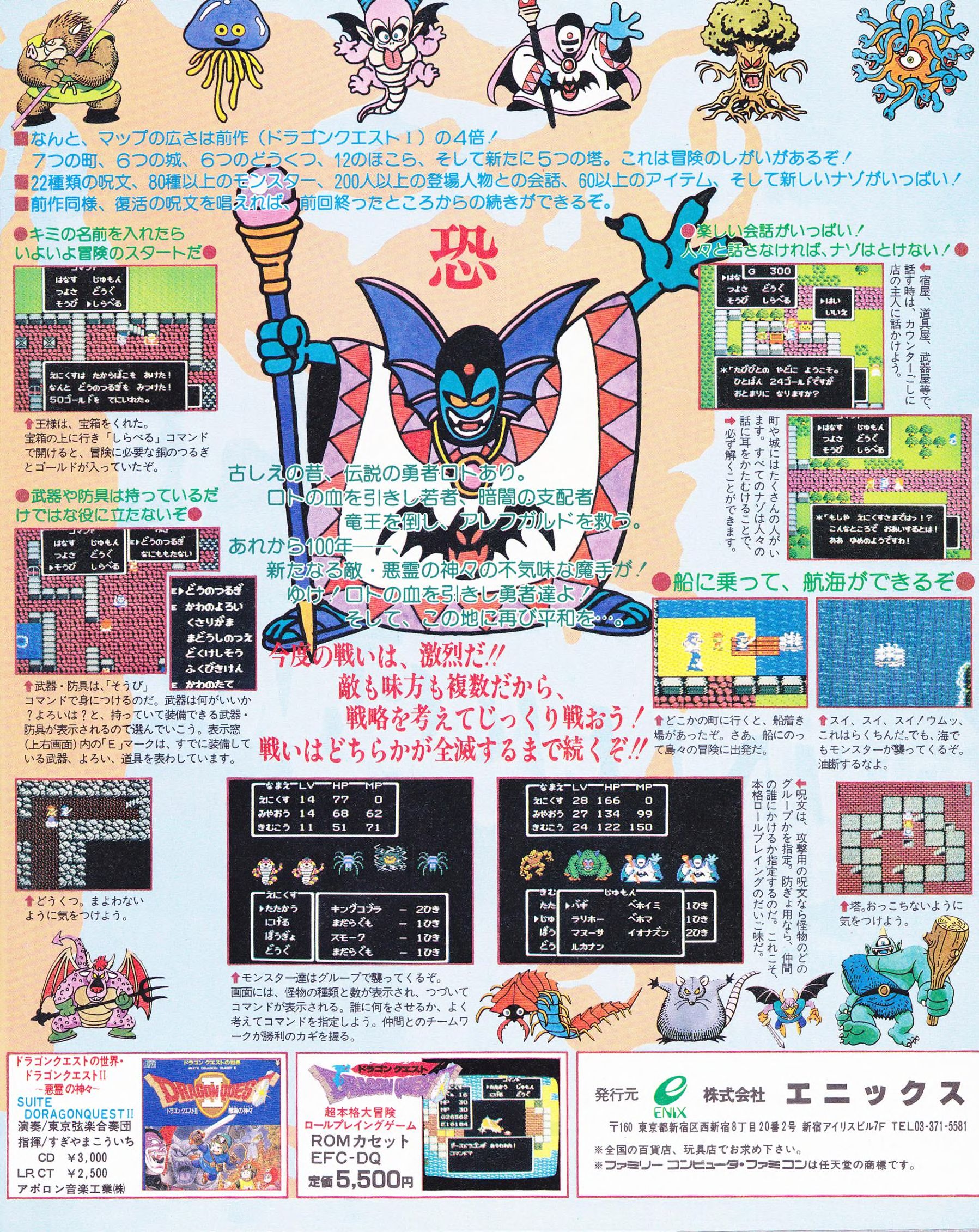
An ad found in Famimaga, March 1987.
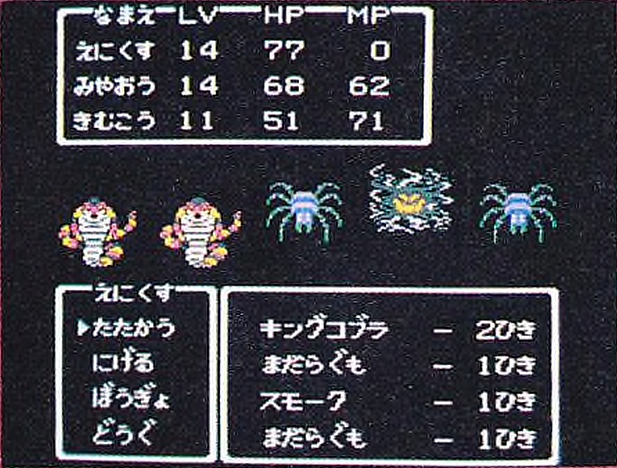
One of the screenshots show a spider enemy cut from final. Its name is まだらぐも, literally Madaragumo, it is apparently based on the [https://en.wikipedia.org/wiki/Trichonephila_clavata|Triconephila clavata], a species found in Japan.

Concept art from Dragon Quest Illustrations: 30th Anniversary Edition, it is simply called Spider.
Others#
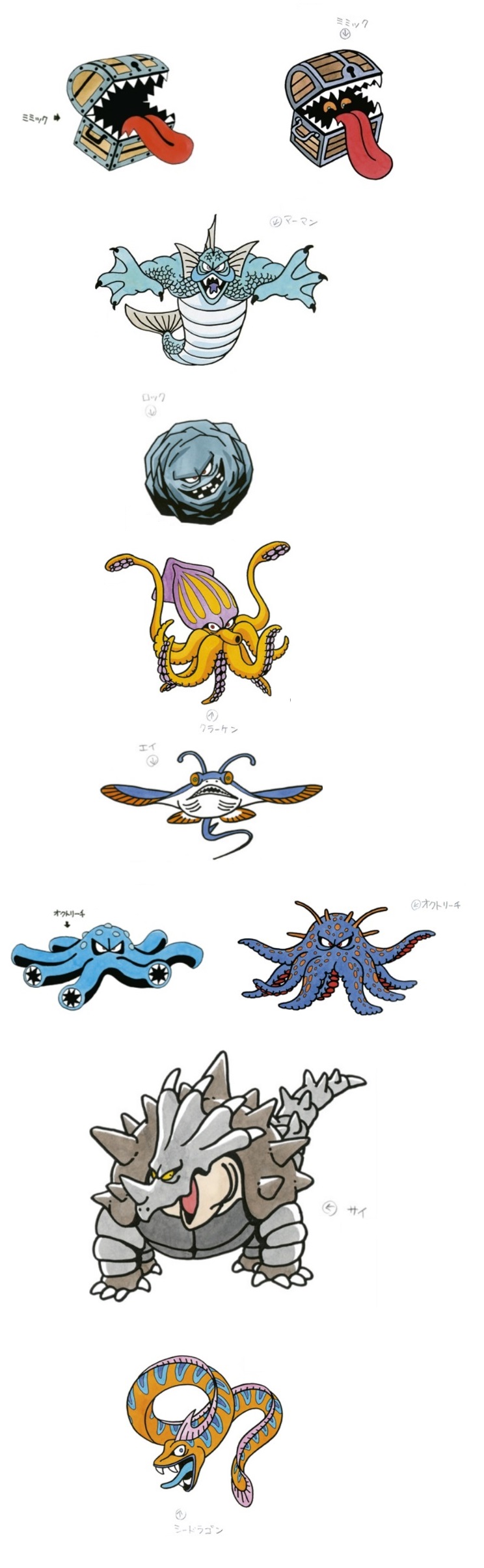
The Dragon Quest Illustrations: 30th Anniversary Edition book reveals more of the cut enemies and all of them (minus the above Spider) would appear in later entries in the series: from top to bottom, Mimic/Cannibox (two versions), Merman, Bomb Crag/Rockbomb and King Squid in Dragon Quest III, Guzzle Ray/Preying Manta in Dragon Quest IV, Octoreach/Suckling Ocker (two versions) and Spikerous/Tortoceratops in Dragon Quest V and finally Moray/Eevil in Dragon Quest VI.
Out of all 9 cut enemies shown in the book, 6 of them were water enemies.
The Mimic/Cannibox, Merman, Bomb Crag/Rockbomb, and King Squid would eventually get to appear in a remake of Dragon Quest II, that being the HD-2D Remake.
Prerelease |
Dragon Quest 3 |
|---|---|
 |
 |
Pixel art for King Squid can be seen in many previews and ads on this page, showing that it was in a state ready to be used in-game. It appears to be identical to its appearance in Dragon Quest 3 except from the palette used.