This is a sub-page of Mario Party 10.
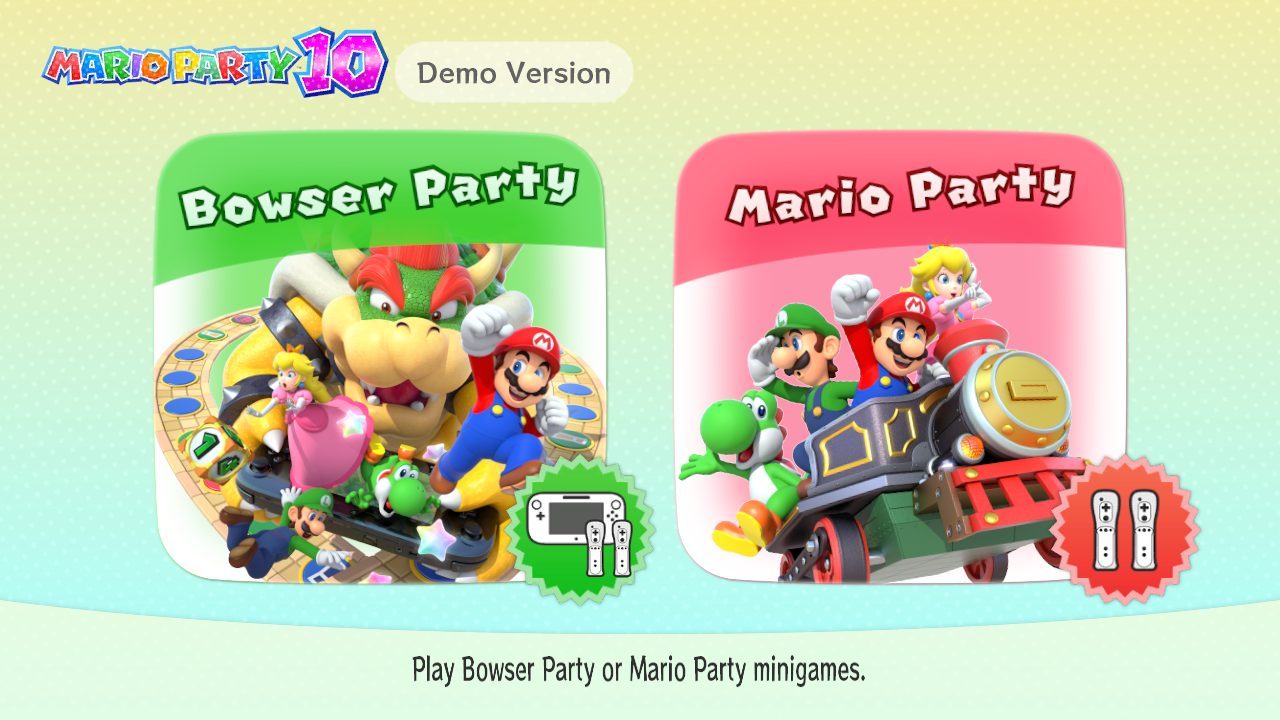
A Kiosk Demo for Mario Party 10, dated February 2015, was found included on a 'Demo Update Disk' that also contains a kiosk demo for the lesser known game Super Smash Bros. for Wii U.
Previously, footage of this demo being played was uploaded by YouTube user Luigispanish in March 2015.
This demo version of the game consists of a selection of eight playable mini-games split between Bowser Party and Mario Party modes. The available minigames are as follows:
Mario Party: Bob-Omb Bogey, Cliffside Crisis, Bob-Omb Combo, Paintball Battle.
Bowser Party: Bowser's Fire Bar Fury, Bowser's Wicked Wheel, Bowser's Hammer Slammer, Bowser's Painball.
Differences#
Main Menu#

|
To do: |
Unlike the final game, this demo only supports up to three real-life players simultaneously (one GamePad, up to two Wii Remotes). Despite this, Mario Party ensures that four players are present in each minigame, with two always being CPUs. (Probably because they're all four player minigames.)
Strangely, the Bowser Minigames always have three players on Team Mario, with one player always being a CPU. As a result, it is impossible to play with four players on Team Mario in this demo.
Result Screen#
|
Kiosk Demo |
Final (Amiibo Party Mode) |
|---|---|
|
|
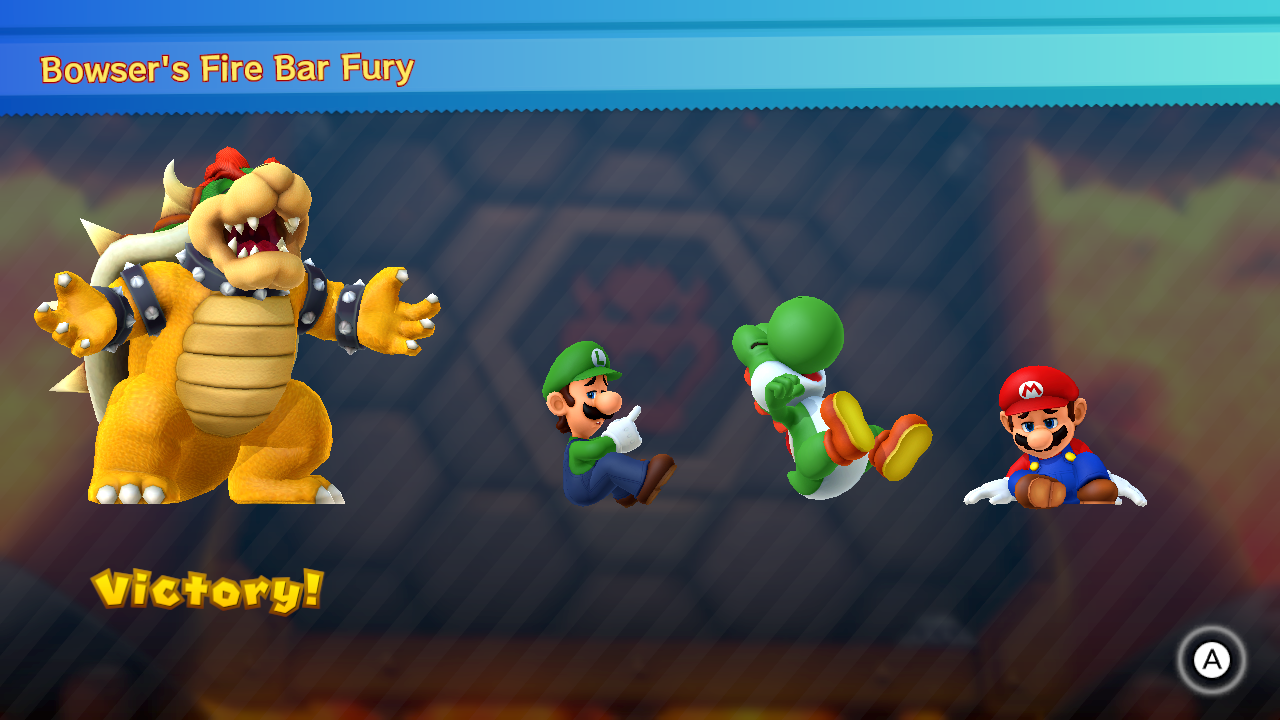
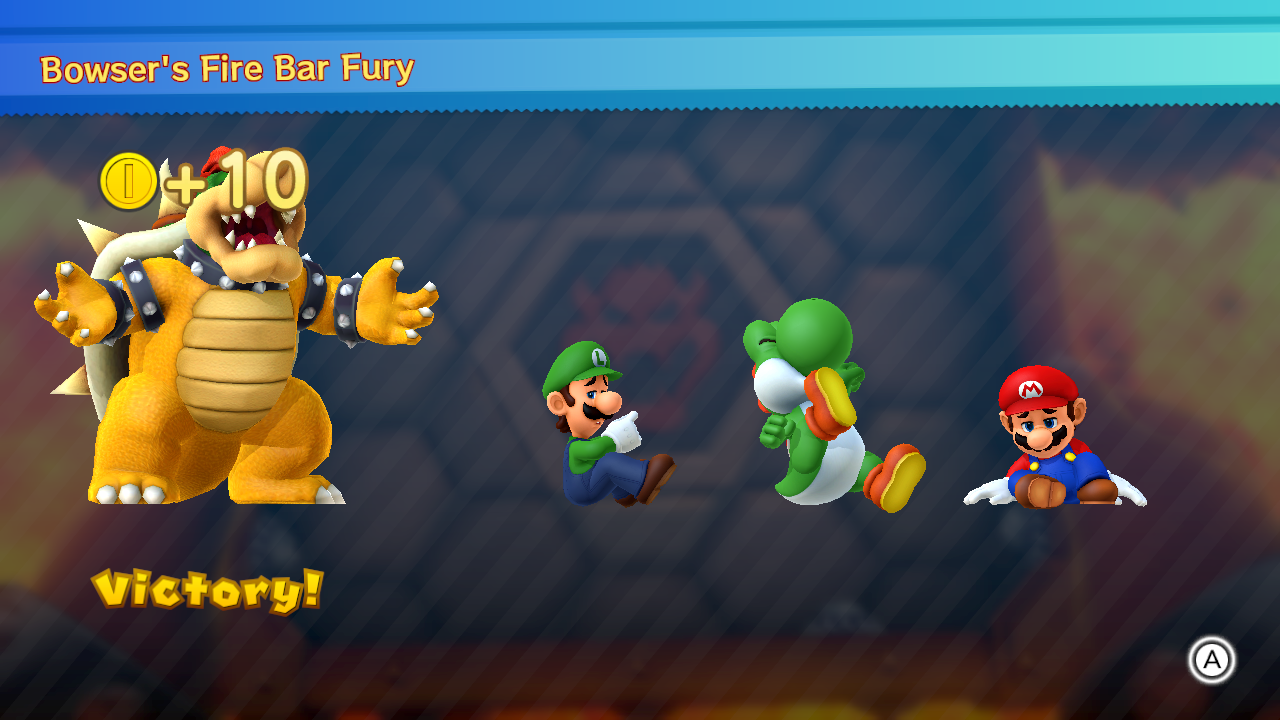
Upon winning a Minigame in Bowser Party mode, the results screen is different. It shows Bowser laughing with "Victory!" displayed below him next to Team Mario, who all perform their 'minigame defeat' animations.
This is almost identical to the results screen used when Bowser wins a Bowser Minigame in the Amiibo Party mode in the final game.
Developer Leftovers#
|
|
To do: |
Unfortunately, most of the content that doesn't feature within this demo was stripped from it's filesystem completely, including the code and assets relevant to board gameplay and the minigames that don't appear within it (which is... most of them).
As a result, there aren't many unique leftovers to note compared to the main game. However, there is one somewhat substantial one.
The content\assets\xml folder was not stripped, still containing debug parameters for all of the game's mini-games (despite other references and code for them being removed). It also still contains TenstGameList.xml and TenstOptionList.xml, and the former contains several notable differences compared to the final game's version of the file. These differences appear to be unique to this demo build.
TenstGameList.xml differences#
As with the released version of the game, this file seems to define several parameters that would have been alterable via the Debug Menu, which was internally referred to as selmenu going by developer comments. This section documents the differences between this build's file and the version of it included in the European V16 release.
The Menu System and Board sections are positioned much farther down the file in this version. You can find them referenced below.
The title for the group "その他ミニゲーム", which roughly translates to "Other Minigames", is instead named "エクストラミニゲーム", which roughly translates to "Extra Minigames" in the Kiosk version. Despite this, the actual contents of the group remains the same across versions. Why they decided to change this is unknown.
A group called Minigame Modes that lists the modes included in the game's 'Extras' menu has one additional entry referencing "mgm04" listed, which is conspicuously absent from the final game and it's version of this file. Unfortunately, unlike the others, no title is given to this mode and no data for it exists within the demo (or final game's) filesystem, making this the only reference to it. Nonetheles, this seems to imply that at some point in development a fourth additional mode was planned to be included in the extras section.
Kiosk Demo |
Final |
|---|---|
|
|
A group called Aging in the final game's version of this file is absent, and in it's place is a new group named Test Minigames, which references several unused RPLs and scenes that aren't in any version of the game's filesystem. Unfortunately there are no descriptions as to what they were for.
<Group name="テストミニゲーム" categ="mg">
    <Item rpl="mg0s01" scene="SceneMg0s01"> mg0s01 : </Item>
    <Item rpl="mg0s02" scene="SceneMg0s02"> mg0s02 : </Item>
    <Item rpl="mg0s03" scene="SceneMg0s03"> mg0s03 : </Item>
    <Item rpl="mg0s04" scene="SceneMg0s04"> mg0s04 : </Item>
    <Item rpl="mg0s05" scene="SceneMg0s05"> mg0s05 : </Item>
    <Item rpl="mg0s06" scene="SceneMg0s06"> mg0s06 : </Item>
    <Item rpl="mg0s07" scene="SceneMg0s07"> mg0s07 : </Item>
    <Item rpl="mg0s08" scene="SceneMg0s08"> mg0s08 : </Item>
    <Item rpl="mg0s09" scene="SceneMg0s09"> mg0s09 : </Item>
    <Item rpl="mg0s10" scene="SceneMg0s10"> mg0s10 : </Item>
  </Group>
The "Menu System" group mentioned earlier was moved down here, for some reason. It contains references to mginst, mgresult, bdresult and several blank entries that are not present in this group in the final game's version of this file.
Kiosk Demo |
Final |
|---|---|
|
|
The "Board" group was also moved down here in this version of the file, but otherwise contains no differences to the same group in the final version of the file.
<Group name="ボード" color="mr" categ="mr">
    <Item rpl="bd001" scene="SceneBD001" dbparam="bd001_dbparam.xml"> bd001 : ワクワクパーク</Item>
    <Item rpl="bd002" scene="SceneBD002" dbparam="bd002_dbparam.xml"> bd002 : ハラハラウッド</Item>
    <Item rpl="bd003" scene="SceneBD003" dbparam="bd003_dbparam.xml"> bd003 : ドキドキオーシャン</Item>
    <Item rpl="bd004" scene="SceneBD004" dbparam="bd004_dbparam.xml"> bd004 : ウキウキエアプレーン</Item>
    <Item rpl="bd005" scene="SceneBD005" dbparam="bd005_dbparam.xml"> bd005 : グラグラキャッスル(仮)</Item>
    <Item rpl="sbd001" scene="SceneSbd001"  dbparam="sbd001_dbparam.xml"> Sbd001 : amiiboパーティー</Item>
  </Group>
Then, we reach several very interesting groups unique to the Kiosk version of this file. These sections are not present in the final game's version of the file anywhere.
<Group name="ND実験部屋 A" color="exp">
    <Item rpl="nex101" scene="SceneNEX101"> NEX101 : テスト</Item>
    <Item rpl="nex102" scene="SceneNEX102"> NEX102 : ウインドウメッセージ表示 テスト</Item>
    <Item rpl="nex103" scene="SceneNEX103"> NEX103 : ミニゲームサンプル</Item>
    <Item rpl="nex104" scene="SceneNEX104"> NEX104 : NDcha_pos テスト</Item>
    <Item rpl="nex105" scene="SceneNEX105"> NEX105 : スケーラブルフォント テスト</Item>
    <Item rpl="nex106" scene="SceneNEX106"> NEX106 : 指カーソル表示 テスト</Item>
    <Item rpl="nex107" scene="SceneNEX107"> NEX107 : キャラ MFA テスト</Item>
    <Item rpl="nex108" scene="SceneNEX108"> NEX108 : ソフトウェアキーボード テスト</Item>
    <Item rpl="nex109" scene="SceneNEX109"> NEX109 : </Item>
    <Item rpl="nex110" scene="SceneNEX110" dbparam="nex110_dbparam.xml"> NEX110 : 写真撮影テスト</Item>
  </Group>
This group's title roughly translates to "ND Test Room A", and contains references to several RPLs and scenes that do not exist within the final game. Their titles are as follows:
RPL Name |
Title |
Translated |
|---|---|---|
nex101 |
テスト |
Test |
nex102 |
ウインドウメッセージ表示 テスト |
Window Message Display Test |
nex103 |
ミニゲームサンプル |
Minigame Sample |
nex104 |
NDcha_pos テスト |
NDcha_pos Test |
nex105 |
スケーラブルフォント テスト |
Scalable Font Test |
nex106 |
指カーソル表示 テスト |
Finger Cursor Display Test |
nex107 |
キャラ MFA テスト |
Character MFA Test |
nex108 |
ソフトウェアキーボード テスト |
Software Keyboard Test |
nex109 |
N/A |
N/A |
nex110 |
写真撮影テスト |
Photography Test |
Then, another group that roughly translates to "ND Test Room B":
<Group name="ND実験部屋 B" color="exp">
    <Item rpl="nex111" scene="SceneNEX111"> NEX111 : GoodJob チェックテスト</Item>
    <Item rpl="nex112" scene="SceneNEX112"> NEX112 : ビークルテスト</Item>
    <Item rpl="nex113" scene="SceneNEX113"> NEX113 : ゲーム途中での\n         パックファイル読み込みテスト</Item>
    <Item rpl="nex114" scene="SceneNEX114"> NEX114 : シンプルお絵かきテスト</Item>
    <Item rpl="nex115" scene="SceneNEX115"> NEX115 : amiibo メニュー用ステータステスト</Item>
    <Item rpl="nex116" scene="SceneNEX116"> NEX116 : amiibo 簡易プレイヤーワーク登録</Item>
    <Item rpl="nex117" scene="SceneNEX117"> NEX117 : </Item>
    <Item rpl="nex118" scene="SceneNEX118"> NEX118 : </Item>
    <Item rpl="nex119" scene="SceneNEX119"> NEX119 : </Item>
    <Item rpl="nex120" scene="SceneNEX120"> NEX120 : </Item>
  </Group>
RPL Name |
Title |
Translated |
|---|---|---|
nex111 |
GoodJob チェックテスト |
GoodJob Check Test |
nex112 |
ビークルテスト |
Vehicle Test |
nex113 |
ゲーム途中でのパックファイル読み込みテスト |
Mid-Game Packfile Loading Test |
nex114 |
シンプルお絵かきテスト |
Simple Drawing Test |
nex115 |
amiibo メニュー用ステータステスト |
Amiibo Menu Status Test |
nex116 |
amiibo 簡易プレイヤーワーク登録 |
amiibo Simple Player-Work Registration |
nex117 |
N/A |
N/A |
nex118 |
N/A |
N/A |
nex119 |
N/A |
N/A |
nex120 |
N/A |
N/A |
Note: 'Good Job List' is the internal name for the achievement list.
Then an empty group is defined named "CA実験部屋 A", which roughly translates to "CA Test Room A". This is most likely in reference to CAProduction, a support studio with strong ties to both Hudson Soft and NDCube, who while not directly credited are believed to have helped develop almost every Mario Party game released so far, including Mario Party 10. Unfortunately since the group is empty, we can only guess what they did for this game.
It is followed by another, not-as empty group that roughly translates to 'Will Test Room':
<Group name="Will実験部屋" color="exp">
    <Item rpl="nex313" scene="SceneNEX313"> nex313 : </Item>
</Group>
Will is a Japanese studio with strong ties to both Hudson Soft and NDCube, who while also not directly credited are believed to have helped develop every Mario Party game since Mario Party Advance, including Mario Party 10. Unfortunately since nex313 isn't given a description, we can only guess what they did for this game.
Another empty group follows, named "スマイルブーム実験部屋", which translates to "Smile Boom Test Room". ...Wait, Smile Boom?
Smile Boom are a Japanese company perhaps best known for their SmileBASIC programming language, and the 'Petit Computer' series. Their entrusted development page reveal that they have worked with NDCube on several titles, officially dating back to 2018 with their work on Super Mario party. However this page also mentions a "Party game for Wii U [not open to the public]" released in 2013, which is almost certainly referring to Wii Party U, a party game released in 2013 that was also developed by NDCube.
This group name existing here either implies that Smile Boom also helped with development on Mario Party 10 and went uncredited, or this group is simply a leftover from development of Wii Party U, which likely used the same debug menu system as Mario Party 10. Given that the group is completely empty, and was removed entirely in the final version, I would lean towards the latter.
After this another group is defined:
<Group name="ロケットスタジオ実験部屋" color="exp">
    <Item rpl="mpx500" scene="SceneMPX500"> mpx500 : </Item>
    <Item rpl="mpx501" scene="SceneMPX501"> mpx501 : </Item>
    <Item rpl="mpx502" scene="SceneMPX502"> mpx502 : </Item>
    <Item rpl="mpx503" scene="SceneMPX503"> mpx503 : </Item>
  </Group>
This name translates to "Rocket Studio Test Room".
...I'm starting to notice a theme here. Rocket Studio is another lesser-known Japanese support studio. I can't find any references to working on an NDCube title on their website, so what involvement they had (and with what game) is anyone's guess.
The next group defined is:
<Group name="描画テスト" color="test">
    <Item rpl="shadowTest" scene=""> shadowTest : デプスシャドウテスト</Item>
    <Item rpl="shadowTest2" scene=""> shadowTest2 : デプスシャドウテスト2</Item>
    <Item rpl="shadowTest3" scene=""> shadowTest3 : デプスシャドウテスト3</Item>
    <Item rpl="shadowTest4" scene=""> shadowTest4 : 投影+デプスシャドウテスト</Item>
    <Item rpl="shadowTest5" scene=""> shadowTest5 : ライトリソースから\nデプスシャドウを設定するサンプル</Item>
    <Item rpl="teresaTest" scene=""> teresaTest : 半透明サンプル</Item>
    <Item rpl="decalTest" scene=""> decalTest : デカールサンプル</Item>
    <Item rpl="customRenderTest" scene=""> customRenderTest : \nカスタムレンダーターゲットサンプル</Item>
    <Item rpl="simpleShadow" scene=""> simpleShadow : \nモデル単位の簡易シャドウサンプル</Item>
   <Item rpl="canvastest" scene=""> canvasTest : お絵かきテスト</Item>
</Group>
Oh, good, we're back to normal. This group's name roughly translates to Drawing Test. As the name implies it contains a collection of debug rendering tests, mostly involving shadows, referencing several RPLs and scenes that do not exist.
RPL Name |
Title |
Translated |
|---|---|---|
shadowTest |
デプスシャドウテスト |
Depth Shadow Test |
shadowTest2 |
デプスシャドウテスト2 |
Depth Shadow Test 2 |
shadowTest3 |
デプスシャドウテスト3 |
Depth Shadow Test 3 |
shadowTest4 |
投影+デプスシャドウテスト |
Projection + Depth Shadow Test |
shadowTest5 |
ライトリソースからデプスシャドウを設定するサンプル |
Light Source Depth Shadow Configuration Sample |
teresaTest |
半透明サンプル |
Translucent Sample |
decalTest |
デカールサンプル |
Decal Sample |
customRenderTest |
カスタムレンダーターゲットサンプル |
Custom Render Target Sample |
simpleShadow |
モデル単位の簡易シャドウサンプル |
Model Shadow Simplification Sample |
canvasTest |
お絵かきテスト |
Drawing Test |
Then another unique group:
<Group name="ゲームテスト" color="test">
    <Item rpl="mrtest" usedbparam="false"> MrTest : メインルールテスト</Item>
    <Item rpl="mgtest" usedbparam="false"> MgTest : ミニゲームテスト</Item>
    <Item rpl="actortest" scene=""> ActorTest : Actorテスト</Item>
    <Item rpl="nex103" scene="SceneNEX103"> NEX103 : ミニゲームサンプル</Item>
    <Item rpl="mgaging" dbparam="mgaging_dbparam.xml"> mgaging: ミニゲームエージング</Item>
    <Item rpl="bdaging" dbparam=""> bdaging: ボードエージング</Item>
    <Item rpl="sbdaging" dbparam=""> sbdaging: amiiboパーティーエージング</Item>
    <Item rpl="kptaging" dbparam=""> kptaging: クッパパーティーエージング</Item>
  </Group>
This group is named "Game Test", and once again references several nonexistant RPLs.
RPL Name |
Title |
Translated |
|---|---|---|
mrtest |
メインルールテスト |
Main Rule Test |
mgtest |
ミニゲームテスト |
Minigame Test |
actortest |
Actorテスト |
Actor Test |
nex103 |
ミニゲームサンプル< |
Minigame Sample |
mgaging |
ミニゲームエージング |
Minigame Aging |
bdaging |
ボードエージング |
Board Aging |
sbdaging |
amiiboパーティーエージング |
Amiibo Party Aging |
kptaging |
クッパパーティーエージング |
Bowser Party Aging |
And the group that follows:
<Group name="2Dテスト" color="test">
    <Item rpl="libmp2dtest" usedbparam="false"> libmp2d : mpライブラリ 2Dテスト</Item>
    <Item rpl="cursortest" scene=""> CursorTest : カーソルテスト</Item>
    <Item rpl="bossResultTest" scene="SceneBossResult"> bossResultTest : ボスリザルトテスト</Item>
    <Item rpl="bdInterResultTest" scene="SceneBdInterResult"> bdInterResultTest : ボード中間結果テスト</Item>
    <Item rpl="vscutinTest" scene="SceneMgCutin"> vscutinTest : VSカットインテスト</Item>
</Group>
The name for this group translates to 2D Test, probably because it's scenes were all made to test 2D scenes and menu screens.
RPL Name |
Title |
Translated |
|---|---|---|
libmp2dtest |
mpライブラリ 2Dテスト |
mpLibrary 2D Test |
cursortest |
カーソルテスト |
Cursor Test |
bossResultTest |
ボスリザルトテスト |
Boss Result Test |
bdInterResultTest |
ボード中間結果テスト |
Board Intermediate Results Test |
vscutinTest |
VSカットインテスト |
VS Cut In test |
And finally, the last group unique to this demo:
<Group name="その他テスト" color="test">
    <Item rpl="mdlviewer" scene="SceneMdlViewer"> MdlViewer : モデルビューワー</Item>
    <Item rpl="soundtest" scene=""> soundtest : サウンドテスト</Item>
    <Item rpl="havoksamples" scene=""> havoksamples : Havokサンプル集 </Item>
    <Item rpl="headtest" scene="SceneHeadTest"> headtest : 首制御 テスト</Item>
    <Item rpl="movieviewer" scene=""> movieViewer : ムービービューア</Item>
    <Item rpl="miiversetest" scene="SceneMiiverseTest"> MiiverseTest : Miiverseテスト</Item>
    <Item rpl="nfctest" scene=""> nfctest : nfctest</Item>
    <Item rpl="nfcReg" scene=""> nfcReg : 使用するNFC登録</Item>
    <Item rpl="soundtest2" scene=""> soundtest2 : サウンド監修</Item>
    <Item rpl="localeTest" scene=""> localeTest : ロケールテスト</Item>
</Group>
The name of this group translates to Other Tests, and it references a range of interesting sounding RPLs and scenes... that still don't exist.
RPL Name |
Title |
Translated |
|---|---|---|
mdlviewer |
モデルビューワー |
Model Viewer |
soundtest |
サウンドテスト |
Sound Test |
havoksamples |
Havokサンプル集 |
Havok Sample Collection |
headtest |
首制御 テスト |
Head Control Test |
movieviewer |
ムービービューア |
Movie Viewer |
miiversetest |
Miiverseテスト |
Miiverse Test |
nfctest |
N/A |
N/A |
nfcReg |
使用するNFC登録 |
Using NFC Registration |
soundtest2 |
サウンド監修 |
Sound Director |
localeTest |
ロケールテスト |
Locale Test |