1942 is a World War II-themed shooter, and Capcom's first big success. Shoot that which shoots at you!
Unused Graphics#
|
Unused bonus item graphics. One seems to be a small atomic bomb and the other a star. There's also a star item in Exed Exes that acts as a screen wipe. It might have been similarly planned for this game's screen wipe to have a unique graphic instead of being labeled with POW like every other item except the Yashichi. |
 |
Some unused icons. It's possible that these are for an earlier lives system, or even to track how many rounds have been cleared Galaga-style. |
 |
A white-colored version of the Capcom logo seen in the yellow box on the title screen. It's stored along with the 8x8 graphics while the used one is in the 16x16 section. |


(Source: Original TCRF research)
|
Used |
Unused |
|---|---|

|

|
An unused, differently colored variant of the typical enemy bullet that unlike the used one, always retains the same palette no matter the color bank...
|
Used |
Unused |
|---|---|

|

|
...and along with that there's a "single" version of the player's standard shot, note that these are all separate graphics. This might indicate that the upgrade system was a little more complex and originally the player started out with just a bullet like the enemy planes do and that the standard shot was one of the upgrades.
Unused Sounds#
ID# |
Sound |
Notes |
|---|---|---|
OD |
This is the player plane's engine sound at the start of each stage but it's cut off by the takeoff/loop sound and so it's not heard completely. |
|
OE |
This was naturally supposed to be used during the landing sequence at the end of each stage but it's never heard, the sounds of the bonus screen are heard during it instead. |
|
1F |
Some simple short beats that may or not had been for testing purposes. |
Version Differences#
There are four known legitimate versions of 1942: the first version, revision A, revision B, and a version licensed to Williams Electronics. The last one is a version that stands out the most from the rest.
Title Screen#
|
Other |
Williams Electronics |
|---|---|

|

|
Capcom's animated copyright logo was elevated to credit Williams Electronics.
High Score List#
|
Other |
Williams Electronics |
|---|---|

|

|
This game features Capcom's tradition of changing the name entry's character limit from 8 to 3, which also changes the high score list as a result.
Stage Intros#
|
Other |
Williams Electronics |
|---|---|

|

|
The stage labeling in the non-Williams versions puts the area name at the top in a red font and below shows "LAST ## STAGE", Williams' version uses the text formula of "TOKYO ETA ##, (AREA)".
|
Other |
Williams Electronics |
|---|---|

|

|
The introductory text for the final stage is also different between these versions.
Ending#
|
Other |
Williams Electronics |
|---|---|

|

|
Upon defeating all the game's stages, the player is shown a screen with text and is given the reward of a whopping 10,000,000 points. Williams Electronics' version changes the ending to a somewhat confusing plot twist and the player is no longer rewarded with any extra points.
HUD#
|
Other |
Williams Electronics |
|---|---|

|

|
The "R" graphic that indicates the player's remaining loop moves was changed to the more descriptive "L".
Gameplay Differences#
The biggest known difference is an oversight that was fixed in revision B. The earlier versions of the game only reward a life in the 10,000 point range between the number you need for an extra life and the next 10,000 after that; for example, 20,000 to 29,990. If you get a large enough round clear bonus that would put your score completely through one of these ranges, you will miss that extra life. The game is also still waiting for you to reach that particular extra life, so you will never get another for the rest of the game. The actual check checks that the 7th (1,000,000 position) and 8th (10,000,000) and greater digits of the score are 0, and the 5th (10,000) and 6th (100,000) are the required digits. Since the score goes through the required digits, the check fails and the extra lives are not awarded. Aside from this, you normally stop gaining extra lives once you reach 1,000,000 points which is the correct behavior.
(Source: Hisa/Novice (forums.marpirc.net))
If you can get 100% destruction rate in a round, 50,000 points are added to your score. However, the game mistakenly claims that you only receive 10,000, which is odd considering that you get 20,000 points for 99% destruction. This was fixed in revision B.
The game may fail to spawn the large boss plane that's on rounds 6, 14, 22, and 30, which causes a softlock.

|
This needs some investigation. |
Anti-Piracy#
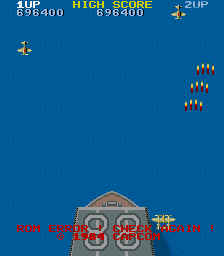
right Upon starting the first Atta stage, the game performs a checksum on the ROM, and if it's not right, the following text will be shown and the game will freeze.
|
|
This needs some investigation. |
References#
|
The 19xx series | |
|---|---|
|
Arcade |
1942 • 1943: The Battle of Midway • 1943 Kai • 1941: Counter Attack • 19XX: The War Against Destiny • 1944: The Loop Master |
|
Amstrad CPC |
|
|
Commodore 64 |
|
|
ZX Spectrum |
|
|
NES |
|
|
SuperGrafx |
|
|
Game Boy Color |
|