 This article has a talk page!
This is a sub-page of Proto:The Legend of the Mystical Ninja.

|
'...But does it make sense?' |
General#
- For instructions on how to access the building menu, please go to the main article. Use Pro Action Replay (PAR) code 7E1C42XX to change the building's subtype, where XX is the subtype ID.
Page 1 |
Page 2 |
||
|---|---|---|---|
ごえもんのいえ |
Goemon's House |
ばんや |
Guardhouse |
- Bank is たびにっき (Travel Diary) in the final version.
- Park is がいじん (Foreigner) in the final version.
- The ろうや (Jail) building is missing from the menu entirely.
|
Prototype |
Final |
|---|---|

|

|
- This border is brighter in the final version.

- The prototype has a second border design that's used in the following buildings:
:* Travel 1 & 2
:* Part-time Job
:* Bank
:* Whac-A-Mole
:* Horse Racing
:* E-awase
:* Puzzle
:* Aiming Shot
:* Hamburger
:* Lottery
:* Barricade
- Cursors do not blink in the prototype.
Goemon's House#
|
Prototype |
Final |
|---|---|

|

|
In what will be a theme for these buildings, the floor texture is muddier in the prototype and the wooden beams are more lightly shaded.
General Store#
|
Prototype |
Final |
|---|---|

|

|
- Art-wise, the only difference between versions is the floor graphic.
Shop 1 (00) |
Shop 2 (01) |
||||
|---|---|---|---|---|---|
Proto |
|
|
|
Proto |
|
Final |
|
|
|
Final |
|
Shop 4 (03) |
Shop 5 (04) |
||||
Proto |
|
|
|
Proto |
|
Final |
|
|
|
Final |
|
 20/30両
 80/90両
 60/80両 (5)
 20/30両
 20/30両
 30/60両
 100/120両
 100/110両
- At this point, there are only six types of shops, with different inventory and prices in each shop.
- The price increases that come after buying an item twice in the same shop are much greater in the final version.
- Bombs come in groups of 5 and 10 in the prototype. This was reduced to 3 and 5 in the prototype, with the five bomb stack only appearing in the final stage.
- The hourglass doesn't do anything yet, nor do the extra lives.

- The prototype has a shop sprite for the question mark bags that are only found in the Maze mini-game in the final game. There's no code for it, though, so what it would actually do is, appropriately enough, a complete mystery.
Diner#
|
Prototype |
Final |
|---|---|

|

|
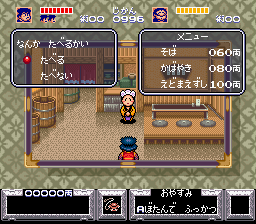
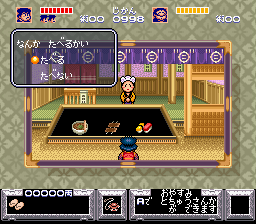
- The prototype's layout is unique to this building type, while the final version changes it to a variant of the general store layout.
|
Prototype |
Final |
|---|---|
|
|
-
The difference in layout is the result of a change in the diner's buying interface:
- The prototype's is entirely text-based, much like the one used in the hamburger restaurant. This interface allows players to only buy one food item at a time; buying a second item requires the player to leave the diner and then come back in again.
- The final game uses the general store's interface, allowing players to buy multiple items of food at once without leaving the diner, but requiring the developers to both represent the food visually and to fit the new graphics into the already cramped VRAM.
Shop 1 (00) |
|||
|---|---|---|---|
Proto |
Soba |
Kabayaki |
Edomae-zushi |
Final |
Soba |
Kabayaki |
Edomae-zushi |
Shop 3 (02) |
|||
Proto |
Taiyaki |
Okonomiyaki |
Kitsune udon |
Final |
Okonomiyaki |
Kitsune udon |
Kakinoha-zushi |
- The prototype has four different diners compared to the final game's eight.
- The pricing system changed along with the shopping interface:
:* In the prototype, the first two items always cost 40 and 60両, and the third item either 100 or 130両 depending on the shop.
:* In the final game, the prices of the three items start out at 40, 60, and 80両. After players purchase a particular item twice, the price for that item is then set to the second value in the table. This can be as little as two and as much as eight times the initial price.
- Taiyaki is the only food that appears in the prototype but not the final game.
- Dango is misspelled "danko" in the prototype.
Travel#
|
Prototype |
Final |
|---|---|

|

|
- A near-insignificant change here. Take a look at the tile at the bottom-left next to the potted plant. They flipped it. Wow!
- None of the three courses restore the player's health in the prototype.
Prototype |
|
|---|---|
Aコースですね。 |
A Course, right? |
Bコースですね。 |
B Course, right? |
Cコースですね。 |
C Course, right? |
- The three course messages were adjusted to state the amount of health that players will recover. The travel lady now stretches out itadakimasu.
Part-time Job#
|
Prototype |
Final |
|---|---|

|

|
- The final game adds a new red object to the shelves in the back.
JP |
EN |
|---|---|
すんまへん |
I'm sorry, |
- This building doesn't do anything yet, and the boss only has a single line of dialogue.
Maze#
|
Prototype |
Final |
|---|---|

|

|
- The prototype seems to be using a copy of Goemon's House with an incorrect tileset, leading to the broken graphics seen here. The final game uses the standard mini-game entrance. Note that the Famicom Goemon games used the prototype setups for maze entrances.
Prototype |
|
|---|---|
いらっしゃい |
Welcome. |
- In the prototype, the maze host follows the same intro format as some of the other mini-game hosts. The final text does more to entice the player to come in.
- The player can enter the maze for free.
- Even if the player selects "No", they'll still enter the maze.
|
Prototype |
Final |
|---|---|

|

|
- The compass features doesn't work; both player sprites always face north.
- There are two black squares next to each compass window.
- The final game adds a drop shadow to each player's maze window.
- The prototype displays nothing in an inactive player's space, while the final game displays a blank window.
- There are no messages for exiting the maze, no matter which door the player uses. In a two-player game, if one player exits the maze, their screen will freeze until the other player leaves.
- Items don't disappear from the maze when collected. The player can collect them over and over, holding up to 6 of each item.
- That said, none of the items do anything yet.
- All items on the HUD save for the money chest are improperly offset.
- The money chest uses a unique, brown sprite in the prototype, while the final game uses the golden money chest that's used everywhere else in the game.
-

- However, this only affects the closest chest sprite. All others still use the older design.
-

- The controls in the prototype are different and include some debugging features.
:* In the prototype, the X Button shrinks the maze window, and the Y Button expands it. Both the A and B Buttons switch between the maze and map screens.
:* In the final game the X Button prematurely ends the mini-game, and the B Button switches between the maze and the map.
- The final version adds an error sound when the player walks into a wall.
Proto |
Proto (Items) |
Final |
|---|---|---|
 |
 |
 |
- The prototype layout doesn't resemble anything in the final game. This map is 128x48, while the final maps are much larger at 112x112.
- There's one of each item in the prototype, with every item but the scrolls being placed in the main path.
- The upper-left coin in the first image marks the starting location, while the second coin marks the player's position in the maze.

- The prototype has three doors: A brown door at the maze's entrance, and red and blue exit doors. The final game removes the brown door and moves the red door to the entrance.
- Temp tiles mark the three doors in the maze: The light green tile is the brown door, the light brown tile is the red door, and the dark brown tile is the blue door. Proper markers were drawn for the final version.

- The prototype forgets to erase any on-screen sprites when switching to the map screen.
- The transition that the game uses to switch between the map and the maze is different:
:* In the prototype, the game erases the maze window, then slowly expands the window back to normal size.
:* In the final game, the game quickly clears the content of the window, leaving a blank, lavender square, then quickly draws the maze / map screen.

- There are special, zoomed-out player sprites in the prototype that go unused. These would most likely be used in a two-player game so that players could see each other in the maze. In the final game, players cannot be seen in the maze at all.
Fortune-Telling#
|
Prototype |
Final |
|---|---|

|

|
- While the building layout is the same, the final game adds a container to the fortune-teller's sprite.
Prototype |
|
|---|---|
どうじゃ どうじゃ |
??? |
- The fortune-teller's text is also different between versions. Oh, and he doesn't actually do anything yet in the prototype.
Gambling#
|
Prototype |
Final |
|---|---|

|

|
- Standard ground and beam graphics changes, plus the host was moved a bit down and to the left.
Type 5 |
Prototype |
|
|---|---|---|
あんちゃん |
Hey kiddo, |
あんちゃん |
- The early intro text doesn't explain how the game works and ends with an exclamation point. It's also missing a pause control code, so the text is cleared immediately.
- The bet limit is only 100両. The final game increases this to 3,000両.
- The final game lets players hold Up/Down to rapidly adjust their bet.
Guardhouse#
|
Prototype |
Final |
|---|---|

|

|
Ground graphics? Wooden beams? They're different.
Omi-Chan#
|
Prototype |
Final |
|---|---|

|

|
Alert the media: They changed the ground and wooden beam graphics here too.
Yanosuke#
|
Prototype |
Final |
|---|---|

|

|
More of the same...wait, why'd they remove the shadow on the ground?
Bank#
 |
 |
Welcome. |
How may I help you? |
- One of two buildings that was completely removed from the game, the Bank would allow players to deposit and withdraw money.

- The top number is how much the player has in their account, and the bottom number is how much the player will deposit.
:* Players use Left / Right to move between digits, and Up / Down to add or subtract from the number. However, there's nothing to keep the player locked in this menu, so pressing Down will make the player leave the bank.
:* The cursor for the numbers is off by one: For example, if the player has the singles digit selected, the tens digit will flash instead.
 |
 |
You don't have enough money. |
- Trying to deposit more than the player has will display an error message. This is also the only way to refresh the window and update the player's account info. However, the message is one character too big for the window, so the "n" character will both overlap the window border and not get properly erased.
- Even if it were implemented properly, the bank would be pretty much useless in the prototype: Players don't lose their on-hand money when they get a game over, and since both players have their own accounts, it can't be used to transfer money from one player to the other.
- It would have some utility if it were kept, since players do lose their money when they get a game over in the final game, but by that point it was too late. It was replaced with the much more useful travel diary service, which provides the player with their current password.
|
Prototype |
Final |
|---|---|

|
|
- While the Bank has its own unique layout, the travel diary uses the same design as the travel agency.
Game Center#
|
Prototype |
Final |
|---|---|

|

|
- Konami Lady seems to be in the middle of a Max Headroom-like laser light show in the prototype, while in the final version she stands in front of a blank TV.
Prototype |
|
|---|---|
ブロックくずし |
Block Break |
ピンポン |
Ping Pong |
- The names for two of the games were changed in an attempt to disguise what inspired them. ブロックくずし (Block kuzushi) is the Japanese term for a Breakout clone.
|
Proto |
Final |
|---|---|

|

|
- The sprite bank used for the Gradius mini-game was greatly reduced in size after the prototype. For instance, the number of tiles used for the largest shield's animation was cut in half...

- ...and the mid-size shield was removed outright, making the shield much less effective for blocking damage.
Prototype |
Final |
|---|---|
|
|


- The player's missiles and the Rugal enemy lost two rotational frames, though it should be noted that the downward missile frame isn't used even in the prototype.
Prototype |
|---|
|
Final |
|


- Four other enemies and the Big Core's eye all lost one to two unique frames of animation each.

- The smallest volcanic rock was removed, leaving only the medium and large-sized rocks.
Whac-A-Mole#
|
Prototype |
Final |
|---|---|

|
|
- This is the first building type (by ID, anyway) in the prototype that uses the standard mini-game template. The walls are orange instead of a grayish green, there are slanted walls leading to the entrance instead of straight ones, there's only one entrance to the building, and the striping on the bottom-left pole goes right instead of left.
JP |
EN |
|---|---|
いらっしゃい |
Welcome. This is |
- In the prototype this is a stand-alone mini-game, while in the final game it's only available through the Part-time Job buildings. The original intro text gives it a different name -- pakopako is a light hitting sound -- while the final game uses the shorter もぐらたいじ, roughly "Mole extermination."
|
Prototype |
Final |
|---|---|

|

|
- The prototype has two extra holes for the Start and Select buttons. These were removed to allow players to pause the game.
- The single player layout originally had a 1P marker on the upper-left corner of the playing field, even though it's possible for the second player to be playing this game alone. The final layout removes that marker.
|
Prototype |
Final |
|---|---|

|

|
- The same button-related changes apply to the two-player layout.
- The difficulty menu in the prototype has the harder mode listed first, meaning it's selected by default. The final game does the logical thing and lists it last.
Horse Racing#
|
Prototype |
Final |
|---|---|

|

|
- Different feel to the horse racing entrance here. The lighting on the pillars -- which changed from purple to green -- is darker, the ground is brighter, and the shadows the pillars cast go all the way to the bottom.
 |
 |
Race #01 |
Race #01 is starting. |
- The initial menu window is smaller in the prototype, and the text more terse.
- There's only the cursor on this menu in the prototype that both players can control. In the final game, each player has a separate betting prompt.
- In a notable instance of something not being changed, Goemon and Ebisumaru's names use hiragana in both the prototype and final versions.
|
Prototype |
Final |
|---|---|

|

|
- Players bet in 1両 increments in the prototype, which can be incremented up to 99 times per bet.
- The final game greatly increases this to 10両 increments but lowers the cap to 49 times. This change was done to fix an issue with the race results screen - see below.
- The message window is the same size on this screen, but it's placed lower.
- The final game adds multiplication signs by the racing odds.
- "Start Key" is written using the English alphabet in the prototype, while it's in katakana in the final game.
- The horse in stall 5 has its head coming out of the gate in the prototype, while the final version properly masks it behind the gate.
|
Prototype |
Final |
|---|---|

|

|
- The final game combines both message windows into one while keeping the same information. The header in the final says "Race results."
- The prototype has a paltry two digits for the amount won, which is guaranteed to roll over if they bet 50両 or more.
- The final game has four digits, which is enough to accommodate the maximum possible payout of 9800両.
E-Awase#
|
Prototype |
Final |
|---|---|

|

|
All of the pictures are different between versions: The prototype uses a full 32x32 graphic for each of the 8 pictures, while the final game stores all of the portraits sans Kobanneko as 16x32 graphics and then mirrors them horizontally. The sixth portrait was changed from Rin-chan of Goemon Gaiden fame to the Lantern Devil, probably to keep the player from confusing her with the eight portrait, Princess Yuki.
Puzzle#
|
Prototype |
Final |
|---|---|

|
|
- In the prototype, the quiz game has its own unique layout, complete with marked entrances for each of the three contestants. The final game just uses the standard mini-game layout.
|
Prototype |
Final |
|---|---|

|
|
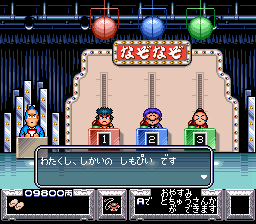
- The message box window is 3 pixels lower lower than it should be in the prototype.
- The quotation marks around the host's name, "Shimopii", had to be taken out when the quotation marks were removed from the game's font.
Aiming Shot#
JP |
EN |
|---|---|
いらっしゃい |
Welcome. This is |
- Like Whac-A-Mole, this was originally a standalone mini-game before it became an offering in the Part-time Job agency. The name in the final game is おにたいじ, "Oni extermination."
|
Prototype |
Final |
|---|---|

|

|
- The timer is yellow in the prototype and pink in the final game.
Show Tent#
- The game immediately jumps to the interior in the prototype, while the final game uses the standard mini-game entrance and charges admission as well.
|
Prototype |
Final |
|---|---|

|

|
- The checkered sliding doors in the back are laid out strangely in the prototype, with two big ones in the middle, two tiny ones anchoring them, and two big ones on the left and right extremes. The final game makes all of the sliding doors the same size. The building as a whole is brighter in the prototype.
- Neither of the shows have been coded yet in the prototype, so there's nothing to see or do here.
Hamburger#
|
Prototype |
Final |
|---|---|

|

|
- The design of this building was simplified in the final version. The corner pieces of the counter were removed, as was the lighting at the top, and both sections of the menu now use the same tiles.
Prototype |
|
|---|---|
ありがとうございました |
Thank you very much. |
- The purchase message was also simplified.
Inn#
|
Prototype |
Final |
|---|---|

|

|
- Ye olde floor changes.
- You can't actually sleep here in the prototype, and the host has no dialogue.
Dojo#
|
Prototype |
Final |
|---|---|

|

|
- The ancient art of floor changes.
- This doesn't work in the prototype either! What a dojoke.
Prototype |
|
|---|---|
このどうじょうで |
How about training |
- The final game adjusts the formatting and punctuation of the prototype text, but more importantly it adds text telling the player that the jutsu only works in the stage it's learned at.
Bathhouse#
|
Prototype |
Final |
|---|---|

|

|
- These floor and wooden beam graphics seem...different, somehow.
- The bathhouse keeper seems to have aged 50 years between versions.
- The bathhouse doesn't work (shock!) and the shopkeeper is mute.
Pawnshop#

- Another cut shop, this would let the player(s) sell items in their inventory. The slot that this shop occupies is blank in the final game.
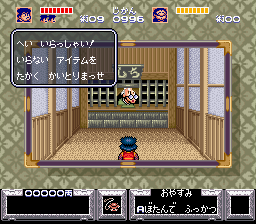 |
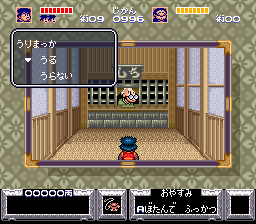 |
Hey, welcome! |
Are you selling? |
- The pawnshop guy has a unique sprite and intro dialogue, two of the few aspects of this shop that were actually finished.
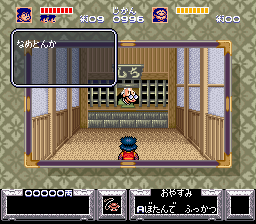 |
Are you kidding me? |
- Like most proprietors in this game, he's bad at dealing with rejection.
|
In-game |
Menus only |
|---|---|
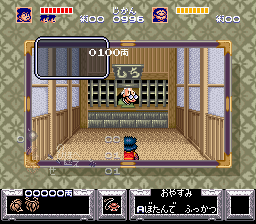
|

|
- In all likelihood, this shop was already on its way out. The currently selected item's price goes outside of the text window. The list of items appears below the window, where the items are listed with garbage text and, due to not appearing in a text window, are very hard to see. Trying to navigate the menu will result in the player leaving the store.
- Sell values are listed below:
|
|
|
|
|
|
|
|
|
|
|
|
|
|


- The sell prices seems odd, with upgraded versions of items selling for less than their weaker counterparts. It's possible that it's either reading from the wrong location in the ROM or the sell data was overwritten with something else.
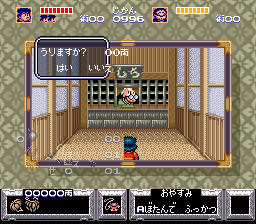 |
Want to sell this? Yes / No |
- Selecting an item to sell will make a confirmation window pop up, but the player won't be able to select either option.
Barricade#
- This standalone mini-game requires two players to even enter. Trying to go in during a 1P game will prompt the following message:
JP |
EN |
|---|---|
このゲームはふたり |
Two players are needed |
 |
 |
A nostalgic Barricade game. |
Press the button to begin! |
- A very brief explanation precedes the game.


- In case the screenshots didn't make it clear enough, yes, this is Snake...or, more accurately, it's Blockade. The genre was brought into Japan by Taito as Barricade, which explains the mini-game name.
 |
 |
 |
Goemon-san won this round. |
Score |
Results |
- The player who survives the round gets a point; the first player to reach 3 points wins. Like the Game Center, there is nothing to win and nothing at stake other than the agony of defeat. It's just a fun little diversion.


- This mini-game was heavily reworked as ぺんきぬり (Painting, as in a house or a fence), then turned into an offering in the Part-time Job office.
:* The game can be played by either one or two players.
:* Players control paintbrushes, and the object is to cover as much of the wall as possible.
:* At the end of the game, players earn one ryō per square. In a two player game, the player who lasts the longest gets their earnings doubled.
Minka#
Minka buildings don't have any layout differences that weren't previously mentioned, though it does have three changes in the resident's dialogue:
Type 5 (04) |
Prototype |
|
|---|---|---|
みなみのひろばで |
The Hiyottoko are |
みなみのひろばで |
- The prototype misspells Hyottoko and isn't clear on whether there's only one or multiple Hyottoko. The final game clarifies that there's more than one by adding -tachi.
Type 6 (05) |
Prototype |
|
|---|---|---|
ちょうちんまじんは |
The Lantern Devil is |
おうごんのまねきねこを |
- An explanation on the Lantern Devil's relation with the Hyottoko was changed to clue the player in on the golden maneki-neko items and how they work.
Type 10 (09) |
Prototype |
|
|---|---|---|
わたしのこどもは |
My child was |
ここだいのはなしだが |
- A message that's a little too dark for this game's tone was changed to a joke about the Konami Code.
Type 11 (0A to 1F) |
|---|
ここはどこ |
- This placeholder takes up the rest of the prototype's slots. Note that the final game expands the number of messages to 24.
(Source: Original TCRF research)