 This article has a talk page!
This page details one or more prototype versions of The Legend of the Mystical Ninja.


General Differences#
Title Screen#
|
Proto |
Final |
|---|---|

|

|
- The password and stereo/monaural options are missing from the prototype's title screen.
- The option text is dark blue instead of reddish pink.
- In the prototype, no sound plays when starting a new game.
Game Intro#
|
Proto |
|---|

|
|
Final |

|
Both the sky and Goemon's house are brighter in the final game.
|
Proto |
Final |
|---|---|

|

|
The large font in the prototype uses a basic thin typeface, while the final version opts for a more calligraphic style.
|
Proto |
Final |
|---|---|

|

|
The intro has an off-model Goemon sprite. Check out the massive shoulders on this guy! He also has a larger face and a different haircut, with more of his forehead visible. The starburst-like shading style in his hair was changed to something more natural, as were his original blob-like ears. All of these changes drastically cut down on the number of tiles stored in VRAM.
|
Proto |
|---|

|
|
Final |

|
Funnily enough, while his eyes had to be readjusted, his mouth graphics are almost identical in both look and placement.
|
Proto |
|---|

|
|
Final |

|
Ebisumaru went through relatively minor changes, with his shoulders narrowing and his eyebrows growing slightly bushier.
Proto |
Final |
|---|---|
 |
 |
The flashing text is green and tan in the prototype, while the final game changes this to a better contrast of orange and white.
Stage Intro#


- The map animation is different in the prototype: The map is visible at the start, then fades to black as Goemon and Ebisumaru jump into frame.
-
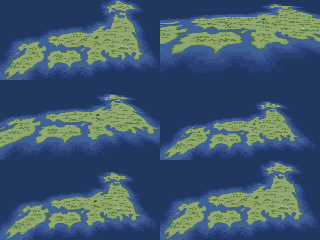

- The final game adds some visual spice (and justifies the map being a Mode 7 background) by adding a zooming and tilting animation. The map then stays on-screen as Goemon and Ebisumaru appear.
- Goemon and Ebisumaru land on the bottom of the map's frame in the prototype, while in the final game they hover a bit above it.
|
Proto |
Final |
|---|---|

|

|
- The full Mode 7 map (which is much more detailed than what's seen in-game) is dotted with several small ships in the prototype. Since those ships were barely visible to begin with, they sank to the bottom of the sea. The prototype map includes the southwest isle of Tanegashima; it's not visible in the prototype, and it wouldn't be visible in the final game either, which is why it was deleted.

- The prototype includes unused tiny Goemon and Ebisumaru sprites. They were most likely meant to be used as map markers: the game would zoom in to the full-sized map and then move the camera over to Goemon and Ebisumaru's current location. This would explain why the map is drawn much larger than it needs to be.

- Stages 8 and 9 have yet to be named, unless you count "AAAAAAA" as a name.
Player Sprites#
Proto |
Final |
|---|---|
 |
 |
Goemon has a slightly darker palette in the prototype, which is especially noticeable with the shades of red. Goemon's default expression changed from looking like a frowning cat to a frowning man, and his arms were put at rest. In the prototype, his face is a bit fatter in his W/E idle animation, and a few bits of hair here and there were deleted from his south-facing idle frame.
Proto |
Final |
|---|---|
 |
 |
In every single frame of Goemon's piggybacking animations, Goemon's ears are drawn smaller and with less detail, and he's missing the part in the middle of his hair; both of these were fixed in the final version. A few tiles were later taken out of his swinging sprites to save space, but since Goemon is always overlapping with Ebisumaru's sprite in these animations, it's not actually noticeable in-game.
Proto |
Final |
|---|---|
 |
 |
A little hard to see, but in Goemon's flying sprites, they remembered to add the part in the middle of his hair.
Proto |
Final |
|---|---|
 |
 |
Fixed the part in the hair, made the ears consistent with the rest of the sprites. The usual.
Proto |
Final |
|---|---|
 |
 |
Two of Ebisumaru's idle frames are drawn off-model (i.e., not fat enough). Even his hands got rounder!
Proto |
Final |
|---|---|
 |
 |
The back of Ebisumaru's head is drawn differently, with a smaller mask and what seems to be black hair underneath. In the final game, the mask covers the entirety of his head. Note that later games in the series use the prototype's design.
Proto |
Final |
|---|---|
 |
 |
The first two sprites saw the sash on Ebisumaru's gi reduced in size, while the third sprite had a bit more pudge added to it.
Proto |
Final |
|---|---|
 |
 |
Ebisumaru's shuriken uses a different, brighter palette in the final game.
 |
This frame from Ebisumaru's Sakura Dance jutsu isn't used in the prototype and was deleted from the final game.
|


There are three hurt frames for both Goemon and Ebisumaru that were deleted from the final game. The second frame, meant to be used while crawling, isn't used even in the prototype...


...but the other two are! In the final game, getting hit while flying simply cancels the jutsu, and getting hit while facing north displays the standard W/E hurt animation. It's likely that all three sprites were cut just to save space.
Text & Font#
- In the prototype, Goemon and Ebisumaru's names are consistently written with the kanji 丸 and hiragana characters - ごえもん and えびす丸 - in all in-game messages. To keep things consistent with both the intro and the game's own title, almost all instances of those names were changed to use katakana (ゴエモン and エビス丸).
Proto |
|---|
 |
Final |
 |
- The digits in the game's basic font were updated to match the ones used in the HUD.
- {| class="wikitable"
|style="padding: 0em; background-color:gray;"| |}
- These red and blue arrows are exclusive to the prototype's font. These are presumably early cursors for Goemon and Ebisumaru respectively, but by this point the cursors had already been changed to sprites.
Proto |
Final |
|---|---|
 |
 |
- There are a few other characters that are prototype-exclusive, but the only ones the game uses are the quotation brackets. The final game adds an asterisk and a left-facing arrow.
HUD#
Prototype |
Final |
|---|---|
 |
 |
A Button to revive. |
You can join in with A. |
- The text in a player's message box prior to joining in is different.
- The sandal and helmet items switched slots.
Continue |
Continue |
Can't Continue |
|---|---|---|
Aで えびす丸 を ひとり もらえます |
Aで ごえもん を ひとり もらえます |
いまは ふっかつ できません |
You can take one Ebisumaru with A. |
You can take one Goemon with A. |
You can't revive right now. |
- Though both versions have the same join-in and continue system, the prototype is missing messages for dead players continuing and being unable to continue. This is one of only two instances of Goemon and Ebisumaru's names being spelled with hiragana in the final game.

- The prototype has HUD graphics for both a single scroll and a set of three scrolls, neither of which are used. The existence of these is a little confusing: even if the game did list how many scrolls the players had on the inventory screen, why would there be two different graphics?
Items#
- {| class="wikitable"
|style="padding: 0em; background-color:gray;"| |}
- The prototype has sprites for an "up" graphic, which would have been used if the player earned a 1up on the field. As it is, there are no 1ups in the prototype, and in the final game all 1ups are either purchased in the shop or found in the Maze minigame.
- In both the prototype and the final version, the player can have up to three stacks of waraji (straw sandals) at once.
:* In the prototype, shops will offer sandals in either two-pair ( ) or three-pair (
 ) stacks. Each stack is counted as a separate item: わらじ1 for two pairs, わらじ2 for three pairs.
::* If the player purchases multiple two-pair stacks, the player won't be upgraded to three-pair speed.
::* If the player has both two-pair and three-pair stacks and takes damage, the game will remove a three-pair stack first.
:* In the final version, pairs of sandals are soid individually ( ) and the player can upgrade from a single pair to a three-pair stack by buying two pairs of sandals. This simplifies the number of items the game has to keep track of and just makes more sense conceptually.
|
Proto |
Final |
|---|---|

|

|
- The Korezou-kun checkpoint item is more heavily shaded in the prototype, making it appear much shinier.

- In the prototype, all Korezou-kun items are gold, while the final game color-codes them based on their checkpoint number. This change is why the the statue was redrawn - the older sprite didn't work well with the new palettes.
Inventory#
|
Proto |
Final |
|---|---|

|

|
- The prototype is missing the up and down arrows that appear if the player has more than five types of items.
- To make room for the arrows, the item list was shifted down 8 pixels.
- Players can carry up to 99 bombs in the prototype. This was reduced to just 30 bombs in the final game.
- Other items are effectively unlimited with a cap of 65,535. The final game adds a more reasonable limit to those items based on their type (for example, the player can only carry 10 sandals and 3 of each healing item).
Money#
- The koban coins dropped by enemies and found in jars are worth only 5両 in the prototype. This was thankfully doubled to 10両 in the final game, cutting out a good deal of potential grinding.
- Special hidden items (like the Kid Dracula head in Stage 1) are worth a mere 10両 in the prototype. In the final game, their value was increased to 100両.
- The players' projectiles attacks cost 2両 in the prototype, which was later increased to 4両 with koban coin inflation.
- Players keep all of their money after getting a game over. In the final game, the player loses all of their money.
Jutsu#
While jutsu are not normally available in the prototype, they are fully coded. Use the following Pro Action Replay (PAR) codes to give Goemon and/or Ebisumaru all four jutsu and infinite power:
Goemon |
Ebisumaru |
|---|---|
7E1ABA09 |
7E1B7A09 |
- Jutsu that deplete energy over time take 40 frames per bar in the prototype and 16 frames per bar in the final game.
- Helper jutsu were rebalanced for the final game:
- In the prototype, their energy depletes over time, but the player can still take damage while riding them.
- In the final game, their energy does not deplete over time, but defeating enemies will remove a bar of energy, and attacks that would normally damage the player will instead deplete the helper's energy. Energy will be rapidly depleted if the enemy or object isn't immediately defeated. Energy will deplete over time while floating on water.

- If the player uses Goemon's anger jutsu and then either falls down a pit or exits from a side-scrolling area to a town area, the screen will remain dimmed until the player uses another jutsu. The final game fixes this oversight by cancelling the anger jutsu if the player moves to a different area.

- If the player uses Goemon's transformation jutsu and then falls down a pit, Goemon's red hair will remain on-screen as he falls.
Continue Point#
Proto |
Final |
|---|---|
 |
 |
The Voice of Korezou-chan A. Continue as is. |
Where do you want to start? |
- This is a very simple text-based screen in the prototype. The final game adds a border of an unrolled scroll.
- The screen is silent in the prototype, while the final game reuses the Game Over track.
- The prototype screen calls Korezou-kun Korezou-chan.
- In the prototype, players can either press A to start off at the first checkpoint or press B to start at the beginning of the action stage. The prototype can only support one checkpoint per area: If the player ignores the first checkpoint, gets the second checkpoint, dies, and then tries to continue from the checkpoint, the game will crash.
- In the final game, players can start off at any checkpoint they've reached, necessitating a cursor on this screen.
Game Over#
Proto |
Final |
|---|---|
 |
 |
Gaame Ooverr |
Gaame Ooverr Continue your journey |
- Like the continue point screen, this is just white text on a black background.
- There's no option to quit the game (and receive a shortened password) in the prototype.
(Source: Original TCRF research)
Audio Differences#
Changed Tracks#
Name |
Proto |
Final |
|---|---|---|
Title ~ Theme of Goemon |
||
The instrumentation is very rough in the prototype. There are also some differences in the opening melody and missing stereo effects. |
||
Introduction ~ No Close Ups! |
||
More rough instrumentation, though further along than the title theme. Final track adds more instruments to the "spooky" section of the song. |
||
Izumo ~ Dragon Pond |
||
There are bad clipping issues in the prototype track, particularly in the opening and ending. Audio is completely centered. |
||
A Game of Trivia |
||
The final game uses a totally different, shorter piece for this slot. |
||
Master of Trivia! |
||
Final track is extended by about 2.5 seconds. Prototype track is once again missing stereo effects. |
||
Hidden Treasure! |
||
The older track is similar in tone to the Famicom games' underground music, but it doesn't really fit with the underground areas in this game. |
||
(Source: Original TCRF research)
Deleted Tracks#
ID |
Track |
Comments |
|---|---|---|
0004 |
A somber tune that is used in the prototype, playing in what should be the Tanuki room in Stage 8. |
|
0014 |
Similar in composition and length to the other minigame entrance tracks. |
|
003C |
A tense, repetitive song. Good candidate for a "time running out" track. |
|
0044 |
Possible unused stage theme, maybe? |
|
0048 |
A sneaky track that could be a cut stage theme. |
|
004C |
Has the feel of an intro for...something. A boss fight, maybe? |
|
0058 |
The longest of the unused tracks, this is actually a rendition of "The Theme From Quarth"! |
|
005C |
Sinister music. Hopefully the instruments in the latter half of the track were just placeholders. |
|
0064 |
A short triumphant theme. There are already other tracks that would serve this piece's purpose. |
|
0070 |
A short, suspenseful track. A likely candidate for this would be the Stage 8 cutscene with General Hannya. |
|
00B8 |
This is used in the prototype for the Tanuki room in Stage 5. The final game just uses the Castle of Ninjas theme that plays in the rest of the side-scrolling section. |
|
00C0 |
A pretty relaxing piece, but it's not clear where this would fit in the game. |
|
00C4 |
This gentle track sounds like another unused building theme. |
|
00CC |
A rather regal bit of music. Could have been meant for the castle in Ryukyu. |
|
0100 |
Very similar to the instrument hit in the game intro, but this is a standalone track. |
(Source: Original TCRF research)
Missing Tracks#
The prototype is missing 20 tracks from the final game. In their place are either reused tracks or nothing at all:
Context |
Proto |
Final |
|---|---|---|
Title Screen Intro |
N/A |
Title ~ Theme of Goemon (Intro) |
Password Entry |
N/A |
Back Into Adventure |
Stage 4 Cutscene |
Ohedojyo Castle Dungeon |
Spunky Female Ninja |
Stage 5 Cutscene |
Shapeshifting Ninja Cat |
Wisdom of the Ages |
Stage 6 Town |
Oedo ~ Goemon's Home |
Kyoto ~ Ancient Capital of Japan |
Stage 6 / 8 Miniboss |
N/A |
Surprise Attack! |
Stage 7 Cutscene |
N/A |
The Truth Reflected |
Stage 8 Town |
Oedo ~ Goemon's Home |
Ryukyu Kingdom |
Stage 8 Sidescroller |
Castle of Ninja |
King Ryukyu's Secret |
Stage 8 Ending |
N/A |
Returning to a Surprise |
Stage 9 Sidescroller |
Ohedojyo Castle Dungeon |
Road to the Flying Castle |
Stage 9 Cutscene |
N/A |
Yuki Rescued ~ The End |
Staff Roll |
N/A |
All's Well That Ends Well |
Inn |
Buy Something or Get Out! |
Rest and Relaxation |
Inn - Resting |
N/A |
Good Night... |
E-awase Entrance |
Goemon and Ebisumaru Live! |
Enter the Card Game |
Lottery Entrance |
How About a Burger |
A Game of Luck |
E-awase |
Painting Panic! |
A Game of Memory |
Hockey |
Balancing Act |
Arcade-Style Fun! |
Show Tent Entrance |
N/A |
Exciting Theatre |
(Source: Original TCRF research)
Other Changes#
The following tracks are missing stereo effects (all channels are centered) but are otherwise complete:
Context |
Name |
|---|---|
Stage 1 - Horohoro Temple |
Horohoro Temple |
Stage 2 - Shikoku Island |
Shikoku Island |
Stage 3 - Onaruto Bridge |
Awaji Island |
Stage 3 - Karakuri Amusement Park |
The Happiest Place in Japan! |
Stage 4 - Harima to Yamato |
Town of Yamato |
Stage 4 - Otafuku Base |
Headquarters of the Otafu Army |
Stage 5 - Iga |
Mountain Village Iga |
Stage 5 - Ninja Mansion |
Castle of Ninja |
Stage 6 - Tengu Mountain |
Tengu Mountain |
Stage 9 - Dungeon |
Ohedojyo Castle Dungeon |
Resident |
A Helpful Fellow's Home |
Hamburger Shop |
How About a Burger? |
Travel Diary / Bank |
Keep an Adventure Log |
Dojo |
You Need More Training! |
Fortune-telling |
In Your Future, I see... |
Gambling |
A Game of Chance |
Game Center |
A Game of Simple Enjoyment |
Quiz Show |
Goemon and Ebisumaru Live! |
Horse Racing - Menu |
Place Your Bets! |
Horse Racing - Start |
Aaaaand They're Off! |
Whac-A-Mole |
Old-Fashioned Challenger |
Painting |
Painting Panic! |
Mini-Game - Aiming Shot |
Balancing Act |
Game Center - Gradius |
Gradius ~ Vic Viper's Theme |
Game Center - Gradius |
Gradius ~ Space Shooting |
Game Center - Gradius |
Gradius ~ Boss Battle |
Ebisumaru's Sakura Dance jutsu |
Ebisumaru's Alluring Dance |
(Source: Original TCRF research)
Sound Effects#
The prototype has 82 sound effects, while the final game has 119 sounds. 11 sounds present in this build were changed between here and the final, mostly adjustments in pitch:
ID |
Proto |
Final |
|---|---|---|
02 |
||
09 |
||
1B |
||
23 |
||
56 |
||
57 |
||
58 |
||
59 |
||
68 |
||
6B |
||
84 |
The prototype has one exclusive sound: 62, a longer, deeper version of the bell gong used in Horohoro Temple.
(Source: Original TCRF research)
|
The Ganbare Goemon series | |
|---|---|
|
NES |
Ganbare Goemon! • Ganbare Goemon Gaiden • Ganbare Goemon Gaiden 2 |
|
MSX2 |
|
|
Game Boy (Color) |
Ganbare Goemon: Sarawareta Ebisumaru • Mystical Ninja Starring Goemon • Ganbare Goemon: Mononoke Douchuu Tobidase Nabebugyou • Ganbare Goemon: Hoshizorashi Dynamites Arawaru!! |
|
SNES |
The Legend of the Mystical Ninja (Prototype) • Ganbare Goemon 2 • Ganbare Goemon 3 (Prototype) |
|
PlayStation |
|
|
Nintendo 64 |
Mystical Ninja Starring Goemon • Goemon's Great Adventure • Goemon: Mononoke Sugoroku |
|
PlayStation 2 |
|
|
Game Boy Advance |
|
|
Nintendo DS |
|