 This article has a talk page!
This is a sub-page of Prerelease:Spyro the Dragon (PlayStation).
Some of the earliest screenshots and footage of the game can be identified by the presence of a silver dragon statue in place of the green design seen in the final game. In addition, a version of the HUD that appears to be earlier than what is seen in any other pre-release media can be seen in this build.
Some screenshots of the build have even displayed a debug menu that is absent from any released build. Oh my!
PETESHOT Screens#
Appearing in a wide range of magazines, this collection of screenshots from early in development is often labelled with the name "PETESHOT" on press CDs - obviously taking its name from Spyro's earlier name. A full image containing all 25 of the screenshots in this collection is found on the Power Source E3 press disc, and metadata on the disc reveals the full image to be called "Pete Mainscreens", despite the name of the file itself being something more generic on that specific disc.
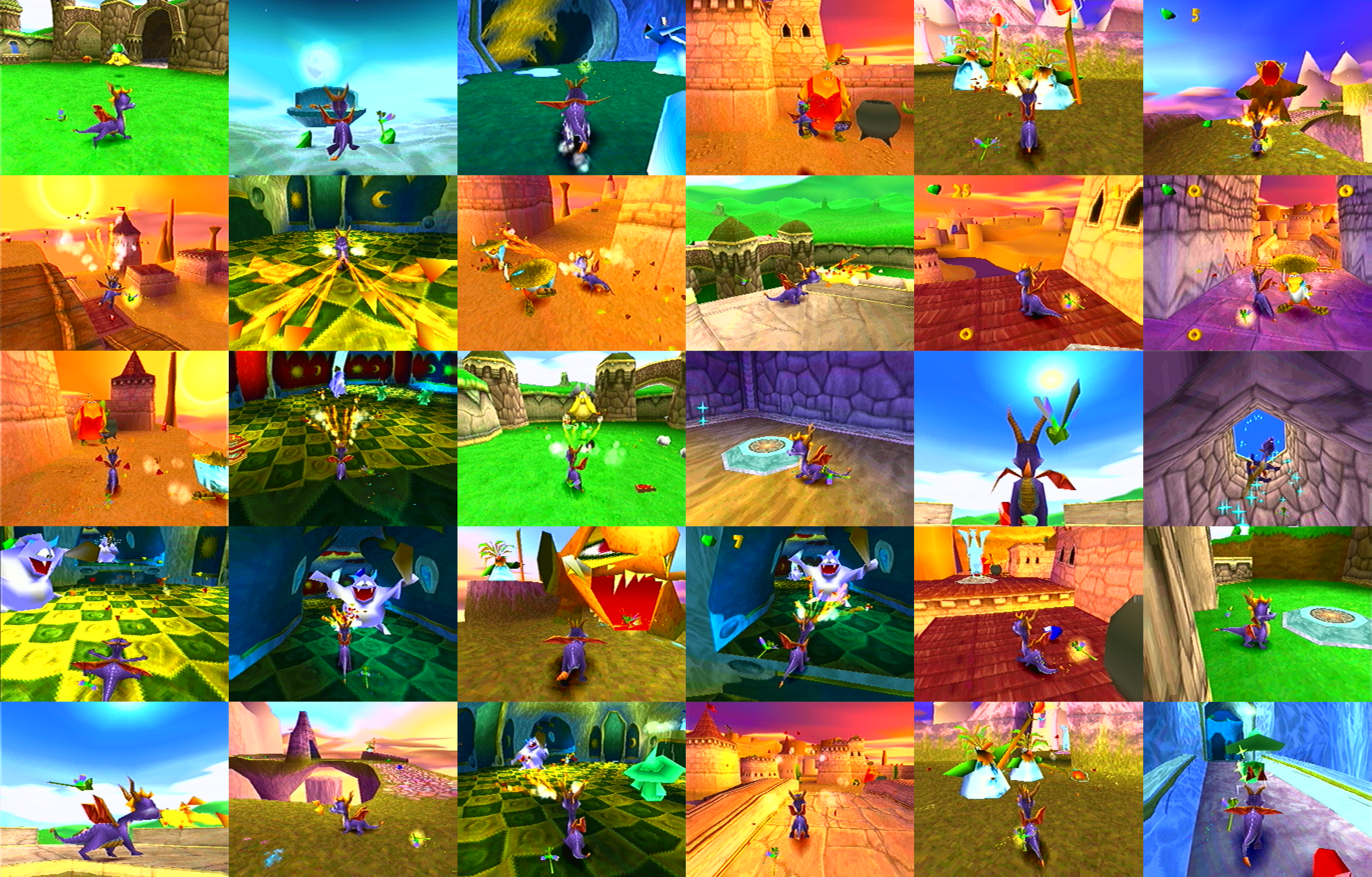
There are a number of screenshots in this collection that are of particular importance.
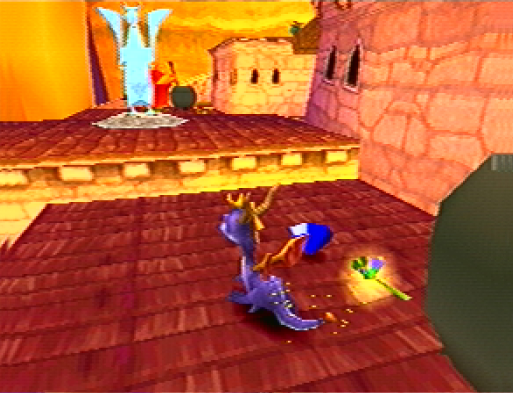
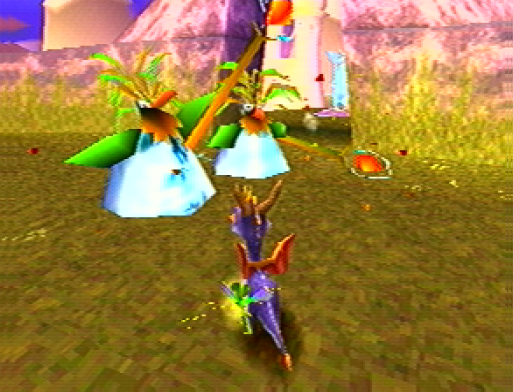
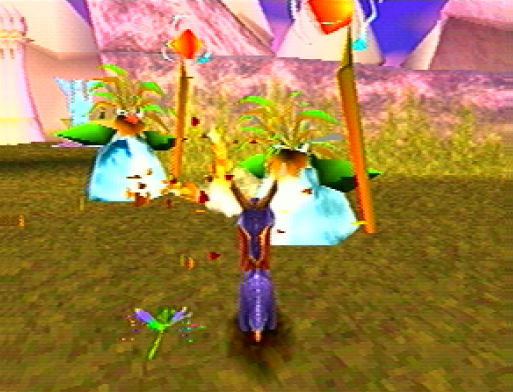
Several of the screenshots show that the dragon statue once featured a more primitive design, with a silver colouring and a rather bizarre model. One image of Cliff Town shows a dragon in a location where no dragon appears in the final game - this dragon was later seen in several of the game’s released prototype builds.
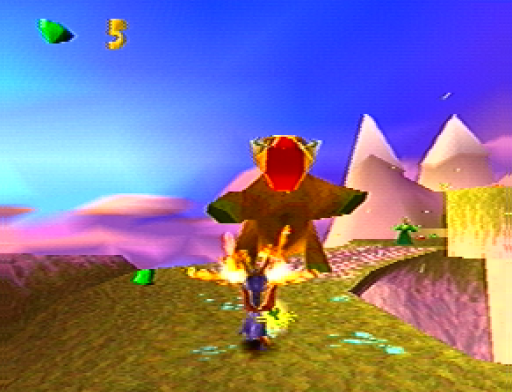
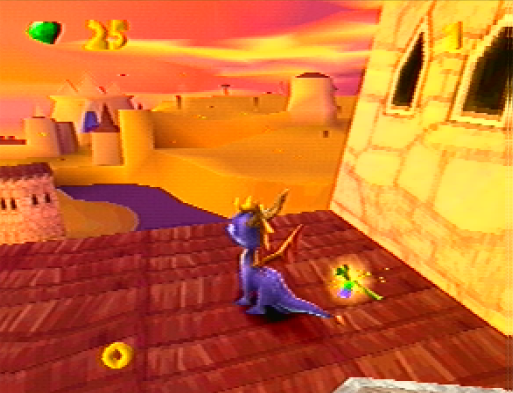
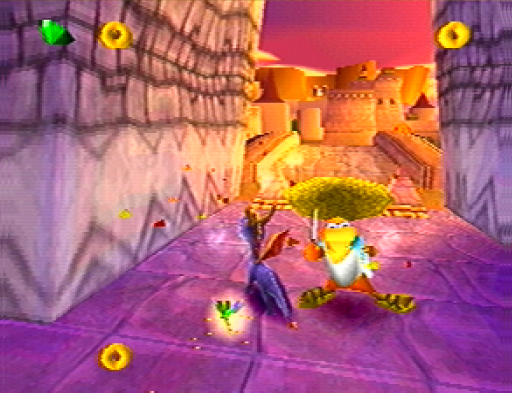
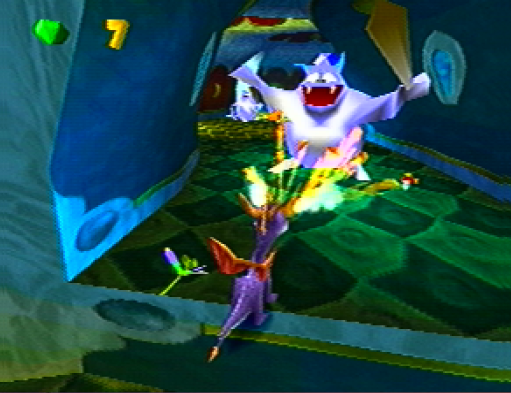
In a few of the screenshots we also see an earlier design for the game's HUD. There are three counters - one in the top left, one in the top right, and one in the bottom left, rather than them all being along the top of the screen. Only the gem counter has an icon next to its number, and the icon is of a green gem instead of a golden treasure chest. Judging by the "1" in one of the Cliff Town images, the dragon counter would go in the top right of the screen. It's unknown whether the final counter - in the bottom left - refers to lives, dragon eggs, or another unknown quantity. The number models used also appear to be different, each of the numbers looking somewhat rounder and using a different shading.
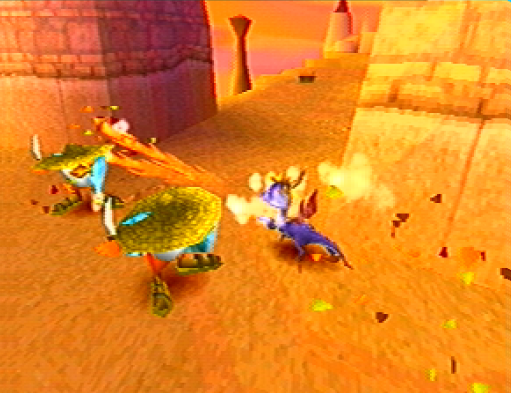
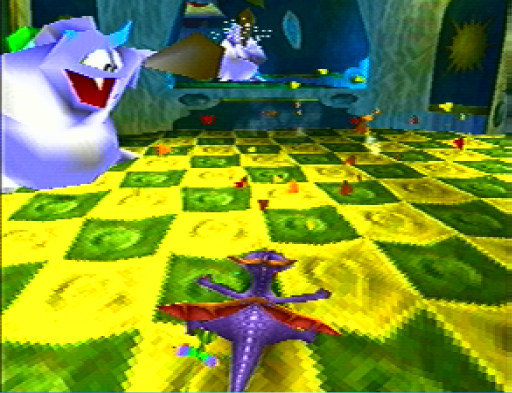
Another notable difference is the presence of these bizarre dark triangles in a number of the images. It appears that the particle effects emitted after Spyro flames were a bit different in this version.
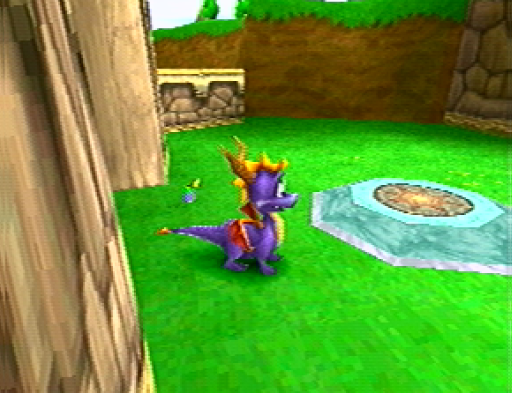
Finally, we note the presence of exit portals in Stone Hill and Cliff Town. From the Stone Hill screenshot, we can't really make out much, other than that it would stand where the exit vortex is placed in the final game. We can barely make out the portal in the Cliff Town screenshot, but from what we can see, the white interior of the portal stands out from this distance. Both of the portals seem to use the same portal frame designs used in their respective homeworlds.
(Source: Power Source Press Kit)
PICT Screens#
A second, less frequently used set of screenshots can also be found across a few magazines. In press kits, these screenshots usually contain the word "PICT" in their name. So far there are no known differences between the build used in these screenshots and the ones used in the PETESHOT images, but this collection of screenshots notably has not been seen to feature Wizard Peak so far, unlike the other collection.
Based on data in the Crash 3 and Spyro Artwork Disc, it appears as though these screenshots were taken on March 20th 1998, giving us a rough estimate of when this build was created.
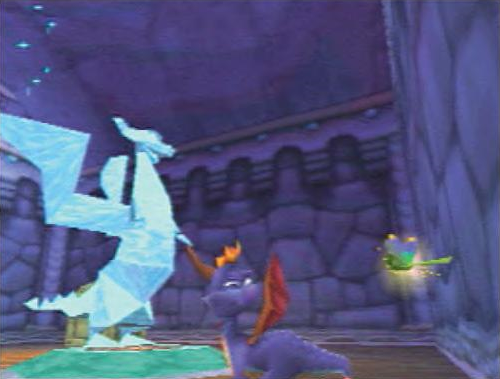
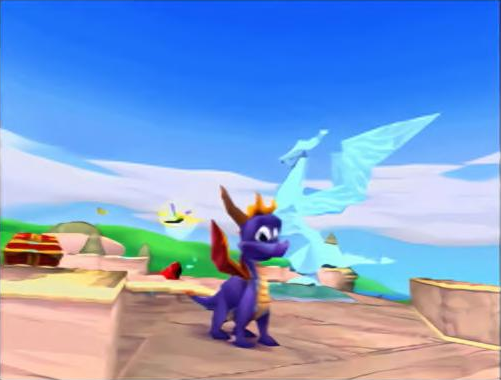
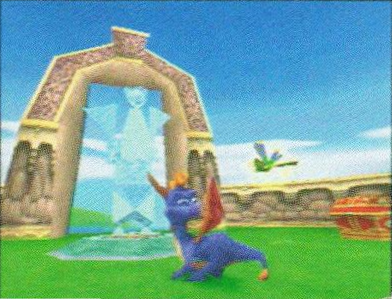
We get a better view of the dragon statues in these screenshots. We also get a nice look at the portal at the end of Stone Hill - it appears very similar to the one used to enter the level, but does not appear to be surrounded by text when the player gets close to it. In the first of the images, a chest can be seen next to the dragon - the design of the locked chest appears to have once been closer to that of a traditional chest (à la The Legend of Zelda) as opposed to the design used in the final game, which is more angular and is made out of metal.
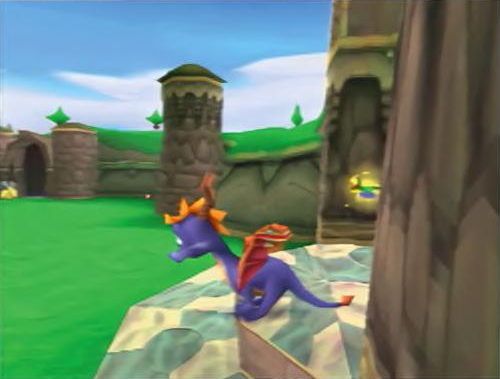


We also get a good few clear shots of a room near the entrance of the level. The room was removed later in development. Notably, in one of the screenshots, what appears to be a debug display of sorts is visible on the bottom of the screen. The text in the display appears to contain the terms "AZIMUTH", "ELEVATION", "RADIUS", "ANGX", "ANGY, "ANGZ" - likely referring to the position of either the player or the camera.
(Source: GameLand Oct 1998)
(Source: BGamer Dec 98)

(Source: AVOC Review)
B-Roll#
Watch on YouTubeFootage shown by "Templo dos Jogos" shows what appears to be another very similar version of the game.
- 0:00 The video starts with Spyro in an unidentified room. The room seems to be around where he'd normally spawn into the level, so perhaps this is where the player starts. In the final game, this room does not exist, but the ground above where the room would have been is still noticeably elevated.
- 0:00 Sparx seems to start off green and doesn't change colour at all throughout the video, even after getting hit. His glow does change though, so Sparx was likely green all the time in this version, similar to the Japanese version of the game.
- 0:01, 0:06, 0:11 Spyro is seen turning around in a manner that's not seen in the final.
- 0:14 Unfinished knockback animation.
- 0:16 There's a weird particle effect when Spyro flames. This is seen again in one of the shorter clips at the end.
- 0:20 The more primitive design for the HUD that's been seen in a few early screenshots. The font is clearly different here and the green gem can be seen.
- 0:25 You get a nice view of the entrance to the room Spyro started in.
- 0:27 Dragons used their early silver model in this version.
- 0:28 When the dragon is collected, it instantly disappears, like some of the dragons do in a few of the released prototypes. This dragon's dialogue would later use dialogue ID 0, perhaps suggesting this build was before any dragon dialogue was in the game.
- 0:28 The dragon counter in the HUD is in the top right instead of the middle, and it has no icon. Screenshots from "Build 1" suggest that a third counter - possibly lives or dragon eggs - would have gone in the bottom left of the screen, but we don't get to see its use here.
- 0:29 The locked chest using a much earlier (and more chest-like) design is seen clearly here.
- 0:39 An exit portal is very clearly seen instead of an exit vortex.
Watch on YouTubeAnother variant of the footage was shown on the Total Play Découvrez les futurs hits PlayStation 98 VHS (11:37). This variant of the footage shows additional clips of Alpine Ridge and Wizard Peak, but it still appears to be edited to be shortened from the original full-length video - evidently, there's more of Alpine Ridge that hasn't yet been seen.
Additional sources of this footage include Games on Film 2/98 and Micromania's E3 coverage, the latter showing a bit more of the beginning section of Alpine Ridge, albeit without any clear differences shown.
Featured Levels#
Looking over all the sources of information for this build, the table below lists which levels are the ones known to be present at this point in development. There may be other levels which were not shown in any of the pre-release materials.
Levels marked in bold are present. Evidently, only a very tiny handful of levels were in a state they were willing to show off at this point.
Artisans Home |
Peace Keepers Home |
Magic Crafters Home |
Beast Makers Home |
Dream Weavers Home |
Gnorc Gnexus |
Stone Hill |
Dry Canyon |
Alpine Ridge |
Terrace Village |
Dark Passage |
Gnorc Cove |
Dark Hollow |
Cliff Town |
High Caves |
Misty Bog |
Lofty Castle |
Twilight Harbor |
Town Square |
Ice Cavern |
Wizard Peak |
Tree Tops |
Haunted Towers |
Gnasty Gnorc |
Toasty |
Doctor Shemp |
Blowhard |
Metalhead |
Jacques |
Gnasty's Loot |
Sunny Flight |
Night Flight |
Crystal Flight |
Wild Flight |
Icy Flight |