 This article has a talk page!
This is a sub-page of Prerelease:Prey (2006).

|
This page is rather stubbly and could use some expansion. |

April 2005#
April 1st#
3D Realms would release the source code of Shadow Warrior for April Fools 2005. Included at the end of the post was a tease of Prey with the following: "P.S. Keep your eyes open for the unveiling of our next game very soon. ;)"2
April 6th#
CNN Money publishes an article containing various rumors about E3. Prey is mentioned among these titles.3
April 26th#
Prey is reannounced in a press release from 2K Games and 3D Realms.45
Innovative First Person Shooter in Development at Human Head Studios New York, NY – April 26, 2005 – 2K Games, a publishing label of Take-Two Interactive Software, Inc. (NASDAQ: TTWO), and 3D Realms today announced Prey, a revolutionary first person shooter for PC and a next-generation console system in development at Human Head Studios, under the direct supervision of 3D Realms.
“The initial concept for Prey had been incubating for a while, waiting for the right opportunity to come along,” said George Broussard, President of 3D Realms. "We jumped at the chance to create this game with a talented developer like Human Head Studios and next-generation technology like the Doom 3 engine."
Scott Miller, CEO of 3D Realms, added, "Prey is special for many reasons, including several new and original gameplay features and a tightly integrated story that packs an emotional punch, unlike other first person shooters."
“Our collaboration with 3D Realms has been enormously rewarding,” added Timothy Gerritsen, CEO of Human Head Studios. “With their help, Prey is sure to breathe new life into the first person shooter genre with a compelling story, innovative gameplay mechanics and dazzling imagery, which is powered by our significantly enhanced version of id Software's original Doom 3 engine.”
Prey will be exclusively showcased at this year’s E3 Expo by ATI in a movie theater-style exhibition. For the world exclusive first details on the game, look for PC Gamer’s June issue featuring Prey as its cover story, arriving on newsstands in early May. Prey is currently scheduled for a 2006 release.
May 2005#
May 11th#
GameSpot: Tell us about the decision to revive Prey after the game's development had basically ceased and all updates ended. Why revive Prey rather than pursue an all-new game or license? What will it offer players that will be distinctive and unique?
Scott Miller: The decision to revive Prey was based on finding a talented studio that we thought could do the project justice. So when we found out that Human Head was interested in developing the game, it became an easy decision to pursue it once again.
Prey's appeal was based on leading-edge technology, a strong, unique character-based story, and unique gameplay hooks. Over the years since Prey's original conception, there's not been a game that's stolen Prey's original thunder. So the door was wide open for us to revive the project.
Also, while the original ideas for Prey were mostly solid, Human Head and we have refined and improved most aspects of the game, and we've cut out some elements that weren't as strong. In effect, the concept, gameplay hooks, and story have benefited from years of consideration, giving the game a foundation that most projects simply cannot match.
GS: And hopefully this next question isn't too presumptuous. But why was Human Head Studios chosen as the developer for Prey?
SM: George [Broussard] and I met the Human Head crew when we were both making games for Gathering of Developers in the late '90s. We were impressed by their game Rune, and we developed a friendship with several of their key people. The second coming of Prey actually began at the very tail end of Gathering's existence, just after Human Head had wrapped up Rune and was looking for a new project. So it became a case of great timing with the right team, since it had just finished a top-notch third-person shooter and therefore had all the right people in place to start on another game. And after meeting with them again to discuss the project, George and I were convinced they were the best team for this project because of their own creative capabilities.
Due to our past success, 3D Realms is in a rare position of being able to partner with other talented developers to create original intellectual property, like it did with Remedy and the Max Payne series. We believe that this is a fantastic way to create new brands without having to stretch the growth of our own company internally. It also gives deserving studios like Remedy and Human Head a chance to create an original property so they can hopefully achieve their own financial independence, a chance that might otherwise be hard to come by.
GS: How much, if any, of the original direction and design has survived from the original game's development? Will players still play as the Native American hunter Talon, who's pitted against three different alien races?
Timothy Gerritsen and Chris Rhinehart: The basic idea of a Native American getting swept up in events that have him pitted against aliens is still the core idea of the game. But the actual story and how it plays out has changed entirely. 3D Realms gave us considerable freedom in exploring this premise, and in partnership with them, we developed a whole new set of characters, adversaries, allies, and situations.
GS: Can you divulge any details about the story in Prey's single-player game? If players won't play as Talon, who will the protagonist be, and what will the player's goals be? What kinds of adventures will players embark on over the course of the game. Interplanetary travel? Capturing monsters alive (or dead) for a trophy room?
TG and CR: At this point, we haven't revealed a lot of details on the characters and story, as we want players to discover them through playing the game. The protagonist in this game is Tommy, an ex-Army Ranger who's returned to a Cherokee reservation in Oklahoma to be with the love of his life. She's the only thing tying him to his heritage, which he personally rejects. As part of the greater story, which we reveal through gameplay, aliens begin abducting small groups of people from the earth. Tommy, his girlfriend, and his grandfather are all taken to an alien ship.
Tommy is hardly a modern-day Rambo. He's a very reluctant hero, and at first, all he cares about is trying to keep his girlfriend and grandfather alive in a situation beyond his control. He's no hunter taking trophies, but rather, he's just a regular guy sucked up into a brutal and horrific situation. He has to fight or die.
Prey or Be Preyed Upon
GS: Tell us about the world of Prey. Will the game take place on a futuristic version of Earth, on another planet, or somewhere else entirely? What kind of environments can we expect to explore and fight through in the game? Will the game be focused primarily on indoor corridor crawls, huge outdoor areas, or some combination of the two?TG and CR: The "sphere" that Tommy finds himself on turns out to be a huge living being the size of the state of Texas. The "corridors" and "rooms" inside this sphere are part of its living flesh, with races of survivors living a parasitic existence by using the materials they harvest from the worlds they visit to build structures within its body. This gives us a chance to really play with locations, which are a combination of flesh and ramshackle walls harvested from spacecraft or buildings that were sucked up with the people the sphere has visited.
These areas range from tightly constricted passages of living, reactive matter to technological corridors that were once the halls of spacecraft to huge cavernous spaces both within the ship's "flesh" and its hollow interior. We really explore this space, as well as Earth locations set in a roadhouse in Oklahoma and in a setting in a spiritual realm that appears to Tommy as canyons in a desert on Earth.
GS: How would you characterize the single-player portion of Prey? Is the game attempting to be a more linear story-driven shooter that focuses on characters and atmosphere? A more action-focused shooter that emphasizes fighting off large hordes of enemies? A more open-ended, more tactical shooter that places enemies and objectives in open areas and lets you tackle them in any order using multiple approaches?
TG and CR: We're definitely going for a character-driven game that pushes atmosphere and story within a high-action environment. However, the game isn't so easy to categorize like that. We play with the environment and how you find your way through it in a number of ways. Going in, we knew that the strength of the Doom 3 engine was not large groups of enemies, but rather, very detailed environments with fewer adversaries. We've spent a lot of time trying to really play up those combat experiences to be more than just running and gunning and mowing things down. Enemies do things you don't quite expect, and the world itself is another danger both actively and passively. You can do things, or things will be done to you, to change the environment as you play. You have to stay on your toes and be ready for anything.
GS: Any plans to include ancillary gameplay beyond running and gunning, like any squad-based missions? Stealth missions? Melee combat? Drivable vehicles? What gameplay features will help Prey distinguish itself from other shooters out there?
TG and CR: The real issue is how do we begin? There are a myriad of new features and gameplay elements that are unique to Prey, and to do justice to them all is difficult in the time and space we have here.
The last thing we wanted was a straight-up corridor hunt, so our major design focus went into creating new ways of playing both in combat and noncombat situations. Portals play a huge part in the gameplay, from teleporting the player around the sphere to creating impossible spaces. There's wall walk, spirit walk, environments that are constructed on the fly, hover vehicles, and much, much more. We'll begin to reveal each of these features, in turn, as we get closer to release.
GS: What can you tell us about the plans for Prey's multiplayer, if any? Could you discuss what modes, or any other unique features, are planned for multiplayer?
TG and CR: The focus of the game is on the single-player experience. However, we've included a multiplayer component that focuses on showcasing the environmental and gameplay features introduced in the single-player game. We'll be introducing these features and how they are used in multiplayer as we get closer to release.
GS: Can you comment on the use of Doom 3 technology to power the game? How are you taking advantage of the engine's particular strengths, like its exceptional lighting and shadow capabilities? What are you adding to the engine to help make sure you can get the most out of it for Prey?
TG and CR: Doom 3 set very high expectations for us to live up to. The engine is the first glimpse into what you can do with next-generation visuals. The engine itself is already capable of some great effects and looks. Doom 3 featured the engine in a way that made sense for the type of experience its developer was trying to deliver. However, our gameplay requirements and desire to create a living world forced us to focus the technology of the engine in some new directions. There are many examples that we will reveal as we go along, but for now, we'll tell you about portals.
Portals were the first thing we focused on. The original Prey made this a prominent feature, and we believed no reintroduction of Prey would be possible without portals featuring prominently in our game. At their simplest level, they are openings from one area of space to another. They are fully dynamic, meaning they can be placed at any orientation and on moving objects. They can even have conflicting physical characteristics (meaning on your side of the portal, gravity is up, while on the other side, it is down). There's so much more to the portals than that, though. We can use them in an obvious fashion--a tear in space appears from which monsters come jumping out of--or we can use them in a way that the player doesn't notice them at all until he or she realizes that something isn't quite the same. Then there's the mind-blowing, messing-with-the-laws-of physics way of using them to create environments that just can't exist in our world.
GS: Finally, is there anything else you'd like to add about Prey?
TG and CR: There's so much, but at this point, we're just in the first stages of revealing the game. We could go on and on, but we have a lot of work to go before we're done. So we need to get back to that. Rest assured that as we get closer to release, we will reveal more of what we've kept under wraps thus far in more detail.
GS: Thank you, gentlemen.
June 2005#
June 3rd#
August 2005#
August 5th#
Watch on YouTubeGamespot would publish an interview with Tim Gerritsen and Chris Rhinehart of Human Head.
September 2005#
We think what will surprise gamers most about Prey is the complexity of background, emotion and narrative that's going into the script. Why is narrative so important to Prey?
Scott Miller: Well, narrative is why we care. Would Max Payne have been nearly as entertaining without its story, leaving only the action parts? I really don't think so. The story is such a huge part of the equation because people inherently love a good story. Plus, the best stories affect people emotionally, so we've tried to create a story that does just that, with several emotional gut punches that we're not going to reveal before the game comes out.
Why did the original version of Prey never get a release?
Scott Miller: Sometimes you just need to give up, and that's what we did. At the time we were trying to expand internally as a company and make three games, and it proved to be too much, so in 1999 we ended up dropping Prey and moving the best people to Duke Nukem Forever. Prey stayed in limbo until late 2001, when we connected with Take 2 and Human Head to revive the project.
There seems to be a lot of playing around with physics, gravity and perspective in what we've seen of Prey...
Scott Miller: Well, the setting of an alien spacecraft gives us a lot of license to develop ideas that don't make sense on Earth. Gravity flipping and Wall Walk - which allows you to run on the walls and ceiling - both fit well and were prototyped very early in the project, which allowed the level designers to utilise them as soon as possible. They're pretty much integral to the design because of the alien setting and since puzzles based around gravity flipping and wall-walking are unique and fun. A simple room can have a completely different set of challenges once we start flipping the player up onto the ceiling. For example, one type of puzzle involves a large chasm the player cannot get across - but you can simply flip gravity to the ceiling, navigate past the chasm (which is now above your head) and finally flip gravity back to normal. The game is filled with moments like that.
Have there been any 'Eureka!' moments in the development of Prey, in which the whole team has been invigorated by the concoction of a new idea?
Scott Miller: The best example of something that just clicked with design is Death Walk. In Prey, death is not permanent. You die and you're transported into an alternate plane of existence, where you must battle for the right to come back to the land of the living. When you succeed, you come back to exactly where you died, to continue the game right where you left off. The team was really excited about it - it's unique to a game like Prey, it fits into the storyline and it's just a great feature. Now that I'm used to Death Walk, I find myself wishing it was in many of the other games I've been playing lately.
Who's writing the script? We've read a copy of the earlier parts of the game and have to say that we're mightily impressed.
Scott Miller: The script has been a long process for us and not a cheap one either! We've spent as much on this script as many Hollywood film scripts. The original story was created by myself and several developers at Human Head Studios. Next, we had a 35-page treatment written by Chris Treagus, an expert in the horror genre. Then, David Freeman, best known for his Hollywood writing workshops, wrote the first draft of the script and Gary Whitta wrote the final draft. Gary used to be the editor of a PC games mag over in the US, and has recently had a script picked up for movie production. He's the writer for the Duke Nukem Forever script too.
What cues are you taking for the way the game sounds?
Scott Miller: When we started research on music and sound, we realised just how different it was from other games from a design standpoint. We really didn't find anything firm to latch on to as a starting place. For Prey's sound design, we wanted to mirror the strong biotech angle brought forth by the level design. The Sphere is a living, growing, dynamic thing, and it should sound alive, wet and perhaps even a bit gross. The monsters are altogether alien, so the less they sound like Earth animals - be they lions, seals, elephants or whatever - the better. The weapons are similarly unique and also carry the same strong biotech design element seen in the levels, so be prepared to hear something new when you fire these guns. Musically, you'll hear a mix of traditional Native American instrumentation and new age electronic soundscapes, with a dash of horror film scoring too.
Finally, could you give us one more reason why Prey is going to kick our lily asses?
Scott Miller: The game has the best opening level of any FPS game yet made. We've not shown this to anyone yet, but the game does not start in the bar room with the alien abduction. That's level two, which is a flashback level.
October 2005#
3D Realms files a trademark for the name "Tommy Tawodi".10
References#
|
|
To do: |
- https://web.archive.org/web/20051023151239/http://www.next-gen.biz/index.php?option=com_content&task=view&id=662&Itemid=2
- https://web.archive.org/web/20050806232303/http://www.gamespot.com/xbox360/action/prey/preview_6130332.html
3D Realms News Posts
- https://legacy.3drealms.com/news/2005/05/prey_e3_coverag.html
- https://legacy.3drealms.com/news/2005/05/more_prey_e3_co.html
- https://legacy.3drealms.com/news/2005/05/more_prey_e3_co_1.html
- https://legacy.3drealms.com/news/2005/05/monday_morning.html
- https://legacy.3drealms.com/news/2005/05/prey_video_foot.html
- https://legacy.3drealms.com/news/2005/06/prey_wins_award.html
- https://legacy.3drealms.com/news/2005/08/new_prey_previe.html
- https://legacy.3drealms.com/news/2005/08/new_prey_stuff.html
- https://legacy.3drealms.com/news/2005/08/new_prey_previe_1.html
- https://legacy.3drealms.com/news/2005/08/i_want_my_preyt.html
- https://legacy.3drealms.com/news/2005/11/play_prey.html
- https://legacy.3drealms.com/news/2005/11/xbox_360_prey_trailer_out_mond.html
- https://legacy.3drealms.com/news/2005/11/official_prey_360_trailer_rele.html
- https://legacy.3drealms.com/news/2005/12/prey_360_preview.html
- Screenshots:
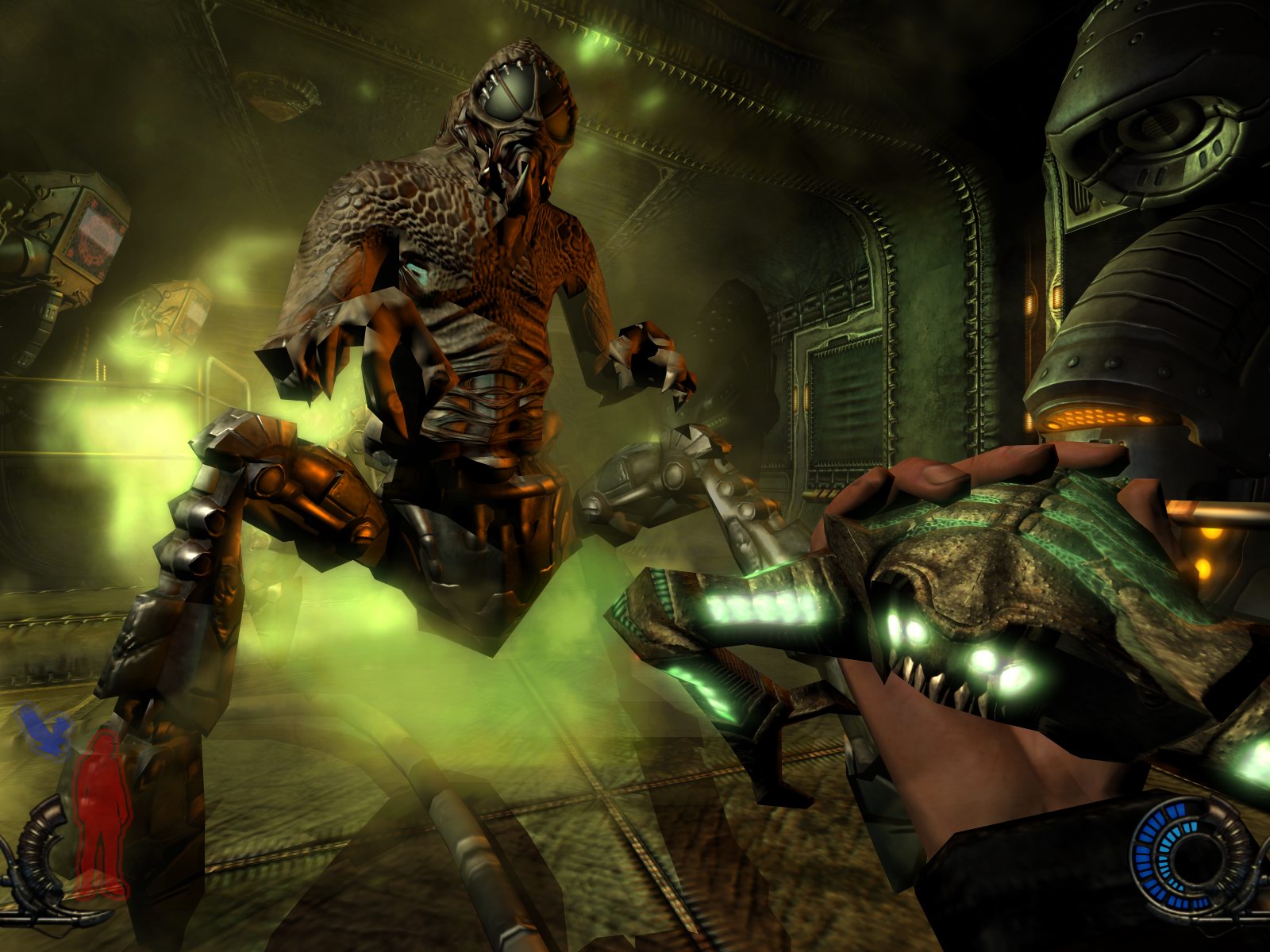

- Linkedin / Twitter posts by Scott Miller - September 27th 2024↩︎
- Shadow Warrior Source Code Released - 3D Realms, April 1st 2005↩︎
- Sneak peek: New Xbox, New Lara Croft - CNN Money, April 6th 2005↩︎
- Innovative First Person Shooter in Development at Human Head Studios - 3D Realms, April 26th 2005↩︎
- Prey Announced - 3D Realms, April 26th 2005↩︎
- Q&A - First Details on the New Prey (page 1 and page 2) - Gamespot, May 11th 2005↩︎
- Prey Q&A - 3D Realms, May 12th 2005↩︎
- Official Prey Video Now Available! - June 3rd 2005↩︎
- Scott Miller talks Prey - Computer and Videogames, September 19th 2005↩︎
- TOMMY TAWODI Trademark - Serial Number 78726394 - Justia Trademarks↩︎