 This article has a talk page!
This page details pre-release information and/or media for Knuckles' Chaotix.
In contrast to the other Genesis-era Sonic games, whose development processes have been thoroughly documented, the story of Knuckles' Chaotix's development remains somewhat enigmatic in spite of the number of available prototypes. The few details that are available point to a troubled development with platform changes and scope reductions, although the game itself doesn't seem to have undergone many drastic changes to its design and gameplay throughout the process.
Timeline#
1994
- January - Development begins, according to CVG's coverage of Winter CES 1995.
- April 1 - A prototype of Sonic Crackers/Sonic Stadium is built.
- May 17 - Sonic Stadium is mentioned in the script of Sonic Mars as a future Sega product.
- June - A prototype build of Yuu Yuu Hakusho: Makyou Toitsusen is built that contains Field sprites for Tails and Sonic that are not in the available Crackers build, although it is likely that the data comes a bit earlier.
- Unknown - Development shifts to the Sega Saturn, according to Tom Kalinske, although other evidence (read below) suggests that it may have only existed in concept form.
- Unknown - Crackers is canceled due to issues with Sega of America, according to Masato Nishimura.
- Unknown - The decision is made to scale the game back and release it on 32X, which may be the "cancellation" that Nishimura refers to.
- June - "Sonic Chaotix" is listed as an upcoming 32X title in the June 1994 issue of Spanish magazine Hobby Consolas, putting into doubt Kalinske's claim that there was a proper Saturn build.
- October/November - The first major reports of a Sonic game for the 32X begin to appear in magazines, with EGM referring to the game as "Sonic Chaotic".
- December 7 - The earliest available 32X build is built.
- December 16 - Clint Dyer's Sonic & Knuckles walkthrough he wrote for Sega of America makes another reference to Sonic Chaotic.
1995
- January 6-9 - Knuckles' Chaotix makes its public debut at Winter CES 1995.
- April 20 - Knuckles' Chaotix is released in North America.
- April 21 - Chaotix is released in Japan.
- May 1 - Knuckles' Chaotix is released in Europe.
Character Origins#
An interesting aspect of Chaotix is the origins of the playable roster - aside from Knuckles, three of the four are known to have been repurposed from other projects.
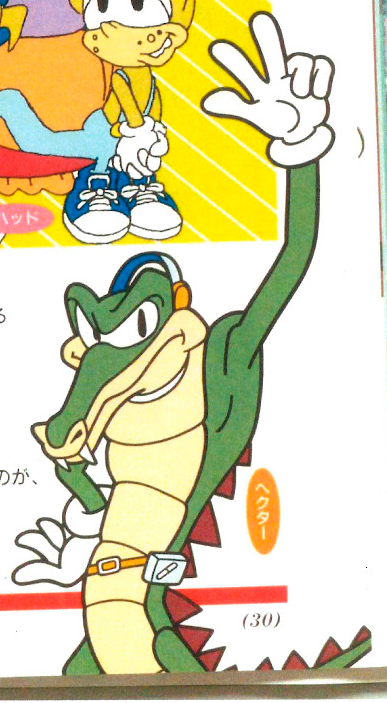
Vector the Crocodile was created for the original Sonic the Hedgehog as part of the "Sonic the Hedgehog Band" that would've appeared in the sound test. Vector's design as it appears in Chaotix was finalized sometime in 1992 and briefly appears in Shogaku Ichinensei's Sonic the Hedgehog manga series.

Charmy Bee debuted in Pops Out of the Time Box Whenever There's a Crisis!, which was published in September 1992 as the sixth manga strip featured in Shogaku Ninensei's Sonic the Hedgehog manga series. This makes Charmy the second Sonic character who appeared in the Sonic games after being introduced in the Sonic manga, following Amy Rose in Sonic the Hedgehog CD.
In a 2018 interview, Sonic's co-creator Naoto Ohshima confirmed that he designed Vector and Charmy, which is why he is credited for "Original Character Concept" in Chaotix.

Mighty's origins are by far the most well-known, as he appeared in an actual Sonic game before Knuckles' Chaotix, the game in question being 1993's arcade-exclusive SegaSonic the Hedgehog. He would end up replacing Sonic in the finished Chaotix after Sonic and Tails were removed.
Espio the Chameleon appears to be the only character specifically created for the game, having been designed by the chief graphic designer, Takumi Miyake. He was the last character to be implemented, with leftover data in prototypes suggesting that he didn't exist during the Genesis phase of development. It's possible that he's based on early concepts of the character who ended up becoming Knuckles - an April 1993 document about Knuckles describes him as having the abilities to run up walls and create whirlwinds, which matches Espio's behavior in Chaotix, rather than gliding and climbing.
Additionally, Bomb appears to have been based on the identically-named Bomb badnik from the original Sonic the Hedgehog. While his final appearance is quite similar to the badnik, his Combi Catcher icon in the 1207 Prototype is identical to the badnik design, seemingly confirming this origin.
(Source: The Untold History of Japanese Game Developers: Volume 3)
Genesis Phase#
Concept Art#
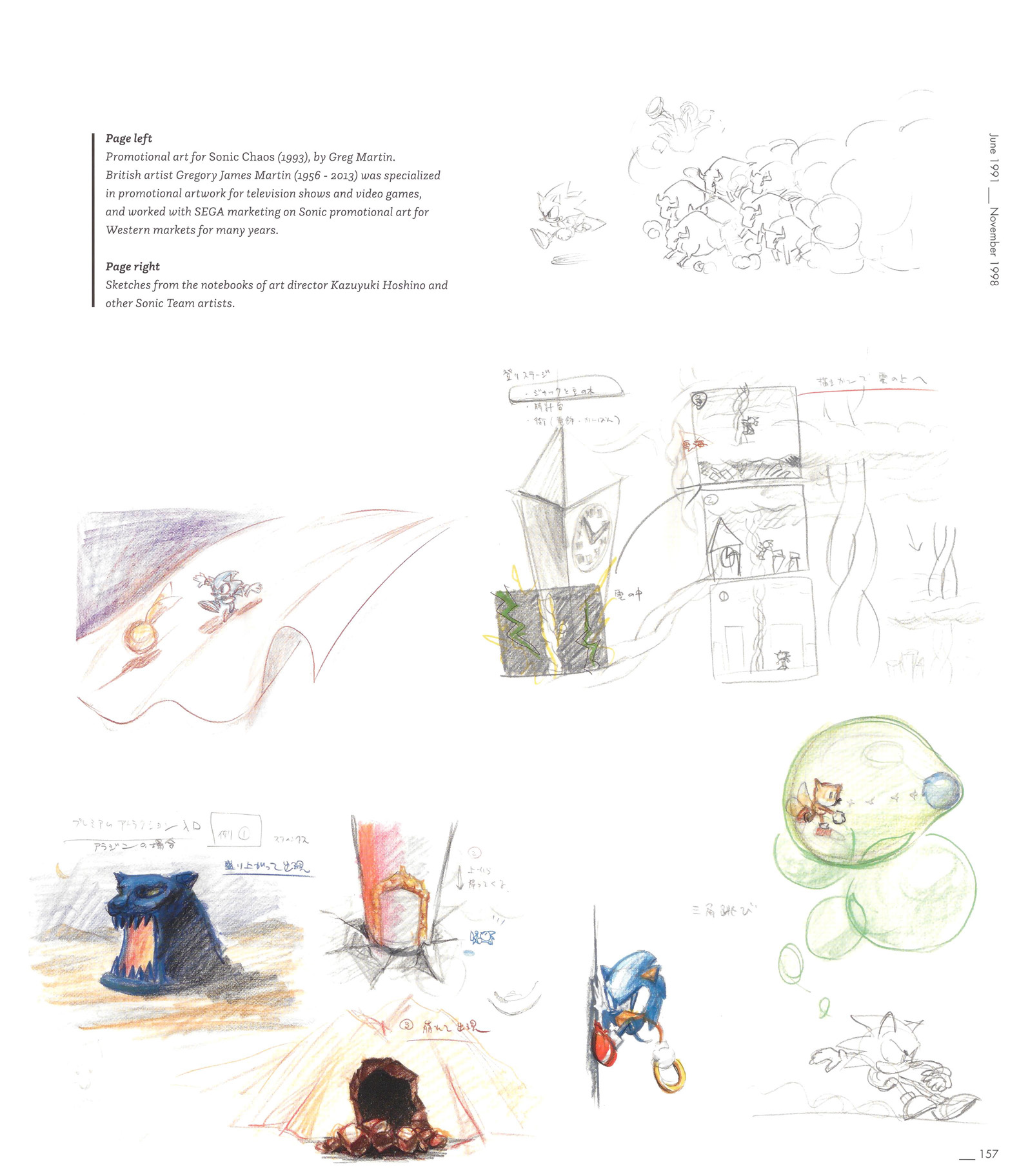
Includes Sonic doing a wall jump, several places that aren't in Chaotix or Crackers, and a stage based on Jack and the Beanstalk at the top-right of the page. At the bottom left, there is concept art of how "Premium Attractions" would be entered. The 1st example states that a sphinx would rise from the ground, and it notes that this idea is from Aladdin. The 2nd example has a pillar falling from the sky, and in the 3rd example, rocks crumble down to reveal an entrance. It's unknown what the "Premium Attractions" would have actually been like, as they're only referenced by name in the prototype's level select.
(Source: Sonic the Hedgehog 25th Anniversary Art Book)

A printout of what appears to be a digital illustration of Sonic, in the same style as the final game's character artwork.
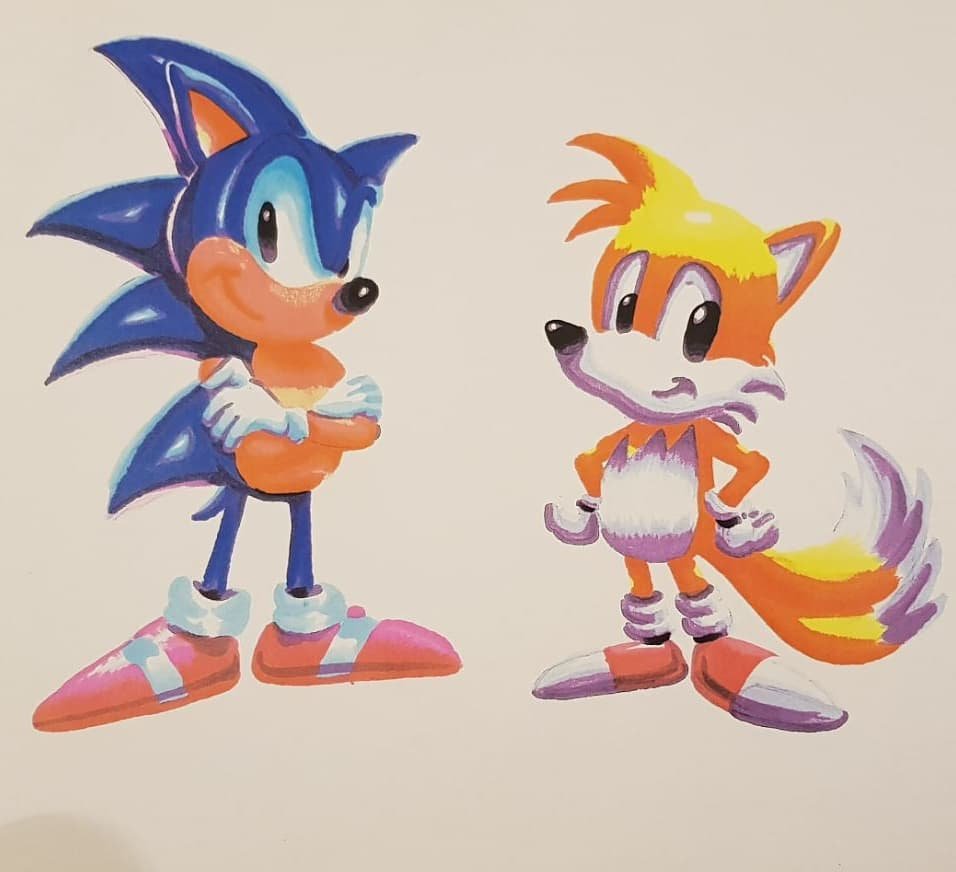
Looks to be basic artwork of Sonic and Tails drawn with marker, based on their artwork on the Sonic 2 US box.
Special Stages#
In 2011, Masato Nishimura revealed that the Special Stages in Crackers were to feature wireframe polygons, similar to Chaotix after a complete run - there, the flat surfaces become wireframes, serving as a "hard mode" where the player can win 50,000 points.
Saturn Phase#
Not much is known about what form Chaotix took when it intended as a Saturn game. Tom Kalinske recalled the Saturn phase of development in a 2011 phone interview:
"Yeah I remember it. It was another one of these things where we just needed titles, because we didn't have enough. The original game was long and it was taking too long to get done, so the decision was made to cut it into parts and introduce it quickly on 32x and that was a simple decision because there were too many needs to have more products on the 32X, it wasn't going to be ready on Saturn, it was too big, it was taking too long, it was over budgeted, it was behind schedule — all those reasons."
-Tom Kalinske, when asked about the Saturn phase of what would become Knuckles' Chaotix 3
drx, responsible for the releases of many Sonic game prototypes and the conductor of the Kalinske interview, corroborated that Chaotix was indeed a Saturn game at one point and a prototype build did exist at one point:
"What ended up as Knuckles Chaotix was at first a true Sonic 2D game (think Sonic 4) for the Sega Saturn. It was instead ported to the 32x and Sonic & Tails were cut and the rest is history. I know this from talking to people involved in Sonic Saturn / Chaotix developers. The sad part, I almost snagged a Saturn proto of this, but it was sadly lost."
-drx on Sonic Retro
Whether Saturn builds of Chaotix actually exist remains the subject of debate, as recollections of a Saturn version come from Sega of America employees who were not directly involved in the game's development. In 2022, Nishimura denied it was ever developed for the Saturn, and drx said it was possible it was only conceptualized for the Saturn and never entered full development.
32X Phase#
After development shifted to the 32X, the game was still seemingly going to feature Sonic as the main character for a brief period, as reports of a 32X Sonic game titled "Sonic Chaotix" or "Sonic Chaotic" surfaced in mid-1994.
According to a former Sega of America employee, the decision to turn Chaotix into a Knuckles spin-off was made after Sega of Japan management nearly canceled it but came to an agreement with Sega of America to release it as a spin-off on the 32X. SoJ lacked confidence that the game would be well received due to the tethering mechanics and feared that releasing it as a major Sonic title would (control your laughter) damage the franchise's reputation. Sega of America fought to keep Sonic in the game, but was ultimately only successful in retaining Metal Sonic as a side character. In the final game, Sonic and Tails only appear during the Good Ending credits roll.
(Source: drx)
Pre-1207 Builds#
SuperJuegos #33 (Cover-dated January 1995)#
This issue, probably published towards the end of 1994, contains the earliest known prerelease coverage of Chaotix.
|
SuperJuegos |
1207 Proto |
|---|---|
|

|
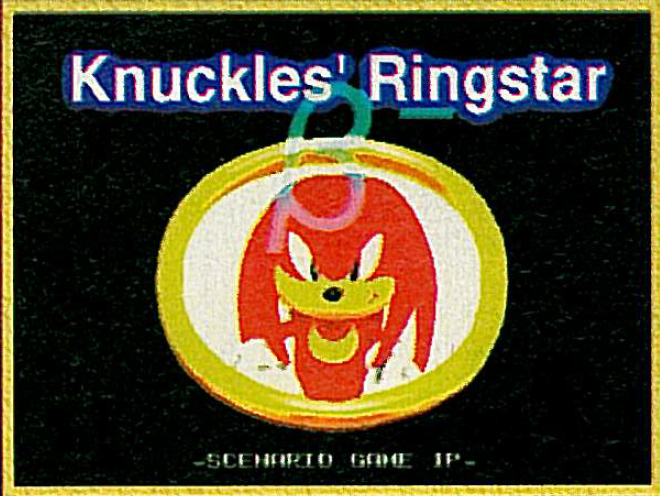
At this point in development, the game's international title was "Knuckles' Ringstar" and it seems to have had a very crude title screen almost devoid of shading and a background. Notably, the Greek symbol for "beta" (β) is present, though it's not certain whether it's part of the title screen or something added in by the magazine. However, because of the outlined Helvetica as an early logo and the incredibly crude Knuckles, it's entirely possible that most of the title screen is a mockup by the magazine in an attempt to make it look good for coverage, as the only thing that doesn't look like a mock-up is the Scenario Game 1P text at the bottom (which is tinted green in this build compared to the 1207 prototype).
|
SuperJuegos |
1207 Proto |
|---|---|
|

|
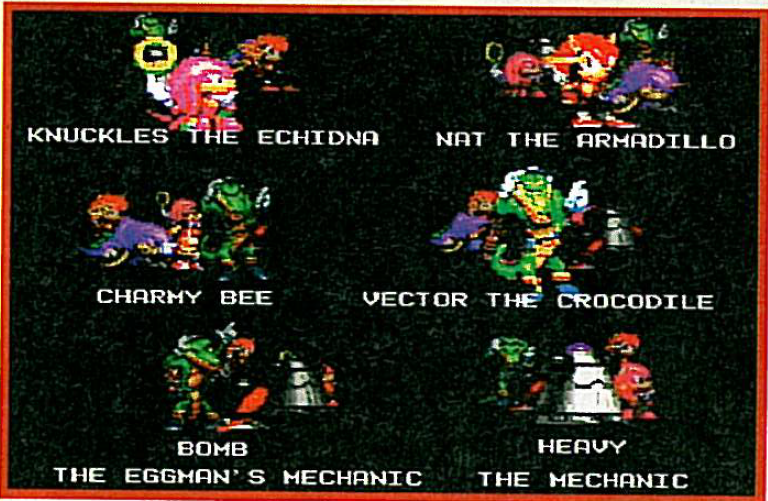
The character select screen is similar to the one seen in the 1207 prototype, though Mighty the Armadillo is called "Nat" here, presumably his original name. Given the way the characters move around, it is likely this is a composite made by the magazine highlighting each character and taking screenshots.
Also, Heavy is listed as "Heavy the Mechanic", rather than "Heavy the Eggman's Mechanic" as it would by the 1207 build.
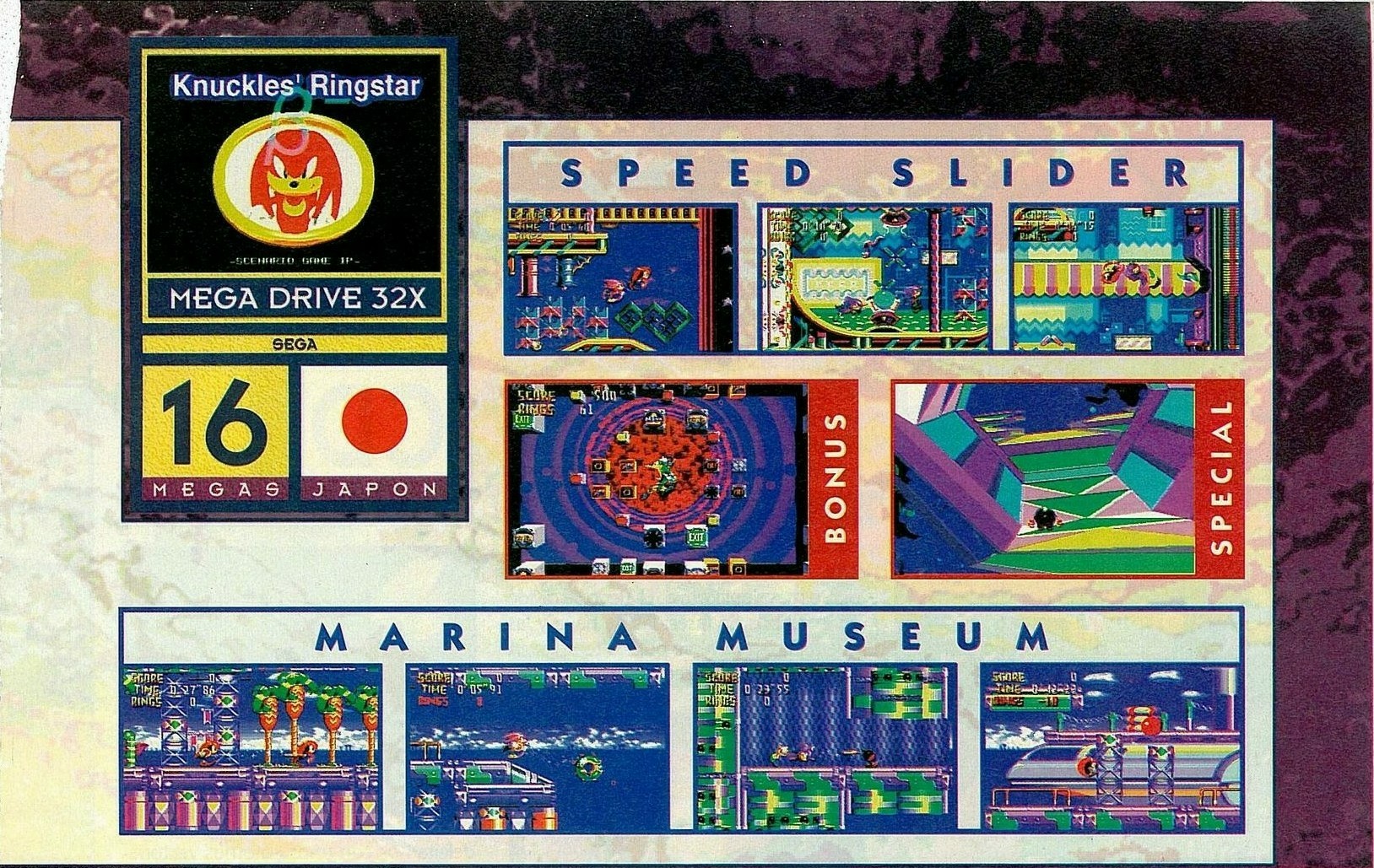
Marina Madness is listed in the article as "Marina Museum". Given that the 1207 prototype contains the alternate name "Marina Drive" in places, it suggests that there was a lot of renaming going on at this point.
TodoSega #23 (Cover-dated February 1995)#
Appears to be using a different build, or at the very least broke an information embargo. The pages themselves don't seem to have any noticeable differences, but the article text reveals that the build used by TodoSega had a playable Tails!
Image |
Translation |
|---|---|
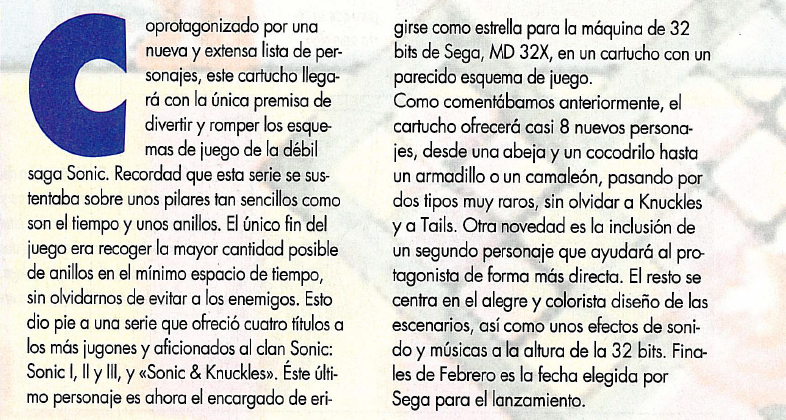 |
"Co-starred by a new and extensive list of new characters, this cartridge will arrive with the only premise to amuse and break the game layout from the weak Sonic saga. Remember that this series was standing on pillars as simple as time and some rings are. The only goal of the game was to collect as many rings as possible in the least amount of time, not forgetting to avoid enemies. This gave birth to a series that offered four titles to gamers and fans of the Sonic clan: Sonic I, II and III, and «Sonic & Knuckles». This latter character is now the one in charge of becoming a star for the 32 bit machine from Sega, MD 32X, in a cartridge with a similar game layout. |
Hobby Consolas #45 (Cover-dated June 1995)#
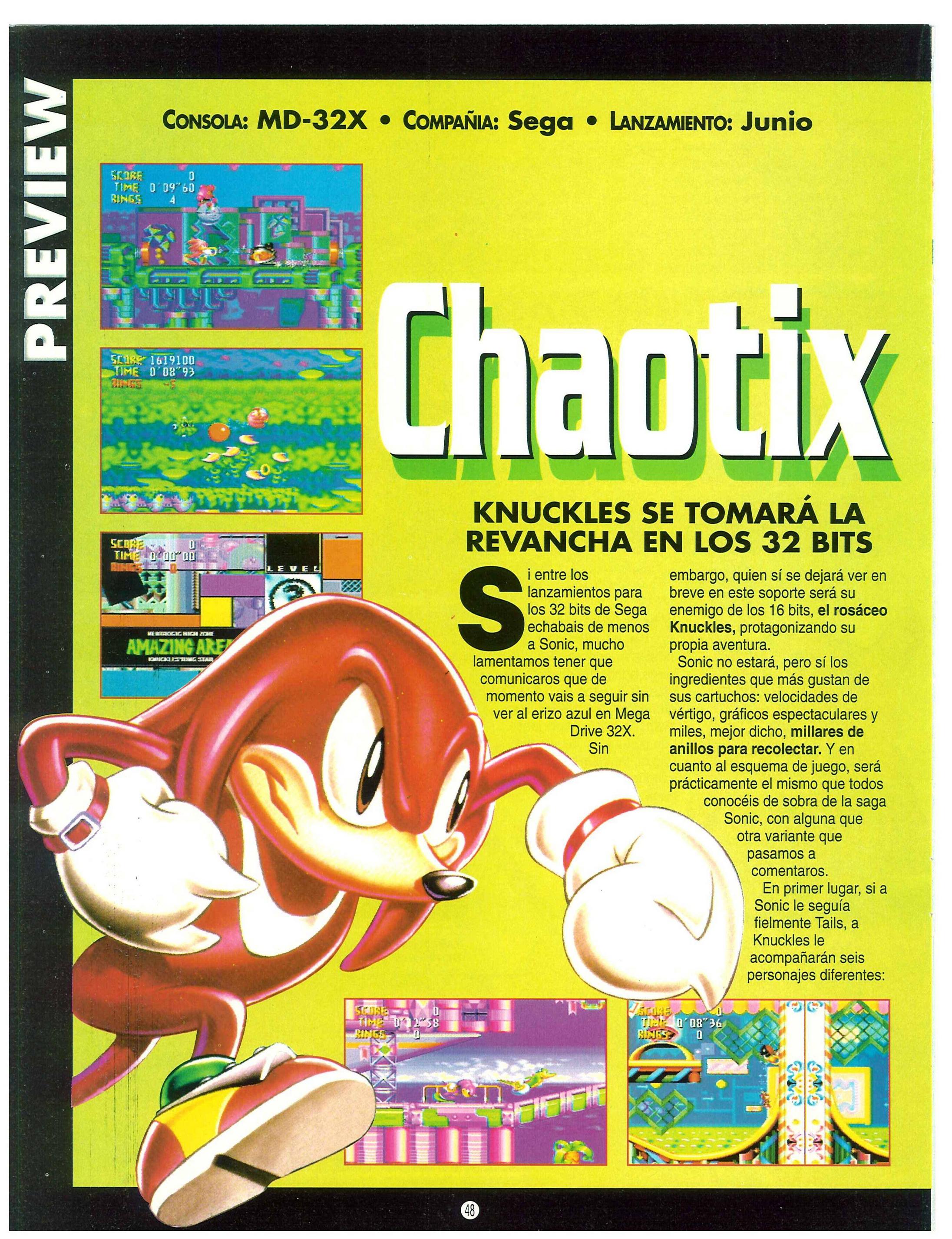
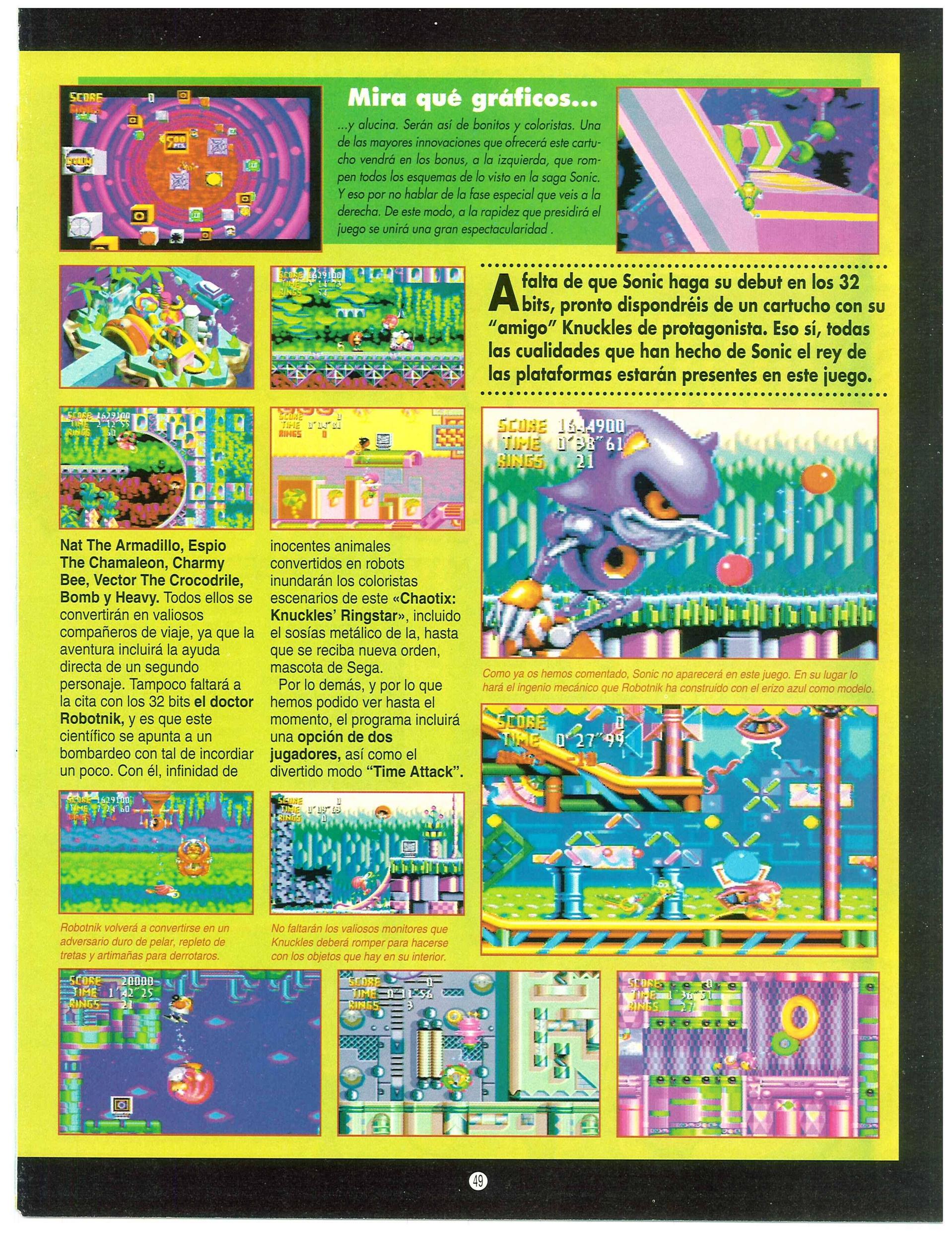 Appears to be the same build covered by SuperJuegos, as evidenced by identical differences referred to in text.
- The game is alternately referred to as "Chaotix", "Knuckles' Ringstar", and "Chaotix: Knuckles' Ringstar".
- The article text still refers to Mighty as "Nat". All other character names are essentially finalized.
- The title card seen on the first page refers to the game as "Knuckles' Ring Star". Also, based on the spacing and letter shapes, the level name would appear to be "Amazing Area" rather than Amazing Arena. The 1207 prototype uses the name "Amazing Zone" in some places.
The Name of the Final Boss#
Information about the seemingly unnamed giant red Metal Sonic would be revealed by the illustrator, Ryo Kudou. During development, he and the programmers would jokingly refer to the boss as "Devil Sonic" in reference to the Devil Gundam from Mobile Fighter G Gundam. However, the internally designated name of the character was "Death Metal Sonic". It is unknown if the name "Death Metal Sonic" was used anywhere in public following the game's release.
(Source: Ryo Kudou on Twitter (4))