 This article has a talk page!
This page details pre-release information and/or media for Alice: Madness Returns.
Subpages#

Development Timeline#
2009
- February 19 - At the D.I.C.E. Summit, EA announced a new Alice game to be in development with the working title The Return of American Mcgee's Alice.
- Unknown date - The game's title changed to American Mcgee's Alice 2.
2010
- June 15 - EA filed a trademark on the name Alice: Madness Returns.
- July 20 - The game's first official teaser trailer is shown at EA's Studio Showcase along with its finalized title. It would come out on PC, PS3 and Xbox 360 with a release window aimed for 2011.
- September 15 - A new CG trailer was unveiled at Tokyo Game Show 2010.
2011
- February 14 - A third CG trailer was unveiled at MSNBC's "In-Game" website.
- March 4 - A new trailer was released showing gameplay footage for the first time, along with a release date set for June 14.
- March 8 - A playable demo was shown off at GDC 2011, with a first look of the Queensland domain.
- April 10 - New gameplay footage was shown through Gamespot in an interview with EA's executive producer, Joel Wade.
- June 2 - Launch trailer for the game gets released, showing more gameplay for the last time.
- June 14 - Alice: Madness Returns releases in North America.
- June 16 - Alice: Madness Returns releases in Europe.
- June 21 - Alice: Madness Returns releases in Japan.
Early Trailer#
Watch on YouTubeOn May 1st, 2017 American Mcgee released a trailer of what appears to be an early build of the game. The trailer is from a development period when the game was titled "American Mcgee's Alice 2", and there are numerous differences in it.
- The London storyline was initially going to be larger. Alice would be wanted for the murder of someone and she would be chased throughout the city by the police.
- Alice's burning house was originally in the streets of London rather than in Hyde Park.
- The transition to Wonderland is different. While she is chased by the cops, Alice accidentally falls off the roof onto the pavemenet of the street below, presumably hitting her head in real-life.
- In the London segments, there would be sneaking mechanics like Alice shifting around ledges. Other actions involve closing doors during chase scenes, sliding on rooftops and walking across pipes attached to buildings.
- Originally, Alice would have more abilities like swimming underwater and dashing through breakable walls.
- The White Rabbit was planned to appear in the Vale of Tears and would guide Alice throughout the level.
- Different level design for London and Wonderland.
- Besides the Vorpal Blade, Alice's initial weapons were different. These were based upon tarot cards and her dress's color would change depending on the weapon she equipped.
- Different UI. There is no health bar and there are four slots with symbols that correlate with Alice's tarot weapons.
- Alice could shoot small beams through the Vorpal Blade and ammo would fill up whenever an enemy was killed.
- The Dodo seems it would have a different role in the game. An NPC perhaps?
- Unused enemies like the Doll Boy and the Automaton 2.0 appear in the trailer.
- Different voice actress for Alice.
Cut Tarot Weapons#
Alice originally had four weapons at her disposal, including the Vorpal Blade. The weapons would be based upon tarot cards and the color of her dress would change depending on which weapon was equiped. Each weapon had two primary attack modes: a ranged attack and another for close combat. The developers however realised that the tarot concept felt too limiting in regards to their ideas. With the addition of new weapons in the roster, the combat system was overhauled and the tarot concept was ultimately abandoned.1
The Cup was a heavy, wooden weapon with a small round exterior and a long and flexible metal chain hidden within it. At long range it could unleash an explosive amount of projectiles at pursing threats, by grinding the end of the Cup. If the enemy was too close, Alice could use the chain attached to the Cup to spin it around at high-speed like a whip. When equipped, Alice's dress would change into a dark purple haze color, with small bits of dust on the apron that reflect the smoke produced by the weapon.
Despite being cut, the Cup's attacks were later separated into two distinct weapons: the Pepper Grinder and another unreleased weapon, the Fire Whip.
The Cup |
Cup Dress |
The Fire Whip |
|---|---|---|
 |
||
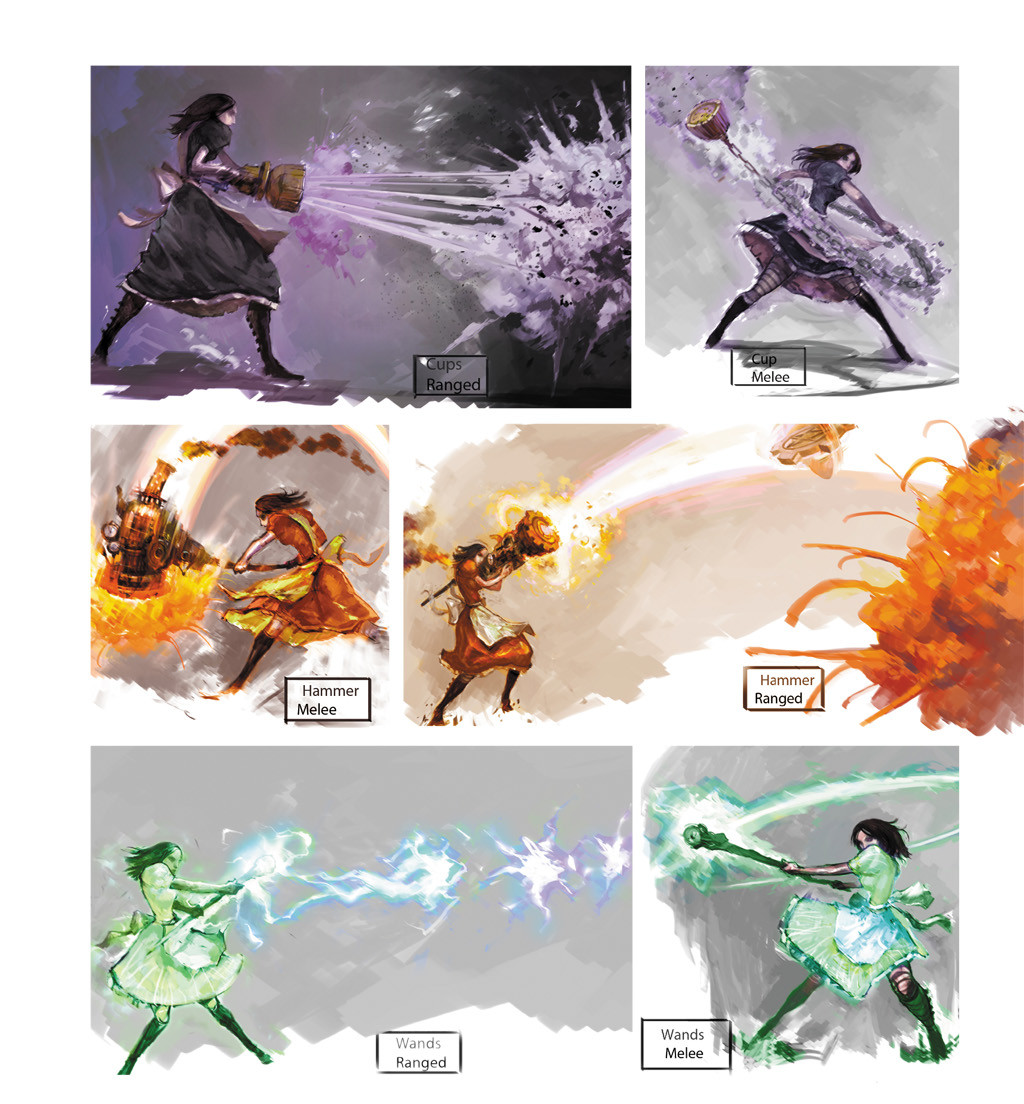

The Hammer was a fire-based weapon that Alice could use to smash her foes by using heavy attacks at close range. Its design is composed of gauges and engines that would help accelerate the power of the user's swing and deliver powerful bursts of fire with its heating metal plate. If Alice was fighting an enemy from a distance, she could transform the Hammer into a long-ranged weapon by adjusting the head's position upwards and launch explosive projectiles at the enemy. When equipped, Alice's dress would change into an orange colored frock which reflected the weapon's elemental nature.
In the final game, the Hammer ended up getting replaced by the Hobby Horse.
The Hammer |
Hammer Dress |
|---|---|
The Wand was an ice-based weapon that could freeze foes to death by producing frost beams at both long and close range. The color of the attack is different between modes: green for melee and light blue for ranged. The Wand looks very similar to the Ice Wand from the first game. When equipped, Alice's dress would change into a light blue and green color which Was reminiscent of the staff's ice beams.
The Wand |
Wand Dress |
|---|---|
Note: In the early gameplay trailer above, the tarot weapons and dresses seem to not match their initial concept designs, making it unclear when were these illustrations made and how much the tarot concept changed during production.
(Source: The Art of Alice: Madness Returns, p. 57)
All-Purpose Umbrella#

According to executive producer R.J. Berg, the Umbrella was initially going to have more involvement during gameplay. It would have served as an "all-purpose, glinding-and-fighting" gadget and Alice would use it in the London segments as well. However due to technical complexities and Alice's possible association with Mary Poppins, the idea was discarded by the developers. In the final game, the Umbrella served as a defensive weapon to deflect enemy projectiles right back at them. 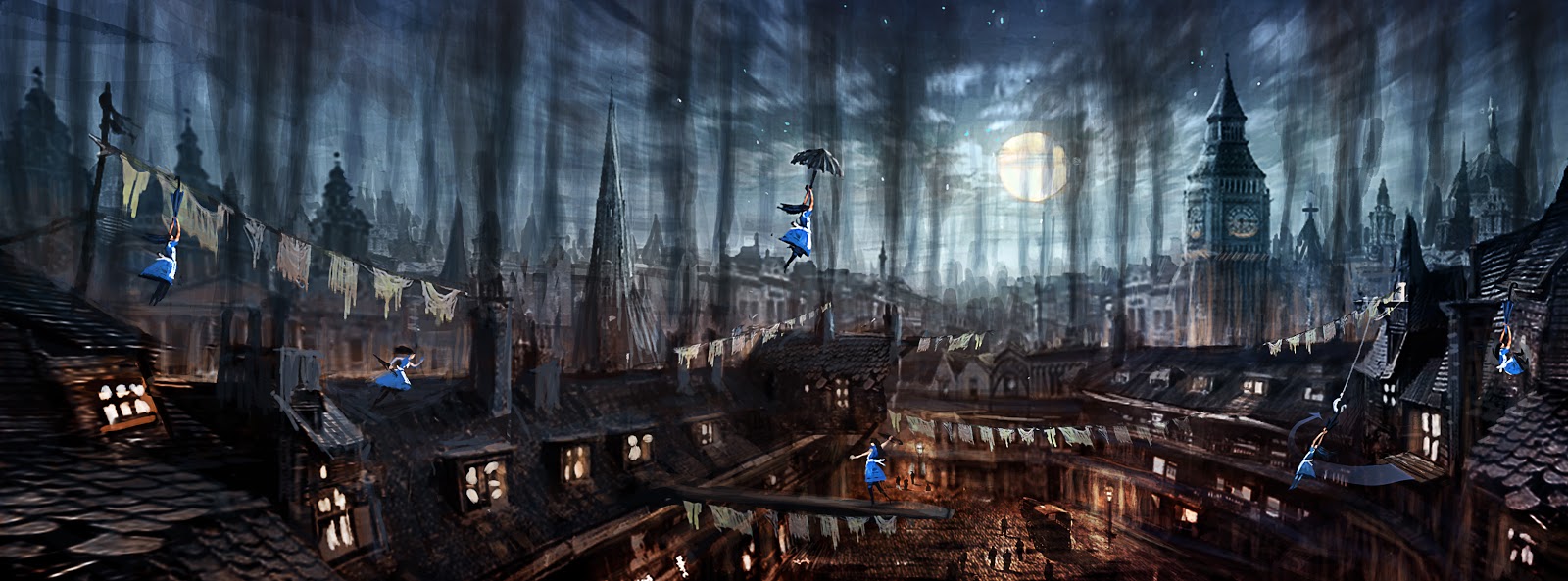
(Source: PSUni.com)
Cut Minigame#

A speed-based minigame was planned at some point. Alice would grind upon a railway and she could either speed up or slow down. In addition, Alice could switch between rails by jumping on the other side of the tracks whenever an obstacle was approaching her.
(Source: The Art of Alice: Madness Returns, p. 53)
References#
- The Art of Alice: Madness Returns, p. 54.↩︎