
|
To do: |
Ultimate Fighter is the Super NES entry of the Hiryuu no Ken series, which attempted to update the series for the post-Street Fighter II era with mixed results.
Passwords#
Ultimate Fighter#

S;.ND— Access the music test menu."ND?NG— View the ending.;N"— Access level 1.TW;— Access level 2.THR""— Access level 3.F;.R— Access level 4.F?V"— Access level 5.D!RG;N— Unknown usage.R?CK— Unknown usage.M!RRY— Enter the first two characters of any legit password and fill in the rest with blanks. After getting the error message, replace the incorrect password with this one to start the stage with 99 magic water bottles.
(Source: FlyingOmelette)
Hiryuu no Ken S#
These passwords work on both versions of Hiryuu no Ken S.
ひりゅうのけん— Access the music test menu.はりけえんきっく— View the ending.みんみん— Enter the first two characters of any legit password and fill in the rest with blanks. After getting the error message, replace the incorrect password with this one to start the stage with 99 magic water bottles.ふうずふう— Unknown usage.あびせげり— Unknown usage.
(Source: http://urawaza.in/sfc/hiryus.htm)
Version Differences#
Hiryuu no Ken S: Golden Fighter was the original version of the game released in Japan in 1992. It was quickly discontinued and replaced by a slightly improved version titled Hiryuu no Ken S: Hyper Version, which was released four months later. Hyper Version differs from Golden Fighter by increasing the playing speed and adding more options. The American version, which was released in 1993 and was titled Ultimate Fighter (likely to cash-in on the yearly Ultimate Fighting Championship event that started the same year), carries over the improvements from Hyper Version while adding further changes of its own, essentially serving as a third version of the game.
Title#
Japan |
|
|---|---|
Golden Fighter |
Hyper Version |
 |
 |
Aside from the title change, Hyper Version changes the background color from black to blue in a matter similar to Street Fighter II′: Champion Edition. The same blue background was used for Ultimate Fighter.
Game Modes#
Japan |
|
|---|---|
Golden Fighter |
Hyper Version |
 |
 |
Golden Fighter has three immediately available game modes (Story, Animation and Vs. Tournament), plus a hidden fourth one by going to the password screen and entering the word たいけつ (showdown). In Hyper Version, the fourth mode is accessible from the main menu and the password required for it was disabled as a result. The color for the background was also changed from green to blue in Hyper Version, although the Golden Fighter logo was oddly enough left unchanged.
In Ultimate Fighter, the order of the game modes were shuffled in order to make Animation Mode (which uses turn-based combats for boss battles) the last option on the menu and the color of the wallpaper was changed back to its original green color.
Japan |
|
|---|---|
Golden Fighter |
Hyper Version |
 |
 |
There were only two difficulty settings in Golden Fighter. This was increased to eight for Hyper Version and Ultimate Fighter.
Japan |
|
|---|---|
Golden Fighter |
Hyper Version |
 |
 |
More options were also added to the Vs. Tournament mode. In addition to the added difficulty levels, Hyper Version also adds the option to adjust the time limit on matches, the handicap of player-controlled characters and the option to watch CPU-only matches (Golden Fighter skips them automatically). Hyper Version also adds the option to allow up to all eight players to use the same character. Ultimate Fighter adds to this with five "turbo mode" settings and a vaguely-named "Cosmic Saucer" option, which is just a mistranslated name for ring-outs (Cosmic Saucer was the name of a projectile attack in Flying Warriors).
Japan |
|
|---|---|
Golden Fighter |
Hyper Version |
 |
|

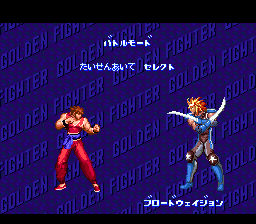
The hidden Battle Mode in Golden Fighter consisted of a simple black screen where you get two options - the first option takes you to any of the 32 boss battles from the game's story mode (each assigned a different hex value), while the second option takes you back to the title screen.
In Hyper Version this game mode was slightly expanded into three screens. The first screen asks you whether you want to start the game mode or return to the main menu. It then proceeds to the same options screen from the Story Mode, followed by an opponent selection screen that actually shows the fighters you can choose. This mode works the same way in Ultimate Fighter, only with the addition of the "Cosmic Saucer" setting on the options menu and the opponents are now ordered in the same order they appear in Story Mode.
Japan |
|
|---|---|
Golden Fighter |
Hyper Version |
 |
 |
The passwords in Ultimate Fighter are much simpler than in the Hiryuu no Ken S due to the switch from hiragana (51 characters, plus diacritic marks for 25 additional voiced consonants) to Roman characters (only 40 characters). The passwords in Ultimate Fighter does not feature vowels (per Nintendo's password censorship policy at the time), but the consonants were not arranged to cover up their omissions. The replacement symbols were instead placed where the vowels should be.
Graphic Changes#
Portraits#
Hiryuu no Ken S |
 |
 |
 |
 |
 |
|---|---|---|---|---|---|
Shoryu |
Wyler |
Ryuhi |
Hayato |
Minmin |
|
Ultimate Fighter |
 |
 |
 |
 |
 |
Jimmy |
Greg |
Rick |
Hayato |
Mary |
The character designs and names of the five main heroes were changed in order to maintain continuity with Flying Warriors, the previous Hiryuu no Ken game that was localized in the U.S. These sets of portraits are used at the start of each chapter, as well as in the status screen.
Only Ryuhi/Rick is playable during the regular side-scrolling and one-on-one segments. During boss battles, the player can switch to any of Ryuhi/Rick's allies with the exception of Minmin/Mary, who isn't playable in her transformed state due to the game designers' inability to include another set of sprites for her fact that she's too injured to transform by the time she joins the player's party in Round 5, which makes her presence in the status screen pretty pointless. However, she's playable in the game's Vs. Tournament mode, where they didn't bother to alter her sprite for the U.S. version like they did for Rick.
Cutscenes#
|
Hiryuu no Ken S |
Ultimate Fighter |
|---|---|
|
|
|


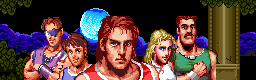
The character design changes extend to the visuals used for the cutscenes, including the abbot at the beginning of the game. Note that they didn't even bother to keep Mary's hair color consistent with her portrait in the final ending group shot.
Transformation Sequences#
|
Hiryuu no Ken S |
Ultimate Fighter |
|---|---|
|
|
|


Like in Flying Warriors, the transformed versions of the player characters were changed from their original Saint Seiya-like designs into more Superman-esque designs. While Jimmy is drawn with more childlike proportions to reflect his young age during his transformation, his actual proportions during battle is the same as the other three Flying Warriors, since he's a sprite/palette-swap of Rick himself.
Sprites#
|
Hiryuu no Ken S |
Ultimate Fighter |
|---|---|

|

|
Other Changes#
- The enemy placement during Story Mode differ significantly between all three versions.
- "Exit" and "Enter" markers were added throughout the stages in Hyper Version. These are also present in Ultimate Fighter.
- In Golden Fighter, you automatically restart a chapter after losing all your lives. In Hyper Version and Ultimate Fighter, you're taking to a game over screen where you can choose whether to restart the chapter or get a password to continue a later time.
- The palette used for some of the enemies and backgrounds in Hyper Version differs compared to the other version.
- Ultimate Fighter features new enemy types and traps not present in either of the Japanese versions.
|
The Flying Dragon/Hiryuu no Ken series | |
|---|---|
|
NES |
Flying Dragon: The Secret Scroll • Hiryuu no Ken II: Dragon no Tsubasa • Hiryuu no Ken III: Gonin no Dragon • Flying Warriors (Prototype) • Hiryuu no Ken Special: Fighting Wars |
|
SNES |
|
|
Nintendo 64 |
|