 This article has a talk page!
This is a sub-page of Teenage Mutant Ninja Turtles: Turtles in Time (Arcade).
Like the prequel, Turtles in Time was first released in the US. Due to the game's slightly unfair nature, the later European and Asian releases addressed the several balance issues of the US version to make the game more accessible to players.
As with most Konami games of the era, two versions of the game exist: the original 4-players version, released in a dedicated monstrous cabinet, and the 2-players version released as a JAMMA conversion kit.
Intro#
|
US/Asia |

|
|---|---|
|
Europe |

|
Yeah, it's this change again. "Ninja" changed to "Hero".
(Source: Original TCRF research)
Title Screen#
|
US/Asia |
Europe |
|---|---|

|

|
The same change also extents in the title screen.
Credits and Player Select Screens#
Credits#
|
2P US |
2P Europe |
|---|---|

|

|
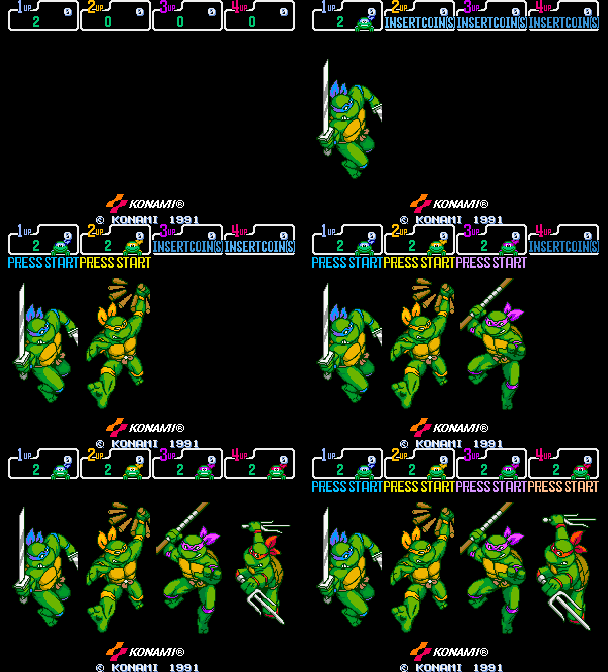
The nature of how the credits system works is different between versions:
- In the original 4 players and US 2 players versions, players have their own credit slot. There is no credit counter, and each coin inserted gives (by default) two extra lives.
- In the European 2 players and Asian versions, players share one credit slot and start with a dedicated number of lives. There is a credit counter that increments each time a player inserts a coin. Compared to the former credits system, players won't receive any extra lives (unless they press Start after inserting a coin). This latter credits system is more accurate to the 2P version of the original Teenage Mutant Ninja Turtles.
The screen above appears before the player select screen in the 2 players version.
Player Select#
|
4 Players |
2 Players |
|---|---|
|
|
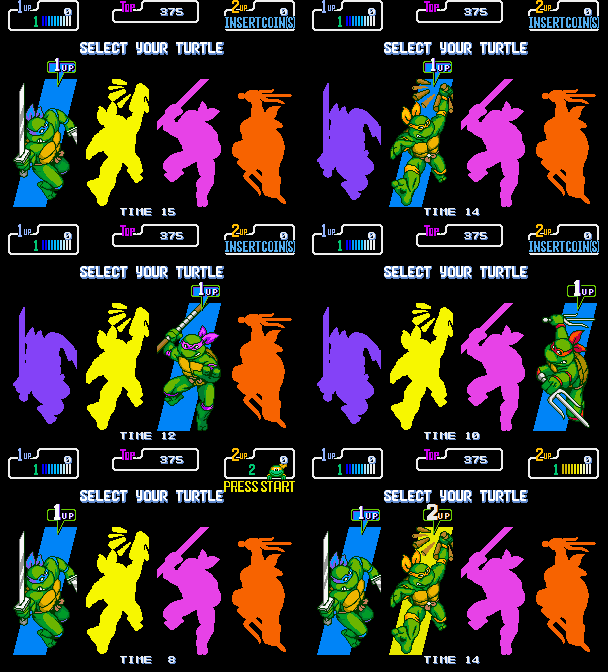
In the original 4 players version, players are automatically assigned a specific TMNT based on their player number, and the game does not begin until the player presses the Start button. In contrast, the 2 players version allows players to freely choose any TMNT within a 15-second timer.
In the 4 players version, the TMNT will zoom in on the screen when a credit is inserted, whereas in the 2 players version:
- The TMNT are already on place.
- Non-highlighted TMNT are depicted as colored silhouettes (purple for Leonardo, yellow for Michaelangelo, pink for Donatello and orange for Raphael).
- The TMNT are higlighted with a Stripe and a cursor above it (blue for player 1 and yellow for player 2).
- The screen is accompanied by this cowa-tastic (cowabunga x fantastic) theme.
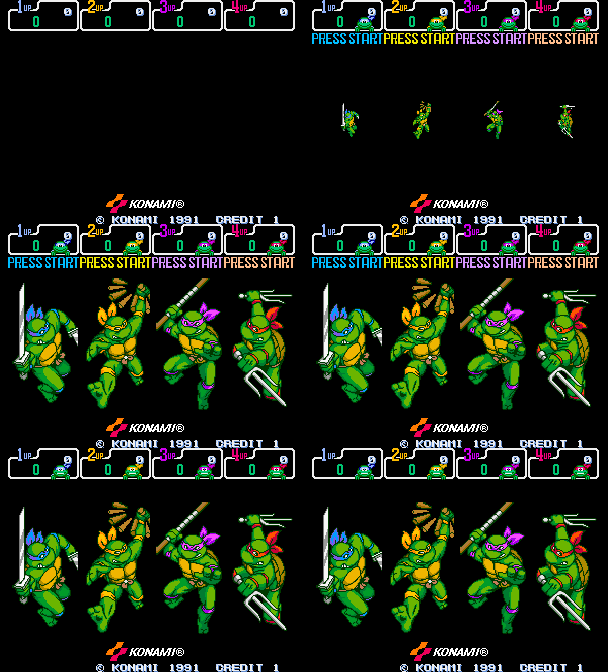
In the Asian version, the TMNT will appear at the same time to compensate the shared credits system explained above.
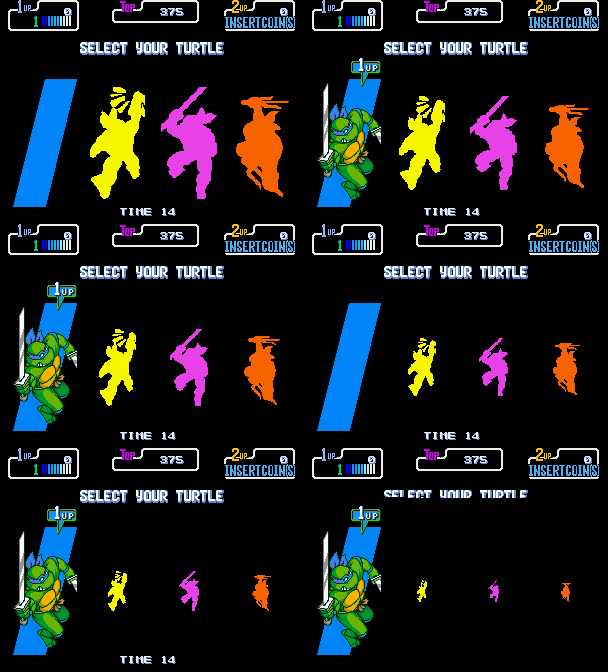
In the 2 players version, the chosen TMNT starts to flash, while the unchosen ones will slowly zoom out off the screen.
Bomb Pizza's duration#
The duration of the bomb pizza's spinning effect was greatly doubled in the European and Asian versions: from 2.5 seconds (170 frames) of the US version, to 4.11 seconds (250 frames).
Level Changes#
The Asian and European versions of the game have extra pizza items that are not present in the US version. Considering how stacked this game can be against the player, they're more than welcome additions:
Stage 3 (Sewer Surfin')#

A bomb pizza was added in between the third and fourth waves of floating spike balls. This pizza is only present in European version, and is the only one that doesn't share a placement with the Asian version.
Stage 4 (Prehistoric Turtlesaurus)#

An energy pizza was added to the cave's entrance.
Stage 5 (Skull and Crossbones)#

An energy pizza was added next to the ship's second mast.
Stage 6 (Bury My Shell at Wounded Knee)#
|
US |
Europe/Asia |
|---|---|

|

|
A bomb pizza was added to the first "U.S. Mail" car, replacing the TNT crate that was present here in the US version.
Stage 8 (Starbase - Where No Turtle Has Gone Before)#

An energy pizza was added right before the battle against Krang, in between two electricity turrets.
Game Options#
|
US |
Europe/Asia |
|---|---|

|

|
The loop setting can be changed to GAME OVER AFTER FINAL STAGE to make the game end after completing the final stage in both versions.
The US version is set to GAME LOOPS ENDLESSLY by default, meaning it will loop back to stage 1 after the credits roll and will continue until all players run out of money, patience, or time and choose to not continue.
The European and Asian versions replace the "loops endlessly" setting with GAME OVER AFTER SECOND ROUND, which causes the game to end after its second loop, similar to most Konami's games of the era, like Sunset Riders, Asterix, X-Men and Violent Storm.