 This article has a talk page!
This is a sub-page of Super Smash Bros. Brawl.

|
This needs some investigation. |
Like the previous Super Smash Bros. games, there's quite a few regional differences. However, this time they're only aesthetic, probably for (now defunct) Wi-Fi compatibility in-between versions.
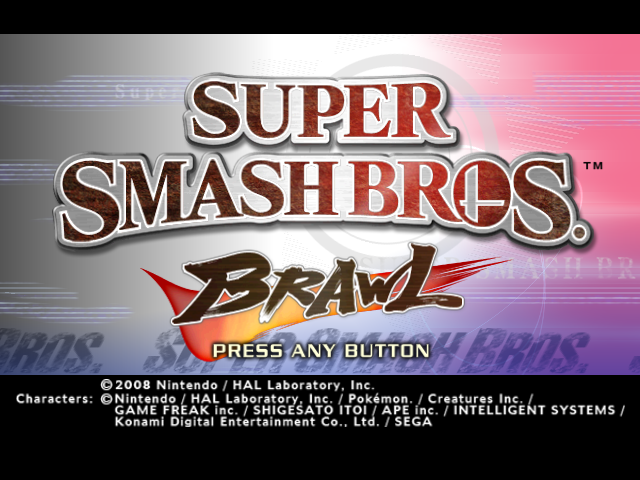
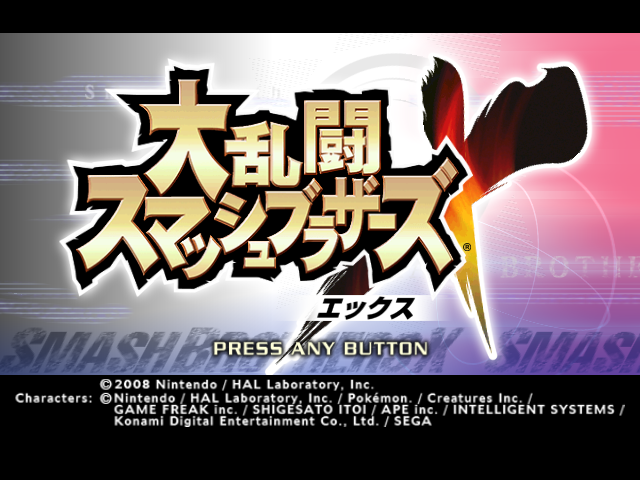
Title Screen#
International |
Japanese |
Korean |
|---|---|---|
 |
 |
 |
- In Japan and Korea, the game is called "Dairantou Smash Bros. X" and "Daenantu Smash Bros. X" respectively, and the logo's title is arranged differently, with a big, stylistic "X" in the back right of the series' logo.
- The text in the background of the Japanese and Korean title screens says "SMASHBROTHERSX". In non-Asian versions, it says "SUPER SMASH BROS."
- The copyright year in the Korean version is changed from "2008" to "2008-2009", due to it releasing over 2 years after its Japanese release there.
Save Data Icon#
|
US/Europe |
Japan/Korea |
|---|---|

|

|
The save data icon from the Japanese and the Korean version has an "X" on the Smash logo.
Character Names#
- Names for all Pokémon species are in all caps in European versions, to match the core series games at the time.
English |
Japanese |
|---|---|
- Jigglypuff is named Purin, its Japanese name, in the Japanese and Korean versions.
English |
Japanese |
|---|---|
- Similarly, Squirtle, Ivysaur and Charizard are named Zenigame, Fushigisou and Lizardon in Japanese and Kkobugi, Isanghepul and Rizamon in Korean, respectively.
- The character name font displayed under the damage counter in Brawls is noticeably squished in the Japanese version, with names like Meta Knight & Zero Suit Samus being confined to one word for consistency's sake. The font was noticeably altered in localized versions to allow the names to be properly spaced out.
- Donkey Kong & Diddy Kong are simply referred to by their first names in the Japanese version, the "Kong" suffix only being added in localisation. The announcements remain the same across all regions in spite of this.
- Captain Falcon goes by "C.Falcon" in the Japanese and Korean versions, which he did across all regions in Melee.
- Mr. Game & Watch loses his title in the Japanese release, only being known as "Game & Watch". The announcement remains the same though.
English |
Japanese |
|---|---|
- King Dedede is merely called "Dedede" in Japanese releases, since his title in Japan is "Dedede Daio" (which, while still translating as "Great King Dedede", is clearly a more decorated title reflecting his self-important nature).
- Also, "Dedede" is pronounced "Day-day-day" as opposed to the English pronounciation "Dee-dee-dee".
English |
Japanese |
|---|---|
- The Ice Climbers are referred to in singular form in Japanese releases ("Ice Climber").
English |
Japanese |
|---|---|
- Olimar's character announcement calls out "Pikmin & Olimar" in Japan and Korea, but omits the word Pikmin in international releases.
English |
Japanese |
|---|---|
- Pokémon Trainer is pronounced differently between the English and Japanese versions. In Japanese, it's pronounced "Po-kay-moan Trainer" to match Japanese pronounciation.
- The Ice Climbers are referred to as "Eol-eum tagi" in Korean.
- The Korean announcer pronounces "R.O.B." as separate letter rather than pronouncing it as "Rob".
English |
Japanese |
|---|---|
- Bowser is referred to as "Koopa" in Japanese version.
English |
Japanese |
|---|---|
- R.O.B. is referred to as "Robot" in Japanese version.
Stage Names#
Names for stages in the North American version are in all caps. In the European version, they're more grammar-friendly. The Rainbow Cruise stage has been renamed to "Rainbow Ride" in the European version, just like in Melee.
Music Tracks#
Some of the track names for music have different names in the European version, most of which are changed simply because the games they were originally from had different names when they were localized. However, this resulted in a rather unusual typo in one instance.
North America |
Europe |
|---|---|
valign=top style="background-color:black; color:white;" ♪DK Jungle 1 Theme (Barrel Blast)| |
valign=top style="background-color:black; color:white;" ♪DK Jungle 1 Theme (Jet Race)| |
♪Squeak Squad Theme |
♪Mouse Attack Theme |
♪Main Theme (Star Fox) |
♪Main Theme (Starwing) |
♪Main Theme (Star Fox 64) |
♪Main Theme (Lylat Wars) |
♪Dialga / Palkia Battle at Spear Pillar! |
♪DIALGA / PALKIA Battle at Spear Pillar! |
♪The Roost |
♪Brewster's Roost |
♪Shaberu! DS Cooking Navi |
♪Shaberu! DS Oryouri Navi |
♪Brain Age: Train Your Brain in Minutes a Day |
♪Dr Kawashima's Brain Training: How Old Is Your Brain? |
♪Rainbow Cruise (Melee) |
♪Rainbow Ride (Melee) |
♪Kongo Jungle (Melee) |
♪Kong Jungle (Melee) |
Classic Mode#
In the Japanese version, the screen shown before fighting a challenger in Classic Mode has some transparent black English capitalized letters forming the opponent's name, and the character's series symbol (and this is seen before fighting a solo opponent, a team with two opponents, a giant opponent or a metal opponent). This detail is removed in the international versions, even the Korean version.
Challenges#
Some of the challenge windows in the Japanese, North American, and Korean versions cannot be broken via Golden Hammers (notably those opened by completing Boss Battles). The European version allows all windows to be smashed that way, despite the instructions claiming otherwise.
Masterpieces#
- The Japanese version includes playable demos of Fire Emblem: Monshou no Nazo and EarthBound. These two games were removed from international versions, though their names still exist in the code. Monshou no Nazo is also referred to as "Shadow Dragons and the Blade of Light", which is both the name of a different Fire Emblem game as well as a condensed retelling as the first book of Monshou no Nazo (the latter of which was the playable portion).
- Star Fox 64 is renamed to Lylat Wars in the European version as the original had a different name.
- All the masterpieces in the European version play at 50Hz.
Chronicle#
The Chronicle in the North American version goes up to December 2007 and lists more specific dates for more recent games. The European version goes up to March 14th 2008, keeps all dates year-only, alters game titles to their non-American versions, drops some US-centric games (such as the Ken Griffey Jr. baseball games) and adds other games (such as Rare games created before or during the time when Nintendo co-owned the UK-based developer, but which do not involve Nintendo-owned characters such as Donkey Kong). All Virtual Boy titles are listed as "Not released" due to the system not being released in European regions.
Additionally, the Japanese version has an exclusive section for Famicom Disk System games while the Korean version removed the Chronicle option altogether.
Graphics#
Home-Run Contest#
The distance counter in the Home-Run Contest measures in feet in the North American version, whereas in the European, Japanese and Korean versions, it measures in metres.
Deflicker#
|
US/Japan |
Europe/Korea |
|---|---|

|

|
In the North American and Japanese version, the menu icon for the Deflicker option is a capital D among straight lines, but in the European and Korean version, the D is replaced with a circle.
Masterpieces#
|
US/Europe |
Japan/Korea |
|---|---|

|

|
In the North American and European version, the Masterpieces icon is a NES cartridge, but in the Japanese and Korean version, it's a Famicom cartridge.
Sounds#

|
This page or section needs more audio. |
English |
Japan |
|---|---|
As with Super Smash Bros. (not including Melee since, while it does have a similar change to what's seen before, the English version refers to it as "Melee!" in that game), the announcer says "Free-for-all!" in the North American and European versions, and "Battle Royal!" in the Japanese version.
English |
Japan |
|---|---|
Like the previous game, the announcer says "Grab the Coins!" in the North American and European versions, and "Get the Coins!" in the Japanese version.
English |
Japan |
|---|---|
Although the mode is called "Tourney" in the North American and European versions, the Japanese version instead refers to it as "Tournament".
English |
Japan |
|---|---|
The announcer says "Rotation!" in the North American and European versions, and, rather amusingly, "Loser out!" in the Japanese version.
English |
Japan |
|---|---|
While the announcer says "Classic Mode!" in the North American and European versions, it is simply referred to as "Classic" in the Japanese version.
English |
Japan |
|---|---|
While the announcer says "Share Stock!" in the North American and European versions, it's "Share Player Stock!" in the Japanese version.
English |
Japan |
|---|---|
Like Super Smash Bros. Melee, after a Brawl finishes, the announcer says "Game!" in the North American and European versions, and "Game set!" in the Japanese version.
English |
Japan |
|---|---|
Also, the announcer says "Time!" in the North American and European versions, and "Time up!" in the Japanese version.
English |
Japan |
|---|---|
The announcer says "All-Star Mode!" in the North American and European versions, and "All-Star!" in the Japanese version. This is rather interesting, considering that the previous game used the line from the latter in all regions. Nonetheless, this change would later be carried over to the next installment.
English |
Japan |
|---|---|
Basic Brawl is known as "Easy Brawl" in the Japanese version.
English |
Japan |
|---|---|
Spectate mode is called out as "Watch" in the Japanese version.
Other#
- In The Subspace Emissary, in the end of the cutscene "Falco Appears", the music track Airship Theme (Super Mario Bros. 3) starts a few seconds before the cutscene ends. However, in the Korean version, the music starts right after the cutscene ends.