Principais Diferenças#
Title Screen#
Japan/North America |
Europe |
Shindou |
iQue |
|---|---|---|---|
 |
 |
 |
 |
- The SUPER MARIO 64 logo was squashed a bit in the European version and it was completely changed in iQue.
- The "TM" texture has 3 different colors and a different font in Europe, Shindou and iQue (JP/US white, PAL orange, Shindou/iQue blue)
- The copyright info was also updated to reflect the European and Shindou releases, and iQue, in addition, that iQue has an extra copyright year (2003, the year that the iQue was released).
Mario's Head#
US/JP |
EU |
|---|---|
 |
 |
Shindou |
iQue |
|---|---|
 |
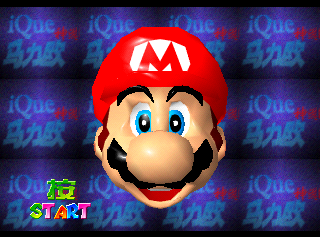 |
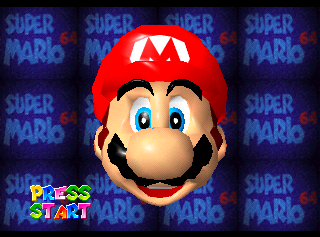
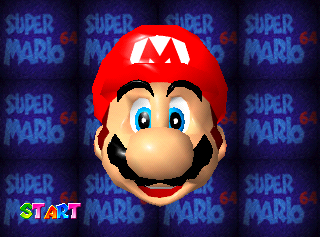
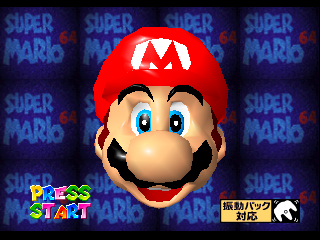
- The intro screen says PRESS START in the US and Japanese versions, but just START in the European version. The Shindou version has a unique graphic on the bottom right of the screen, used to indicate that a Rumble Pak can be used. The background was changed in the iQue version, just to let you know what version you're playing.
Game Over#
|
International |
iQue |
|---|---|
|
|
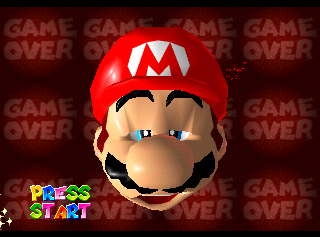
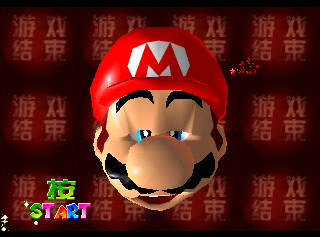
- Speaking of background change above, this one from the "Game Over" screen was also changed in the iQue version.
File Select#
US |
EU |
|---|---|
 |
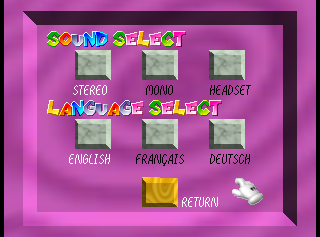 |
- In the European version, the options menu has three different languages, but the American and Japanese versions don't have a language selection, with the options menu containing only sound options and the language being locked into English or Japanese, respectively. Because of this, the European version has the "Sound" button changed to "Options".
JP |
US/EU |
iQue |
|---|---|---|
 |
 |
 |
- In the US/EU version, a Mario's head icon replaces the word "Mario" (マリオ) on the left of letter of which save file high scores belong to.
- The iQue version uses two pages to display score info due to the larger Chinese characters, thus you change between them with L and R, making this the only version of Super Mario 64 to give a function to the L button.
Hud Textures#
|
Versão Japonêsa |
Versão Européia |
|---|---|

|

|
- O ícone de "chave" foi retirado das versões a não ser a japonêsa, com um Ü azul tendo o seu lugar na versão européia e nada na versão americana.
Ä (ae) |
Ö (oe) |
Ü (ue) |
|---|---|---|
 |
 |
|
- Na versão européia as letras com tremas (Ä, Ö e Ü) foram adicionadas. Apesar disso, o Ü não é usado em nenhum lugar do jogo.
- As letras V e Z do alfabeto foram adicionadas de novo na à versão Europa de Super Mario 64.
Peach's Letter#
|
Japan |
English Localization |
|---|---|

|
|
Japan |
Translation |
English Localization |
|---|---|---|
<pre lang=ja style="font-family:"MS Gothic",monospace;">おしろへ あそびに きてください。 ケーキ を つくって まってます。 ーピーチよりー |
|
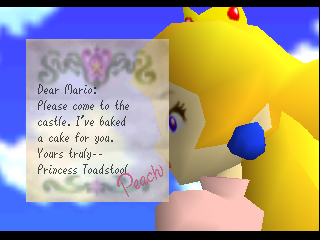
<pre lang=ja style="font-family:"MS Gothic",monospace;">Dear Mario: Please come to the castle. I've baked a cake for you. Yours truly-- Princess Toadstool Peach |
- In Peach's letter to Mario, the English version adds a personal greeting to the beginning and a "Peach" signature in pink ink to the end.
(Source: The Mushroom Kingdom)
Others#
Vozes#
Mario#
Há algumas linhas que não são faladas por Mario na versão japonêsa:
- "Hello!" quando ele aparece durante a introdução do jogo.
- "Okey-dokey!" quando você escolhe uma jogada.
- "Let's-a go!" quando se escolhe uma estrela.
- "Game over." quando você perde todas as vidas.
- "Press START to play." durante a introdução.
- Todos os sonhos sobre macarrão não estão presentes.
- To talk to NPCs or read signs, the player has to press the B button in the original Japanese version. Overseas and in Europe, either the A button or the B button can be used. The text was not changed to compensate for this and still mentions only the B button. The interaction radius has also been made a bit more lenient.
- The American version has code to detect a PAL TV and change its output accordingly, which is odd given there is a separate European version for PAL regions. The Japanese version doesn't have this code.
- In the Japanese version, coins could land on the void and stay there. Later versions despawn any coins that land on the void.
- In the Japanese version, MIPS has the same speed both times he spawns in the basement. In all other versions, MIPS is slightly slower the first time he spawns (at 15 stars). MIPS also has significantly less gravity in the Japanese version.
Peach (Princesa)#
A Princesa Peach não têm nenhuma fala na versão japonêsa original do jogo, ambos no começo e no fim do jogo. Isso foi colocado em todas as outras versões.
Peach (Princesa)#
A Princesa Peach não têm nenhuma fala na versão japonêsa original do jogo, ambos no começo e no fim do jogo. Isso foi colocado em todas as outras versões.
|
Versão Japonêsa |
Versão Americana |
|---|---|
|
|
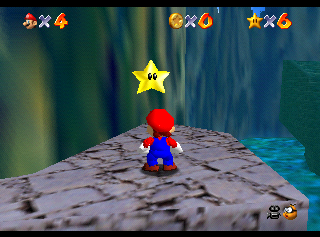
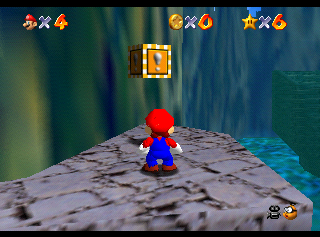
A estrela na pedra está ali normalmente na versão japonêsa, mas está dentro de uma bloco de exclamação amarelo na versão americana. Novamente, todas as versões do remake do jogo para DS têm a posição da estrela igual a versão japonêsa.
|
Versão Japonêsa |
Versão Americana |
|---|---|
|
|
|
A estrela na pedra está ali normalmente na versão japonesa, mas está dentro de uma bloco de exclamação amarelo na versão americana. Novamente, todas as versões do remake do jogo para DS têm a posição da estrela igual a versão japonesa.
Cool Cool Mountain#
|
Versão Japonêsa |
Versão Americana |
|---|---|
|
|
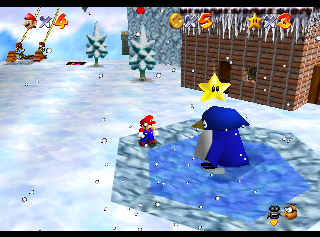
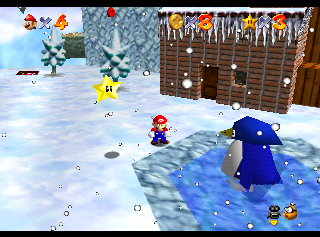
Quando você leva o penguim pequeno a mãe dele, a estrela aparece bem em cima dela na versão japonêsa. Isso foi alterado na versão americana onde a estrela encontra-se perto ao "lago", provavelmente pois a posição original deixa ela em um lugar muito difícil de ser coletada.
Big Boo's Haunt#
When Mario stops touching the tilting platform on the second floor of Big Boo's Haunt, the platform immediately starts to return to its original position in the Japanese version. In the American version, it continues to tilt in the direction Mario was standing for about half a second.
(Source: 1)
Rainbow Ride#
|
JP |
US/EU/JP (Shindou) |
|---|---|
|
|
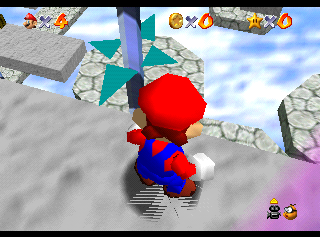
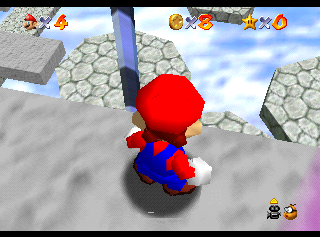
In the original Japanese version, the pole located above one of the four rotating platforms has four small blue arrows around its top, similar to a rose compass. These arrows were removed in all other versions.
Bugs#
Alguns Bugs da versão japonesa foram consertados na versão americana.
The lines of code relevant to this glitch were included in game.c in the July 2020 source code leak. While the glitch has been fixed, the relevant lines have a comment that reads "JPBUG."
if (marioWorks->nlifes > 100)  marioWorks->nlifes = 100;   /* for sefty    */
if (marioWorks->ncoins > 999)  marioWorks->ncoins = 999;    /* for sefty    */  /* JPBUG    */
if (playerMeter.coin   > 999)  playerMeter.coin   = 999;    /* for sefty    */  /* JPBUG    */
Presumably the glitch came from copy-pasting the logic from the first line into the second and forgetting to change one of the variables:
if (marioWorks->ncoins > 999) marioWorks->nlifes = 999; /* OOPS! */
(Source: pannenkoek2012)
- In the Japanese version, when Bowser is defeated and leaves behind the key, run to where the key will land and press C-Up and look somewhere. Mario will keep looking that way during the key collection cutscene.
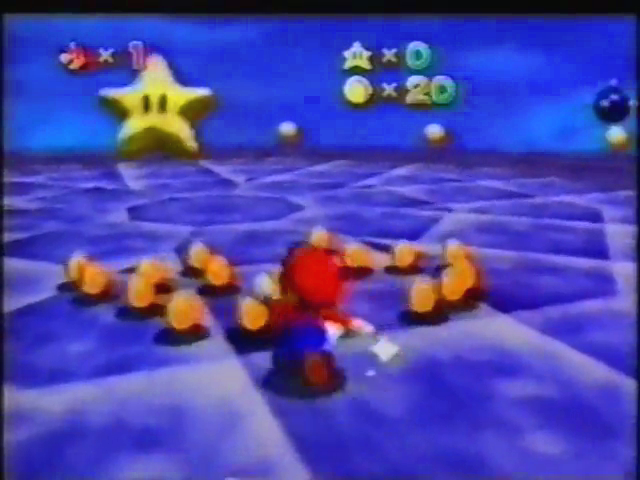
- Further, the key collection cutscene shows a Star instead of a key; early footage (see right) of the first Bowser fight shows him leaving behind a Star upon defeat, suggesting that this is a very old leftover.
(Source: darkeye14)
- In both Bowser in the Sky and Shifting Sand Land's pyramid, it is possible to trigger a bug that causes the music to stop. Attempting to leave the course will cause the game to freeze.
- If you exit a level while on a falling bridge block, upon returning to the castle, Mario will clip through the first thing he stands on.
- An exploit was fixed where the game freezes all surroundings except for Mario himself when a text box is queued up, but doesn't actually check whether Mario can receive the text box (is standing on solid ground), thus allowing to move around in a frozen world where no objects update (collected stars don't disappear, doors don't open, etc.) as long as you stay in mid-air. Notable applications included the cap switches, the boos in Big Boo's Haunt Star 1, and Ukiki in Tall Tall Mountain.
- If you take a warp while racing Koopa the Quick in Course 1 (Bob-omb Battlefield), the race music will change back to the regular course music.
- On the first star of Big Boo's Haunt, there is one Boo in the room with the Mr. I where you get the Star "Eye to Eye in the Secret Room". In the Japanese version this Boo counts towards the five boos required to spawn the Big Boo; if this Boo is killed last, the text box won't show up and the jingle won't play due to the Big Boo downstairs being despawned. The later versions added a check so only the five boos on the lower floors count.
- In the Japanese version, Bowser's collision doesn't despawn when he is defeated at the end of Bowser in the Sky, so Mario will still be able to collide with him as if he were there.
- In the Japanese version, King Bob-omb's velocity is not set to zero when he despawns, i. e. by warping away from the battle. As a result, if you start the battle, warp away using the warp right below him, warp back and then talk to him, he will move away while the text box is up.
- The Japanese version has a camera glitch. If Mario grabs a Wing Cap and triple jumps to take off but dives or ground pounds after the camera moves close but before he actually starts flying, the camera will stay behind Mario as if he were still in flight.
- When Piranha Plants are killed and then despawn during the death animation due to being too far away, the Japanese version will simply interrupt the death animation and patiently wait for the player to return to finish the death animation. Trying to do this in later versions will reset the Piranha Plants.
- Mario takes damage from bumping into a sleeping Piranha Plant in the Japanese version only. In later versions he will not take damage from this action.
- Dying from fall damage while falling into the trigger for the Lakitu cutscene at the very beginning of the game causes a softlock in the Japanese version.
(Source: Super Mario Wiki)
Versão americana para européia
- Na introdução, quando Mario pula para fora do cano, um som é tocado na versão americana. Esse som é muito mais quieto na versão européia, tanto que quase não dá para ouví-lo.
- As portas do Bowser fazem um som diferente de quando abrem para quando fecham na versão americana. Os dois sons são bem parecidos na versão européia.
- O som de quando você pega uma moeda amarela é um pouco diferente na versão européia.
- Quando você para de puxar a cara do Mario na introdução, o som da versão européia está meio mal sincronizado.
US to European
- In the intro, when Mario jumps out of the pipe and the pipe goes back into the ground, a variation of the classic Mario "pipe sound" is heard in the US version. This sound has been made a lot quieter in the European version, almost down to where you can't hear it.
- Bowser's doors have completely different sounds for opening and closing in the US version. In the European version, they sound pretty much the same.
- The yellow coin collecting sound is slightly slowed down in the European version.
- When letting go of Mario's face when playing around with it, the European version's sound is in a lower pitch.
Shindou Pak Taiou Versão#
A fala "Buh-bye!" foi reutilizada para o modo de espera em Super Mario 64 DS e New Super Mario Bros.
It fixes the "backwards long jump" glitch, adds Rumble Pak support, and makes Mario face the screen after grabbing a tree.
The only other difference was Mario's taunt when swinging Bowser far away ("Buh-bye!", rather than "So long, eh Bowser!", or just "Here we go!" in the original Japanese release), as Bowser is named Koopa in Japanese. The "Buh-bye!" clip is slowed down compared to the sound clip in the DS version and the first and second jump sounds are higher in pitch from their international counterparts.
First Jump
Second Jump
"Buh-bye!"
Adição#

Um novo easter-egg foi colocado na tela "Press Start". Apertando o botão Z faz com que o fundo fique cheio de imagens da cara do Mario. Essas imagens são pegas do Frame Buffer, então elas se mexem junto com o próprio Mario.
New Feature#
A neat Easter egg was added to the "Press Start" screen: pressing Z makes the background get filled out with images of Mario's face. This is taken from the frame buffer, so the faces move alongside the modeled Mario face. This is still present in the iQue Player version.
Text Differences#
The Shindou version insists you can use A as an alternative to B for interacting with things. Non-Japanese scripts are based on the original Japanese version. The localized English version is also present to complete the comparison.
Japan |
Translation |
English Localization |
Shindou Pak Taiou Version |
Translation |
|---|---|---|---|---|
<pre lang=ja style="font-family:"MS Gothic",monospace;">おおっと、ここはキケンな せんじょうの どまんなか。 『え』のなかのせかいには クッパが ぬすんだ パワースターがある。 まずは、あかいボムへいに はなしかけてみるといい! Bボタンではなしができる。 きっと、ちからになって くれるはずだ。 カンバンを よむときも たちどまって Bボタン! AかBボタンですすめる! まえにたつだけで はなし かける、どうぶつもいます。 |
|
<pre lang=ja style="font-family:"MS Gothic",monospace;">Wow! You're smack in the middle of the battlefield. You'll find the Power Stars that Bowser stole inside the painting worlds. First, talk to the Bob-omb Buddy. (Press B to talk.) He'll certainly help you out, and so will his comrades in other areas. To read signs, stop, face them and press B. Press A or B to scroll ahead. You can talk to some other characters by facing them and pressing B. |
<pre lang=ja style="font-family:"MS Gothic",monospace;">おおっと、ここはキケンな せんじょうの どまんなか。 『え』のなかのせかいには クッパが ぬすんだ パワースターがある。 まずは、あかいボムへいに はなしかけてみるといい! Bボタンではなしができる。 きっと、ちからになって くれるはずだ。 カンバンは まえにたって AかBボタンでよめます。 まえにたつだけで はなし かけてくれる どうぶつも います。 |
|
<pre lang=ja style="font-family:"MS Gothic",monospace;">このように カンバンの まえで Bボタンをおすと よむことができます。 ノコノコや どうぶつたち と はなすときは、まえに たちどまってください。 このコースにあるクッパに ぬすまれたパワースターを とりかえしてください。 |
<pre lang=en style="font-family:"MS Gothic",monospace;">You can read a sign by standing in front of it like this and pressing the B button. To talk to Nokonokos and other creatures, stand in front of them. Please recover the Power Stars stolen by Koopa that are hidden in this course. |
<pre lang=en style="font-family:"MS Gothic",monospace;">To read a sign, stand in front of it and press B, like you did just now. When you want to talk to a Koopa Troopa or other animal, stand right in front of it. Please recover the Stars that are stolen by Bowser in this course. |
<pre lang=ja style="font-family:"MS Gothic",monospace;">このように カンバンの まえでAかBボタンをおし よむことができます。 ノコノコや どうぶつたち と はなすときは、まえに たちどまってください。 このコースにあるクッパに ぬすまれたパワースターを とりかえしてください。 |
<pre lang=en style="font-family:"MS Gothic",monospace;">You can read a sign by standing in front of it like this and pressing the A or B button. To talk to Nokonoko and other creatures, stand in front of them. Please recover the Power Stars stolen by Koopa that are hidden in this course. |
<pre lang=ja style="font-family:"MS Gothic",monospace;">『ピーチの おしろ』
Aボタン『ジャンプ』 Zボタン『しゃがむ』 Bボタン『カンバンよむ』
もういちどおす『なげる』 |
<pre lang=en style="font-family:"MS Gothic",monospace;">Peach's Castle
A Button - Jump Z Button - Crouch B Button - Read Signs
|
<pre lang=en style="font-family:"MS Gothic",monospace;">Princess Toadstool's castle is just ahead. Press A to jump, Z to crouch, and B to punch, read a sign, or grab something. Press B again to throw something you're holding. |
<pre lang=ja style="font-family:"MS Gothic",monospace;">『ピーチの おしろ』
Aボタン『ジャンプ』
Zボタン『しゃがむ』 Bボタン『パンチ』
|
<pre lang=en style="font-family:"MS Gothic",monospace;">Peach's Castle
A Button - Jump
Z Button - Crouch B Button - Punch
|
Virtual Console version#
The Wii Virtual Console version of Super Mario 64 contains a floating-point rounding error as a result of an emulation inaccuracy. This results in the platforms in Bowser in the Fire Sea very slowly moving up with every cycle.
This glitch would be later exploited in an online speedrunning category titled the "A Button Challenge", where Super Mario 64 is beaten with the most minimal A presses possible.
Because the platform slowly moves up, this allows for a strategy that takes up to THREE DAYS to be performed involving waiting for the platform to rise at the right height and using a glitch that launches Mario up to the elevator without reaching the pole (which in the context of this challenge requires one A press).
This bug was fixed with all later Nintendo 64 games released via Virtual Console, as well as the Wii U VC version of Super Mario 64.
Super Mario 3D All-Stars#

|
To do:
|
The version included in Super Mario 3D All-Stars is based on the Shindou Pak Taiou version, with some textures being redrawn in a higher resolution (most notably the HUD and Mario's textures). Certain textures that were based on pre-existing artwork, like the Bowser puzzle, use higher resolution prints of said artwork, and most other textures, like the Hazy Maze Cave map, were upscaled using AI. For languages other than Japanese, the text is translated accordingly. These changes are actually patched in on-the-fly as the game runs, and as a result ripping and playing the ROM on an emulator gives you the standard, no-nonsense Shindou Mario 64 experience.