このページは Super Mario 64 (Nintendo 64) のサブページです。

|
やるべきこと一覧 |
一般の違い#
タイトル画面#
日本版/北米版 |
欧州版 |
|---|---|
 |
 |
振動パック対応版 |
iQue(中国版) |
|---|---|
 |
 |
- 「SUPER MARIO 64」のロゴは、欧州版では小さく縮まれ、iQue版では完全に変更された。
- 「TM」テクスチャは、欧州版、振動パック対応版、iQue版で異なる色とフォントを使用している(日本/北米版は白色、欧州版はオレンジ色、振動パック対応版とiQue版は赤色)。
- 著作権情報は、欧州版および新道版のリリースを反映するように更新され、さらに iQue には追加の著作権年があることも記載されています。(2003年、iQueが発売された年)。
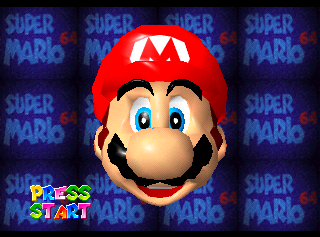
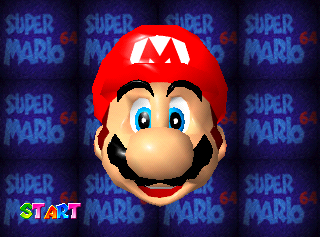
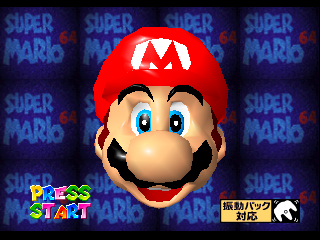
マリオの顔#
日本版/北米版 |
欧州版 |
|---|---|
 |
 |
振動パック対応版 |
iQue(中国版) |
|---|---|
 |
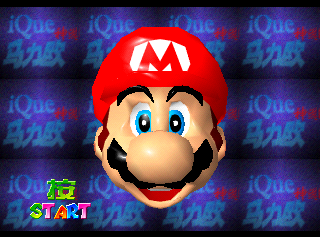 |
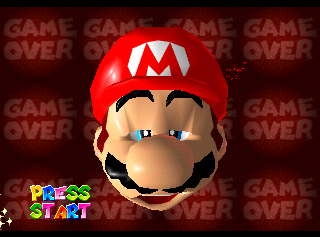
- マリオの顔の画面には、日本版と北米版では「PRESS START」と表示されるが、欧州版では単に「START」を表示される。 The Shindou version has a unique graphic on the bottom right of the screen, used to indicate that a Rumble Pak can be used. The background was changed in the iQue version, just to let you know what version you're playing.
ゲームオーバー#
|
国際版 |
iQue(中国版) |
|---|---|
|
|
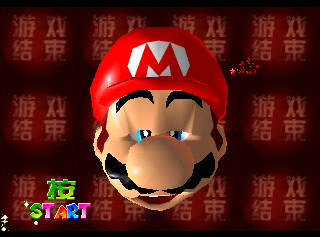
- iQue版では、ゲームオーバー画面の背景も変更された。
ファイル選択#
北米版 |
欧州版 |
|---|---|
 |
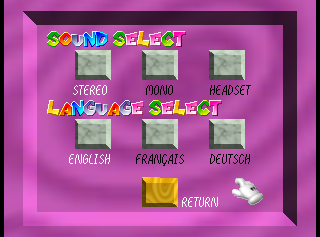 |
- 欧州版のオプションメニューには、3つの言語選択オプションがある。北米版と日本版には、このようなオプションがなくて、言語がそれぞれ英語または日本語に固定されている。
- 米国/EU版では、マリオの頭部アイコンが、セーブファイルのハイスコアが属する文字の左側にある「マリオ」という単語に置き換えられます。
- iQue版は、漢字が大きいためスコア情報を表示するために2ページを使用し、LとR'を切り替えることで、Lボタンに機能を付与する唯一の『Super Mario 64』のバージョンとなります。
HUDテクスチャ#
|
日本版 |
欧州版 |
|---|---|

|

|
- 未使用の「key」HUDアイコンは国際版から削除されました。米国版では乱雑な混乱として表示され、欧州版では銀青色のÜとして表示されます。
Ä (ae) |
Ö (oe) |
Ü (ue) |
|---|---|---|
 |
 |
|
- 欧州版では、「ドイツ語のウムラウト」(Ä、Ö、Ü)が追加された。しかし、Üはゲーム内で一切使用されていない。
- 欧州版では、VとZのアルファベットタイルが再追加された。
ピーチの手紙#
|
日本版 |
英語版 |
|---|---|

|
|
日本版 |
英語版 |
|---|---|
<pre lang=ja style="font-family:"MS Gothic",monospace;">おしろへ あそびに きてください。 ケーキ を つくって まってます。 ーピーチよりー |
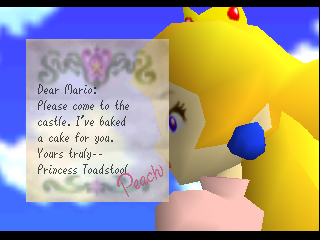
<pre lang=ja style="font-family:"MS Gothic",monospace;">Dear Mario: Please come to the castle. I've baked a cake for you. Yours truly-- Princess Toadstool Peach |
- ピーチからマリオへの手紙には、英語版では冒頭に個人的な挨拶と末尾にピンク色で「Peach」の署名が追加されている。
(出典: The Mushroom Kingdom)
その他#
- マリオがクッパと戦うゲームプレイデモが日本語版にありません。他のゲームプレイデモはまだ残っています。
- NPCと会話したりサインを読んだりするには、プレイヤーは元の日本語版でBボタンを押すだけですが、海外およびヨーロッパでは、AボタンまたはBボタンのいずれかを使用できます。しかしテキストは変更されておらず、依然としてBボタンのみが記載されています。インタラクション半径もやや寛大にしました。
- アメリカ版にはPAL TVを検出し、それに応じて出力を変更するコードがあり、PAL地域用の別個のヨーロッパ版があることを考えると奇妙です。日本語版にはこのコードがありません。
- 日本語版では、コインは虚空に着地し、そこに留まることができます。後期バージョンでは、虚空に着地したコインはすべて消滅します。
- 日本語版では、ミップは地下でスポーンする2回とも同じ速度です。他のすべてのバージョンでは、ミップは彼が最初に出現したとき(15星)でやや遅くなります。ミップは日本語版でも重力が大幅に少なくなっています。
キャラボイス#
マリオ#
マリオは日本語版では数行を言いません。
- "Hello!" 彼が首のみであなたに挨拶したとき。
- "Okey-dokey!" セーブデータを選択したとき。
- "Let's-a go!" スターを選択したとき。
- "Game over!" 死んでしまったとき。
- "Press START to play!" デモを見たとき。
- "D'oh!" 壁に幅跳びなどで飛び込んだとき。彼は代わりに"Uhn!"と言います。マリオが壁にぶつかるときのように、別の方法で。
- "Boing!" 波しぶきに飛び込んだとき。
- "Wha-ha!"または"Yipee!"3段ジャンプをするとき。彼は代わりに"Yahoo!"と言うだけです。それは国際版でもランダムに起こり得ます。
- "Ha Ha!"イントロでパイプから飛び降りるとき彼はまだバックフリップの後にそれを言います。
- マリオは"Mamma mia!"とは言いません。日本語版で、彼が命を失った後、絵画以外のコースから落ちたとき。彼は国際版で行います。
- "So long,eh Bowser!"クッパを遠くに投げ出すとき(日本では彼の名前が「クッパ」であるため)。彼はむしろ"Here we go!"と言う。たとえば、彼を少し離れた場所に投げ出すときのように。
- 彼の"I'm-a tired!"そして、アイドリング中にパスタに関する夢が欠けています。
(Source: The Mushroom Kingdom)
ピーチ#
プリンセス・ピーチは、オリジナルの日本版では、冒頭と最後のカットシーンで声が一切ありません。これは他のすべてのバージョンに追加されました。
ステージ変更#
|
JP |
US/JP (Shindou) |
|---|---|

|

|
In the Japanese version, the painting of Jolly Roger Bay is essentially water with some bubbles added in. It also was unique in that it did not have a gold frame (sported by almost every other painting in the game, excluding the Cool Cool Mountain and the Wet-Dry World paintings). In the American version, the painting has been changed and the frame was made golden. For some reason, all versions of Super Mario 64 DS use the Japanese picture.
|
Japan/Shindou |
US |
|---|---|
|
|
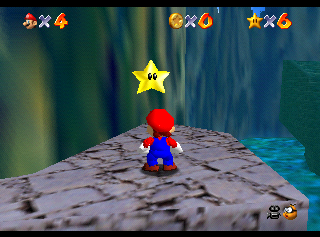
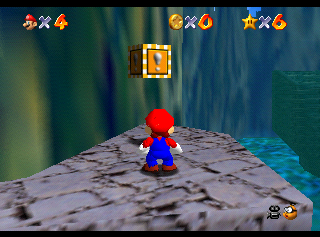
In the level itself, the Star on the stone pillar is out in the open in the Japanese version, but contained inside a ! box in the American version, probably to make the Star's position not too obvious. Again, all versions of the DS remake leave the star out like in the Japanese release.
さむいさむい マウンテン#
|
Japan |
US |
|---|---|
|
|
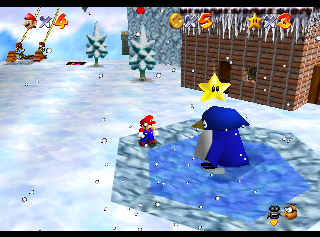
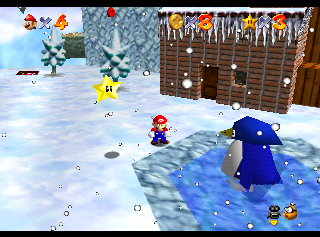
When you take the baby penguin to its mother, the Power Star is placed right above the mother in the Japanese version. This was probably a bit hard to collect, so the Star was moved next to the pool in the American version.
テレサの ホラーハウス#
When Mario stops touching the tilting platform on the second floor of Big Boo's Haunt, the platform immediately starts to return to its original position in the Japanese version. In the American version, it continues to tilt in the direction Mario was standing for about half a second.
(Source: 1)
レインボークルーズ#
|
JP |
US/EU/JP (Shindou) |
|---|---|
|

|
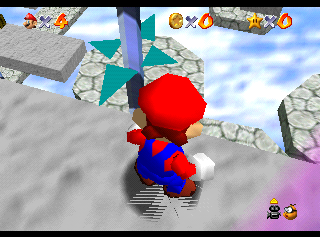
In the original Japanese version, the pole located above one of the four rotating platforms has four small blue arrows around its top, similar to a rose compass. These arrows were removed in all other versions.
バグ#
Some glitches which were present in the Japanese version have been fixed for the American release.
1000枚コインバグ#
It's possible to collect more than 999 coins (for instance, grabbing the coins generated by Bowser's fire), at which point the coin counter gets forced back to 999. A bug in the Japanese version causes it to instead try to set the life counter to 999. Since the life counter is only 8 bits, this becomes -25, which is displayed as M25 in the game. (M is used in the place of a minus sign. This is also seen in the debug displays.) If you then try talking to Yoshi without entering a new course to reset the invisible coin counter, the game will lock up. He'll try to give you 100 total lives, but the game will continuously set Mario's life total to -25 each frame, and you'll be stuck on the roof with Yoshi while the "counting" sound effect continuously playing. Watch on YouTube
The lines of code relevant to this glitch were included in game.c in the July 2020 source code leak. While the glitch has been fixed, the relevant lines have a comment that reads "JPBUG."
if (marioWorks->nlifes > 100)  marioWorks->nlifes = 100;   /* for sefty    */
if (marioWorks->ncoins > 999)  marioWorks->ncoins = 999;    /* for sefty    */  /* JPBUG    */
if (playerMeter.coin   > 999)  playerMeter.coin   = 999;    /* for sefty    */  /* JPBUG    */
Presumably the glitch came from copy-pasting the logic from the first line into the second and forgetting to change one of the variables:
if (marioWorks->ncoins > 999) marioWorks->nlifes = 999; /* OOPS! */
(Source: pannenkoek2012)
- In the Japanese version, when Bowser is defeated and leaves behind the key, run to where the key will land and press C-Up and look somewhere. Mario will keep looking that way during the key collection cutscene.
- Further, the key collection cutscene shows a Star instead of a key; early footage (see right) of the first Bowser fight shows him leaving behind a Star upon defeat, suggesting that this is a very old leftover.
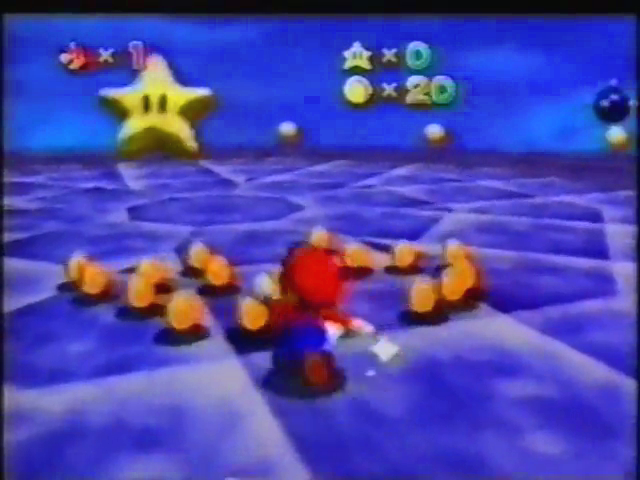
(Source: darkeye14)
- In both Bowser in the Sky and Shifting Sand Land's pyramid, it is possible to trigger a bug that causes the music to stop. Attempting to leave the course will cause the game to freeze.
- If you exit a level while on a falling bridge block, upon returning to the castle, Mario will clip through the first thing he stands on.
- An exploit was fixed where the game freezes all surroundings except for Mario himself when a text box is queued up, but doesn't actually check whether Mario can receive the text box (is standing on solid ground), thus allowing to move around in a frozen world where no objects update (collected stars don't disappear, doors don't open, etc.) as long as you stay in mid-air. Notable applications included the cap switches, the boos in Big Boo's Haunt Star 1, and Ukiki in Tall Tall Mountain.
- If you take a warp while racing Koopa the Quick in Course 1 (Bob-omb Battlefield), the race music will change back to the regular course music.
- On the first star of Big Boo's Haunt, there is one Boo in the room with the Mr. I where you get the Star "Eye to Eye in the Secret Room". In the Japanese version this Boo counts towards the five boos required to spawn the Big Boo; if this Boo is killed last, the text box won't show up and the jingle won't play due to the Big Boo downstairs being despawned. The later versions added a check so only the five boos on the lower floors count.
- In the Japanese version, Bowser's collision doesn't despawn when he is defeated at the end of Bowser in the Sky, so Mario will still be able to collide with him as if he were there.
- In the Japanese version, King Bob-omb's velocity is not set to zero when he despawns, i. e. by warping away from the battle. As a result, if you start the battle, warp away using the warp right below him, warp back and then talk to him, he will move away while the text box is up.
- The Japanese version has a camera glitch. If Mario grabs a Wing Cap and triple jumps to take off but dives or ground pounds after the camera moves close but before he actually starts flying, the camera will stay behind Mario as if he were still in flight.
- When Piranha Plants are killed and then despawn during the death animation due to being too far away, the Japanese version will simply interrupt the death animation and patiently wait for the player to return to finish the death animation. Trying to do this in later versions will reset the Piranha Plants.
- Mario takes damage from bumping into a sleeping Piranha Plant in the Japanese version only. In later versions he will not take damage from this action.
- Dying from fall damage while falling into the trigger for the Lakitu cutscene at the very beginning of the game causes a softlock in the Japanese version.
(Source: Super Mario Wiki)
SE変更#
|
|
やるべきこと一覧 |
Japanese to US
- The Chain Chomp makes a totally different barking sound in the Japanese version.
- When collecting Red Coins, the Japanese version uses a different sound that doesn't increase in pitch with each successive coin. This also applies to secrets (for the stars that require finding five "secrets" on the course) and the water rings in Dire Dire Docks.
- Finding the secret shortcut on the slide of Cool Cool Mountain does not play a jingle in the Japanese version. The object that plays this jingle is missing entirely.
- Hitting a cap switch does not play a jingle in the Japanese version.
- The Big Boo in the merry-go-round of Big Boo's Haunt plays the sound effect normally used for opening the chests in Jolly Roger's Bay when he spawns, this was changed to the standard jingle in later versions.
- In all versions other than the Japanese version, coins stop playing a sound for every consecutive bounce after the 5th.
- The Japanese version is missing certain sound effects in the game's opening, specifically the "whoosh" when Lakitu is flying, the "click" when the camera goes into his point of view, and the "boing" when Mario jumps out of the pipe.
- The warping sound effect heard when exiting a course without getting a Star is absent in the Japanese version, and the star sound effect doesn't play when entering certain "mini-courses" like the Tower of the Wing Cap.
- An audio cue titled "Lakitu's Message" was added when Lakitu flies up to Mario to introduce himself and explain the camera controls. Thus, it isn't in the official soundtrack.
- Money Bags don't make a sound when they turn back into a coin in the Japanese version.
- The flying ship on Rainbow Ride is silent in the Japanese version.
- The buzz when trying to zoom out the camera while the camera is already zoomed out is missing in the Japanese version.
(Source: The Mushroom Kingdom)
US版からヨーロッパ板へ
- In the intro, when Mario jumps out of the pipe and the pipe goes back into the ground, a variation of the classic Mario "pipe sound" is heard in the US version. This sound has been made a lot quieter in the European version, almost down to where you can't hear it.
- Bowser's doors have completely different sounds for opening and closing in the US version. In the European version, they sound pretty much the same.
- The yellow coin collecting sound is slightly slowed down in the European version.
- When letting go of Mario's face when playing around with it, the European version's sound is in a lower pitch.
振動パック対応版#
A Japanese re-release that could be primarily considered an "International Edition", as it includes nearly all the changes to the international version.
It fixes the "backwards long jump" glitch, adds Rumble Pak support, and makes Mario face the screen after grabbing a tree.
The only other difference was Mario's taunt when swinging Bowser far away ("Buh-bye!", rather than "So long, eh Bowser!", or just "Here we go!" in the original Japanese release), as Bowser is named Koopa in Japanese. The "Buh-bye!" clip is slowed down compared to the sound clip in the DS version and the first and second jump sounds are higher in pitch from their international counterparts.
ジャンプ1
ジャンプ2
「バイバイ」
The "Buh-bye!" clip was sped up and reused for Sleep Mode in Super Mario 64 DS and New Super Mario Bros., and once again when throwing Bowser far away in the former game.
新機能#

A neat Easter egg was added to the "Press Start" screen: pressing Z makes the background get filled out with images of Mario's face. This is taken from the frame buffer, so the faces move alongside the modeled Mario face. This is still present in the iQue Player version.
セリフ変更#
The Shindou version insists you can use A as an alternative to B for interacting with things. Non-Japanese scripts are based on the original Japanese version. The localized English version is also present to complete the comparison.
Japan |
Translation |
English Localization |
Shindou Pak Taiou Version |
Translation |
|---|---|---|---|---|
<pre lang=ja style="font-family:"MS Gothic",monospace;">おおっと、ここはキケンな せんじょうの どまんなか。 『え』のなかのせかいには クッパが ぬすんだ パワースターがある。 まずは、あかいボムへいに はなしかけてみるといい! Bボタンではなしができる。 きっと、ちからになって くれるはずだ。 カンバンを よむときも たちどまって Bボタン! AかBボタンですすめる! まえにたつだけで はなし かける、どうぶつもいます。 |
|
<pre lang=ja style="font-family:"MS Gothic",monospace;">Wow! You're smack in the middle of the battlefield. You'll find the Power Stars that Bowser stole inside the painting worlds. First, talk to the Bob-omb Buddy. (Press B to talk.) He'll certainly help you out, and so will his comrades in other areas. To read signs, stop, face them and press B. Press A or B to scroll ahead. You can talk to some other characters by facing them and pressing B. |
<pre lang=ja style="font-family:"MS Gothic",monospace;">おおっと、ここはキケンな せんじょうの どまんなか。 『え』のなかのせかいには クッパが ぬすんだ パワースターがある。 まずは、あかいボムへいに はなしかけてみるといい! Bボタンではなしができる。 きっと、ちからになって くれるはずだ。 カンバンは まえにたって AかBボタンでよめます。 まえにたつだけで はなし かけてくれる どうぶつも います。 |
|
<pre lang=ja style="font-family:"MS Gothic",monospace;">このように カンバンの まえで Bボタンをおすと よむことができます。 ノコノコや どうぶつたち と はなすときは、まえに たちどまってください。 このコースにあるクッパに ぬすまれたパワースターを とりかえしてください。 |
<pre lang=en style="font-family:"MS Gothic",monospace;">You can read a sign by standing in front of it like this and pressing the B button. To talk to Nokonokos and other creatures, stand in front of them. Please recover the Power Stars stolen by Koopa that are hidden in this course. |
<pre lang=en style="font-family:"MS Gothic",monospace;">To read a sign, stand in front of it and press B, like you did just now. When you want to talk to a Koopa Troopa or other animal, stand right in front of it. Please recover the Stars that are stolen by Bowser in this course. |
<pre lang=ja style="font-family:"MS Gothic",monospace;">このように カンバンの まえでAかBボタンをおし よむことができます。 ノコノコや どうぶつたち と はなすときは、まえに たちどまってください。 このコースにあるクッパに ぬすまれたパワースターを とりかえしてください。 |
<pre lang=en style="font-family:"MS Gothic",monospace;">You can read a sign by standing in front of it like this and pressing the A or B button. To talk to Nokonoko and other creatures, stand in front of them. Please recover the Power Stars stolen by Koopa that are hidden in this course. |
<pre lang=ja style="font-family:"MS Gothic",monospace;">『ピーチの おしろ』
Aボタン『ジャンプ』 Zボタン『しゃがむ』 Bボタン『カンバンよむ』
もういちどおす『なげる』 |
<pre lang=en style="font-family:"MS Gothic",monospace;">Peach's Castle
A Button - Jump Z Button - Crouch B Button - Read Signs
|
<pre lang=en style="font-family:"MS Gothic",monospace;">Princess Toadstool's castle is just ahead. Press A to jump, Z to crouch, and B to punch, read a sign, or grab something. Press B again to throw something you're holding. |
<pre lang=ja style="font-family:"MS Gothic",monospace;">『ピーチの おしろ』
Aボタン『ジャンプ』
Zボタン『しゃがむ』 Bボタン『パンチ』
|
<pre lang=en style="font-family:"MS Gothic",monospace;">Peach's Castle
A Button - Jump
Z Button - Crouch B Button - Punch
|
バーチャルコンソール版#
The Wii Virtual Console version of Super Mario 64 contains a floating-point rounding error as a result of an emulation inaccuracy. This results in the platforms in Bowser in the Fire Sea very slowly moving up with every cycle.
This glitch would be later exploited in an online speedrunning category titled the "A Button Challenge", where Super Mario 64 is beaten with the most minimal A presses possible.
Because the platform slowly moves up, this allows for a strategy that takes up to THREE DAYS to be performed involving waiting for the platform to rise at the right height and using a glitch that launches Mario up to the elevator without reaching the pole (which in the context of this challenge requires one A press).
This bug was fixed with all later Nintendo 64 games released via Virtual Console, as well as the Wii U VC version of Super Mario 64.
スーパーマリオ3Dコレクション#
|
|
やるべきこと一覧
|
The version included in Super Mario 3D All-Stars is based on the Shindou Pak Taiou version, with some textures being redrawn in a higher resolution (most notably the HUD and Mario's textures). Certain textures that were based on pre-existing artwork, like the Bowser puzzle, use higher resolution prints of said artwork, and most other textures, like the Hazy Maze Cave map, were upscaled using AI. For languages other than Japanese, the text is translated accordingly. These changes are actually patched in on-the-fly as the game runs, and as a result ripping and playing the ROM on an emulator gives you the standard, no-nonsense Shindou Mario 64 experience.