
|
Oh dear, I do believe I have the vapors. |
It's a bird!
It's a plane!
It's The Rocketeer! May 1940. You are Tom Cody - a US army scientist that receives a set of strange futuristic items via time travel (achieved by altering the time-plane of their molecular structure) from scientists 100 years ahead in a dystopian future where the Nazis won World War II. They established a terroristic fascist world government on Earth within the Interplanetary Union of Fascists which was created by an unknown alien race. The aliens struck a deal with the Germans and allowed them to utilize their lunar technology which lowers only male IQ by 30 points in order to win the war and enslave the earth.
...and that's not even the whole story.
Rocket Ranger is an "Interactive Movie" directly inspired by 1950s science fiction serials, most notably Commando Cody. This game contains (for the time) a detailed, intricate, and compelling story, stunning cinematics, artwork, music scores, and digitized speech. It literally has a fascist alien in it, brainwashed zombie slave women in dominatrix outfits, and it treats you to a brilliant medley score in the unlikely event that you actually win. What more could you ask for?
...Aside from sheer luck not being a literal requirement to win, and maybe slightly reduced difficulty levels. In an effort to ensure that the game wasn't too "easy" like Defender of the Crown, Rocket Ranger is notoriously unforgiving. It's pretty likely that most people didn't beat this game until emulators and savestates became a thing.
The game was released for numerous systems - Commodore 64, NES, Apple IIgs, DOS, Atari ST/STE, and even an FM Towns release in Japan.
You better have your decoder wheel!
Type 'TYPE RocketRanger2:Codes PRT:' from CLI to print out the codes you will need for this program.
Architecture#
The architecture of the Amiga version was pretty advanced for the time. In order to crunch all of the data onto 2 standard 880KB amiga diskettes and move the data in and out of memory as efficiently as possible during gameplay, Cinemaware developed a custom data compression and disk management system named "Quick-DOS". It provided the capability to compress the dataset of roughly 4 MB onto 2 amiga-formatted diskettes (880 KB per diskette) and to read at 3x the rated drive speed. This actually out-performed Amiga DOS capability of reading from a hard drive, which is why Cinemaware opted to not include a hard drive installation method.
Copy Protection#
The immediate means of copy protection was the decoder wheel that was required to play the game. Loading an invalid amount of lunarium into the rocket pack results in an immediate game over. The game's manual indicates that Rocket Ranger is not copy protected, and that you are in fact allowed to make a backup copy of the game:
The two Rocket Ranger disks, labeled Reel One and Reel Two, are not copy protected. Using Workbench or CLI you can create backups of these master disks for your own personal use. If you do not know how to copy disks, please refer to the Amlga owner's manual that came with your computer. After making the backup copies, store the original masters in a safe location. Please do not give away backup copies. Rocket Ranger is the most ambitious game ever created for the Amiga, involving over 5 man years of development. We would love to create even more ambitious products in future, but will be unable to do so if software theft prevents us from paying our bills. If you support us, we will support you.
This actually appears to be misleading or maybe even outright untrue. On both disks, the game's assets are packed into 2 files - KBLOCKS.0 and KBLOCKS.1. Performing an analysis on the contents of both disks confirm that these files have intentionally corrupted data blocks and/or intentionally incorrect size specified in the header, both of which prevents standard copying of the disks. This was a very common copy protection mechanism of that era, though one could make exact copies of diskettes with programs like XCOPY that would bypass this protection.
Reel 1 |
Reel 2 |
Standard Copy Attempt |
|---|---|---|
 |
 |
 |
It is unknown if the initial print of the game contained this additional layer of copy protection or not. It's possible that it didn't, and later revisions added it without the manual being updated to reflect the change.
Unused Dialogue#
In the main executable there is a section that contains all of the dialogue choices from the zeppelin and interrogation sequences. Among the zeppelin sequence dialogue choices, there is 1 unused line:
A little trust.
Music#
There is one music track that the player never gets an opportunity to hear the entirety of in-game. smus.SxF7 is the audio track that is played when flying to an unknown location, or back to Ft. Dix. The transition to the next scene will always occur before the music reaches it's loop point.
Beta/Pre-Release Content#
The Rocket Ranger Slideshow#
There exists a teaser slideshow featuring artwork from the game. It appears that this was compiled prior to the retail build because:
- The primary screen says that the game is "Available shortly from... MIRRORSOFT", which was Cinemaware's longstanding European partner and publisher.
- The timestamps on majority of the disk's files are 3/24/1988, which is 3 months prior to the retail release of June 1988.
Per those facts, the slideshow contains what is presently assumed to be beta content as there are many differences from the retail build. This was likely used for magazine previews as most of these exact screenshots are in numerous magazine articles. Most (if not all) of what is seen here is likely from the promotional material that is noted in the Cinemaware Amiga Promotional Videos section later on in this article.
Title Card:
Slideshow |
Final |
|---|---|
 |
 |
In the slideshow screenshot, Rocket Ranger is flying in front of the logo. Whereas in the final version, he flies across the screen first. The logo appears, and he does not fly in front of it. The spacing of the logo is different between versions. The slideshow screenshot also has a somewhat crude copyright stamp whereas the final does not.
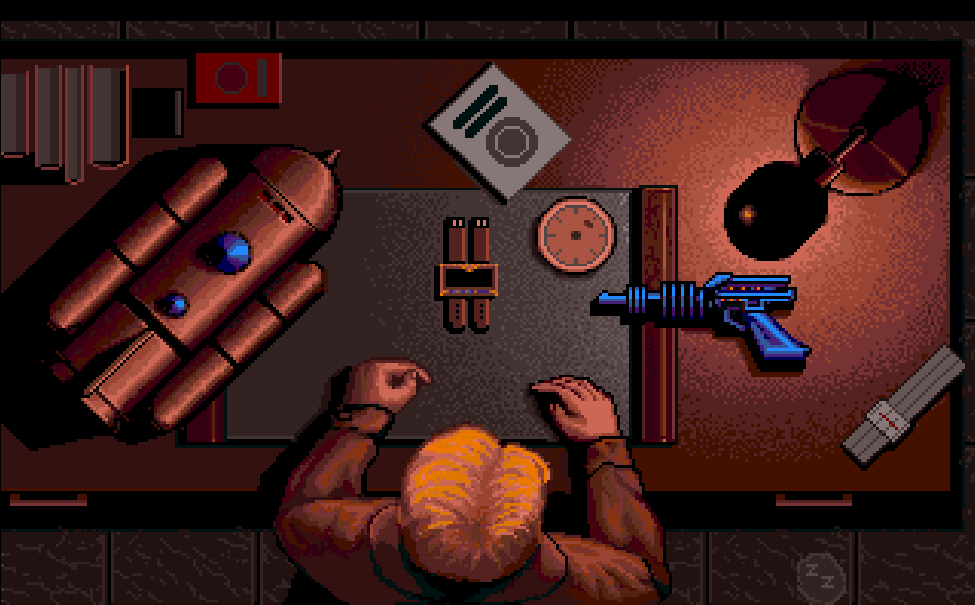
Overhead Desk Scene:
Slideshow |
Final |
|---|---|
 |
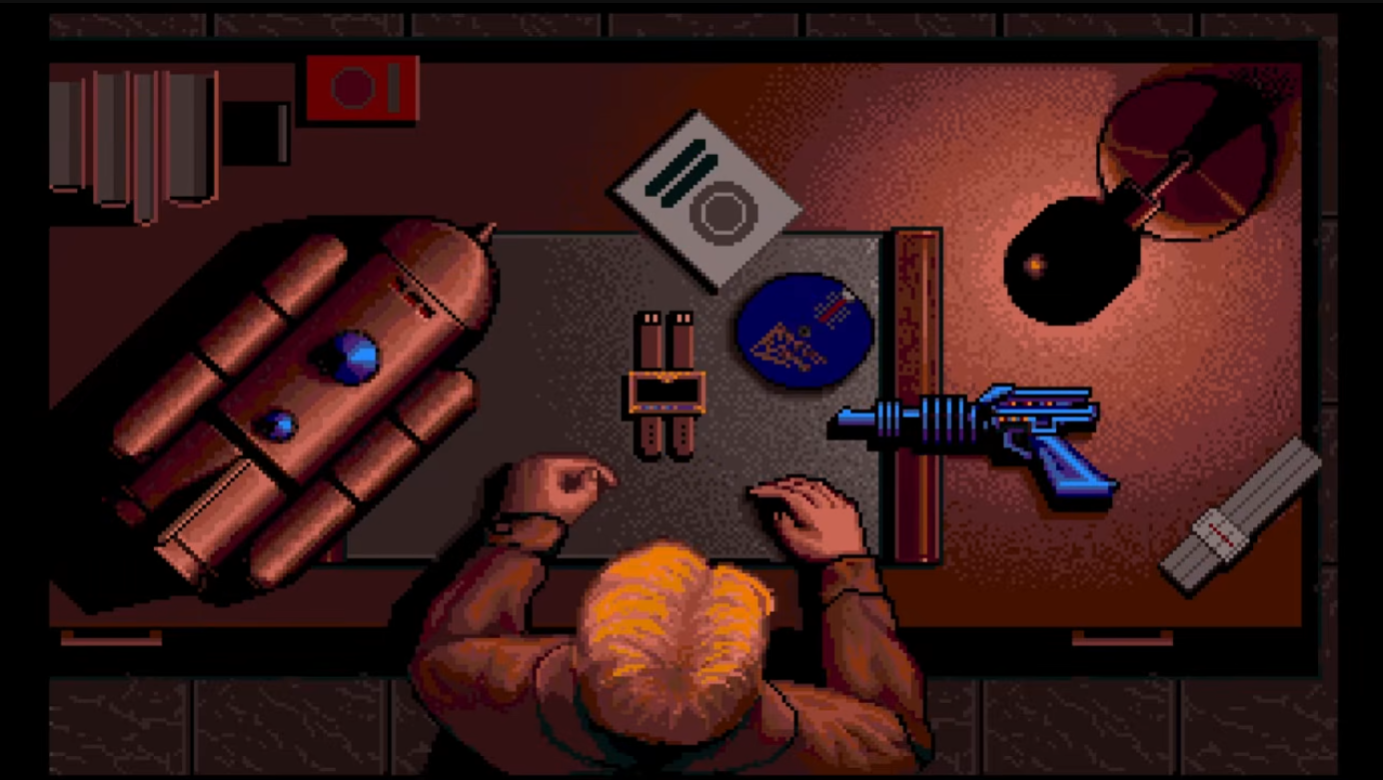 |
The decoder wheel in the slideshow version is more basic-looking, and a different color. The decoder wheel in the final matches the real decoder wheel that came with the game. The spacing of the items on the desk is different between versions.
Takeoff Sequence:
Slideshow |
Final |
|---|---|
 |
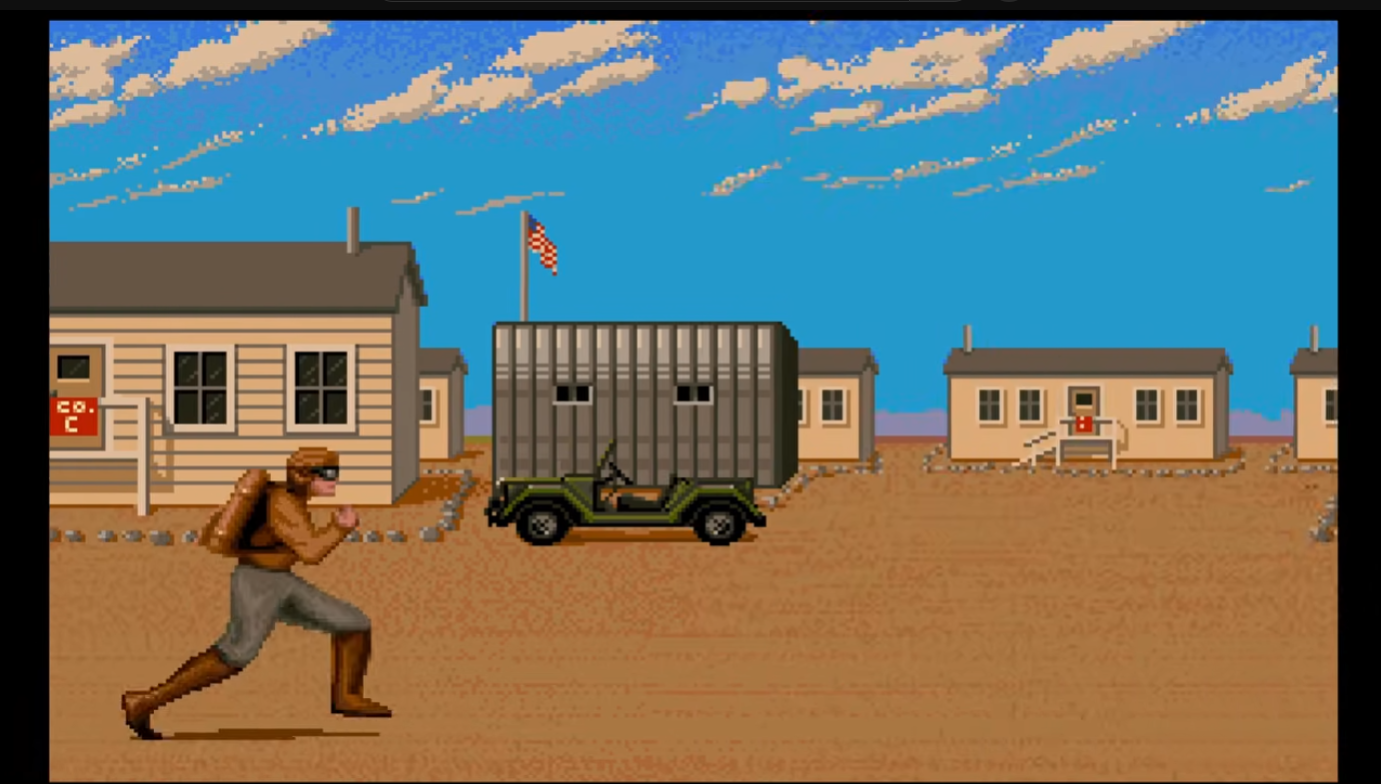 |
It appears that the original takeoff mechanic was a little different as there is a bar on the left-hand side.
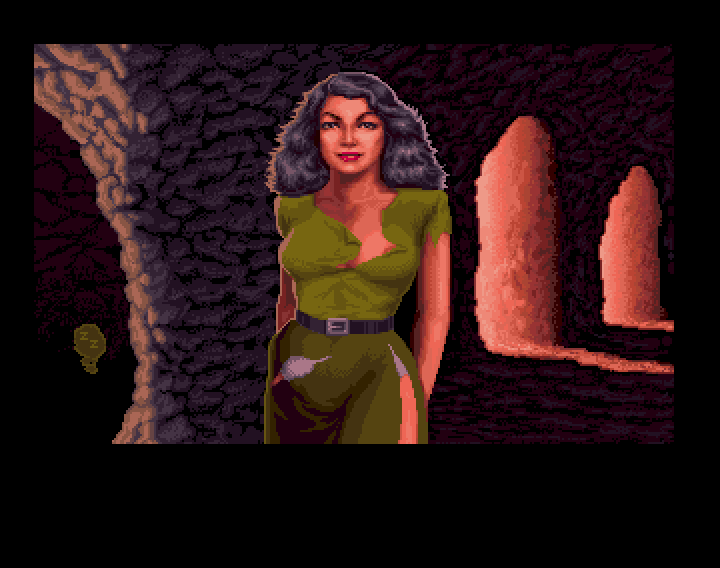
Ending Sequence:
Beta |
Final |
|---|---|
 |
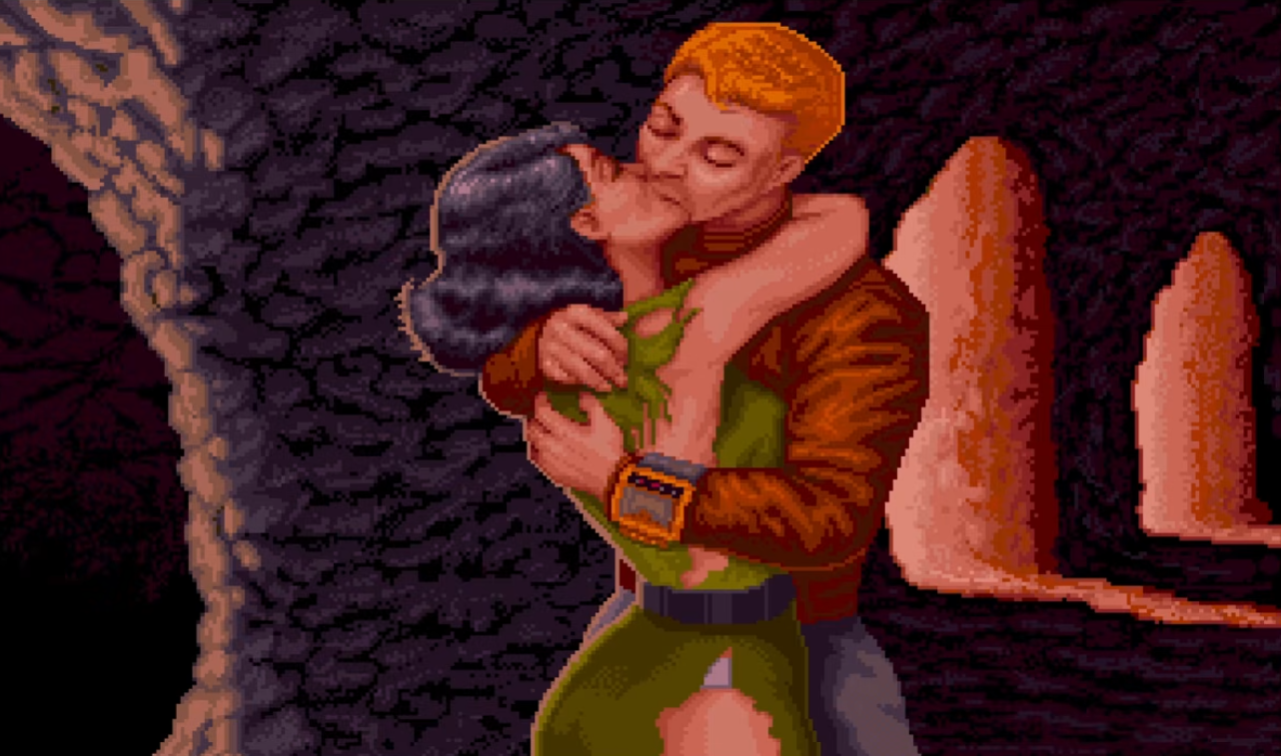 |
In the slideshow screenshot, it appears that this scene is in a first-person view. Jane looks completely different and is facing you. A very small portion of her breast is exposed and she also appears to be wearing much more conservative underwear than in the final version. In the final version, it was changed to a second-person view as Rocket Ranger is on-screen. He and Jane embrace, and there is no partial nudity. She does appear to be wearing less conservative underwear.
Perhaps the most interesting thing about the beta Jane image is that it's actually on the retail box artwork even though it doesn't appear in the game.
Unused Content#
Yes, even the demo slideshow itself has unused content. Upon loading the applications, a simple script is executed that loads and scrolls each image located on the root directory of the disk. Once it reaches the end, it simply restarts back at the beginning. The application that is used to load and display the screenshots is called picshow, which is located in the c directory on the disk.
load year
scrollup
load bidnpa
scrollup
load map
scrollup
load nazimenace
scrollup
load rocketshop
scrollup
load takeoff
scrollup
load woman
scrollup
load moonscape
scrollup
load flyover
scrollup
load desk
scrollup
load wwsc
scrollup
load zep
scrollup
load hq
scrollup
load title
scrollup
restart
In the files there are a few images that are not called in the slideshow:
Slideshow |
Final |
|---|---|
 |
 |
In the unused slideshow demo screenshot, Gondola, Jane appears to be speaking or smiling as Otto is about to speak. In the final version, Jane's mouth remains closed when Otto speaks.
There is a file named DogFight. Based on the title, this is likely supposed to be an image of the DogFight In The Clouds sequence - Rocket Ranger fighting ME-109s in the air. However, when forcefully loading it with picshow we are unfortunately presented with a garbled mess:

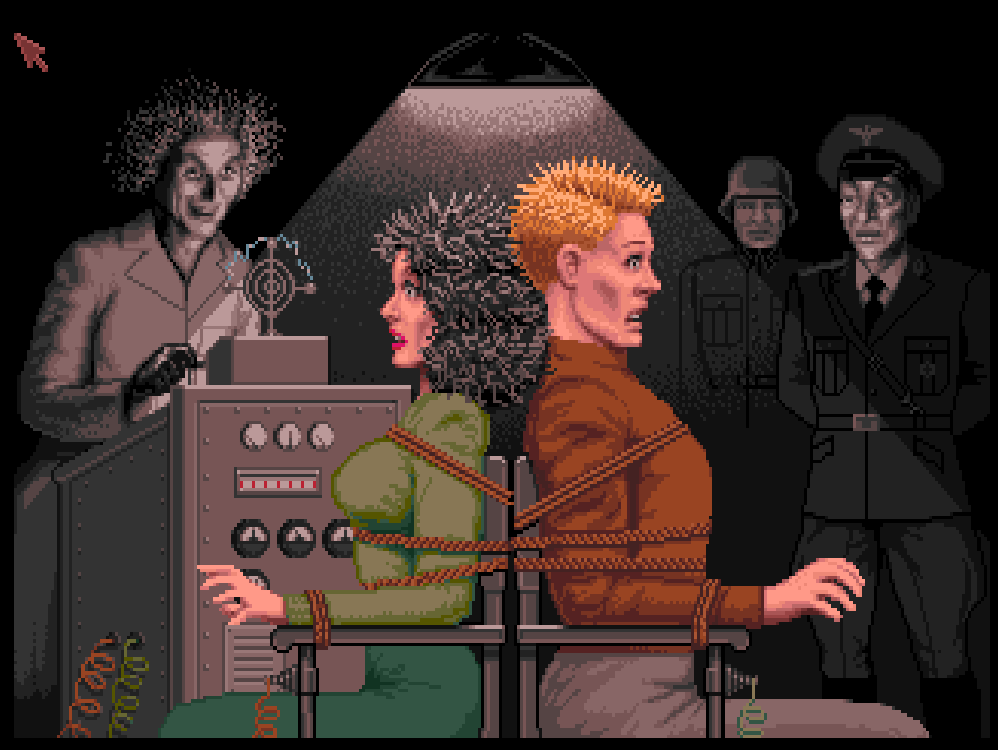
Last but certainly not least, the last unused image is Interro, short for interrogation. As the title implies, it is a screenshot of the interrogation sequence which can be reached by failing to rescue the Barnstorffs via the Zeppelin sequence. After that, they are brought to Germany, and if you beat the ME-109 minigame in time, this sequence is accessed. Additionally, if you fail to rescue them from Germany, they will then be taken to the desert lunarium base. If you know where it is, and you beat the mini-game in time, you will also be presented with this sequence. This screenshot does not have any differences from the retail version, but including it here as it is unused from the slideshow.
Cinemaware Amiga Promotional Videos#
The C64Archive YouTube Channel has 2 Cinemaware promotional videos. These videos contain (you guessed it) snip-its of pre-release content from Rocket Ranger. Not entirely sure, but it is possible that all of the active gameplay clips we see here may just be scripted events rather than actual live gameplay.
Part 1:
Video |
Final |
Differences |
|---|---|---|
 |
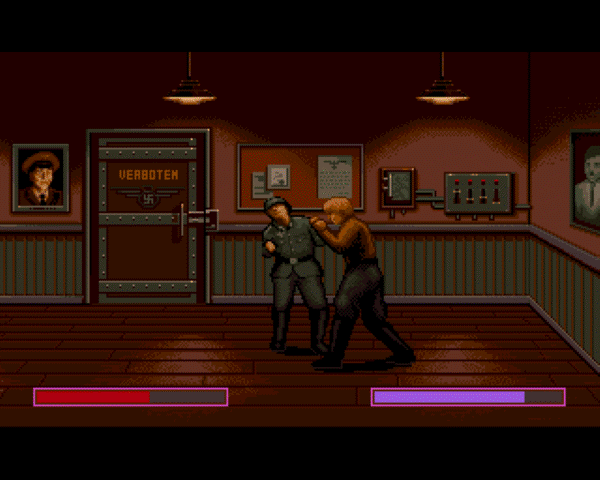 |
There are no health bars, the portrait on the wall to the left of the door is of Adolf Hitler, whereas in the final it is the primary antagonist, Colonel Leermeister. There is no wall on the right side. Oddly enough, this version of the room is used in other versions of the game - C64, Atari St, etc. 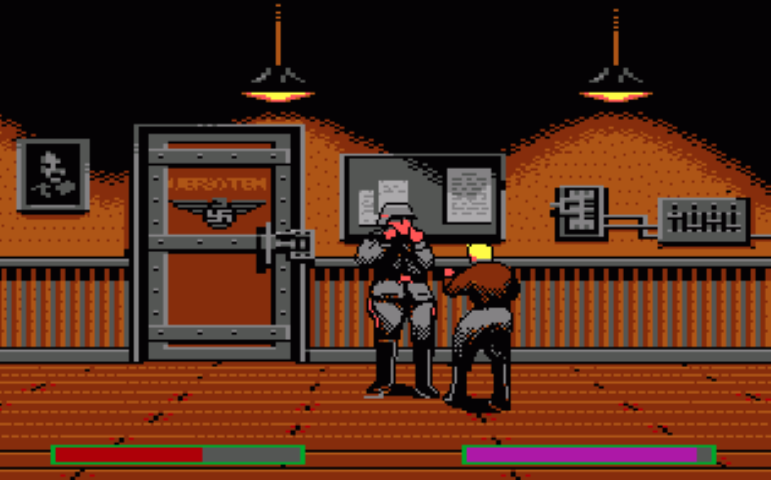 |
 |
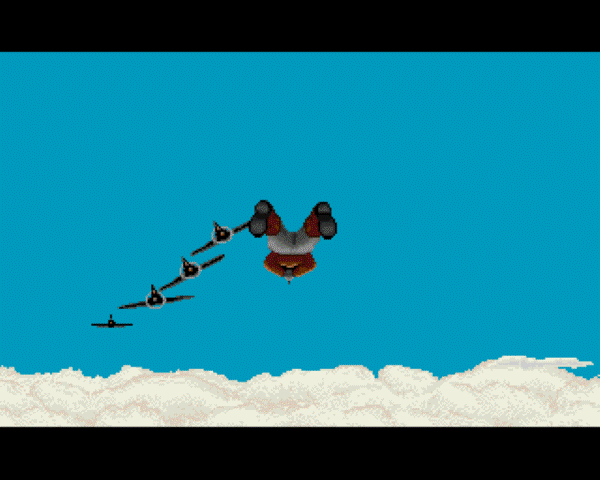 |
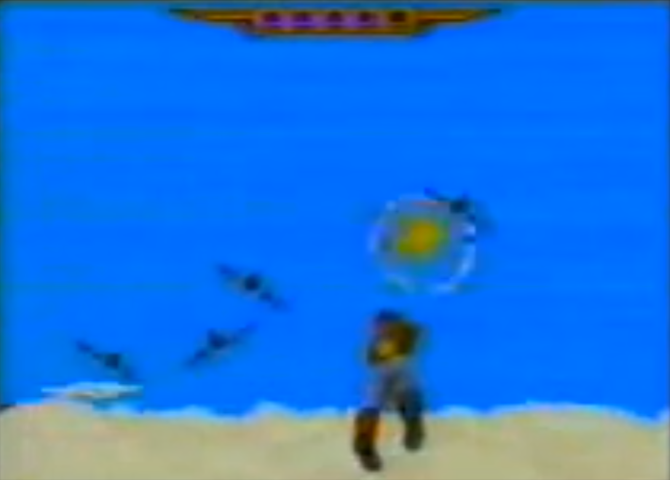
The flight behavior of the ME-109s is different, and there is some sort of bar at the top of the screen. In the video, Rocket Ranger flies right in front of the firing ME-109s and does not take any damage, whereas in the final, he would have absolutely taken damage. The explosion effect is different as well. |
 |
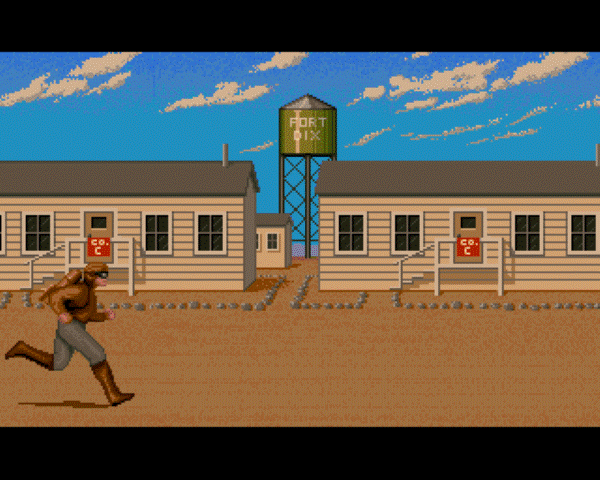 |
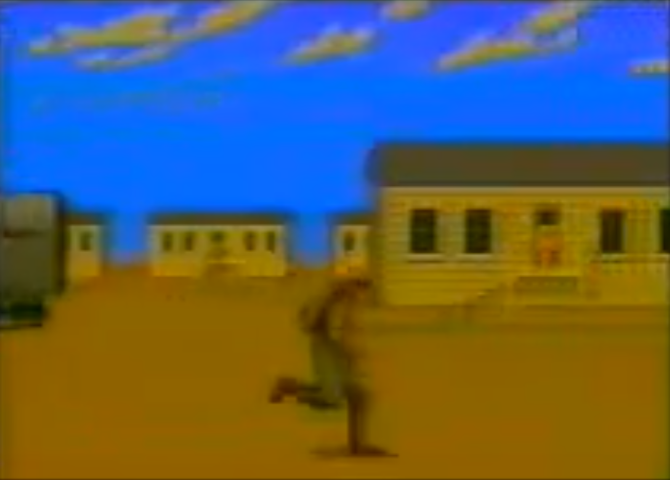
Interestingly, the takeoff sequence in the video does not contain the bar in the bottom left corner as the slideshow does. Though, he is running much further to the right as he is in the slideshow. In the final version, he will never get that far to the right before either taking off, or failing to take off. The running animation in the video is different than it is in the final, and it also shows the rare scene where Rocket Ranger unknowingly knocks a bird out of the sky after a successful takeoff. |
Part 2:
Video |
Final |
Differences |
|---|---|---|
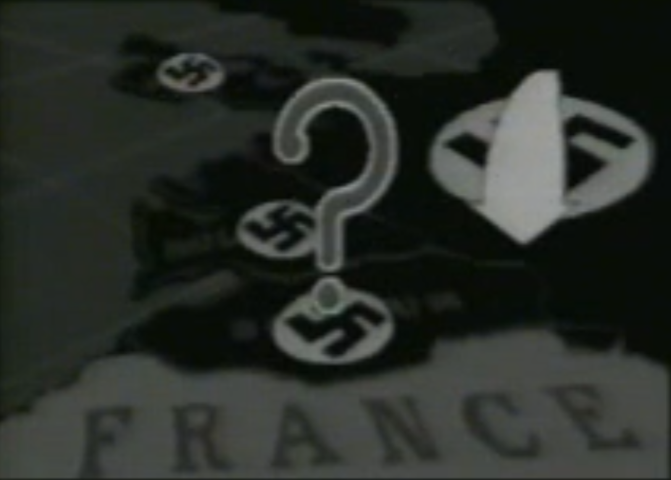 |
 |
Very slight difference here - the question mark is grey with a white outline, whereas in the final version, the question mark is just white. |
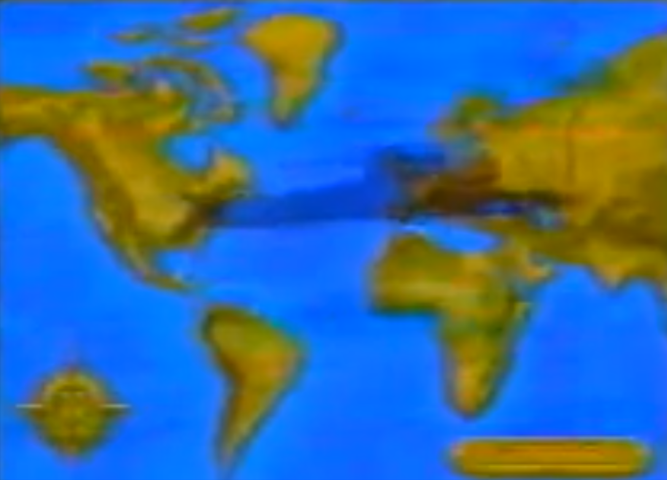 |
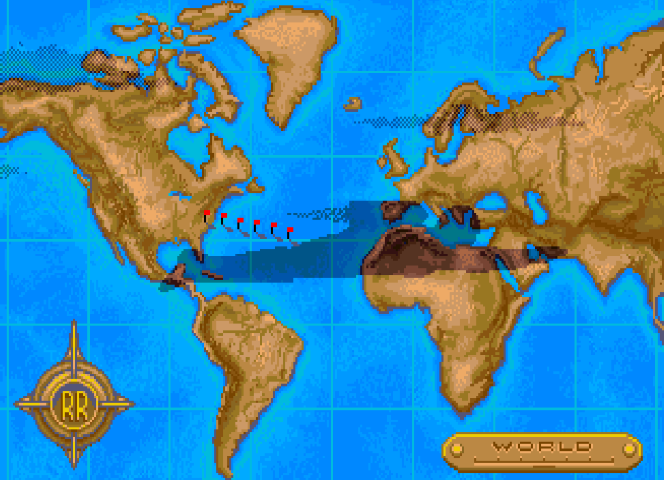 |
In the video, we see the flying-to-destination sequence without any destination markers on the map. Whereas in the final version, there is always destination markers on the map |
 |
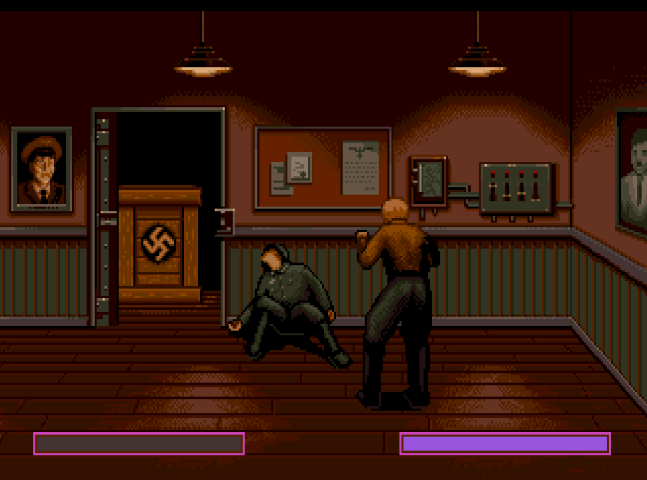 |
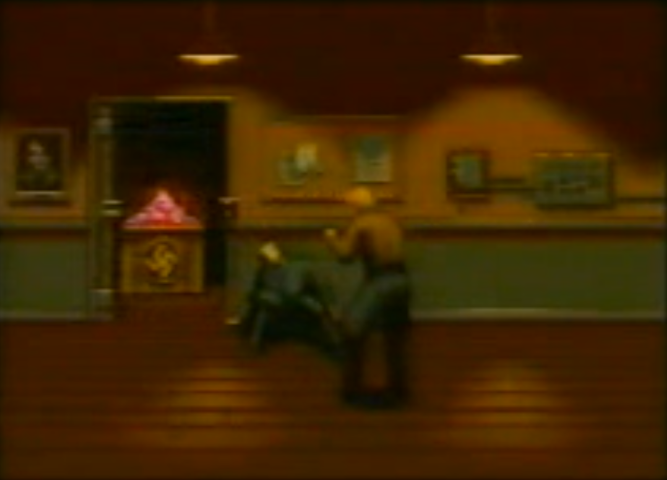
In the video, there is some strange pink glowing thing on top of the rocket part box with the swastika on it, which is not present in the final version. The box itself is also slightly different. All other differences are noted in the Part 1 section above. |
- In the jungle and moon sequences, Rocket Ranger moves left/right much faster than the final version.
- The green radium shots from Rocket Ranger's radium pistol are a little different. In the pre-release footage, the radium beams are much thinner than in the final version. Additionally, the visual effect when hitting an enemy and a subsequent explosion is also different.
Audio Differences:
For some reason, the introduction score appears to have been modified and cut for the Amiga version. In the Amiga version, the drum cadence is only 3 measures before the rest of the instruments come in and sonically assault you with the most evil-sounding F# chord. In most other versions, (for instance, the Commodore 64 and Atari ST versions) the snare cadence is a little bit different - it's 5 measures instead of 3, and you get the evil F# chord twice instead of once as it is in the Amiga version. What's really interesting is that in the Part 2 video above, we get to hear a few seconds of what sounds like the uncompressed original version of this tune. The synth sound is a little different, and the arrangement matches the "uncut" version. The quality unfortunately isn't great due to the quality of the video, and running it through a stem editor to remove the voiceover.
Video |
Amiga |
Commodore 64 |
Atari ST |
|---|---|---|---|
Regional Differences#
There were three known source builds of the game: United States, Europe, and Germany. The German build is based on the European build. There was also a French release by Ubi Soft in English which is rare and very difficult to find.
General#
- US Version is NTSC, 60HZ, whereas the European and German versions are PAL, 50Hz. As such, these versions run ~15% slower.
- The European and German versions share the same lunarium codes, but the US version has completely different lunarium codes. the European and German versions being slightly more "difficult" as the Lunarium requirements per location are generally larger. However, the game starts with more Lunarium in storage, and more Lunarium is gained when raiding bases to accommodate for this.
- In all versions of the game, the Chapter 1 screen strongly urges you to fly to the Atlantic right away to save the Barnstorffs. In all versions, the game automatically puts 60 Lunarium units in the rocket pack so that you can jump into the first mission right away without having to go to the War Room or the Fuel depot first - you go right to takeoff, look up the Lunarium unit amount, put it in, and fly to the Atlantic. In the US version, USA <-----> Atlantic is 23 Lunarium units. If you fly to the Atlantic and subdue the gunners in the gondola, but fail the dialogue sequence with Jane, you are forced to jump from the zeppelin. Because of this, you cannot send for SOS to get back to Ft. Dix - you are required to fly somewhere (or, if you put 0 Lunarium units in the rocket pack, you will just fall to your death which is consistent in all versions). This specific scenario differs between game versions. In the US version, you will have enough Lunarium to fly back to Ft. Dix or any other valid location, and then send SOS from there. In the European and German versions, USA <-----> Atlantic is 31 Lunarium units. Since you started with the automatic 60 Lunarium units in the rocket pack, you are unable to fly back to Ft. Dix. 60-31 = 29. This means that you are forced to fly to any other valid location. You might get lucky and find something, or, you may not be lucky and find nothing. Either way, you can at least now send for SOS to get back to Ft. Dix. The penalty for which, is the loss of precious time. Also considering the additional time that is lost by flying to a country where there is no base, or opportunity to decrease enemy efficiency. In order to prevent all of this, you would have had to have known to add at least 2 more units of Lunarium to the rocket pack before doing the mission - which new and inexperienced players likely wouldn't. It is unknown if this clunky mechanical difference was intentional, or was simply an oversight.
German Version#
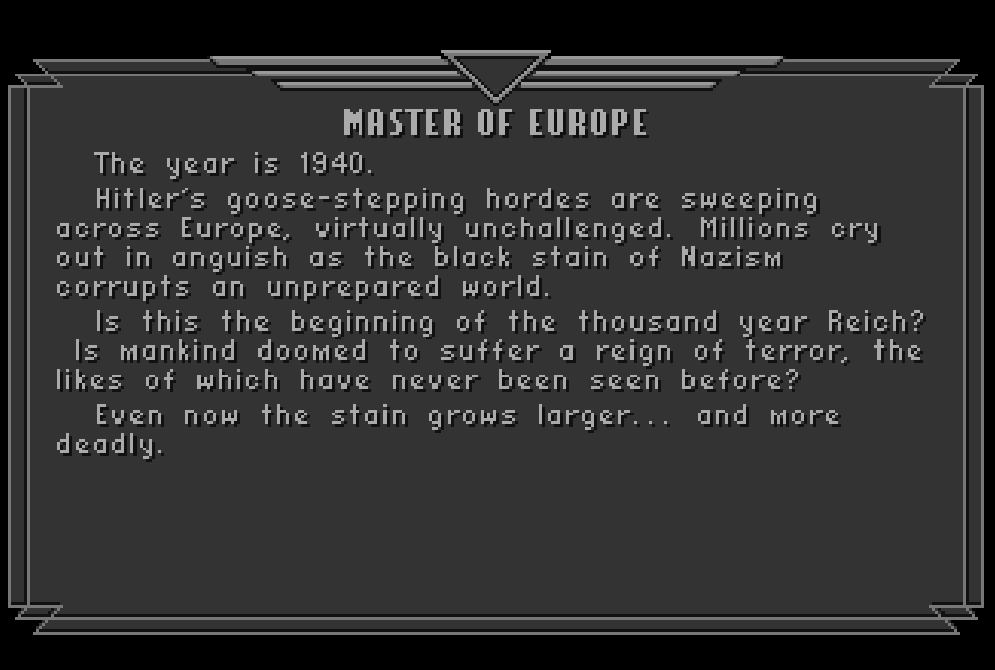
The German version in particular had numerous changes due to the country's strict laws forbidding any depictions of Nazi ideology. As a result, all Nazi scenes and references were excised and the plot was heavily modified: The year is changed to the "near future" of 1990, and the Nazis are replaced with the "Leutonian" alien race. After an alien moon surrounded by an impenetrable force appears in the sky, they immediately establish '"Greater Leutonia" in Germany. The antagonist was changed from Colonel Leermeister to "Krag" - the alien leader who, due to regional differences, you fight at the end of the game. All of the introduction sequences were removed, and instead of the rocket pack being sent back via time travel, the player invents the rocket pack. Interestingly, the German version is in english.
This version of the story was also used in the NES version due to Nintendo of America's strict content policies at the time.
US/Europe |
Germany |
|---|---|
 |
 |
 |
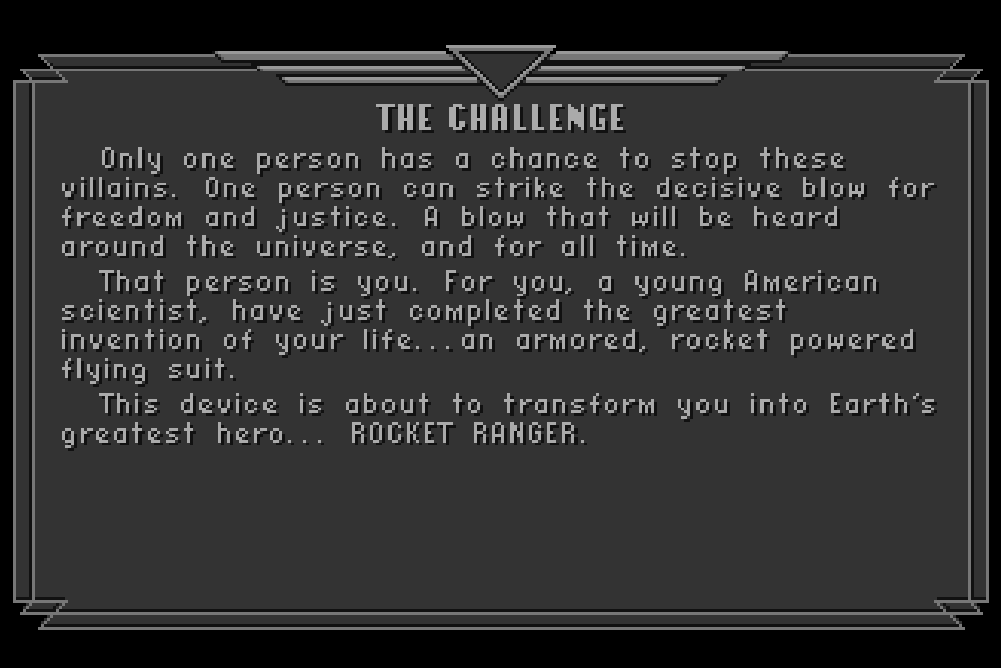 |
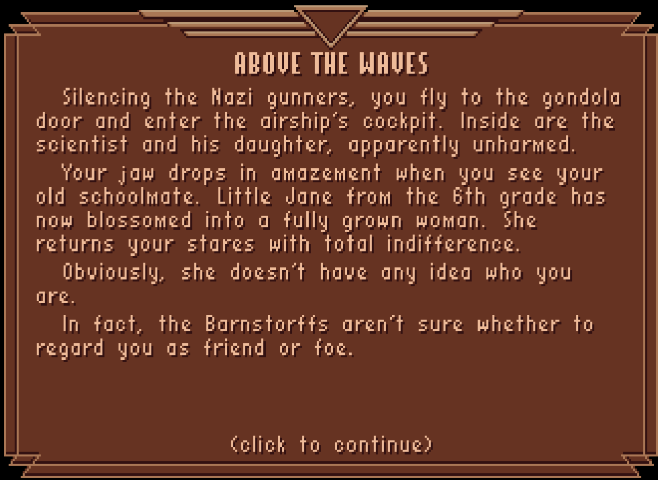
Due to this, there are many changes in not just the narration itself, but also the tone of the narration to reflect the era change to 1990.
US/Europe |
Germany |
|---|---|
 |
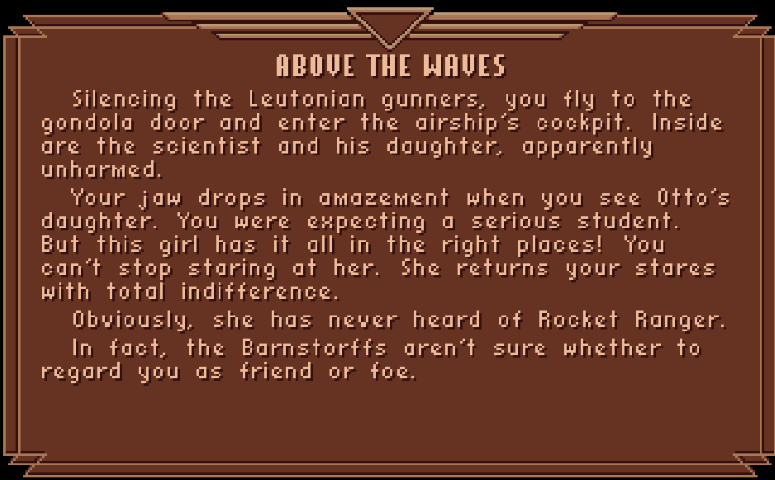 |
This version is affectionally referred to as the "Space Ranger" version among fans as the modified plot morphs it into more of an intergalactic space war story. Keep in mind that aside from replacing the swastikas with a different alien logo, no major artwork was redone for the German version. So, you have a bit of a misnomer - you're battling an alien race that look like human 1940s German soldiers, flying around in 1940s-esque dirigibles, all wrapped in an artstyle that represents the futuristic visions of the 1940s era. It's about as goofy as it sounds.
US/Europe |
Germany |
|---|---|
 |
 |
So let me get this straight - these guys look exactly like Nazis, and speak with a very deliberate German accent, but they're aliens?!
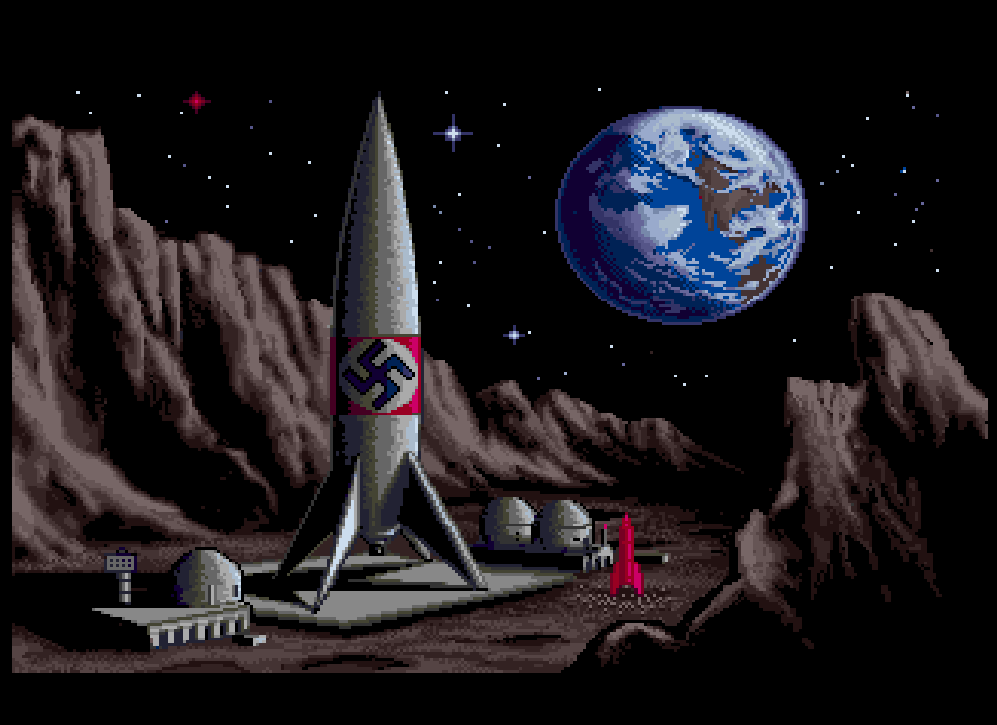
Upon gathering all 5 rocket pieces and 500 units of Lunarium, you begin the final sequences of the game:
US/Europe |
Germany |
|---|---|
 |
 |
 |
 |
 |
 |
 |
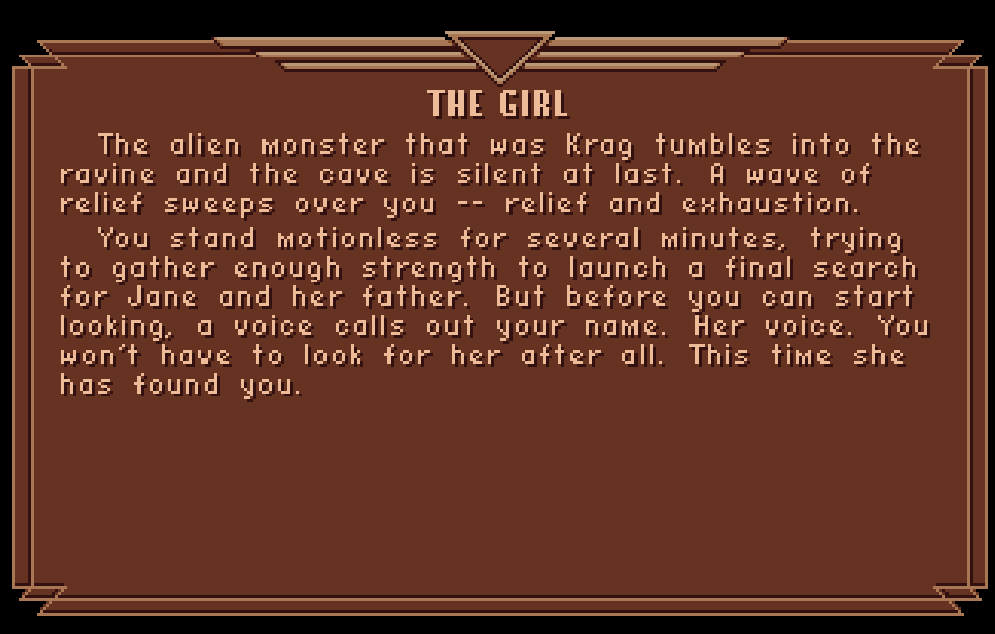 |
In the German version, the ending is a little bit clunky. Prior to fighting Krag, it says that you see Jane and Otto Barnstorff waving to you, which indicates that they see you, and thus, everyone knows where each other is. After you defeat Krag, it says that you're about to start looking for them, but this time, Jane finds you. How could that be when you've already physically seen each other?
Ft. Dix Arrest Ending#
This is not unused, but there's a good chance that not many have seen this screen. The game manual states:
IMPORTANT: You cannot remain in Ft. Dix longer than twelve months in a row or you risk a court martial for cowardice. Wars are won by fighting, NOT by hanging out in New Jersey.
In order to trigger this screen, you have to stay at Ft. Dix for 1 year in-game time (or longer) without flying anywhere.
US/Europe |
Germany |
|---|---|
 |
 |
Development Text#
On Disk 1 in the main executable, there are strings that contain error messages that are separated into 2 groups:
Hex Offset |
String |
|---|---|
0x5EF12 |
Rocket Ranger Error |
0x5EF76 |
Can't open file |
0x5EFA0 |
Out of chip |
0x5EFB5 |
Out of memory |
These likely are technically not unused - they are system condition error messages. Just including them for the sake of preservation.
Hex Offset |
String |
|---|---|
0x607DC |
Can't allocate animation bitmaps. |
0x60821* |
Can't open animation views. |
0x60832 |
Can't open animation rastport. |
0x608E3 |
Read error on file |
These are particularly interesting because the fact they are grouped together this way suggests that they belong to a dedicated error-reporting subsystem. They're not random scattered strings. The errors in the second group are not generic DOS or Intuition errors, which suggests that they're specific to a custom animation engine - likely MovE (see below)
If an exception is thrown via 0x5EF12 - Rocket Ranger Error there is what appears to be a leftover debugging function at 0x5EF26 which is the next listed string:
Trap %ld, %lx %lx %lx %lx %lx %lx %lx %lx %lx %lx %lx %lx %lx %lx %lx %lx
Trap %ld is not a user-facing error message - it's a programmer diagnostic format string. It looks like it was intended to print:
- Trap number
- CPU register values
- Exception context
In other words, this function isn't just "show an error box" - it appears to have been capable of dumping debugging information when an unhandled exception occurs.
Embedded Developer Debug Log#
A comparison of the KBLOCKS archives was competed between 2 copies of the game - an actual retail build, and the widespread QUARTEX cracked release. KBLOCKS.0 on Disk 2 contains the following developer text:
d2k >>vd0:d2k.log1 FFHT FFLT FFPN FFSH FFW1 FFWN FFWS FFXT FLK0 FLK1 FLK2 FLK3 FLK4 FLK5 RocketRanger1: 1
d2k >>vd0:d2k.log1 FO1A FO1B FO1C FO1D FO1E FO1F FO20 FO21 FO22 FO23 FO24 FO25 FO26 FO27 RocketRanger1: 1
d2k >>vd0:d2k.log1 ZAZ1 ZAZ2 ZAZ3 ZAZP ZAZQ RocketRanger1: 1
diskchange RocketRanger1:
cd jh0:rr/data/smsh/2
d2k >>vd0:d2k.log2 C2AN C3AN C4AN CAAN CABD CABK CAD1 CAD2 CAF1 CAF2 CAS1 CAS2 CAS3 CASO RocketRanger2: 0
d2k >>vd0:d2k.log2 GAR3 GMovE
This reveals:
- The internal packer tool's name/invocation: d2k ("data to KBlocks", almost certainly), redirecting its own console output to vd0:d2k.log1 / .log2 / .log3 - three separate log files, one per build pass.
- A literal developer working-directory path:
cd jh0:rr/data/smsh/2
jh0: is an Amiga volume/device assign, almost certainly Jeffrey Hilbers, credited as Rocket Ranger's Chief Graphic Artist - fits perfectly, since this build pass is packing the KBlocks archives, exactly what you'd expect to be run from the art lead's own workstation. RR is plainly the Rocket Ranger project folder, data the asset directory, smsh an internal subdirectory name. Producer John Cutter recalls seeing smsh used a lot internally, with a guess of something like "small shell" or "state machine hash," though he's not fully certain. A second, later theory - given smsh sits in the very build pipeline that packs the archive's SMUS-format music chunks, it may relate to "SMUS" itself - a conversion/packing tool for Sonix Music Driver output, rather than either of John Cutter's guesses. Neither theory is confirmed. This is about as direct a window into Cinemaware's actual build environment down to whose Amiga it ran on that we'll probably ever see.
- A literal diskchange RocketRanger1: prompt - the packer interactively asked for a disk swap mid-build, confirming this is a real multi-disk master build transcript, not test/sample output.
- It logs, in batches, the tag names it just packed, followed by RocketRanger1:/RocketRanger2: and a 0/1 flag - plausibly which destination disk each batch was written to, or a success/fail flag. Not fully confirmed; flagging for anyone who wants to dig further.
This appears to be genuine unintentional leftover developer text. It sits in what was very likely unused/unerased sector space on the disk media used to master the game, never cleared before the final resource data was packed around it.
And the real kicker - this text was found on the QUARTEX release - it is completely absent from the legitimate retail release that was analyzed. It is worth noting that the filesize and structure of the KBLOCKS archives are different between them, with a valid suspicion that either QUARTEX modified the files, or, the QUARTEX release was sourced from a pre-release build of the game.
Easter Eggs#
In all versions of the game - during a successful takeoff sequence, there is a brief scene where Rocket Ranger soars upward through the air. On very random and rare occassions, there are a few slightly altered scenes:
- A bird is flying by. As Rocket Ranger soars upward through the air, he flies by the bird and the momentum knocks it out of the sky.


- Rocket Ranger soars upward through the air as normal. After he is off-screen, a flying saucer comes into view and then flies away. This is actually a brief foreshadowing of the big plot reveal towards the end of the game.
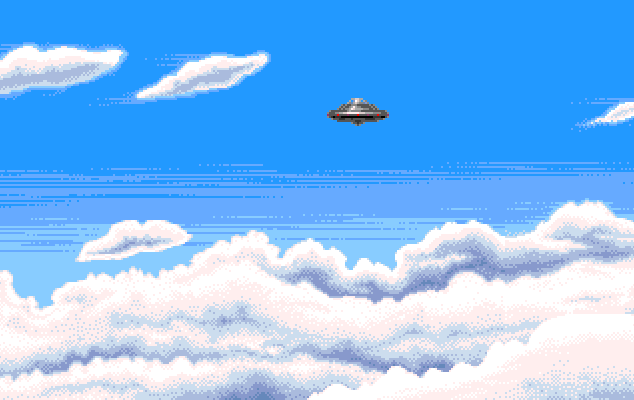
- Even rarer than the previous two, both the bird and the flying saucer can occur in the same scene.
Miscellaneous#
- On Disk 1 in the main executable, there is a copyright stamp for Cinemaware's proprietary animation engine:
MovE v0.35 - © 1988 Cinemaware Corp.
- Upon completing the game, after the medley finishes, the game will loop back to the beginning. If you continue to play, you'll see that the difficulty increases - the Nazis move faster and are more efficient.
- John Cutter's wife Melanie Cutter voiced Jane and the dominatrix outfit-wearing Nazi slaves on the moon.
- Computographist Randy Platt, and Artist Rob Landeros voiced Tom Cody (Rocket Ranger), Colonel Leermeister, Dr. Barnstorff, the Nazi guard, and the fascist alien. It is not presently known who voiced which (of these) characters.
- Every location type has an associated music track. For some reason, the very first flight you take in the game will ignore the location's associated music track and always play smus.SxF7. It is unknown if this is intentional or not.
From The Creators#
This section details commentary from Cinemaware staff that created this masterpiece.
The Game's Difficulty:#
John Cutter: "... I don't think I ever beat it myself!"
Pre-Release Content:#
John Cutter: "I don't remember why we had the demo disks. (Though we did send out disks to magazines, as I recall.) Might have been demos for CES / E3, too. (Though they are more likely to be for magazines.)"
Stories From the Game's Development:#
Regarding the fistfight sequence:
John Cutter: "That scene wasn't working very well. It just wasn't fun to play. Then our sound guy, Bill Williams, recorded some "punch" sounds from an old John Wayne movie and we put those in. Suddenly, that sequence was fun to play! It was like you were in a brawl in an old Western!"
Jeff Godfrey: "When I started working at Cinemaware, Rocket Ranger was pretty much done. They were busy trying to fit it on as few disks as possible, but they asked me to rework the sprites for the fist fight because the Nazi soldier looked like he had a fur collar on his coat. So my first few weeks at Cinemaware I reworked the sprites and created new sprites for a spinning knockout. It was nice to have a game published so soon after starting in the industry." - https://imgur.com/gallery/rocket-ranger-videogames-advert-late-80s-amiga-apple-ii-atari-st-c64-pc-knEuy8D