 This article has a talk page!
Puggsy is a puzzle platformer by those silly Brits, where you pick up stuff and use that stuff in order to make other stuff do stuff to get your stuff working in order to get your other stuff out of whatever stuff you've gotten your stuff into.
A version for the SNES was planned, but eventually scrapped.
Sub-Page#


Anti-Piracy Method#
left|Yes, "thats" all the the levels "your" allowed to play. Although the official retail cart does not contain SRAM, the game attempts to write to it anyway in order to detect third-party copying devices (which always contain SRAM). If the write is successful, the game will appear to function normally, though the player won't jump as high as normal. In addition to this, after clearing a few levels the game will stop and present the player with a personal "gotcha" message from the Traveller's Tales devs. Rather infamously, many emulators which blindly create SRAM regions for each game will also trip the check.
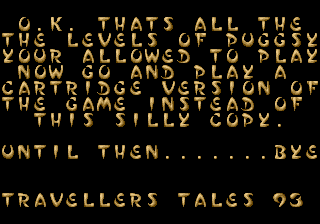
The game also tries to prevent these tests from being easily detected and removed - there are six write checks split into three sets, with one of them stored at the end of a subroutine called four times throughout the game, another checked once immediately before one instance of the subroutine call is executed, and the third in a vertical interrupt routine. The SRAM address the game checks also cannot be detected easily, as the game loads an address some random distance away from the actual address and adds the distance immediately afterward through lea instructions. All checks have different base values and distances.
Alternate Sega Logo Screens#
Watch on YouTubeIn order to easily pass Sega's quality checks, many variations of the Sega logo screen were implemented and could be selected by simply changing the version code in the ROM header. A very similar system was also used in Wiz 'n' Liz. This is what it's set to by default:
(VER=0112)The numbers after "VER=" are as follows:
- First digit - Unused.
0012 |
0112 |
|---|---|
 |
 |
- Second digit - Prints the license text if set to 1, and doesn't print it if set to 0.
0002 |
0102 |
0112 |
|---|---|---|
 |
 |
|
- Third digit - Plays the Sega logo animation if set to 1, and shows a static logo screen if set to 0.
0001 |
0101 |
0011 |
|---|---|---|
 |
 |
 |
0111 |
0112 |
|---|---|
 |
|
- Last digit - Shows the Sega logo with TM if set to 2, shows the logo without TM if set to 1, and skips logo intro if set to 0.
"A Hidden Place" Passwords#

If you take five specific letters in A Hidden Place, stack them on top of each other, and push that stack through the exit gate, you can unlock interesting effects. These effects are listed in the order the game checks, and take effect after the score tally:
- CHEAT - Enables infinite lives, but turns Puggsy (and things that use his colors, such as letters/numbers) green as a consequence.
- HEROS - Opens a cutscene window with a demoscene-esque credits/greets message from the developers scrolling by.
SO YOU HAVE FOUND ANOTHER SECRET BIT. THIS SCROLL TEXT IS JUST TO SAY THAT PUGGSY
WAS WRITTEN BY JON BURTON AND ANDY INGRAM. ALL THE GFX WERE DRAWN BY ANDY INGRAM
AND THE GAME WAS DESIGNED AND PROGRAMMED BY JON BURTON. THE LEVEL DESIGNS WERE ALSO
BY JON BURTON. MUSIC WAS BY MATT FURNISS AND S. HOLLINGWORTH OF KRISALIS SOFTWARE.
HOPE YOU ENJOY THE REST OF THE GAME. THERE IS MORE TOO IT THAN MEETS THE EYE. A BIG THANKS
TO M.R.CHUDLEY FOR THE USE OF THE FLUFFY WUFFY BUNNY WABBITS GFX.     IN TRUE DEMO STYLE
IT IS TIME TO WRAP SEE YA..................................- SHOES - Gives Puggsy a pair of shoes.
- OTHER - Opens a blank screen that shows red/blue and yellow/white streams of particles swirling around each other while the Light House music plays. The effect is very similar to the fireworks seen in early prototypes. The animation loops infinitely until you press Start.
(Source: Andlabs (OTHER))
Unused Music Track#
A short track that's not used anywhere. It's a lot shorter than most of the stage themes.
Regional Differences#
Junior mode, which can be accessed on the title screen, is a demo game for beginners that uses level layouts from the main game. The levels and items used in this mode were changed for the US version, likely because the European version was rather challenging for beginners.
While both versions end with the boss from the Pyramids, it only takes two hits in the US version as opposed to seven in the European version.
Levels#
The chart below illustrates which levels from the main game were used for each Junior level. The Light House 2 was originally a hidden level in the European version; this was moved to Level 5 in the US version.
Level |
Europe |
US |
|---|---|---|
Level 1 |
The Beach 3 |
The Beach 1 |
Level 2 |
The Cove 1 |
The Beach 3 |
Level 3 |
Darkskull Castle 3 |
Star Fall Lake 2 |
Level 4 |
Pyramids 3 |
Diamond Mines 1 |
Level 5 |
N/A |
The Light House 2 |
Hidden Level |
The Light House 2 |
N/A |
Map#
|
Europe |
US |
|---|---|

|

|
The map screen in the US version was altered as a result of the aforementioned level changes.
Item Layout Differences#
The levels that are shared in both versions - Beach 3 and The Light House 2 - have different item layouts in US version to make them easier, while the European version stays closer to the layouts found in the full game.
Beach 3#
Europe |
US |
|---|---|
 |
 |
 |
 |
In the US version, the staircase of barrels at the beginning is already fully assembled, and a stack of coins and extra lives has been added near the switch at the end. The US version also uses the music from A Hidden Place.
The Light House 2#
Europe |
US |
|---|---|
 |
 |
 |
 |
 |
 |
In the US version, the lighter on the far right has already been repaired and the candle was moved right next to it. The coin next to the machine on the far left was moved to the right of the machine in the US version, while it's on the left of it in the European version. The exit gate is also yellow in the US version, as opposed to purple in the European version.
Boss Fight#
Europe |
US |
|---|---|
 |
 |
In the European version, the boss starts with all 6 hit points like the main game. The US version dropped this to 1.
|
The Puggsy series | |
|---|---|
|
SNES |
|
|
Genesis |
|
|
Sega CD |
|