This is a sub-page of Professor Layton and the Last Specter.
Many puzzles in the Japanese version had the player write an answer in either hiragana or katakana. A few of their corresponding US puzzles reused the setup and changed the method of input to circling an item or location. However, most were replaced with either completely new puzzles, or Weekly Puzzles from the Japanese version. Some other puzzles were altered or replaced, despite not depending on the Japanese language.
Main story puzzles#
Changed for America#
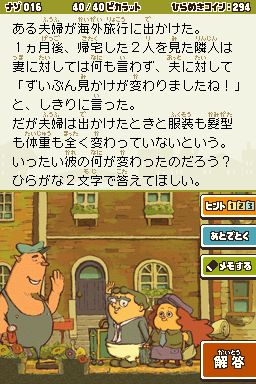
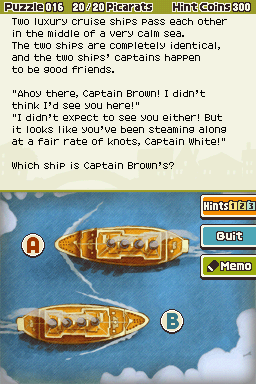
Puzzle No. 016: The Japanese version is about a couple returning from a month-long vacation, and their neighbor noticing that the husband, but not the wife, now looks much different. The player must answer with what about him changed. The US version is about determining which of two ships passing by each other on the sea belongs to which captain.
|
Japan |
US |
|---|---|
|
|
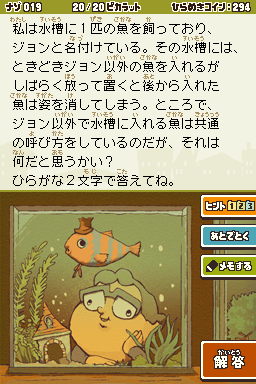
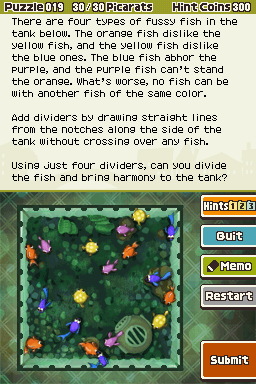
Puzzle No. 019: The Japanese version is about someone who puts other fish into the tank for their fish John, only for the other fish to later disappear. The player must use two hiragana to explain why this happens. The US version is about drawing lines to separate the four species of fish in a tank based on what species can tolerate each other.
|
Japan |
US |
|---|---|
|
|
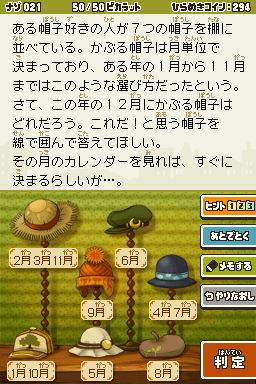
Puzzle No. 021: The Japanese puzzle is about someone who wears one of seven hats based on the months of the year, and asks which hat would also be worn in December. The US version replaces this with Japanese Weekly Puzzle 44, about using hints to find the correct numeral code.
|
Japan |
US |
|---|---|
|

|
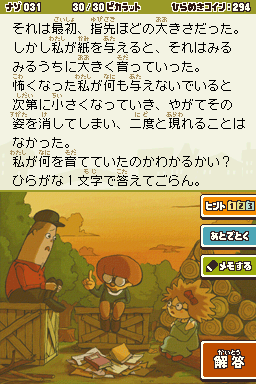
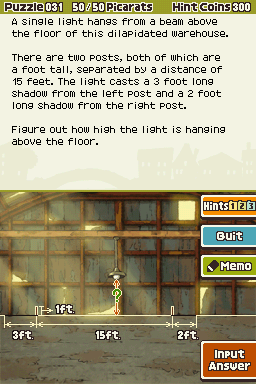
Puzzle No. 031: The Japanese version asks the player to write the name of an initially tiny object that grows before your eyes when it is given paper, but shrinks and eventually disappears should you stop giving it paper. The US version replaces this with Japanese Weekly Puzzle 48, about finding how far off the ground a light is, given the lengths of the shadows it casts on objects.
|
Japan |
US |
|---|---|
|
|
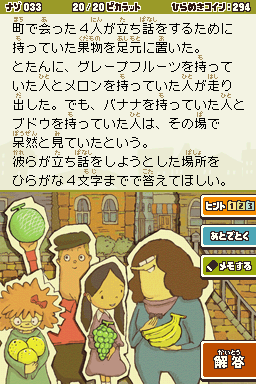
Puzzle No. 033: Both versions concern the meeting location for some people who put certain types of fruit on the ground. The Japanese version has the player write a word that describes where they met. The US version has the player circle the meeting location on a map.
|
Japan |
US |
|---|---|
|

|
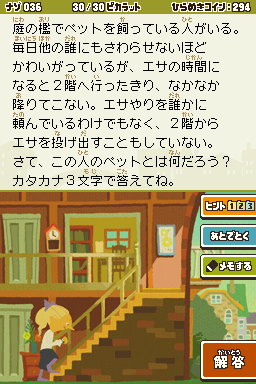
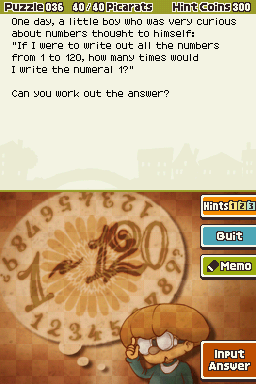
Puzzle No. 036: The Japanese version asks the player to write what kind of animal someone is keeping for a pet, based on how they have to feed it from the second story of a building. The US version asks how many times the digit 1 is written when writing out all the numbers from 1 to 120.
|
Japan |
US |
|---|---|
|
|
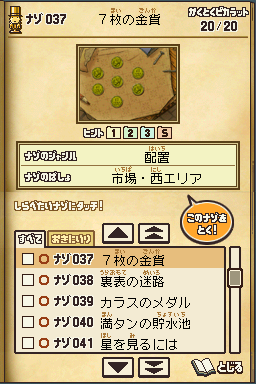
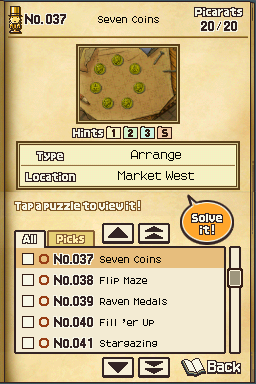
Puzzle No. 037 has a different preview picture in the Japanese version. It shows seven coins in a hexagon with one in the center, whereas they are in a heptagon in the US preview and both the US/JP versions of the puzzle itself.
|
Japan |
US |
|---|---|
|
|
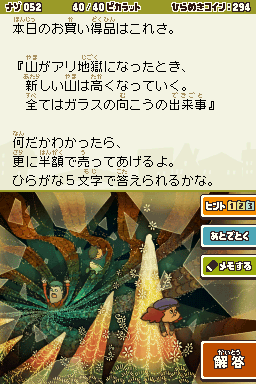
Puzzle No. 052: Both versions describe an object with a riddle. The Japanese version asks for an answer using 5 hiragana characters, and also presents the puzzle as "This item is today's bargain. [riddle] If you know what it is, I'll sell it to you half off." The US version asks the player to circle one of the items on the table.
The Japanese riddle translates as "When the mountain turns into an antlion pit, a new mountain starts to grow. It all occurs beyond the glass."
|
Japan |
US |
|---|---|
|

|
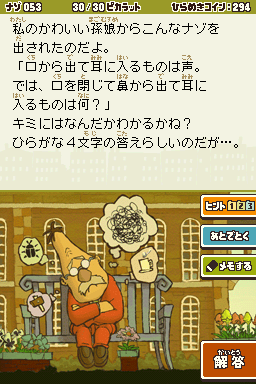
Puzzle No. 053: The Japanese version has a riddle that translates as, "If your voice is what comes out your mouth and enters your ears, what would be something that, with your mouth closed, comes out your nose and enters your ears?" The US version replaces this with Japanese Weekly Puzzle 38, about which book on a shelf is never taken out first.
|
Japan |
US |
|---|---|
|

|
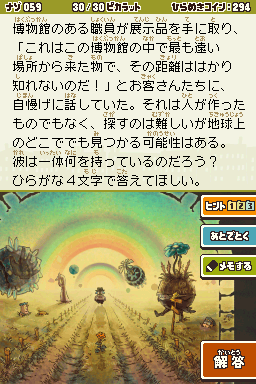
Puzzle No. 059: Both versions concern a museum employee describing the object that came from the farthest away from the museum. The Japanese version asks for its name. The US version has the player circle which room the object is in, and adds the part about getting lost in the museum.
|
Japan |
US |
|---|---|
|

|
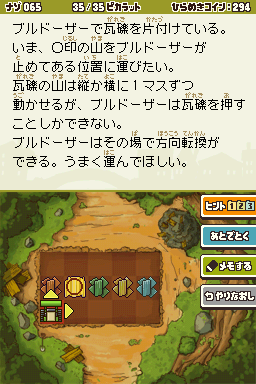
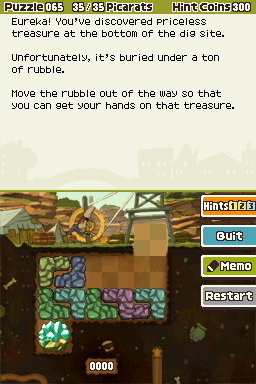
Puzzle No. 065: The Japanese version has the player control a bulldozer to push the yellow block into the bulldozer's starting position. The US version replaces this with a sliding block puzzle.
|
Japan |
US |
|---|---|
|
|
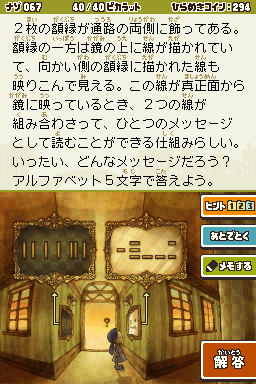
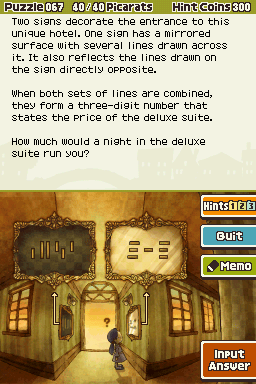
Puzzle No. 067: Both versions have the player determine what message is reflected in a mirror. The US version hides the price of the deluxe suite at a hotel, whereas the JP version hides a message in English and simply describes the location as a passage.
|
Japan |
US |
|---|---|
|
|
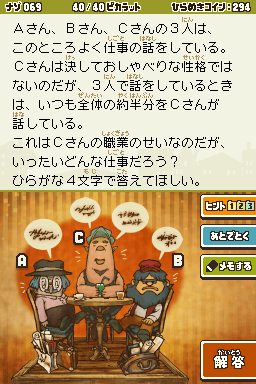
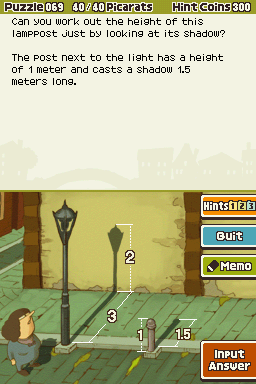
Puzzle No. 069: The Japanese version has the player input the profession of a man who talks roughly half the time when talking in a group of three, despite not being a talkative person. The US version replaces this with Japanese Weekly Puzzle 49, concerning the height of a lamppost based on the height of the shadow it casts on a nearby wall, and on the height and shadow of a nearby post.
|
Japan |
US |
|---|---|
|
|
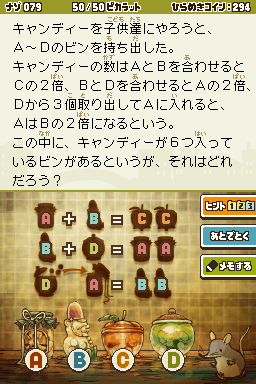
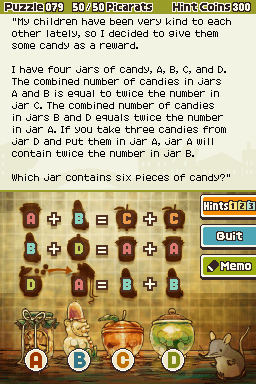
Puzzle No. 079: The US version adds plus signs to the right hand sides of the equations.
|
Japan |
US |
|---|---|
|
|
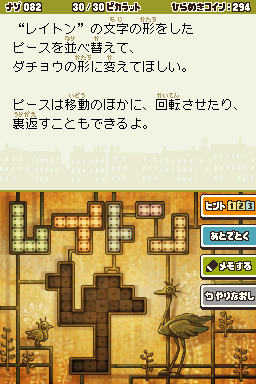
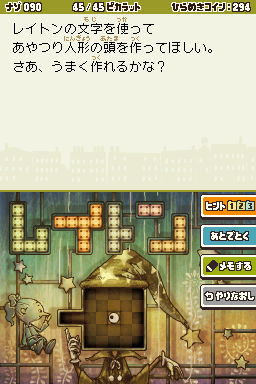
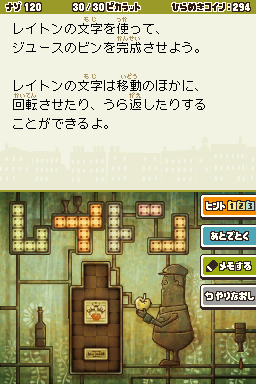
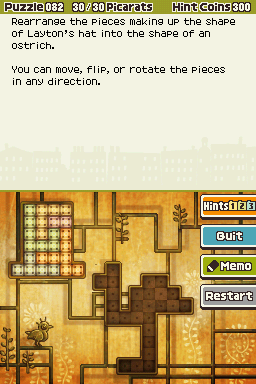
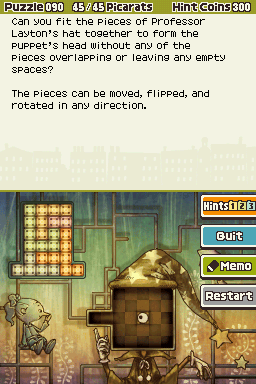
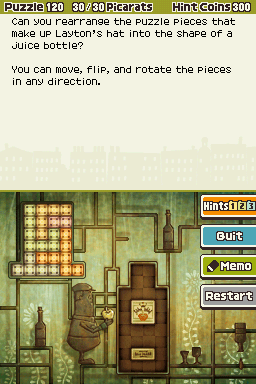
Puzzles 082, 090, and 120 each have the same respective solution between versions, but use different initial layouts for the blocks. The Japanese puzzles arrange them to spell out レイトン "Layton". The US puzzles arrange them in the shape of Layton's hat.
Puzzle 082 |
Puzzle 090 |
Puzzle 120 |
|---|---|---|
 |
 |
 |
 |
 |
 |
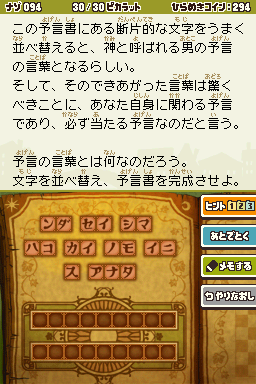
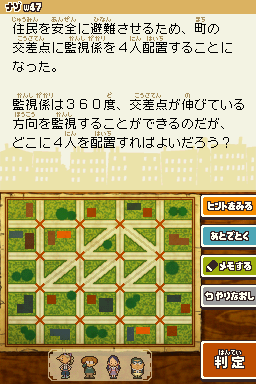
Puzzle No. 094: The Japanese version has the player use the katakana blocks to construct a sentence containing a prediction from the gods, as the puzzle is so named (神の予言). The prediction ends up translating to "You will correctly solve this puzzle." The US version replaces this with Japanese Weekly Puzzle 47, and also uses police officers as the patrollers instead of the puzzle characters.
Japan 094 |
US 094 |
Japan W47 |
|---|---|---|
 |
 |
 |
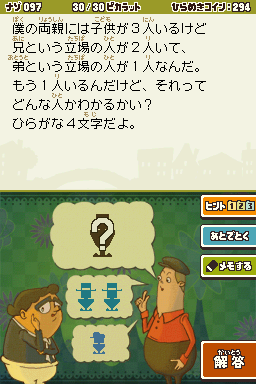
Puzzle No. 097: The Japanese version is about a family that has 3 children, of whom two can say "I'm an older brother," but only one can say "I'm a younger brother." The player needs to describe the other child. The US version concerns how many friends a girl is inviting over for a party.
|
Japan |
US |
|---|---|
|
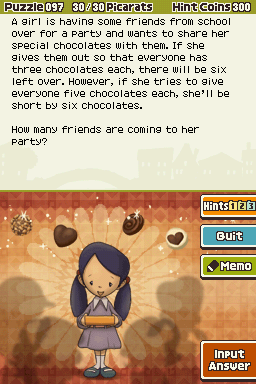
|
Puzzle No. 102: The Japanese version is about which member of a family is the most prideful, based on who has the longest facial hair. The US version replaces this with Japanese Weekly Puzzle 05, which is about cleaning up the pieces of a broken window.
|
Japan |
US |
|---|---|
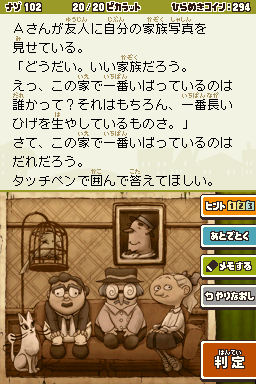
|
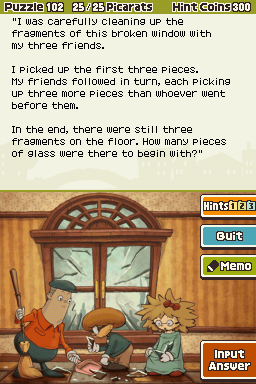
|
Puzzle No. 105: The Japanese version has the player use the katakana characters in the heart to determine what someone's wife wants, based on what she told him on their first date: "I don't need anything like a diamond ring, a pearl necklace, ruby earrings, or a platinum tiara".
The method for finding the solution is to eliminate every katakana that is used in the list of jewelry. It ultimately leaves you with just the キ and ス, which gives two accepted answers キス "a kiss" or スキ "I love you."
Because this setup would not easily carry over to a heart filled with letters of the alphabet, the US version replaces this with Japanese Weekly Puzzle 50, which is about a girl giving away all but one of the flowers in a bouquet to other people.
|
Japan |
US |
|---|---|

|
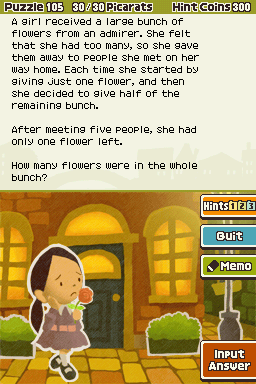
|
Puzzle No. 127: Both versions of the puzzle are about following directions for pressing buttons on a phone keypad, but each direction in the list is flipped between the versions. The Japanese list is up, left, up, right, up, right, down, and left. The US list is down, right, down, left, down, left, up, and right.
|
Japan |
US |
|---|---|
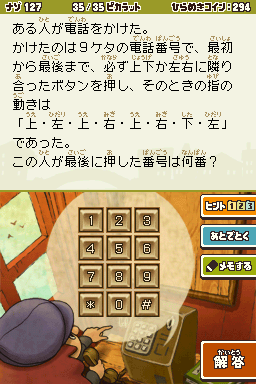
|
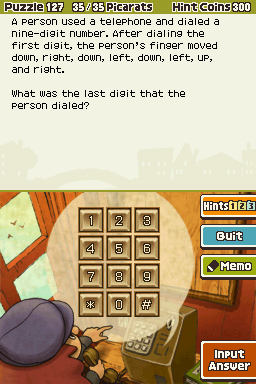
|
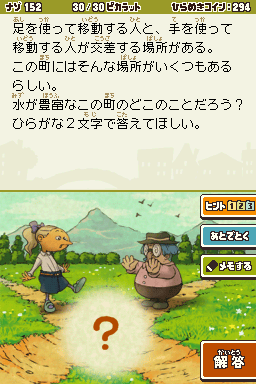
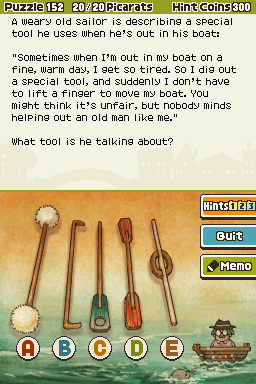
Puzzle No. 152: The Japanese version has the player write the answer to the question, "In a town full of bodies of water, at what kind of place would people who move with their feet cross paths with people who move with their hands?" The US version replaces this with Japanese Weekly Puzzle 28, about the tool an old sailor would use so that he doesn't have to row his boat when he gets tired.
|
Japan |
US |
|---|---|
|
|
Changed for Europe#

|
This page or section needs more images. |
Only Puzzle No. 006 was slightly changed: You still have to reassemble the broken nameplate like in the US version, but instead of forming the word “POST”, you must form the number “1234”.
Of course, there is the fact that most puzzle titles and instructions have been rewritten, on par with the earlier games in the series.
Weekly Puzzles#

|
This needs some investigation. |
Japan-only Weekly Puzzles#
Thirteen of the Japanese version's 52 Weekly Puzzles were cut from the US version, because they either depended on the Japanese language or required writing a word in hiragana. Another eight listed above were repurposed as puzzles for the main story.
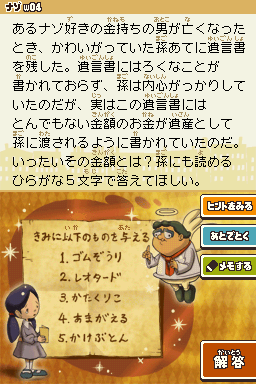
Japanese Puzzle W04 孫への遺言書 "Will to my Granddaughter": A wealthy lover of puzzles passes away and appears to leave unimportant items for his granddaughter in his will (rubber flip-flops, a leotard, potato starch, a Japanese tree frog, and a bed cover). Deep down, she is disappointed, but the will actually contains a hidden message for a very large sum of money she is to inherit. What's the message?
The solution is to use the number on each line to, for example, take the 1st kana on line 1 and the 2nd kana on line 2. This gives you ゴオくえん -> 五億円 -> 500 million yen.
Japanese Puzzle W08 冬の張り込み "Winter Surveillance": A detective is in front of a warehouse in the middle of winter, on the lookout for a criminal. Despite staying quiet in the shadows, the criminal did something that caused them to be discovered and forced them to escape out a back door. What was it?

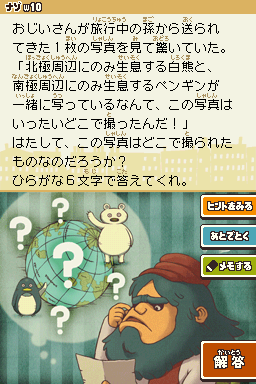
Japanese Puzzle W10 ペンギンと白熊 "Penguins and Polar Bears": A man receives a photo from his travelling grandchild, and is surprised to see polar bears from the Arctic and penguins from the Antarctic in the same photo. Where on Earth could it have been taken?
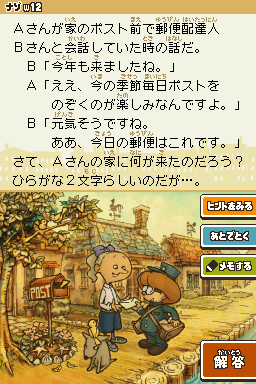
Japanese Puzzle W12 来たものは? "What Has Come Here?": A postman is delivering mail to a woman, and brings up that something nice has come to her house once again this year. She agrees, "Yes, I enjoy seeing it every day this season." What is it?
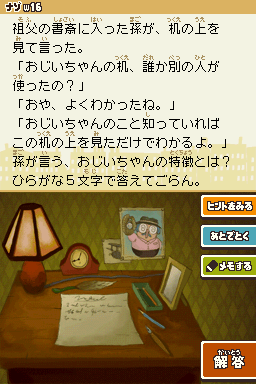
Japanese Puzzle W16 誰かが使った机 "Someone's Used the Desk": A chlid looks at their grandfather's desk and notices just from looking at it that someone else has been using it, because of a certain trait about the grandfather.
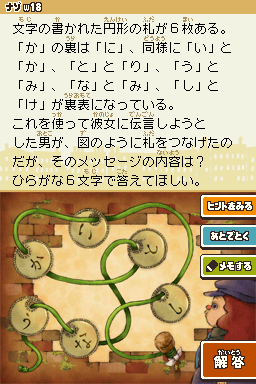
Japanese Puzzle W18 円形の札 "Circular Tags": A man has a string with six tags on it, each with a hiragana character on both sides. When he pulls the string taut, the tags spell out a message for his girlfriend. What could the message be?
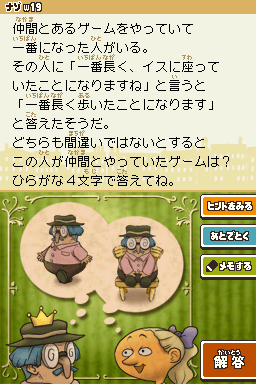
Japanese Puzzle W19 長く歩いた人 "A Person Who Walked for a Long Time": After some friends finish playing a game, one says to the winner, "You sat in chairs longer than any of us." However, he replies, "I walked the most of us." Both are telling the truth, so what game were they playing?
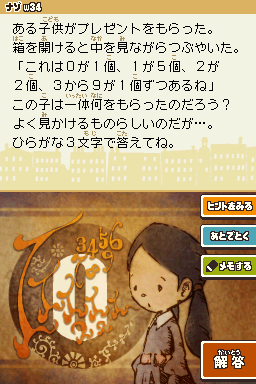
Japanese Puzzle W34 0が1個 "It Has One 0": A child receives a present and mutters about it, "It has one 0, five 1s, two 2s, and one each of 3 through 9." What present did she get?

|
'...But does it make sense?' |
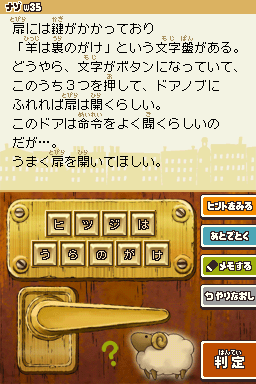
Japanese Puzzle W35 扉の暗号 "The Door's Code": The lock on a door has a keypad of kana characters that reads ヒツジはうらのがけ "The sheep is the cliff on the inlet." Which three buttons should you press to order the door to open?
The solution is to press the ヒ, ら, and け buttons, to spell out 開け hirake, which is the command "Open!"
Japanese Puzzle W36 その競技は? "What Competition Is That?": Three Olympic athletes are talking about their events. The hammer thrower says, "I have to spin round and round, and throw things." The long jumper says, "I have to run and jump." The third athlete says, "My event isn't in track and field, but I do everything the hammer thrower and long jumper do." What is the third athlete's event?

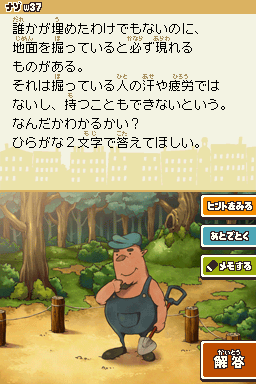
Japanese Puzzle W37 地面を掘ると "When He Digs Up the Ground": Although a man hasn't buried anything, something is appearing as he digs up the ground. It is neither his sweat or fatigue, nor is it something that can be held. What could this something be?
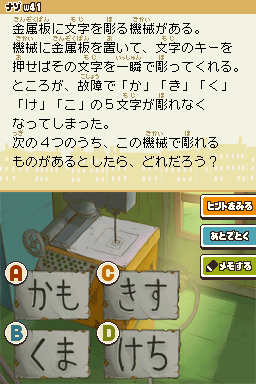
Japanese Puzzle W41 故障した機械 "The Faulty Machine": There is a machine that engraves hiragana characters into metal plates. As soon as you press a key for a character, the machine engraves it in an instant. Unfortunately, a fault leaves it unable to write the five hiragana from ka through ko. Which of the below four messages can the machine still engrave?
The solution is that it can still engrave くま, by using a へ he kana rotated 90 degrees as a substitute for the く ku.
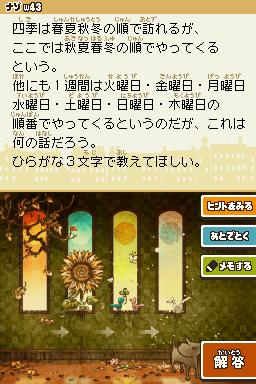
Japanese Puzzle W43 四季の順 "Order of the Four Seasons": Somewhere, the four seasons come in the order autumn, spring, summer, and winter. Moreover, the days of the week come in the order Friday, Monday, Saturday, Sunday, Thursday, Tuesday, and Wednesday. Where could this be?
(Translation note: the days and seasons are intentionally not in the same order as the original Japanese)
New Weekly Puzzles for US#
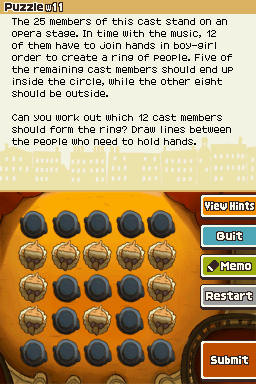
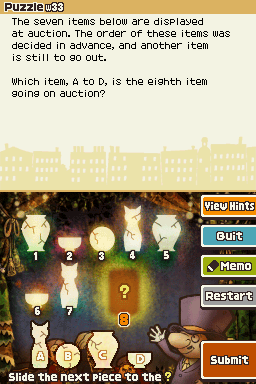
Weekly Puzzles W11 and W33 were created for the US version.
|
US W11 |
US W33 |
|---|---|
|
|