 This article has a talk page!
This is a sub-page of Hatsune Miku: Project Mirai DX.
Unused Graphics#
obj_stgpv011#

This is used in Piano Girl's stage model, but its only seen for less than a second in-game at the end of the PV without showing the stars. Since it only shows one color from the texture, the stars go unused.
obj_stgpv043#
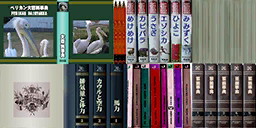
Kokoro's stage model has an odd texture for books. This could possibly relate to something with the original animated PV, meaning that PV may have been planned at one point.
obj_stgpv075#
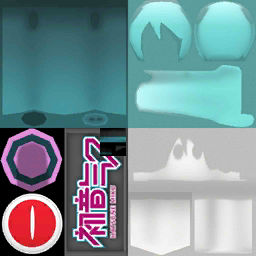
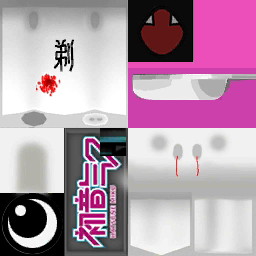
These textures are used in Common World Domination's PV for Aimaina-chan and Doshite, but Aimaina-chan uses the same texture from the room item, and it has a Hatsune Miku logo like how other room items do, but with a small square texture covering some of it. Doshite's textures are laid out like a room item, so it may have been planned to be a room item, but most likely cut because of the knife she has and the blood coming out of her eyes. The Hatsune Miku logos however are probably just placeholder to cover up transparency.
spr_ae_adv#

A graphic used for the eShop Demo on the title screen. This graphic is in all versions untranslated.

Another graphic used in the eShop Demo on the bottom screen. All versions have this untranslated.

This graphic is seen in Mirai 1 and Mirai 2 when the game starts up, but it doesn't appear at all in Mirai DX.
spr_ae_costume#
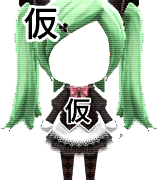
A placeholder costume preview with "temporary" written on top twice.


Body icons exist for all of Gumi's modules. Either Gumi was planned to be playable in "My Room" or you were originally able to change into her body modules only for a PV like every other character, or both.
spr_ae_closet#

The American and European version of the game contains an untranslated leftover of a help bar for Dress-Up from the Japanese version of the game.
spr_ae_dance#

Four copies of this placeholder stage icon are left among used stage icons.
spr_ae_game#

A leftover star note from Mirai 1. This is still fully functional in game and works almost the same way as Mirai 1. When a note is missed, it doesn't disappear like how it did in Mirai 1. All 4 buttons work with it (A, B, Y, X), but the D-Pad doesn't (Up, Right, Down, Left). The Role Model item also hits X with it, as that's the default note according to the hex values, which X is 00. The note can be seen in-game in the video above.


Three graphics that say "Get!". They may have been a placeholder for getting a note, as they also have an earlier font design.
spr_ae_profilecmn#


More leftover Japanese menu sprites in the American and European version. The orange Mirai 2 ones are unused entirely.
spr_ae_pv030 / spr_ae_pv037#


An unused logo and credit for the song StargazeR, indicating that it was planned to be included at one point. This is directly ported from Dreamy Theater 2nd, because the texture names have "pv202" which is the PV for StargazeR in Dreamy Theater 2nd.
spr_ae_minigame#
|
Early |
Final |
|---|---|
|
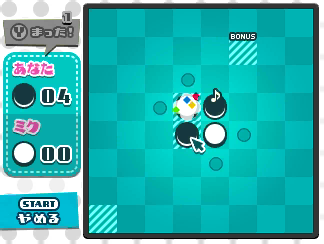
A placeholder menu of the Mikuversi minigame. The layout and design seems close to the final.
spr_ae_mplayer#

The music player in Mirai 1 didn't have icons at all, so this icon seems odd due to the fact that Yumeyume's animated PV is playable in the options. It might have been used for testing.
spr_ae_puyocmn#
|
Early |
Final |
|---|---|
|
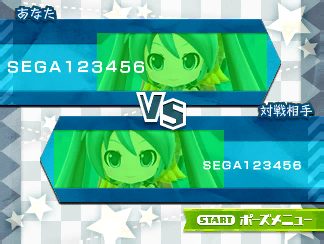
A test menu for PuyoPuyo. There's also a placeholder Mirai Username, which is "SEGA123456".
spr_ae_pvcmn#

This Leia graphic would have been used for the bottom screen menu when playing the PV. It's the same one from Mirai 1.
spr_ae_pvsel#

An unused text graphic for Leia. Strangely, this was updated from the unused one in Mirai 1.


While this is used in the song select, there's an unused copy of this text for Yumeyume. It was even translated in the American and European version.

Leftover theater info from Mirai 1 for Yumeyume.
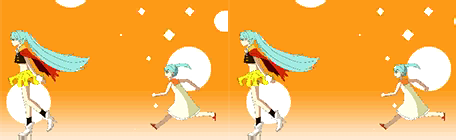
Either SEGA planned to make Yumeyume's animated PV an option to switch PVs from the 3D version, since it has several files to make this possible, or a simple leftover.
Easy |
Normal |
Hard |
|---|---|---|
 |
 |
 |
 |
 |
 |
All the numbers for each difficulty have graphics for numbers 1-9. However, Easy only uses 1-3, Normal uses 3-6, and Hard uses 6-9, making 4-9 unused for Easy, 1, 2, and 7-9 unused for Normal, and 1-5 unused for Hard.
spr_ae_pvshow#
|
Early |
Final |
|---|---|
|
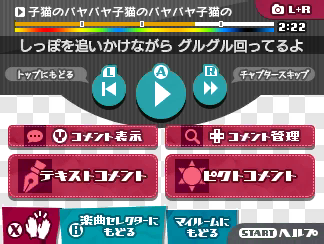
A placeholder graphic of the full bottom screen menu when viewing a PV. It has small differences from the one in game, like a rainbow color line for where comments are, Koneko no Payapaya's song title, time of where the song is at, and some lyrics from said song, all in Japanese. This could possibly be an early design of the menu, as it also has different skip point graphics than the ones in the final.
spr_ae_remodel#
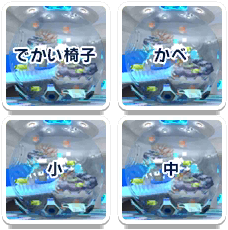
Four item placeholder icons. The top left says "football", top right says "huge chair", bottom left says "small", and the bottom right says "during". If put together, it makes a full sentence:
"Huge chair during small football."
This could have been a little inside joke one of the developers did.
spr_ae_result#


A generic demo end screen. This design is commonly seen in various E3 demos for 3DS games.


These graphics were used on the bottom screen at the results screen in the eShop Demo. Of course though, in their respective versions.
spr_ae_roomitem#

Four placeholders for item names. From top left to bottom right, they read Poster (8), Poster (9), AAAAA, and <
spr_ae_test#
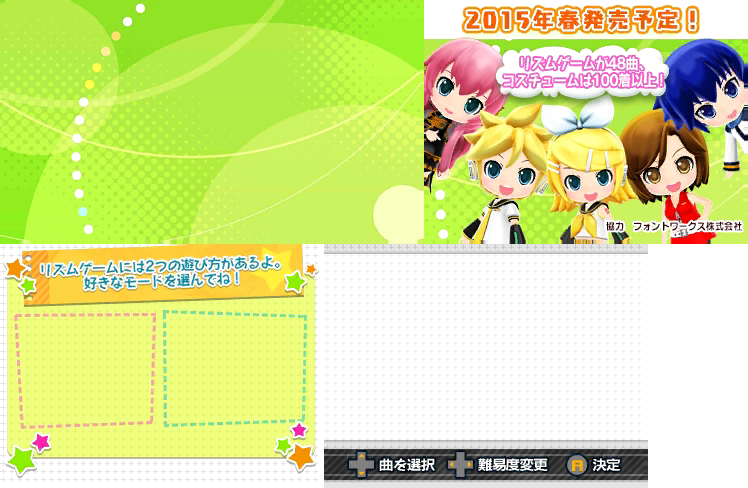
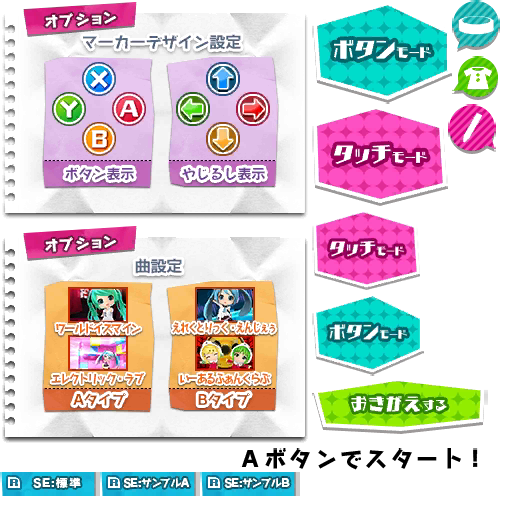
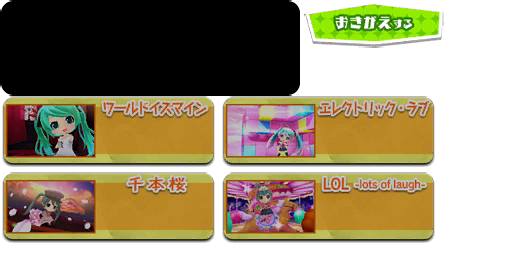
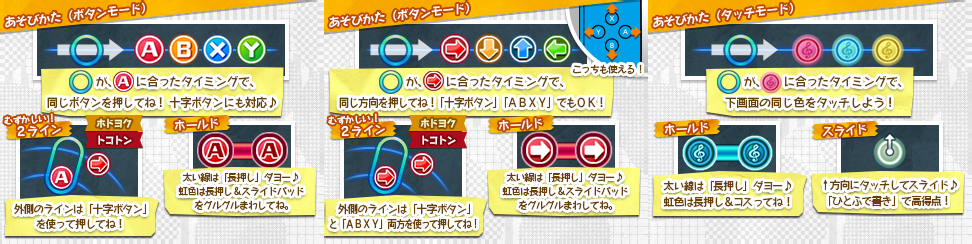
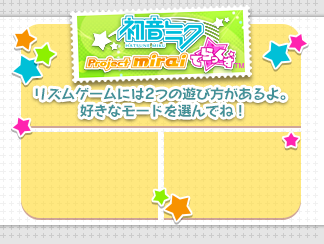
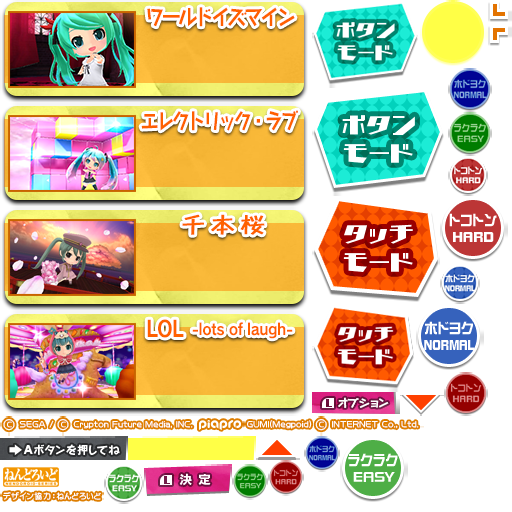


Various leftover graphics from a demo version of the game.
spr_puyoaqua#
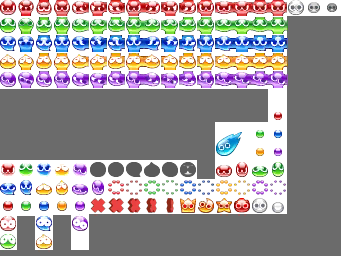
Possible earlier Puyo Puyo sprites known as Aqua that seem to be a mix of the Mirai and Classic sprites. This file is entirely unused.