 This article has a talk page!
Evil Zone is a 3D fighting game notable for having a unique story mode for each of the characters, complete with episode names and previews with voice acting.
Debug Display#
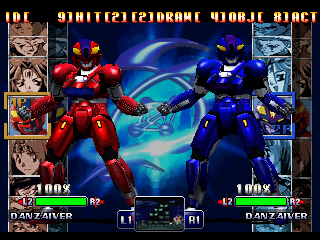
Use the following code to display debug text on top of the screen. This debug text is similar to The Pro Wrestling'' andWWF SmackDown!'', both games are developed by Yuke's respectively.
Japan |
US |
Europe |
|---|---|---|
|
|
|
(Source: Original TCRF research)
This flag can be activated by a hidden debug menu that replaces the pause menu in Versus mode. Set 80083eb8 to 01 in the NTSC-U version to activate it.
Unused Video#
ENDING1P.STR, only present in the Japanese and European versions, is an early version of the game's credits cinematic, dated January 31, 1998. The most notable difference is that Japanese text is used, whereas the final credits sequence uses English.
Regional Differences#
Intro/Title#
- A different intro song is used for the game's localizations.
Japan |
US/Europe |
|---|---|
- The title screens are completely different for each region, reflecting the art of the boxarts. The copyrights at the bottom are also different:
Japan |
USA |
Europe |
|---|---|---|
 |
 |
 |
Characters#
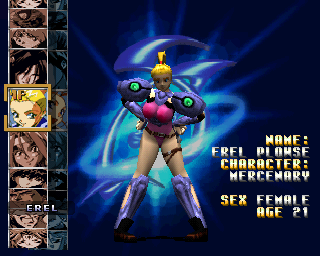
- The characters Alty Al Lazel, Erel Plowse, Midori Himeno, Setsuna Saizuki and Linedwell Rainrix had their ages (15, 17, 18, 14 and 20, respectively) changed to 21 in the American and European releases. Curiously, the European instruction booklet uses the age data from the original Japanese release.
- In addition, Erel was given less suggestive clothing in the American release. Despite this, her design was not changed in the game's prerendered cutscenes or in the instruction booklet.
Japan |
US |
Europe |
|---|---|---|
 |
 |
 |
- Erel was also given a different theme in the localizations.
Japan |
US/Europe |
|---|---|
Story#
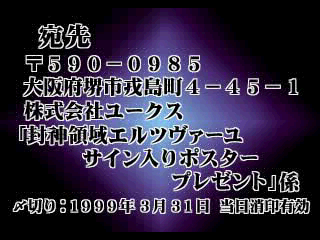
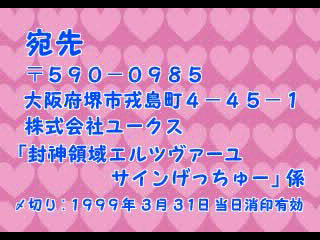
- In the Japanese version, at some point in each character's story, an ad for what seems to have been a promotional event is displayed. The text for each character is mostly the same, barring the "prize" that is being advertised. The only exception to this is Midori Himeno's story, which instead features drawings submitted by fans.
Danzaiver

Japanese |
Translation |
|---|---|
|
|
Alty Al Lazel

Japanese |
Translation |
|---|---|
|
|
Keiya Tenpouin
Japanese |
Translation |
|---|---|
|
|
Erel Plowse
Japanese |
Translation |
|---|---|
|
|
Midori Himeno
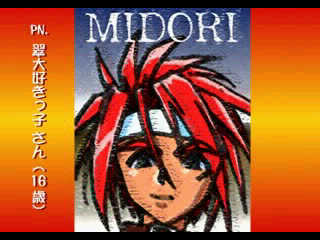
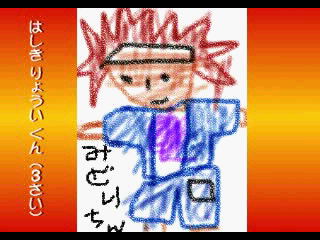
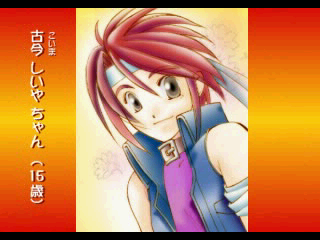
Japanese |
Translation |
Japanese |
Translation |
Japanese |
Translation |
|---|---|---|---|---|---|
PN. 翠大好きっ子 さん |
pen name Midori Lover |
はしき りょうい くん |
Ryoi Hashiki |
古今 しいや ちゃん |
Shiiya Koima |
Setsuna Saizuki

Japanese |
Translation |
|---|---|
|
|
Gally 'Vanish' Gregman

Japanese |
Translation |
|---|---|
|
|
Linedwell Rainrix

Japanese |
Translation |
|---|---|
|
|
Kakurine
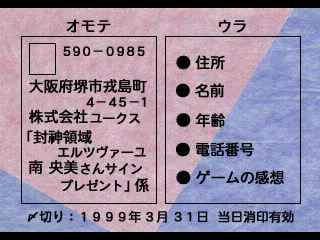
Japanese |
|
|---|---|
|
|
〆切り1999年3月31日 当日消印有効 |
|
Ihadulca
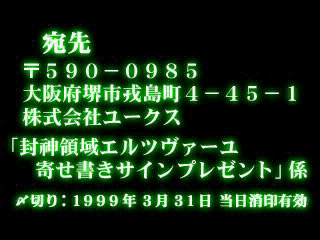
Japanese |
Translation |
|---|---|
|
|
- In the Japanese version, the characters Linedwell and Kakurine use remixed versions of their themes for their story mode cutscenes. In the localizations, however, the original versions are used.
- In the localizations, Kakurine's voice changes during cutscenes with Ihadulca. This does not happen in the original Japanese release.
- In the Japanese version, Midori's theme during the story mode cutscenes lacks the introduction part.