 This article has a talk page!
Dynamite Headdy is an interesting, rather unique game in which you fire your head at enemies and get different heads as powerups. It also doesn't take itself very seriously.


Debugging Functions#
Stage Select#

On the title screen, highlight Start Game and press C, A, Left, Right, B. If Headdy says "Nice!", press Start, and you'll be taken to a stage select screen.
Animation Viewer#

On the title screen, highlight Options and press C, A, Left, Right, B. If Headdy says "Nice!", press Start, and you'll be taken to a screen used to test Headdy's animations. Press Left and Right to cycle through frames. Hold A and press Left or Right to switch characters. Hold C to freeze the animation, and press Start to leave. There are animations for his bodies and heads, though the unused powerup isn't here.
(Source: GameFAQs)
Unused Ability#


Use the Pro Action Replay Code FFE19E:0180 and hit any HeadCase in Stage 2-2 to obtain this unused head. Unfortunately, it's useless.
Judging from the zeroes for eyes and the cylindrical button on top of the head, this could have acted like a stopwatch, with the Attack button being used to freeze time. As it is now, it's completely functionless.
Since there's already a time-freezing head anyway (which was coded before this head), it's not that big of a loss either way.
There is one remnant of this ability in the final game: The Ticker Head's HeadCase icon  was originally meant for this head, as seen in the prototype ROM.
(Source: Original TCRF research)
Unused Graphics#
 |
Stored with the rest of the Ticker Head graphics are what look like early hurt sprites, just in a different angle compared to those in the final. These are the only sprites for this head that seem to fit more with the blue palette from the prototype, and are even in that version of the game, but they weren't used then and still aren't used now. |
 |
An angry Headdy face looking onwards, the first graphic stored in the bank for head sprites used for cutscenes. No cutscene ever uses this. |
 |
These markers were used in the prototype version, back when a 2P mode was planned. This is as far as they ever got with that mode. |
 |
Lowercase letters are in the game's font, but the English script is in all caps. |
 |
This is interesting: Sub-game bonuses for a continue, extra life, and health! At one point, the basketball game might have worked like a more traditional bonus game. |
 |
Thicker (by 8 pixels) platforms that were meant for HangMan's stage. |
 |
These scrolls, translated as "Enemy" / "Small Fry" and "Boss", would have appeared in HeadCase and Beau's rooms respectively. |
 |
A downward arrow on a metal plate, found in the Scene 4-1 tileset. It's not in the prototype's tileset, so it was added at some point to communicate, uh, something. |
|
Two unused signs from Scene 8-1. Neither of them are that useful; there are other things in the stage that let the player know what's up. |
 |
This glassy shine sprite would be placed over the Soldier chambers in Scene 8-1. Given the small vertical space in those rooms, this sprite would just add clutter. |

|
These static cloud tiles would have been used in Scene 8-3 before the multi-layered moving clouds were implemented. |
 |
These big bricks would be used at the top of Scene 8-3's background, but with the size of the windows and the curtain tiles, there's no room left for them to go. |
 |
There are many spikes in Scene 8-3. These helpful numbers in the tileset, which appear next to each spike bottom tile, help artists to know which spike top tile to use. |

|
This sign was used in the prototype in Scene 8-4, where it was placed above the first Flipper. Again, it's not necessary, so it was removed. |

|
A few unused tiles from the Twin Freaks stage. The girders are used in the prototype, but the smaller blocks aren't used in any version. |


|
Early |
Final |
|---|---|

|

|
An earlier, sprite-based version of the Dynamite Headdy sign from Scene 2-2 is loaded in memory at the start of the level. The main differences are a light-blue metal pole, a flatter top, and blander lettering.
|
Early |
Final |
|---|---|

|

|
The paper stack was changed from a background element to a sprite so it could move when The President slams his fist on his desk. The only real difference is that the sprite is 24x24 while the background-based object is 32x32.
(Source: Original TCRF research)
Unused Audio#
Headdy saying "Hey!". According to this video footage from the VHS Video&Games Vol. 1: Dynamite Headdy from Spain, in an early build this voice clip would've been used when Headdy grabbed a Hangman (4:10, 6:49).
The song titled "Next Stage" plays at the end of a level, when Headdy is confused for a bit, and then walks off to the right (not the part where Heather appears, that part plays the theme "Why, Figgy?"). Headdy only stays in his place for around 3 seconds, and reaches the other end of the screen, when the music fades out, in the next 5 or so seconds.
But the song goes beyond that. The main part is repeated one or two more times than what you hear normally, and on top of that, the final 4 repetitions of the main melody have less instruments each time. The entirety of the song is featured on the official soundtrack release as part of "Why, Fingy?"
"Geisha Robot" is the song that plays when the paradisiac background of Headdy Wonderland shatters, revealing Dark Demon's castle. In the international version, after staring at the castle for a bit, Heather jumps right and is caught by the Nasty Gatekeeper. At this point the song ends, after around 11 seconds. However, there's quite a bit more to the song than just that. In the Japanese version, Fingy speaks to Headdy before jumping away, and since the dialog can be read at the player's pace, the song can be played out in its entirety. The track can be found on the Sound Test on the Japanese version, but not on the international version, which means that people outside of Japan can never normally hear the full track. Notably, it is also the only track omitted from the game's official soundtrack release.
(GoldS: Original TCRF research)
Regional Differences#
The game was heavily altered for overseas release, removing and changing tons of random things.
Title Screen#
|
Japanese |
International |
|---|---|
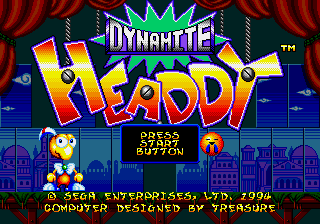
|

|
- "Press Start Button" lost its Button, and the copyright became a little less lengthy.
|
Japanese |
International |
|---|---|

|

|
- "Configuration" is no longer abbreviated, and "Cancel" is the more descriptive "Cancel Head" in the international builds.
- As stated above, on the Japanese version, it's possible to hear the entirety of the track Geisha Robot, either in-game or on the Sound Test, as track 27 (despite only starting after 10 seconds of silence in the latter). This track is missing from the Sound Test in the international release.
- Another entry that's erroneously missing from the international version's Sound Test is the "generic enemy destruction" noise; number 5C on the Japanese Sound Test.
- The hidden Stage Select works differently between versions.
- In the Japanese game, only the first part of each stage can be selected (1-1, 2-1, etc.)
- In the international game, this restriction was lifted, so the player can start at any part of the game.
General Changes#
- In the Japanese game, the players start with 2 continues while the localized versions start with none.
- After defeating a boss, collecting 10 continue icons gives the player a continue. In the international game, this takes 13 continue icons. Doesn't seem like much, but it makes collecting continues significantly more difficult.
- All of the Boss Stage dialogue triggers from the Japanese game have been removed. The only dialogue left in the game comes from HeadCase, HangMan, and Beau.
- In the Japanese version, if you enter the tutorial segments, you'd be asked if you want to practice or leave the room. In the international versions, once you enter the room there's no turning back, and you don't get any dialogue if you fail these attempts.
- An applause sound effect has been added to Headdy's victory animation.
Stage Name Changes#
All stage names except for "Backstage Battle" and "Baby Face" were changed to make pop culture references / puns.
Japanese |
International |
|---|---|
Scene 1 |
|
ESCAPE HERO! |
THE GETAWAY |
Scene 2 |
|
THREE FRIENDS |
PRACTICE AREA |
FRIEND'S ROOM |
MEET HEADCASE |
NORTH TOWN |
TOYS N THE HOOD |
CONCERT PANIC |
MAD DOG AND HEADDY |
Scene 3 |
|
FIRE CARNIVAL |
DOWN UNDER |
GUEST AREA |
THE GREEN ROOM |
STARLIGHT STORM |
CLOTHES ENCOUNTERS |
Scene 4 |
|
SOUTH TOWN |
TERMINATE HER TOO |
WORKING GEAR |
MAD MECHS |
RESTLESS FACTORY |
MAD MECHS 2 |
MYSTERY SPOT |
HEATHERNAPPED |
Scene 5 |
|
PUPPET TOWER |
GO HEADDY GO |
GO UP! |
STAIR WARS |
ROLLING ROLLING |
TOWERING INTERNAL |
ON THE SKY |
SPINDERELLA |
Scene 6 |
|
AIR WALKER |
THE FLYING GAME |
RECKLESS WHEEL |
FLY HARD |
LIGHT VELOCITY |
FLY HARD 2 |
Scene 7 |
|
PARADISE? |
HEADDY WONDERLAND |
Scene 8 |
|
FIGHT! |
THE ROCKET TIER |
MISSILE BASE |
ILLEGAL WEAPON 3 |
RADICAL PARTY |
FUN FORGIVEN |
REVERSE WORLD |
VICE VERSA |
FUNNY ANGRY |
TWIN FREAKS |
Scene 9 |
|
THE RIVAL |
FATAL CONTRAPTION |
BRAIN BREAK! |
FAR TREK |
FINAL ATTACK |
FINALE ANALYSIS |
Graphics Changes#
Life Light
|
Japanese |
International |
|---|---|

|

|
An 'H' ('E' for bosses) was added to the life bar (or life light in this case) for the American and European versions. Interestingly, upon opening the Japanese ROM with Tile Layer Pro, you will see the life light with the 'H'/'E' at around 000D2000.
Head Trip
|
Japanese |
International |
|---|---|

|

|
The Head Trip power-up (Buddha Head in the Japanese version) got changed from a kanji (which translates to 'Buddha') to ... a head.
|
Japanese |
International |
|---|---|

|

|
This same change is present in Scene 8-3 as well.
Trademark Symbols
|
Japanese |
International |
|---|---|

|

|
Due to reasons (probably the legal department), every instance of the Headdy, SEGA, and Treasure logos gained a trademark symbol in the localized versions.
|
Japanese |
International |
|---|---|
|
|

|
The sign in Scene 2-2 had to be changed too, with the left and right sides of the signboard flattened to make room for the trademark symbol.
Other Stage Graphics
|
Japanese |
International |
|---|---|

|

|
With the names of most of the scenes in the game changed, the continue screen's tattered program sheet had to be rewritten and redrawn.
|
Japanese |
International |
|---|---|

|

|
"Scene Final" changed to "Final Scene". The "Final" part uses the stage's green/red cycling palette in the international game.
|
Japanese |
International |
|---|---|

|

|
This "Puppets Introdution" (sic) sign in the Cast Roll was redrawn.
Maruyama/Trouble Bruin
{| class="wikitable" style="margin: auto;" !Japanese !International |- |

 |


 |- |
 |
 |} The character was made to look angrier, and his palette changed from purple to brown to reinforce the whole "Bear" thing. Even his new name, Trouble Bruin, is a play on a rarely-used synonym for "bear". It didn't really work; people still think he's a cat. All of Maruyama's boss forms had their palettes changed as well. Interestingly, despite the character being renamed, the "Maruyama" sample heard in the song "Maruyama Appears" was left intact.
|
Japanese |
International |
|---|---|
|
|
|


These palette changes affect some of the game's enemies and a boss as well, leading to some interesting color choices. Pink frogs, anyone?
|
Japanese |
International |
|---|---|
|
|
|


The Spider Phantom / Super Finagler's laser graphics were changed as well. The exact reason for this change is unknown, but it is not palette-related.
Rebecca/Mons Meg
|
Japanese |
International |
|---|---|

|

|
Rebecca was originally a toy doll, but was changed to a robot.
Yayoi/Gatekeeper
|
Japanese |
International |
|---|---|

|

|
The character was changed from a geisha to a generic robot. Given the above change, it's likely both were done because someone on the localization team objected to the player being made to harm a human-like female character.
Stage Differences#
Scene 1-1
|
Japanese |
|
|---|---|
|
International |
|


- Maruyama's light orbs are harmless, but Trouble Bruin's orbs are not!
- The number and pattern of the orbs released after he crashed into the wall was also changed.
- Maruyama creates 4 small orbs that fly off to the right, and 3 large orbs that bounce to the left.
- Trouble Bruin creates 6 (well 8, but two of them go off-screen quickly) large orbs that bounce up high, then spawns 2 more that bounce to the left.
Scene 3-1
The lone HeadCase in this area, located in the Flying Soldier arena, has been removed.
Scene 5-2
The boss fight here is significantly more difficult in the international game.
- Maruyama has just 4 hit points in the Japanese game. Trouble Bruin has 8 HP!
- His attack pattern was changed as well:
- Maruyama has a predictable pattern. He will cut part of the tower 3 times, charge at Headdy, then repeat the cycle.
- Trouble Bruin, on the other hand, seems to be completely random as to when he'll cut the tower or charge at Headdy. Combined with the doubled HP, this can make the fight take much, much longer to complete.
Scene 6-1
|
Japanese |
International |
|---|---|

|

|
- The first wave of enemies in the Japanese version is a lone Back Speeder / Flying Shark. In the international build, there are five of them.
- The Japanese game has a second wave of Jayron / Hover robots. This was taken out of the international game.
- The claw carrying the Sky Jaws / Sky Battleship moves at a lethargic 1 pixel per frame in the Japanese game, making the intro to this mini-boss take 14(!) seconds. This was thankfully doubled to 2 pixels per frame.
Scene 6-4
|
Japanese |
International |
|---|---|

|

|
Before the boss, each power-up appears on a separate screen in the Japanese version. They're all grouped together on one screen in the localized version.
Scene 7-1
In a rather infamous difficulty change, Izayoi / Nasty Gatekeeper's HP was nearly doubled from 9 to 17 HP.
Scene 8-3
- The flipping HangMen at the end of the stage take longer to flip in the Japanese game.
- Japanese: 180 frames (3 seconds)
- International: 120 frames (2 seconds)
Scene 8-5
Rever Face / Twin Freaks is another boss that underwent difficulty tweaks.
- The actual weak point was changed. Rever Face's hitbox is his entire ear. Twin Freaks's hitbox is just the center of the ear.
- To make up for the smaller hitbox, his HP was reduced from 33 HP to 17 HP in the localized game.
Scene 9-3
- Dark Demon's HP was nearly doubled from 9 HP (Japanese) to 17 HP (International).
|
Japanese |
|
|---|---|
|
International |
|


- With all of the dialogue removed from the boss stages, the pre-ending scene had to be reworked.
- In the Japanese game, Smily (the yellow badge) is revealed to be a badge to be awarded to the greatest puppet: Headdy. Smily happily attaches himself to Headdy's face as Fingy watches on.
- In the international game, Heather looks at Headdy as hearts fly out of her like a Belmont candle. Heather happily attaches herself to Headdy's face as Smiley watches on.
Ending#
|
Japanese |
|
|---|---|
|
International |
|


In the international game, Headdy's with Heather as she leaves, and he even waves her goodbye. He's not here in the Japanese game.
So where is he?


Headdy's too busy trying to pry Smily off of his face. He briefly succeeds, only for Smily to gleefully reattach himself.
Headdy was never heard from again.
Bonus Game#
|
Japanese |
International |
|---|---|

|

|
The objective was made much clearer in the American and European versions of the game. 'Sub Game' was changed to 'Bonus Game'. Also, the 'Intermission' graphic was reduced in size, and has no gradient.
All three of the messages here were changed as well.
Japanese |
International |
|---|---|
GET |
MAKE |
YOU GOT |
YOU MADE |
YOU GOT |
YOU MADE |
Cast Roll#
Almost every single character in the cast roll received a name change:
Japanese |
International |
|---|---|
General |
|
Mokkun |
HeadCase |
Yakkun |
HangMan |
Fukkun |
Beau |
Fingy |
Heather |
King Dark Demon |
Dark Demon |
Smily |
Smiley |
Maruyama |
Trouble Bruin |
Scene 1-1 |
|
Maruco |
Townsfolk |
Paul 1 |
Wee Spike |
Paul 2 |
Spike |
Paul 3 |
Big Spike |
Toruzo-Kun |
Robo-Collector |
Super Red Arrow |
Yellow Baron |
Maruyama & Kuma Body |
Trouble Bruin |
Scene 2-1 |
|
Miss Carroll |
Miss Daisy |
Scene 2-2 |
|
D.D. Soldiers |
Soldiers |
Honeywan I |
Old McGee |
Happy Comecome |
Snake Eyes |
Scene 2-3 |
|
Octopus Trap |
Floating Platfrom [sic] |
Bounty Boundy |
Mad Dog |
Scene 3-1 |
|
Bob |
Paddock |
Scene 3-2 |
|
Tail Hanger |
Rocket Grappler |
Scene 3-3 |
|
Marrio & Nettoh |
Puppeteer & Gentleman Jim |
Scene 3-4 |
|
Jacquline Dressy |
Wooden Dresser |
Scene 4-1 |
|
Clowny |
Tumblesets |
Rebecca |
Mons Meg |
Browny Bon-Bon |
Happy Campers |
Super Machine Tank IV |
Super Tank Machine |
Funky Ronmell |
Funky Jeep Man |
Scene 4-2 |
|
Momoiro Gozen |
Wise Women |
Scene 5-2 |
|
Tower Crasher |
Flying Scythe |
Scene 5-3 |
|
Armored Soldier |
Armordillo |
Scene 5-4 |
|
Motor Hand |
Spinderella |
Scene 6-1 |
|
Back Speeder |
Flying Shark |
Sky Jaws |
Sky Battleship |
Scene 6-2 |
|
Chris Wheel |
Wheeler-Dealer |
Scene 6-4 |
|
Mitsuru |
Baby Face |
Scene 7-1 |
|
McKenzy |
Mckenzy |
Yayoi |
Gatekeeper |
Izayoi |
Nasty Gatekeeper |
Scene 8-2 |
|
Base Captain |
Missile Man |
Scene 8-3 |
|
Mustle Nasunasu |
Penguin |
Taro |
Tarot |
Head Spitter |
Venus Headdy Trap |
Scene 8-4 |
|
Shogun |
Shogun |
Thunder Captain |
Sparky |
Scene 8-5 |
|
Hyottoko Guy |
Bean Head |
Scene 9-1 |
|
Pachinko Sub |
Propeller Head |
Julian |
Julian |
Maruyama & Spider Phantom |
Super Finagler |
(Source: http://dhvstb.webs.com/regionalvariations.htm, Original TCRF Research)
Credits#
In the credits of the Japanese version, each individual developer has a short message included before their name. In the international version, these messages were removed, and more names were added to credit those involved with said version.
References#
- ソフトウェア一覧(セガ発売) | メガドライブ |セガ SEGA↩︎
- Outpost Sega: Dynamite Headdy - Electronic Gaming Monthly, Volume 7, Issue 8, Number 61, August 1994↩︎
- CVG Review: Dynamite Headdy - Computer & Video Games, Issue 155, October 1994↩︎
- Tec Toy: Games em lançamento - Ação Games, Issue 72, December 1994↩︎
- Tec Toy também promete novidades "Tec Toy also promises new features" - O Estado de S. Paulo, December 5, 1994↩︎
|
The Dynamite Headdy series | |
|---|---|
|
Genesis |
|
|
Game Gear, Sega Master System |
|