This is a sub-page of Donkey Kong 64.
During the development of Banjo-Kazooie, Rare had discovered a method of cold swapping that would allow the data from one cartridge to survive a power cycle and be read by another. Intending to use this transfer method to unlock bonuses across games, Rare planned to have seven items hidden in Banjo-Kazooie, accessible only by connecting to a future title through cartridge swapping.
Donkey Kong 64 was one such title, establishing a considerable link between the two games during its development. However, during the final month of development, Nintendo had ordered the cancellation of the feature, leaving Rare to redact and modify several areas of the final game. The remnants of the Stop 'N' Swop feature in Donkey Kong 64 have been catalogued below.
Donkey Kong's Treehouse#
Banjo-Kazooie freezer#

During promotion for Donkey Kong 64, a curious screenshot could be found on Nintendo's Japanese site 1 featuring a Banjo-Kazooie freezer inside Donkey Kong's Treehouse. The Banjo-Kazooie freezer is absent in the final game, leaving fans to suspect that its removal was involved in redaction of the Stop 'N' Swop feature. This was proven correct on December 22nd, 2025 when former Rare designer Gregg Mayles uploaded the Banjo-Tooie Coldswap Document on his X account. The first page of the document details that the Ice Key transferred from Banjo-Kazooie would be placed inside the Banjo-Kazooie freezer after it had been utilized. The Ice Key would be kept in the freezer for safe-keeping, until it could be transferred again when players coldswapped Donkey Kong 64 with Banjo-Tooie.
While the model of the Banjo-Kazooie freezer and the Ice Key have been removed entirely in all retail copies of Donkey Kong 64, an unused cutscene remains in the game, and can still be accessed using the IntroStory Glitch. In this cutscene, the camera hones in on the corner of the Treehouse where the Banjo-Kazooie freezer once stood, presumably to show the Ice Key being housed inside, before transitioning to Chunky's Gorilla Gone area in Crystal Caves.

The transportation to Crystal Caves following the cutscene seems to imply that the player would have been in Crystal Caves when the game demonstrated the Ice Key being stored away, with further evidence of this connection found in that level...
Crystal Caves#
Big Icy Door#

The connection to Banjo-Kazooie would have allowed players to return to Freezeezy Peak and collect the Ice Key, where it could then be transferred to Donkey Kong 64 to open a 'Big Icy Door', as discussed in the Stop 'N' Swop Patent
The location of this Big Icy Door was planned to be in Crystal Caves, across from the entrance in Chunky's "Gorilla Gone" Room. Presently, the leftmost side of the room ends in a wall, which the camera whips to reveal as though it's meant to be showing something significant. The Big Icy Door would have been found along this wall, covering a small area that players could unlock to gain access.
This extra room was removed from the Donkey Kong 64 Player's Guide in America prior to publication, but was not fixed by Nintendo of Europe or Nintendo of Japan in their respective strategy guides.
(Source: Rare Gamer)
In "Hoah Game Special 172, Donkey Kong 64: Operation Golden Banana" by Japanese publisher, Kodansha, the location is also preserved with the text intended for the secret item beyond the door. Translated, the text reads:


"Mysterious Item!? I can't see the inside, but I feel like there's something here. When will this place open? A mysterious item...?"
While the "Mysterious Item" and the Big Icy Door have been removed entirely from Donkey Kong 64, the Ice Key has remained in the data, intended to appear in the inventory menu upon a successful transfer from Banjo-Kazooie. Rather than removing the Ice Key entry from the internal memory, Rare has set it to be automatically collected by default, simply disabling the functionality attached to it.
While the Ice Key's reward within Donkey Kong 64 has long been speculated, players might have inadvertently received an answer within the Banjo-Tooie Coldswap Document. Following the successful transfer from Donkey Kong 64 to Banjo-Tooie, players would take the Ice Key to the Ice Safe in Hailfire Peaks. While this location did remain in the final game, and would provide players with the Mega Glowbo to transform Kazooie into a Dragon, the original design planned for a different reward entirely. Opening the Ice Safe would have instead provide players with a "Super Jiggy" that would otherwise have been unobtainable. As the unused Cauldron Keep 'Castle' level would have resulted in 10 further Jiggies, the Super Jiggy would have brought the total to 101:
“Bottles pops up with a congratulatory message, telling the player it must do something good if you can now complete everything else. When the player has done this, they will have 101 Jiggies instead of instead of 100 and will get to see the special 'out takes' ending.” - Banjo-Tooie Coldswap Document, 27/8/99
The outtakes ending for 101% completion might seem familiar to players who have completed Donkey Kong 64, as returning to the Banana Fairy Queen after photographing all 20 Banana Fairies during that game will reward the player with the 201st Golden Banana. Provided that players collect the remaining 200 Golden Bananas and defeat King K. Rool, they will unlock an 'out takes' ending that plays following the end credits. Given this logic, it's possible that the 201st Golden Banana was originally held behind the Big Icy Door, and unlocked the 'out takes' ending. When Stop 'N' Swop was cancelled, the Big Icy Door was removed, and the 201st Golden Banana was moved to the Banana Fairy Queen's area.
Creepy Castle#
Golden Donkey Kong Bust#
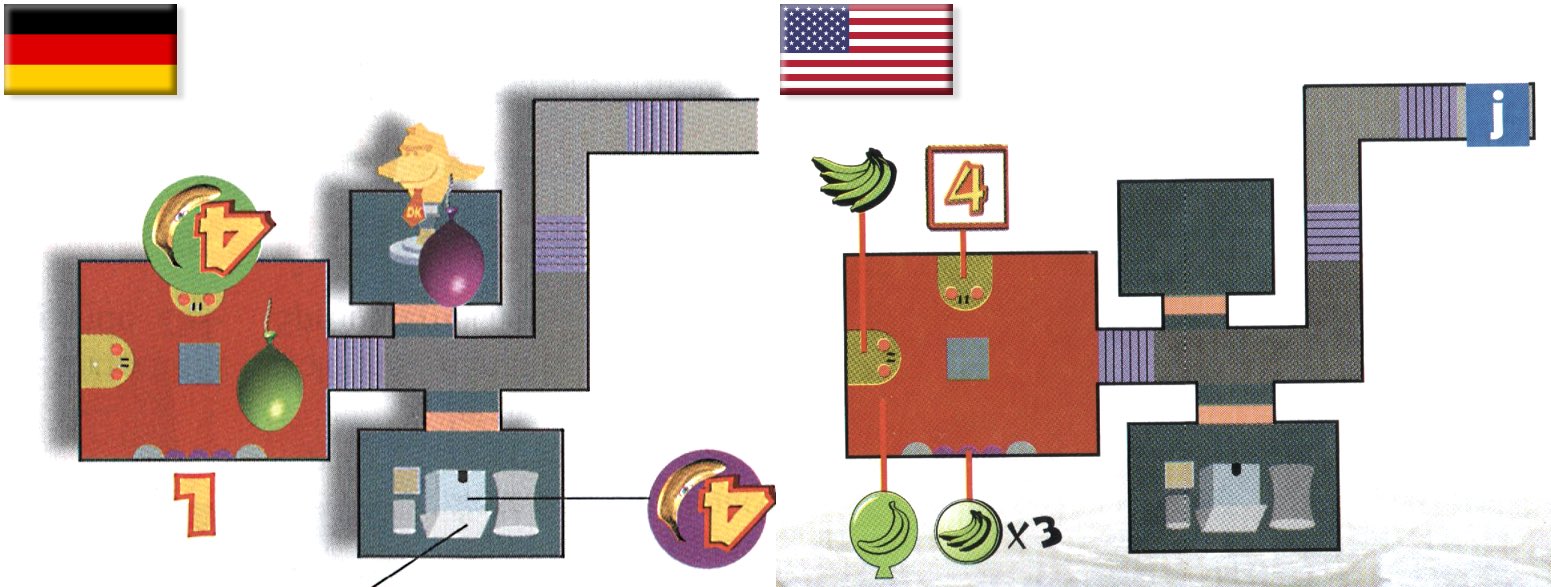
 Exploring the Museum in Creepy Castle in the final game will have players passing a peculiar pedestal - this "mystery pillar" can be found in a room of its own, a light above shining on nothing. For decades, the presence of this pillar and its seemingly empty display confused players, but during development it was meant to showcase a Golden Donkey Kong Bust. The graphic of this statue (including its pedestal) was removed from the English Donkey Kong 64 Player's Guide, but was published in the German variant.
Speaking with the RetroHour Podcast, Engineer and inventor of Stop 'N' Swop, Paul Machacek spoke on the elements of the game that were modified following Nintendo's order for the features' cancellation (1:01:03):
(Source: Rare Gamer)
“The problem was DK64 was going to manufacture and we can’t just re-jig the backgrounds and the stuff that we’d set up that was enabled for Donkey Kong 64. We just disabled the minimum amount of stuff that we needed to change in the game and take out the scanning software. So that's why there's a few places where there's like a pedestal with nothing on it - there was supposed to be something on it and you know a week before we gave the final build to Nintendo, there was something sitting on that pedestal. I don't remember what it was now…” - Paul Machacek
The purpose of the Golden Donkey Kong Bust, and its relation to Banjo-Tooie, would be revealed in the Banjo-Tooie Coldswap Document:
There is a Gold DK Bust in DK64, located in a glass case on the Creepy Castle level. This can't be got during normal play.
* The player must activate an undecided feature in Banjo-Tooie.
* A recreated Banjo-Tooie cut sequence shows the glass case shattering on DK64, allowing access to the Gold DK Bust inside.
* Once this sequence has finished, Bottles will explain how the Coldswap works. He will repeat this message if you return to the molehill where the undecided feature was activated from.
*The player must then switch off Banjo-Tooie and plug in DK64 within the allowed time limit.
*The player then plays DK64 and collects the Gold DK Bust.
*The player must then switch off DK64 and plug in Banjo-Tooie within the allowed time limit.
*If the process is done successfully, when the game restarts Bottles will tell DK to look in the Multiplayer options on the Game Selection Screen. Donkey Kong (and possibly others from DK64) will now be available as controllable multiplayer characters.
References#
- Donkey Kong 64 Nintendo Japanese Site - Nintendo, c. 1999↩︎