Dementium II is a first-person survival horror game for the Nintendo DS. It is the sequel to 2007's Dementium: The Ward, also for the DS.
Unused Maps#
arena#
A testing area where it's possible to spawn one of all enemy types, the area itself is untextured.
p0_007#
An Operating Theater in the Bright Dawn Treatment Center. As the entire world of the game was built first before the player's final path was mapped out, the room remains partially unused, as it only appears in a cutscene. The player enters the room only once in the entire duration of the game, and the hellish counterpart of this area loads for the first Boss fight instead of the normal one here. Theres no physical way to climb back up from the bottom platform, it seems that the room was intended to only be used in the cutscene it appears in.
p0_014#
According to Gregg Hargrove, this room was never meant to be unused in the first place. Because nothing really was ever going to happen in this area (Items, Weapons, Enemies), the developers had the two adjacent rooms skip the area in order to make a quick shortcut for testers and bugfixing. The room is unused because the developers simply forgot to place the area back into rotation. The doors take you to the rooms adjacent on the mini-map.
p0_029#
A early version of the bathroom in the Bright Dawn Treatment Center. Before deciding on the final path the player would take, the entire world was built first. Since this room is locked off, it remains unused and is separated here. The doors take you to the rooms adjacent on the mini-map, and surprisingly, the spawns in the other rooms act as if the area was never segmented off to begin with.
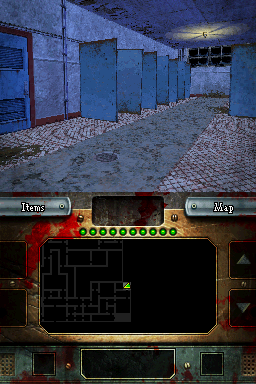
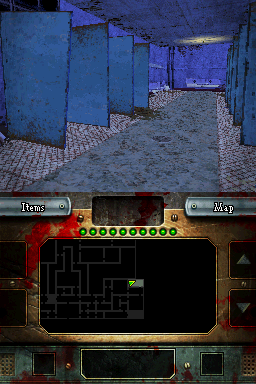
p0_034#
An unused corridor in the Bright Dawn Treatment Center. Before deciding on the final path the player would take, the entire world was built first. Since this room is locked off, it remains unused, and is separated here. The doors take you to the rooms adjacent on the mini-map, and surprisingly, the spawns in the other rooms act as if the area was never segmented off to begin with.
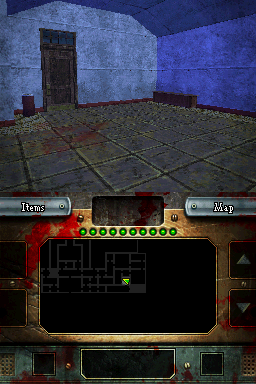
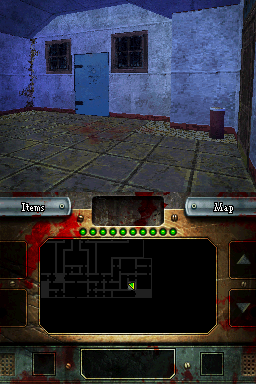
p0_041#
Attempting to load the map will crash the game.
v0_000_old#
Before the actual development of Dementium 2, a village tech demo was created. The map is still present in the game files and with a little bit of hacking it can be accessed. Some parts of the village are still present in the final game but the layout is overall very different.
dummy#
Trying to load the map will crash the game.
Unused Models and Animations#
Flamethrower Reload Animation#
Strangely enough, it seems that at one point the Flamethrower was to have a reload function similar to all other weapons in Dementium 2. In the final product, they settled for scattering gas canisters around the world, for infinite refills on flamethrower fuel, as long as you could make your way back to one of said canisters. Watch on YouTube
Gas Mouth#
According to Gregg Hargrove, the Gas Mouth was meant as an environmental hazard to replace rushes of steam once the player progressed through the basement. Since steam and other environmental hazards were never implemented, the enemy has nothing to replace, therefore remains unused. Watch on YouTube
Developer Notes#
In most of the level .ini files of the game, the following note is present, it's referencing the village tech demo that was developed prior to the game.
";Config for village demo level, do not use more than 500 particles"
";DrawMaxSectors always draws 5 sectors, good for outdoor regions that dont portalize well"
Also in the enemy .ini files there are notes of the developers which reveal the name of every enemy in the game:
"; Parameters for Aerial Hunter"
"; Colossus"
"; Parameters for Flying Swarm (fixed health of 1)"
"; Parameters for Gnaw Boss"
";Gorgamesh"
";Leaper"
"; Parameters for Lost Soul"
"; Parameters for Malatesta (final boss)"
";Screamer (was Mindless Flyer)"
";Melee Guard"
"; Reanimator"
";Rifle Guard"
"; Parameters for Scritter (fixed health of 1)"
"; Parameters for Slime Mine"
";Spitter"
";Wailer"
"; Wendigo"
";Zombie"
Hidden Functions#
A lot of functions in the game are managed by .ini files, the Village.ini has an unused function which allows you to skip the intro.
"SkipIntro = false"
In the files is also a removeme.ini but it is empty.
Unused Cutscenes#
ehell#
An unused cutscene showing Elizabeth Redmoor scrubbing a bloody floor, the cutscene looks as if it was meant to be in the final passage. Watch on YouTube
Unused Items#
Antidote#
An unused item, possibly used in the beta, as Dementium II HD is based on an older version of Dementium II, and it includes this item. 

Unused Textures#
Chest Maw textures#
The variations of the Chest Maw textures in the game's files, the one used is v2. Interestingly enough, the v3 texture seems to be higher quality than the used one (v2), so maybe the v3 texture was the intended texture.
Version 1 Texture, unused |
Version 2 Texture, used |
Version 3 Texture, unused |
|---|---|---|
 |
 |
 |
Moon and Dementium: The Ward Leftovers#
There are several leftover graphics from Moon and Dementium: The Ward, which were developed by the same studio. Most of the graphics are interface related.
File Load Splashscreen#

Scrcap.tex#

|
Please elaborate. |
One interesting note, is that a screenshot for MOON exists in the files, but the way the image is displayed matches the display of a NOGBA emulator, rather than an actual capture of a DS screen.
Scrcap in Dementium 2 |
Scrcap in MOON |
No$GBA emu with nocash render |
|---|---|---|
 |
 |
 |
Anti-Piracy#
At startup, the game investigates the cartridge's EEPROM save chip. Because flashcarts often patch over the Nitro SDK functions to read and write save data, the game uses its own functions to manually communicate with the slot-1 SPI bus. It will try to read a byte of save data, read the status register, get the chip's JEDEC ID, and also attempt an invalid command (id 00). If the chip does not respond as an authentic cartridge's would, it will prevent the player from loading any saves, and show a vague error screen saying the save data could not be accessed.

(Source: Original TCRF research)
|
The Dementium series | |
|---|---|
|
Nintendo DS |
|