 This article has a talk page!
This is a sub-page of Proto:Shadow Warrior (1997).
The November 1996 Shadow Warrior prototype is a demonstration made by 3D Realms to be sent to the game's eventual publisher, GT Interactive, probably to pitch the game to them.
At this stage, the game is pretty close to the final game. Most of the final's mechanics are in place and close to how they are in the final game, but need a bit of polish the last few months can give. The art style is very close to the final's, but a little darker than in the retail game. Some of the levels included with the prototype show that the levels are either close ($airport) or still have a ways to go ($dozer/Zilla Construction) before reaching their final incarnations.
General#
Player sprite#

The player's sprite is darker than it was in previous builds.
|
November 1996 |
June 27th, 1996 |
|---|---|
|
|

|
Boot up screen#

When the game is started, it will show a screen with a red bar at the time (the final game uses a green bar that contains two sentences instead of one) and a message that the prototype was given to Good Times Interactive (GT Interactive, who is the game's publisher for the final game) on November 15th, 1996. There is also a message telling you not to distribute it, which has clearly failed horribly. Hitting any key will initiate the boot-up sequence and start the game.
It also calls this prototype "Alpha Version .09".
|
Prototype |
Final |
|---|---|
|
|

|
Menu#
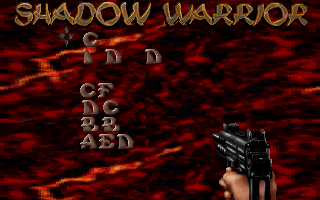
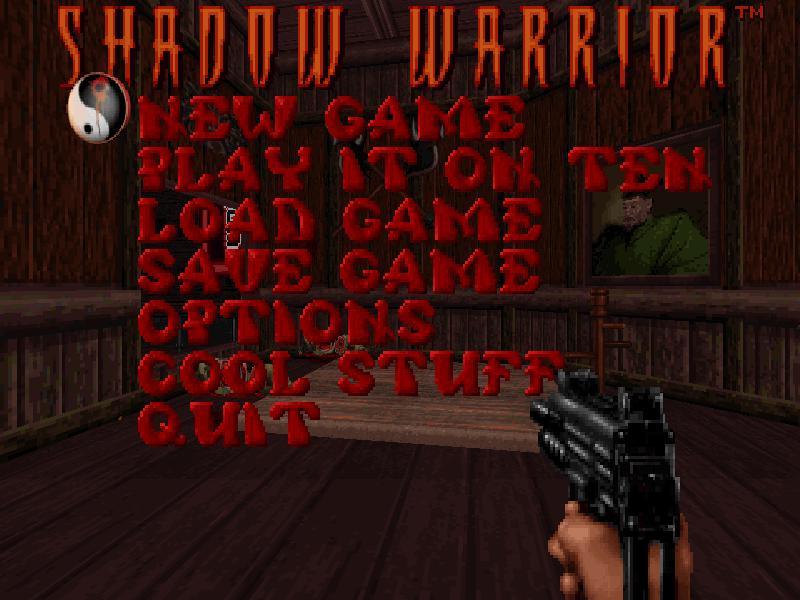
The Menu uses a different font than either the previous prototypes or the final game. The shuriken icon is also much smaller than in previous builds. The graphics used for the menu in earlier prototypes are still in this version's files, however.
Menu-based messages display gibberish for the most part. The only one that works is the "start single player game" and options menus.
When a single player game is selected from the menu, the player can either choose the shareware or registered levels. The shareware levels option will send the player to $airport, while the registered levels option will make the game crash because it can't find "E2L1". This suggests that the registered levels option is actually a renamed version of the "Fists of Fury" episode from previous prototypes (dating back to the September 1995 prototype), as it also causes a crash with the same error when selected.
The ability to load games does not seem to work, as nothing will happen if one selects where the "load game" menu would be.

|
Prototype |
Final |
|---|---|
|
|
|
HUD#

The HUD uses the final's design.
This prototype also introduces the "simplified" HUD one can toggle in the final game as well.

Inventory#
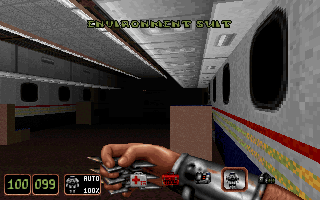
The November 1996 build contains the Duke 3D-style inventory the final game uses, completely removing what's left of the old spell system earlier prototypes had.
Loading screen#

This prototype implements Duke Nukem 3D-like loading screens while loading a level that display text, which also appear in the final game. However, the screens displays gibberish instead, like with the menus.
Cheats#
This prototype removes what's left of the old keybind cheats and replaces therm with typed-in codes.
This is also the last prototype that has the player input cheats directly, like in Doom. The 1997 prototype and the final game change cheat input in various ways.
Old |
New |
Effect |
|---|---|---|
Alt + A |
swmap |
Displays everything on the in-game map, including enemies, sprites, props, and tags. |
Alt + R |
swstart |
Restarts the level with the player's current inventory and other effects, such as God mode. Health is reset to 100. |
Chopsticks idle animation#

This prototype includes the chopsticks idle animation. This version uses armbands the rest of the prototype's first person weapons use and the final frame in the animation lacks an armband, period.
The animation plays a bit more often than in the final game.
|
Prototype |
Final |
|---|---|

|

|
|
Prototype |
Final |
|---|---|

|

|
|
Prototype |
Final |
|---|---|
|
|

|
Graphics#
Removed graphics#
Graphic |
Tile Number |
Notes |
|---|---|---|
 |
2323 |
|
 |
2796 |
|
 |
2798 |
Goes with the "biological hazard" tiles seen in the final's Battleship level. |
 |
2799 |
|
 |
2800 |
|
 |
3680 |
Changed graphics#
June 11th, 1996 |
Final Game |
Tile Number |
Notes |
|---|---|---|---|
 |
 |
3377 |
The nuclear warning symbol given a proper yellow instead of a greenish color. It's not easy being green, after all. |
 |
 |
3476 |
The prototype's texture is from Duke Nukem 3D. Might've been a placeholder until a proper sprite was made. |
New skybox#
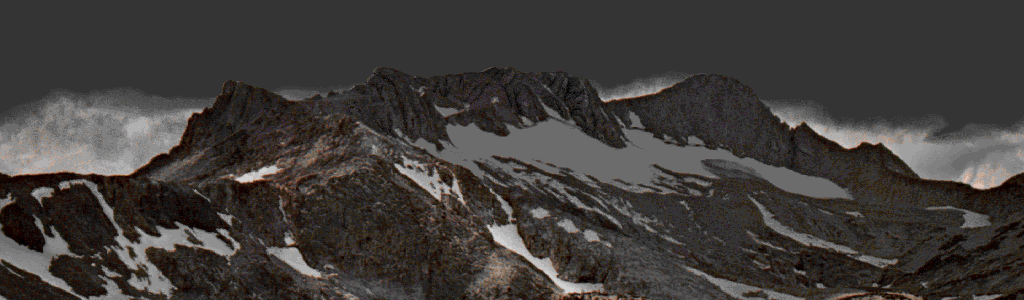
This prototype introduces a new skybox. An improved version of it is used in the 1997 prototype. It also exists in the final game's files, but goes unused.
3D Realms title#
This prototype uses the 3D Realms title from Duke Nukem 3D Atomic Edition.
Menu font#

The font used for the garbled portions of the menu is used in the final game, but is made red.
|
Prototype |
Final |
|---|---|
|
|

|
Voxels#
This prototype comes with more voxels than previous ones. In addition to the ones found in the June 27th prototype, this one also contains voxels for the Grenade Launcher, camera, both regular and Portable Medkits, the Uzi, and Grenade Launcher ammo.
Something interesting to note is that the voxel for the regular Medkit uses the final's colors, but the sprite version uses the colors seen in previous prototypes. It seems they might've already planned on switching to the final colors, but didn't bother to change the sprite version yet.
Music and sounds#
This prototype is the first one to contain the MIDI music composed by Lee Jackson. They are meant for the Roland SC-88, which is the same device used for the final game.
Some songs went unused in the final game, those being Taiko Recall, 254mm, Morse Kodo and Pyroclastic Flow, which are featured in this prototype, the next, and for 254mm and Morse Kodo, still in the final Shareware version, while Taiko Recall and Pyroclastic Flow did not make it.
Taiko Recall was later released onto Lee Jackson's YouTube channel on June 22nd, 2019.
Taiko Recall
254mm
Morse Kodo
Pyroclastic Flow
However, the old soundtrack is still contained in the GRP file, some files have been corrupted, Intro12 was replaced with Sianra23, meaning between the previous and this prototype, Sianra may have been intended to be the game's theme song before Lee Jackson got on, and curiously, unique to this prototype, is an older version called Sianra21, which was not present in the previous prototypes.
SIANRA21 November 28th, 1996 |
SIANRA23 June 11th, 1996 |
|---|---|
Weapons#
Katana#

The Katana is the same as it was in the previous prototype.
Shuriken#

Thrown Shurikens will now attach themselves to walls, but they cannot be picked up. Otherwise, it is the same as before.
Uzi#

The Uzi graphic is a little bit darker compared to the one used in the final game.
Dual Uzis now function properly, somewhat. While you can use them fine, both guns will reload as soon as you draw them for the first time, and they will automatically reload after 50 rounds, instead of the final's 100.
Otherwise, they're the same as they were in the previous build.
|
Prototype |
Final |
|---|---|
|
|

|
Riot Gun#

The Riot Gun now uses the final's sprite, but with darker colors, and has a faster rate of fire. The burst-fire mode in the final Riot Gun is still not in this version.
|
Prototype |
Final |
|---|---|
|
|

|
Rocket Launcher#

The Rocket Launcher has changed little since the previous prototype. The big change is that the HEAT mode the final Rocket Launcher has is now implemented and works the same as it does in the final game.
Its third firing mode is still the large rocket burst seen in previous prototypes. With the second firing mode from the previous prototype now confirmed to become the HEAT mode, it seems that the nuclear rocket seen in the final game was once the 20-rocket burst seen in various prototypes. It occupies the same firing mode the nuclear rocket does and the graphic showing "20" on the Rocket Launcher itself occupies the same slot that the nuclear symbol icon on the Rocket Launcher does in the final game.
The 20-round burst has a slight delay on the shots it fires instead of shooting all of them at once (like in previous prototypes), possibly to prevent slowdown. It still does not consume ammo when fired. And, like it's previous incarnations, it can occasionally crash the game, though it's more stable than before.
This weapon's first person sprite is a little bit darker than in the final game.
|
Prototype |
Final |
|---|---|
|
|

|
Grenade Launcher#

The Grenade Launcher's damage has been upped just enough to make it as powerful as it is in the final game.
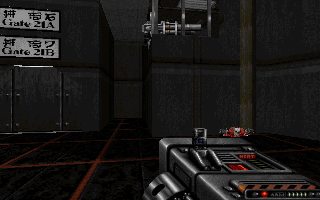
Of note is that, for some strange reason, the item sprite for the Grenade Launcher is much larger than the other weapon item sprites in both this prototype and the final game. This can cause some problems, such as it clipping through decorations and walls.
|
Prototype |
Final |
|---|---|

|

|
Sticky Bomb#

The Sticky Bomb's first person graphic is darker and has some gray bleeding into the band. However, it is otherwise the same as it is in the final game.
|
Prototype |
Final |
|---|---|
|
|

|
Railgun#

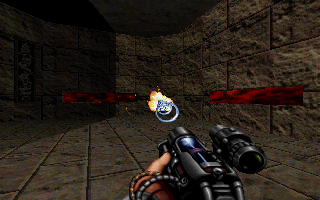
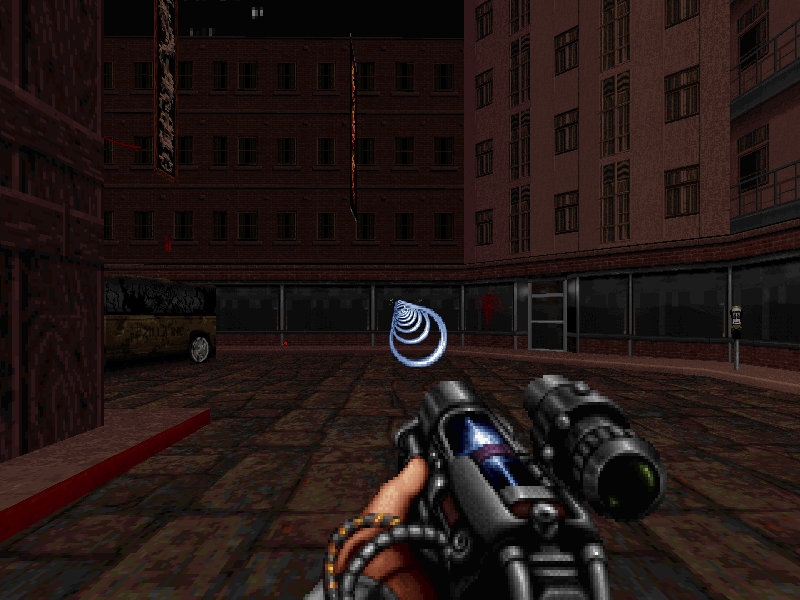
The Railgun has received it's final sprite (but darker compared to the final sprite) and behaves mostly the same as it does in the final game. However, it holds 40 rounds instead of 20, and the firing effects are a mix of the final's and the August 1996 prototype's. It has the final's trail, but the projectile shot explodes, like in the August 1996 prototype.
|
Prototype |
Final |
|---|---|
|
|

|
|
Prototype |
Final |
|---|---|
|
|
Ripper Heart#

The Ripper Heart has a few changes compared to previous builds.
First, enemies will freeze in the last frame they were in when hit with a projectile from this weapon. Second, a killed enemy will spawn a regular Baby Ripper instead of two tiny Baby Rippers.
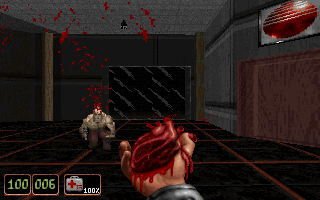
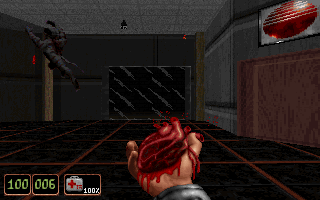
Guardian Head#

The Guardian Head is the same as it is in the August 1996 prototype.
Enemies#
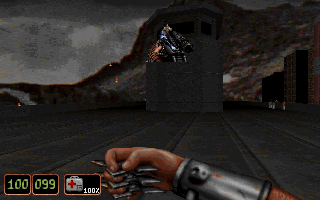
Ninja#

The final Ninja is now in the game. However, all Ninja types have brown pants, making it impossible to see what type they are less you see keep track of their attacks.
A look at his raw graphics reveals that his kneepads are a grayish color instead of being the same color as his pants and he's a little darker than in the final game.
The first person Railgun graphic crossbow arrow/rocket bug from the previous prototype is still in this one.
|
Prototype |
Final |
|---|---|
|
|

|
Coolie#

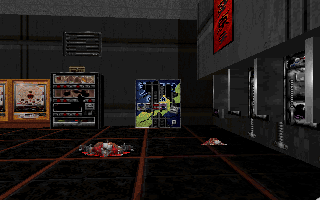
The Coolie now has his final sprite, but it's a little darker than the one in the final game. However, he still cannot be gibbed, like in previous prototypes, and will always spawn a Coolie Ghost when killed.
When a Coolie dies, his head will never disappear during and after the Coolie Ghost is spawned, unlike the final game.
|
Prototype |
Final |
|---|---|
|
|

|
Coolie Ghost#

The Coolie Ghost behaves similar to how he did in previous prototypes, but now uses the final's sprite. The sprite is a little darker than the one in the final game, though.
The projectiles he shoots are the same puke projectiles the player can shoot after he's killed instead of the glowing things he did in both earlier prototypes and the final game.
Of note is that the Coolie Ghost sprites form the August 1996 prototype are still in the game, but unused.
|
Prototype |
Final |
|---|---|
|
|

|
Baby Ripper#

The Baby Ripper is the same as he was in previous prototypes.
Items#
Most of the items in this prototype are the same as the previous protos, but there are some exceptions.
Cloak#

This prototype introduces a new item; the Cloak. It is represented as a small futuristic device. It can be activated in the inventory.
Based on its name, it was meant to help make the player hard to see, but enemies will ignore it.
Interestingly, a proper item sprite for this item does not exist. The only sprite for it is for its inventory graphic.
It's likely it was replaced with the Smoke Bomb in the final game, since they both share a similar function and have the same item percentage drain rate.
Environmental Suit#

The Environmental Suit is back, but now it operates like Duke 3D's Boots in that it's automatically activated when you walk over a hazardous surface.
It also no longer blinks in and out of existence, like it did previously.
Portable Medkit#

The Portable Medkit makes its first appearance in this prototype. It is the same as it is in the final game.
If one plays an old map, such as $boss1, it becomes apparent that the Portable Medkit simply replaced the large Medkit found in earlier prototypes instead of being a new item, as large Medkit items will give the Portable Medkit instead.
Key#

This prototype replaces the key graphics seen in the previous prototype with the keycards seen in the final game. However, the keys are still set to rotate, which does not happen in the final game.
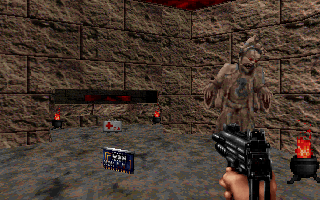
Levels#
This prototype comes packed with six levels; $airport, $dozer, $plax1, $huge, $volcano, and $yamato. All of these levels appear in the final game.
$airport is the only level with enemies.