 This article has a talk page!
This is a sub-page of Proto:Knuckles' Chaotix.

General Differences#
- The game's header and title cards refer to itself as Knuckles' Ringstar, a name that was only used in very early promotional screenshots.
- The build is quite infamous for its poor PWM implementation which causes rather unpleasant sounds to play on certain emulators upon bootup (most notably Kega).
- All 32X art is uncompressed. In the final game, most of the static art uses the C42 compression. Everything that uses the 32X VDP is viewable in this build.
- Heavy's name is sometimes listed as "Heaby", a mistranslation due to Japanese not differentiating between "b" and "v".
Gameplay Differences#
- The time-of-day system doesn't work correctly if you select a completed save, with each level selected seemingly having a time of day arbitrarily assigned to it.
- You can only jump at 2 heights, being the minimum and maximum jump heights in the final, and the window to jump at minimum height is rather tight.
- Every character except Espio has an ability programmed, though Vector can only climb walls and it's very tricky to do so. There are sprites for Vector's double-jump ability in the ROM, however.
- When Mighty uses the wall kick, it is different and "automatic". It uses a sprite that goes unused in the final, and matches up with an unused sprite for Sonic in Sonic Crackers. Also of note is that the sound effect when he clings to a wall is different, using Vector/Espio/Knuckles' sound for when they cling to a wall.
- When Knuckles is climbing, you have to keep A/B/C pressed to climb, otherwise Knuckles falls off. In addition, the animation that plays when you move from wall to floor is a little more rough.
- Vector's running animation is faster.
- If Vector is holding a character and jumps, there is no running animation like in the final.
- Free movement/Debug Mode is always enabled.
- The line that holds two characters together is always blue.
- Items do not "pop out" of monitors, though graphics do exist for the animation.
- Rolling into a monitor does not break it.
- Icons for your current powerup don't display near the bottom of the screen.
- The character switch monitor does not work.
- The "change your partner into someone else" monitor doesn't exist.
- The invincibility stars are very different - there's less of them (only two at a time, it seems), and they're small gold five-pointed stars. The stars also only surround the first player, unlike in the final where both players are surrounded.
- Invincibility does not destroy enemies.
- Buttons do not make any noise when pressed, but when they spawn they make a noise.
- Crumbling platforms use a different sound effect, very similar (if not identical) to those in earlier Sonic games.
- Enemies do not drop "battery rings" when defeated.
- Metal Sonic will not attack you if you are idle in a level. Likely done intentionally for testers.
- The timer infinitely loops during a level. Again, probably done intentionally for testers.
- Pausing the game does not stop the music.
- When clearing a level, "Mechanical Dance" plays instead of "From Party to Party".
- The cutscenes before the bosses are fully implemented, although the boss music starts directly in the cutscenes instead of playing "Have Some Fun".
- When entering a Special Stage from a normal level, when the results screen is finished, the game incorrectly plays the "enter Special Stage" sound effect.
- Pressing A + B + C + Start during gameplay resets the game.
Sega Screen & Menus#
|
Prototype 1207 |
Final |
|---|---|
|
|
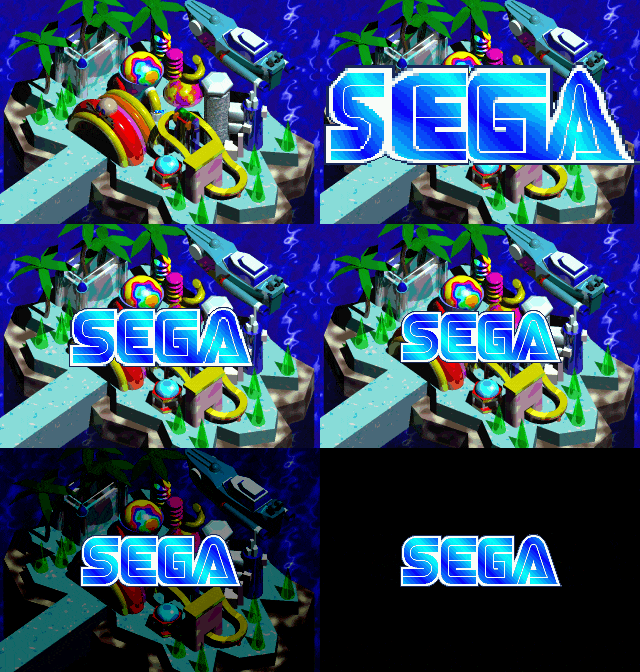
The Sega screen uses a promotional image of Newtrogic High Zone, the final changed this to the Game Over/Level Beat screen instead. The Sega logo lacks the "TM" and instead of zooming in, the Newtrogic High image fades to black, leaving the Sega logo in the dark for a few seconds.
|
Prototype 1207 |
Final |
|---|---|
|
|

|
The title screen is in a somewhat preliminary state:
- No intro sequence is present.
- The main characters are absent, and their graphics do not exist in the ROM.
- The Chaotix logo has no palette cycling, nor does it have the TM mark.
- The "Push Start" sign is more basic.
- The main menu is where the copyright text would be.
- Selecting TIME ATTACK will just put you into save slot 1, but it brings you to the level select seen in normal play.
- Selecting OPTION brings you only to the Sound Test, which is a very basic screen: a black background with white text.
- Cheat menus are accessible by highlighting OPTION, then pressing A + Start for Color Test, C + Start for Sound Test, or B + Start for Jam Out mode (which acts similar to ToeJam & Earl).
- In Jam Out mode, press A, B, C, or Start to play the many different PWM samples. Buttons on the D-Pad can be held to change between sound banks. A + B + C + Start will exit the Jam Out menu.
|
1207 Prototype |
Final |
|---|---|

|

|
The sound test is very basic. The graphics are minimal, and the X, Y and Z buttons don't do anything.
|
Prototype 1207 |
Final |
|---|---|

|

|
The save menu is in an earlier state than the title and is very buggy:
- The background isn't present yet.
- Controls are reversed (Up moves down, Down moves up).
- The zone icons are organized differently.
- Level numbers in the save files do not render properly.
- Playtime isn't showed yet.
- Selecting file 1, 2, or 3 may place you instantly in the World Entrance with two Espios. Selecting "No Save" will start the game normally.
|
Prototype 1207 |
Final |
|---|---|

|

|
Incredibly bare bones at this point; there's an empty slot after Knuckles (likely meant for Tails, see below) and the player has the option to choose Heavy and Bomb, which are only Combi Catcher characters in the final.

The Combi Catcher doesn't even exist yet; instead, whenever the player exits the hub to the right, an extremely barebones screen pops up. If you're not playing as Mighty, Epsio or "Tails", the first question mark will be Mighty, the second question mark will be unselectable (probably Tails) and the third question mark will be Espio. Interestingly, Bomb's icon depicts the Sonic 1 enemy of the same name, while Heavy's icon depicts a generic black weight. Unlike the World Entrance, the screen will play different tracks depending on the time of day (The tracks are the same as the final's world entrance).
Afterwards is a level select screen with vastly different names:
|
Prototype |
Final |
|---|---|
|
|
- There is no image for Speed Slider at this point in development. It doesn't exist in the ROM.
- "Atraction" is misspelled with only two Ts.
- Speed Slider and Amazzing Arena aren't selectable, choosing them will play a buzzer and push you left.
- When selecting an attraction, a different song plays for a few frames before the level you chose loads.
Graphical Differences#

|
To do:
|
Characters#
Several of the characters (namely Knuckles, Vector and Espio) have some different sprites compared to the final.
|
Prototype 1207 |
Final |
|---|---|

|

|
Prototype 1207 |
|---|
 |
Some of Knuckles' sprites have slightly different shading and overall looks.
Prototype 1207 |
Final |
|---|---|
 |
 |
 |
 |
|
|
To do: |
Vector's running sprites have rougher borders, simpler shading, and less motion. It's likely that the simpler shading is a holdover when the game was still being developed for Genesis, given the palette for him and Knuckles could already be found in Crackers.
Other#
Prototype 1207 |
|---|
 |
The end of level sign is completely different, missing the 3D effect seen in the final game.
Level 0s#
Unlike the final game, Botanic Base and Amazing Arena's 0th levels have unique layouts, being shorter and simpler compared to their 1st levels. More of these layouts would be added in later prototypes, however they would all be removed in prototype 0208.
Hidden Time Attack Screen#
A strange oddity occurs in this prototype. Normally, selecting the "TIME ATTACK" option on the title screen brings you to the prototype's usual rudimentary character select menu and the "ATRACTION SELECT" screen. Selecting this option will boot into a player selection screen, followed by an NPC selection screen. Normally, you would just enter the regular stage selection screen, but you can access the actual "TIME ATTACK" menu by performing 2 full rotations to the right in the player selection screen. What's going on is that whenever you move the player selection, the word (2 byte) value at address 0xFFFAC0 will be incremented or decremented by 0x20. Due to the fact there are 8 possible selections, a full rotation will result in an increase or decrease of 0x100, making the top byte of it effectively being the rotation iteration ID, and that is what is checked to activate the "TIME ATTACK" menu.
As of the 1207 build, however, this screen contains some differences from the final game, and differences from later revisions. It contains a functional level select, with the alternate level names, and what seems to be a simple graphical mockup of the results screen. Further revisions of the game would gradually remove/improve the "TIME ATTACK" option and ultimately replace it with the "TRAINING" option.
Selecting an attraction from the main game will take you to its 'Level 0'. This seems to confirm that the level 0 layouts were intended for time attack.
There are three "Time Attack Zones":
- Time Attack 1 - Loads alternate Isolated Island with Botanic Base's title card.
- Time Attack 2 - Loads another alternate Isolated Island with Botanic Base's title card.
- Time Attack 3 - Loads blank level with a nameless title card.
|
Standard Zones |
Time Attack Zones |
|---|---|

|

|
What's interesting is that one of the names listed on this results screen mockup is "NUTS". This is most likely referring to Mighty; an early prerelease screenshot shows that he was originally known as Nat, which is spelled like "nuts" in Japanese (ナッツ, natsu). All of the rank text is merely a placeholder, stored as a plain tilemap that gets loaded directly into VRAM.
        lea     Map_TimeAttackRankPlaces(pc),a1 ; Draw rank place numbers (1ST, 2ND, 3RD)
        move.l  #$53140003,d0
        moveq   #(192/8)-1,d1
        moveq   #(8/8)-1,d2
        moveq   #0,d3
        jsr     DrawTilemap

        lea     Map_TimeAttackRankLabels(pc),a1 ; Draw rank labels (TIME, POINTS, RINGS, PLAYER, NPC)
        move.l  #$54040003,d0
        moveq   #(48/8)-1,d1
        moveq   #(40/8)-1,d2
        moveq   #0,d3
        jsr     DrawTilemap

        lea     Map_TimeAttackRankData(pc),a1   ; Draw 1st place rank data (9'59'99, 00000, 000, NUTS, VECTOR)
        move.l  #$54160003,d0
        moveq   #(56/8)-1,d1
        moveq   #(40/8)-1,d2
        moveq   #0,d3
        jsr     DrawTilemap

        lea     Map_TimeAttackRankData(pc),a1   ; Draw 2nd place rank data (9'59'99, 00000, 000, NUTS, VECTOR)
        move.l  #$542A0003,d0
        moveq   #(56/8)-1,d1
        moveq   #(40/8)-1,d2
        moveq   #0,d3
        jsr     DrawTilemap

        lea     Map_TimeAttackRankData(pc),a1   ; Draw 3rd place rank data (9'59'99, 00000, 000, NUTS, VECTOR)
        move.l  #$543E0003,d0
        moveq   #(56/8)-1,d1
        moveq   #(40/8)-1,d2
        moveq   #0,d3
        jsr     DrawTilemap
Map_TimeAttackRankPlaces:
dc.w '1'-$20, 'S'-$20, 'T'-$20, ':'-$20, ' '-$20, ' '-$20, ' '-$20, ' '-$20, ' '-$20, ' '-$20
dc.w '2'-$20, 'N'-$20, 'D'-$20, ':'-$20, ' '-$20, ' '-$20, ' '-$20, ' '-$20, ' '-$20, ' '-$20
dc.w '3'-$20, 'R'-$20, 'D'-$20, ':'-$20
Map_TimeAttackRankLabels:
dc.w ' '-$20, ' '-$20, 'T'-$20, 'I'-$20, 'M'-$20, 'E'-$20
dc.w 'P'-$20, 'O'-$20, 'I'-$20, 'N'-$20, 'T'-$20, 'S'-$20
dc.w ' '-$20, 'R'-$20, 'I'-$20, 'N'-$20, 'G'-$20, 'S'-$20
dc.w 'P'-$20, 'L'-$20, 'A'-$20, 'Y'-$20, 'E'-$20, 'R'-$20
dc.w ' '-$20, ' '-$20, ' '-$20, 'N'-$20, 'P'-$20, 'C'-$20
Map_TimeAttackRankData:
dc.w '9'-$20, "'"-$20, '5'-$20, '9'-$20, '"'-$20, '9'-$20, '9'-$20
dc.w ' '-$20, " "-$20, '0'-$20, '0'-$20, '0'-$20, '0'-$20, '0'-$20
dc.w ' '-$20, " "-$20, ' '-$20, ' '-$20, '0'-$20, '0'-$20, '0'-$20
dc.w ' '-$20, " "-$20, ' '-$20, 'N'-$20, 'U'-$20, 'T'-$20, 'S'-$20
dc.w ' '-$20, "V"-$20, 'E'-$20, 'C'-$20, 'T'-$20, 'O'-$20, 'R'-$20Unused Graphics#
Artwork |
Description |
||||
|---|---|---|---|---|---|
 |
A breakable block that would have been used in Botanic Base. |
||||
 |
Some unused sprites for the Botanic Base boss that show large thorns. |
||||
|
Miscellaneous unused sprites for Isolated Island. |
||||
 |
A flying carpet. Used in the 0119 prototype in Speed Slider. |
||||
|
Miscellaneous unused sprites for Speed Slider. |
||||
 |
These sprites were likely supposed to be used with the tunnels that Speed Slider had in later prototypes. |
||||
 |
A scrapped enemy for Speed Slider. This was used in the 0119 prototype. |
||||
|
Some sort of enemy for Speed Slider. This had its appearance updated in the final game, though it still went unused. |
||||
 |
Graphics that look like a spike shooting out of something or bouncing around. |
||||
 |
Graphics spelling out "Sonic Crackers S32X" ("S32X" standing for "Super 32X"), confirming that Sonic Crackers is a Chaotix prototype. |
||||
|
Graphics for the seven small animals first seen in Sonic 1, albeit with a discrepancy compared to their depictions in earlier Sonic titles: the rabbit (Pocky/Johnny Lightfoot), seal (Rocky/Joe Sushi), and chicken (Cucky/Chirps) are usually all depicted using shades of grey. The rabbit and seal use shades of blue here to approximate a similar appearance, but for whatever reason the chicken has been drawn using the palette's orange/brown shades instead, resulting in a markedly different appearance. Ricky is used in the 1227 prototype, released when defeating a certain badnik in Amazing Arena. |
||||
 |
An unused portrait of Isolated Island in the style of the other portraits. Used in alternate Time Attack screen. |


Sonic and Tails#

Graphics are in the ROM for Sonic and Tails monitors. The image above uses a palette that was unused in Sonic Crackers.
Intrestingly, they can be seen in early footage of Sonic Mania.

There is an empty space in the character selection menu following Mighty, who originally was Sonic. This space is believed to originally be reserved for Tails - the palette above is assigned to the character in the slot after Mighty, and contains many colors that were used in Crackers for Tails. In later Chaotix protos, the palette still exists but the character's palette pointer points to Mighty's palette instead. While most other characters in Chaotix use 18 entries + a transparent color for their sprites, this one only has 15 + transparency, indicating a leftover from earlier in development.
To properly play as Tails in this prototype, change the bytes at address 0x16060 from 03 CC to 04 F4. To fly, press Up and C in mid-air. Unlike later prototypes, his palette remains intact. While he uses broken Knuckles graphics as in the final, the animations are not as erratic. Unfortunately, Tails has a tendency to crash the game a lot, including on real hardware and in Kega Fusion. Currently, the most stable emulator for playing as Tails is Gens, though the proto itself is very unstable in that emulator.
Unused Object Placement Mode#
Watch on YouTubeHidden in this prototype is unreferenced code that enables an Object Placement mode similar to earlier Sonic titles. Of note, this is the only time the unused "Test" and "Skull" graphics have appeared in the game.
Controls are as follows:
A - Change submode
Z - Enable/disable mode

Submode 1 -
Up/Down/Left/Right - Move
B - Advance 1 object
C - Place object
X - Return 1 object
Y - Advance 16 objects

Submode 2 -
Up - Return 1 object definition
Down - Advance 1 object definition

Submode 3 -
C - Erase object

Submode 4 -
C - Erase object layout
Hidden Strings#
Present at 0x6E1E is a small sound driver string. A partial version remains in the final ROM.
casablanca version by MILPO
Present starting at 0x3DC30 is the diagnostic menu text from the 32X version of After Burner.