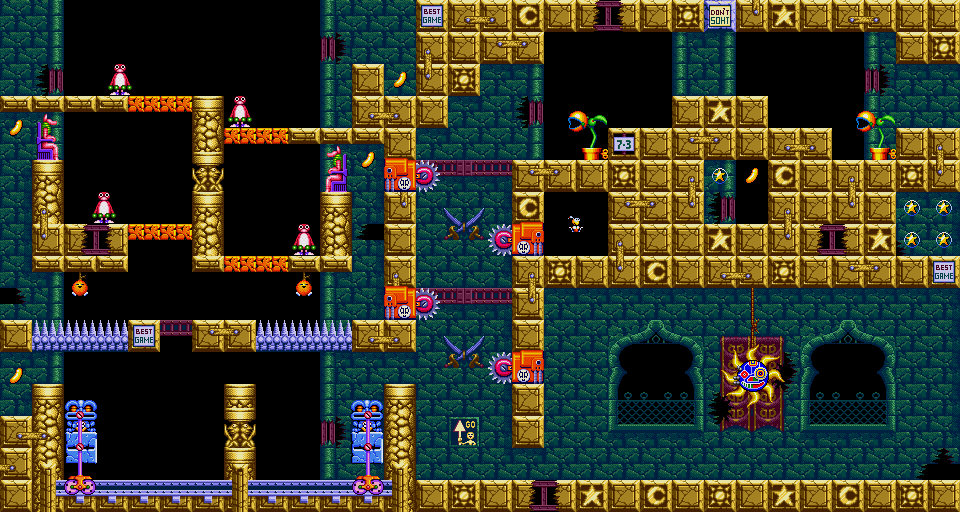
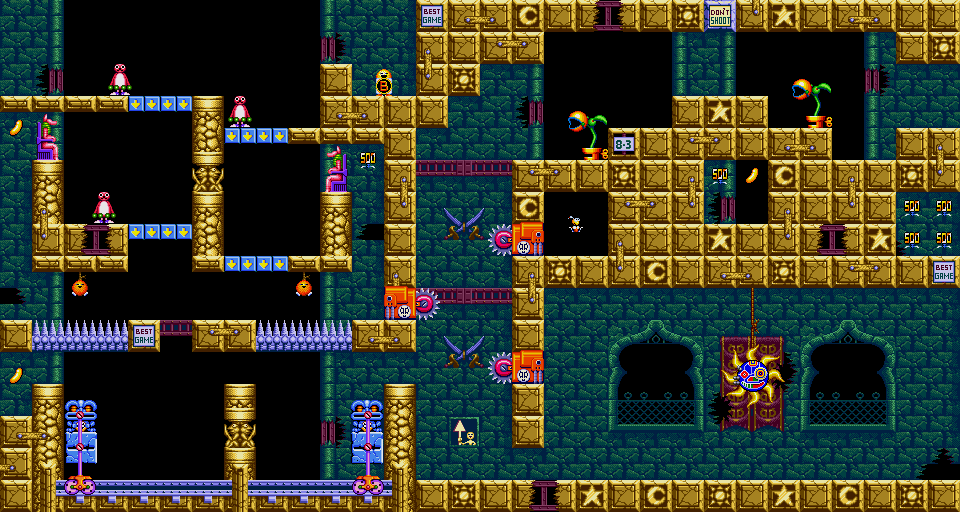
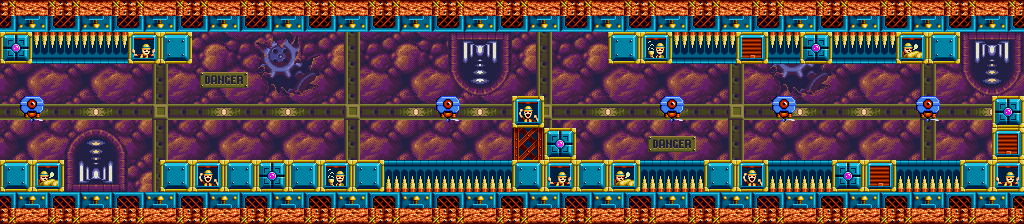
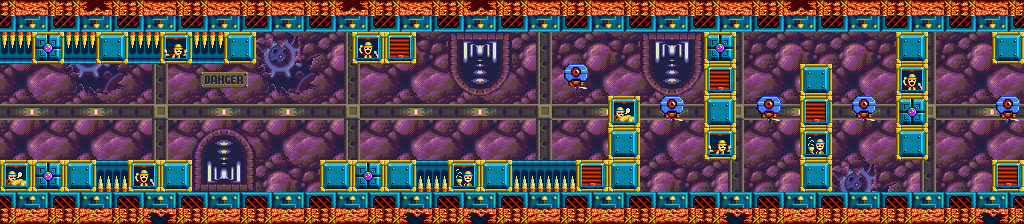
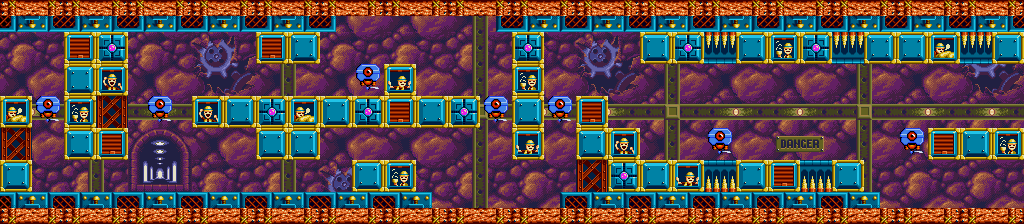
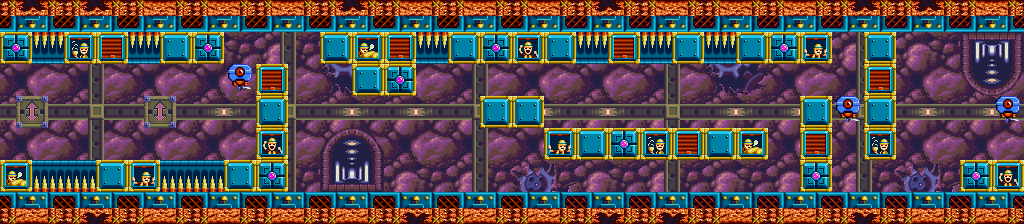
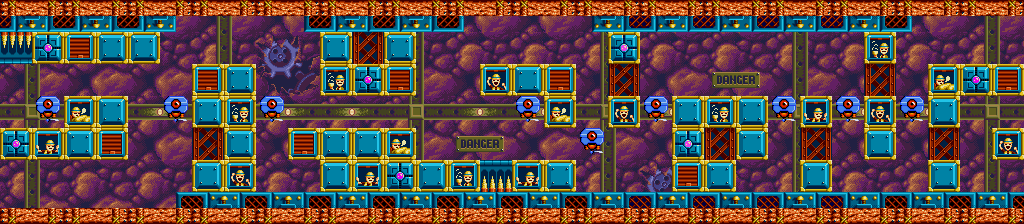
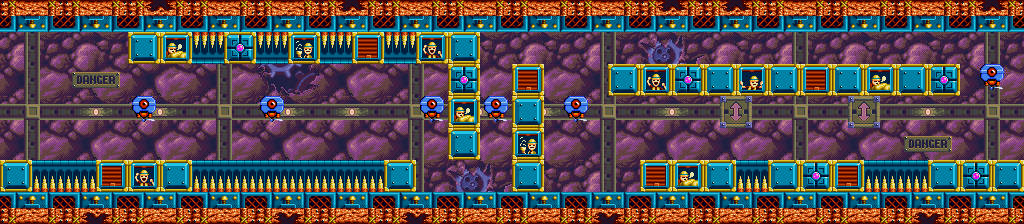
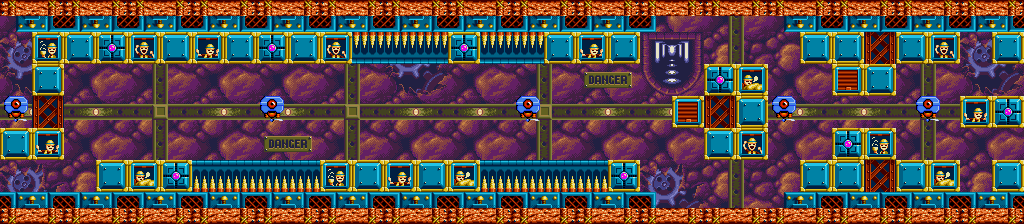
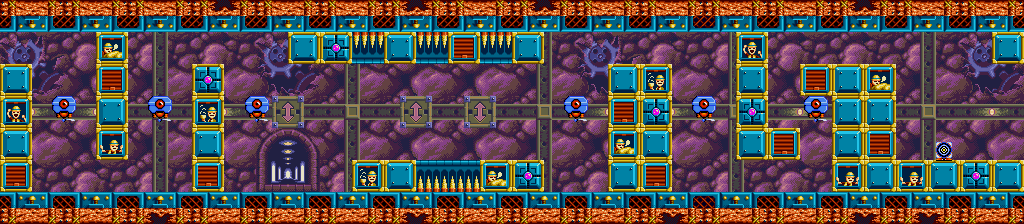
The background of this scene uses a markedly darker palette in the prototype.
Maruyama's Tower Crasher behaves differently.
Maruyama sways back and forth in the air, getting close enough to get into Headdy's range. In the final version, he flies more-or-less in place, out of range.
Maruyama will never charge at Headdy as he does in the final version.
Maruyama can be hit at any time in the prototype! In the finished game, he can only be hit after charging at Headdy, and even then he can only be hit once.
The Tower Crasher takes 8 hits to defeat, just as it does in the international versions. In the final Japanese version, it takes just 4 hits.
When the Tower Crasher is defeated, the body explodes, and the head and claw fall. In the final version, all three pieces fall, and the "winding down" sound is used.
After the Tower Crasher is defeated, the player is immediately taken to the next stage. In the final version, the player must climb to the top of the screen first.
In-between the prototype and the final version, the Sale sign was changed and the game was demoted from No.1 Action to Head Action. Whatever those mean.
Prototype
Final
The white cows face right in the prototype and left in the final version. Good change. Worth it.
Three of the butterflies were removed to make room for more cows. Never enough cows.
The weird Secret Bonus cow is missing from the prototype version.
The reliable Liberty Head shows up here as well, but only in the final game. As usual.
Prototype
N/A
Final
The Bino / Fat bird takes two hits in the prototype and just one in the final version. This is a proper Secret Bonus Point in both versions!
Since there are only four Keymaster bosses in the prototype, Yayoi's pack takes 4 keys. This was appropriately changed to 5 keys in the retail game.
Izayoi is a pushover in the prototype. She doesn't cover her face after being hit, and she has no counter-attack sequence.
The Dark Demon Castle background isn't animated in the prototype.
There is a total of 7secrets listed in the score tally, compared to 3 in the final.
Maruyama doesn't show up for his short post-boss scene.
There are a total of 4(!) health fruits in the first section of the prototype. One of those was replaced by a 500 point bonus.
The other fruit was replaced by the last Liberty Head Headcase. The platform he's on was extended slightly to accommodate him.
The second Head Spitter was moved up to the platform on the left. With where it is in the prototype, Headdy can just jump over it.
Prototype
N/A
Final
The stone bricks in the prototype act like platforms; they're not solid at the bottom. They're completely solid in the final game.
The brown-yellow blocks that make up the stage are completely solid in the prototype. This is a bad thing: Headdy can easily get himself crushed by using the Spike Head on ceilings. They were changed to alternate between solid and hollow every 8 pixels, which is how blocks act in every other stage.
The "DON'T SHOOT" bricks don't do anything in the prototype. The graphics for the Buddha and Bino markers are in the game, though.
The chains in the stage aren't as rusty in the final game.
Prototype
Final
The design of the beams was simplified for the final version.
Prototype
Final
Furthering this simplification trend, the platforms guides were shortened to one bar.
Prototype
Final
And again, two become one. Two ropes, that is.
Prototype
Final
The yellow lines were removed from this piece of scenery at the end of the stage. Improvement?
Prototype
Final
Two of the normal crates were changed to Hammer crates.
Of course, a HeadCase with a Hammer Head needed to be added as a result. Too bad he also has a Buddha Head!
The two Ojizos switched platforms in the final layout.
Prototype
Final
This section is more difficult in the finished game. Headdy has to jump onto the first row of spikes, go all the way to the left, then get in the right position to get past the final row.
One of the spike platforms was deleted from the final version due to the above change.
Prototype
Final
There are no platform tracks in the prototype stage.
The Pin Head path is more difficult in the final game, with more turns required to avoid getting crushed.
The last Battle Tanky is improperly placed in a wall in the prototype.
An increase in difficulty should mean better rewards, so the 500 point bonus and health fruit were replaced with extra lives.
Headcase Set 1
Headcase Set 2
Prototype
N/A
Final
The cutscene at the end of the stage is missing all sound effects, and the music doesn't stop playing like it does in the finished game.
The final stage's BG had a bit of a makeover between the prototype and final builds.
There's a skylight in the prototype's foreground. This was removed from the final game, presumably due to the changed star graphics (see below).
The yellow rings around the pillars are missing from the prototype's foreground.
All of the pillars are at the same height in the final version.
The two torches were replaced by gargoyles.
The endless hallway behind the curtain was replaced by a modestly-sized throne.
The eagle atop the doorway was changed to some kind of demon man.
A "FINAL SCENE" sign was added in the finished game.
The old room design is still used in the Game Gear port!
Prototype
Final
The background is more star-studded in the final game. The stars at the top and bottom are also more detailed in the final version.
Prototype
Final
All of the blocks in the prototype's stone crusher use the same design.
One of the one-block gaps in the middle was widened to a two-block gap. This way, wherever the crusher stops, there will always be a two-wide gap for Headdy to crawl into.
Before each Dark Demon attack, four different heads out of a set of eight circle Headdy. Only two of those heads were changed.
Prototype
Final
The Empty Head was removed because it trivialized every attack, and the Sleepy Head was removed because being able to refill health made the fight too easy.
Dark Demon can be attacked multiple times per phase in the prototype. Obviously, this makes the fight a lot faster and easier to get through.
Dark Demon has 17 HP, as he does in the final international game. In the final Japanese game, this was lowered to 9 HP.
The crusher has no collision detection in the prototype. It can't harm Headdy at all!
Though the post-boss cutscene is complete, there's no ending programmed yet. In this build, Smiley is stuck to Headdy's face for all of eternity.
Even though the Bonus Stage and Number Pad screens aren't in the game yet, the secret final boss screen is! Use Pro Action Replay (PAR) code FFE8C3:0034 on the Stage Select screen to access it.
Prototype
Final
There's no actual boss fight here yet, though.
The background is static in the prototype. In the final game, the clouds have parallax scrolling, and a helicopter moves in and out of frame.
The pen holder and paper stack are part of the background in the prototype. In the final game these were both changed to sprites, so that when the boss slams his desk, they both fly up.
Exiting the stage right leads to the Game Over screen.
This is partially coded as well. Use Pro Action Replay (PAR) code FFE8C3:003E on the Stage Select screen to access it.
Prototype
Final
The prototype reuses the title screen's background as a placeholder for the final version's unique design. The sign was also moved to the right, just a tad.
Prototype
Final
The villagers stop on different frames in each version.
Prototype
Final
HEY DON'T HIT ME!!!
The torch-bearing D.D. Soldier was moved to the top of the sign.
The sword-carrying D.D. Soldier is animated in the final game, making the freaked-out soldier's reaction more reasonable.
Prototype
Final
Two more Flying Soldiers were added on both sides.
Prototype
Final
The deflating Balloon Kelly flies further in the final version.
Prototype
Final
HangMan's graphics aren't properly loaded in the prototype.
There are no enemy names in the prototype. Smiley's dialogue from Scene 8-3, え (What?), is used as filler.
In the final game, all of the enemies are silent. They still have their sound effects in the prototype.
After finishing with the Scene 8 enemies, two garbage objects walk across the screen. After that, the game locks up.
 This article has a talk page!