 This article has a talk page!
This page details one or more prototype versions of Descent II (PC).
The Descent II Interactive Demo, with the executable built December 14th, 1995, gives an incomplete look at the game's state a few months before the commercial release.
Graphics#

|
To do: |
|
Demo |
Final |
|---|---|

|

|
Though graphics resolutions higher than 320x200 aren't enabled in the demo, all of the high-resolution gauges remain. The demo's high-resolution afterburner gauge is yellow compared to the final one's red.
Level Differences#
|
|
To do: |
The three included levels are close to the final versions, but a few secret areas have been added into the final versions of the levels.
Level 1#
|
Demo |
Final |
|---|---|

|
|
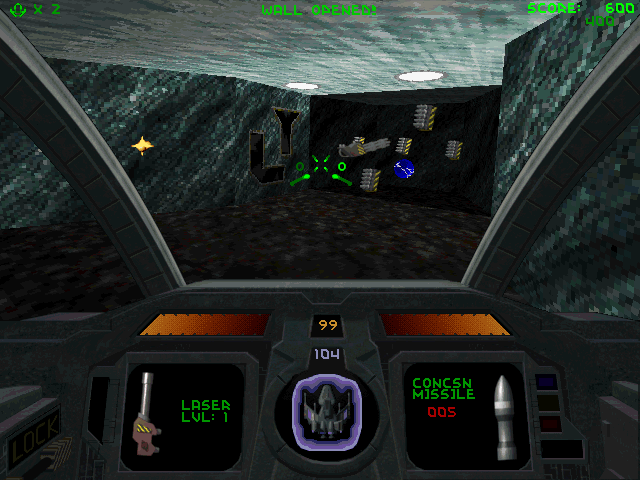
A secret area was added to the final version of the vulcan room, where shooting the monitor opens a wall, revealing more vulcan ammo.
|
Where the switch is added |
What is opened |
|---|---|

|
|
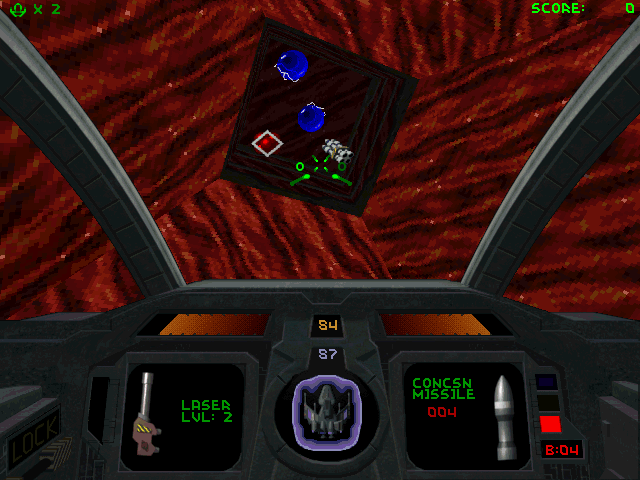
Behind the bottom of this lava fall in the red key room, the final version adds a switch, revealing an area with some missiles and shield powerups.
Level 2#
Demo |
Final |
What is opened |
|---|---|---|
 |
 |
 |
A secret switch was added to one of the lava chambers in the starting room, opening up the entrance door to reveal some missiles.
Weapons#
Gauss Cannon#
The Gauss Cannon in the demo is even more ridiculously powerful, traveling at 1000 units/second and doing 40 damage per shot (including up to 40 extra splash damage). The final release tunes this down to 700 units/second and 25 damage per shot (with up to 25 extra damage).
Helix Cannon#
The Helix Cannon, on the other hand, is quite a bit weaker than the final release, doing 7 damage per projectile and taking 1.5 units of energy to fire. The final release raises the damage to a hefty 11 per projectile and makes it use only .75 units of energy. For balance reasons, when in a multiplayer game, the Helix Cannon's energy use is increased back to 1.5 units and the damage is reduced to 75%, bringing it back in line with this iteration of the weapon.
Omega Cannon#
|
Demo |
Final |
|---|---|

|

|
Despite not being included in the demo officially, it's possible to modify the demo to restore the needed assets. This reveals that the Omega Cannon fires completely differently, instead of attacking with a giant lightning bolt, it instead quickly creates two beams of Plasma projectiles, costing 1 unit of energy per beam. In practice, this version is much weaker, taking several beams to destroy even weaker armored robots.
Guided Missile#
Guided Missiles are slightly weaker than the final release, doing 45 damage per missile (including up to 45 extra splash damage). The final release tunes this to 55 damage.
Smart Mine#
Smart mines don't last as long in the demo before automatically detonating, with this happening after 35 seconds. The final release increases this to two minutes.
Mercury Missile#
Though no assets related to the Mercury Missile are present in the archive, editing a save to grant all weapons reveals that the missile is considered a "large" missile that is fired from under the ship, like the Smart Missile, Mega Missile, and Earthshaker Missile. This is changed in the final release so that they are fired from the sides. Of note, all the unavailable weapons are described in the demo's text file with descriptions very close to the final, but the Mercury Missile is simply described as ???, suggesting it was the last of the new weapons to be fully realized.
Earthshaker Missile#
Also has no data present, but its earthshaking capability is already implemented. It cannot split off into bomblets, unlike the final version.
Minefield Mine#
The mine placeable by level designers doesn't vary its damage based on difficulty level, doing 30 damage at all difficulty levels. The final version scales down to 10 damage on the easiest difficulty level.
Robots#
The demo contains models and data for only a few robots, the ITD, the PEST, the PIG, the Smelter, the Diamond Claw, the Sidearm and its miniature Modula, the Thief-Bot, and the Guide-Bot. In addition, the Zeta Aquilae boss appears in the data, but the boss level isn't actually included. The AI stats are mistakenly included for the "Evil Twin" enemy and the E-Bandit, but none of the other data or their models are included.
Smelter#
The demo Smelter moves slower, and fires less projectiles on the easier difficulty levels.
Sidearm#
The demo Sidearm moves faster than the final release Sidearm, and grants 1250 points instead of 1000, but fires less projectiles.
Zeta Aquilae Boss#
The stats for the boss are very incomplete in the demo. It has the same attacks as the final version, and 3000 health, but gives 2500 points instead of the final's 7500 points, attacks slower and can't see all around it like all the bosses in the final game. It also behaves the same as the original Descent's level 7 boss, teleporting on hit and making the same sounds.
ITD Bot#
The demo ITD moves slower and has slower projectiles, but also attacks more frequently on the easier skills. It makes the same sound as the Sidearm Modula, and would get a unique sound in the final release.
PEST Bot#
The demo PEST fires less shots on the easiest difficulty, doesn't chase targets as far, and attacks slightly more frequently, but is overall the same.
PIG Bot#
The demo PIG fires slightly less frequently on the easiest difficulty than the final version.
Diamond Claw#
The demo Diamond Claw doesn't pursue targets as much as the final version, and turns slightly slower. The plasma blobs emitted when shooting the robot with a energy weapon are fired in a random direction and don't always lock onto the attacker. In the final version, the plasma blobs were tweaked to always target the attacker.
Thief Bot#
To make him slightly easier to catch, his speed was reduced on the easier difficulties in the final version.
Sounds#
A number of unused sounds are included in the demo, and a few are different compared to the final versions.
|
Demo |
Final |
|---|---|
The sound the afterburner makes when the player stops using it was made more distinct.
|
Demo |
Final |
|---|---|
The convertor sound was made higher pitched in the final.
|
Demo |
Final |
|---|---|
The sound of dropping a weapon was remade entirely to sound better.
|
Demo |
Final |
|---|---|
The unused sound of an earthshaker impact was also redone entirely.
|
Demo |
Final |
|---|---|
As was the sound of an illusionary wall fading.
|
Demo |
Final |
|---|---|
The sound of the fan was changed before release. None of the demo levels use fans, so this sound is effectively unused.
|
Demo |
Final |
|---|---|
The sound of the Mega Missile impact was heavily revised. With no Mega missiles in the demo, this sound is also unused.
|
Demo |
Final |
|---|---|
The splash heard when water is hit by a projectile is changed to something that sounds more fitting.
|
Demo |
Final |
|---|---|
The scream the Thief-Bot makes when killed was replaced with a higher pitched version.
This ding sound effect goes unused in the demo and is removed in the final release.
Command Line Parameters#
A few command line parameters are checked, though in practice aren't useful or are unused. Most of them are used in the final release.
"-superhires" is checked to add more screen resolutions available in the menu. They still cannot be selected, though.
"-mvedir" is checked to change the directory full motion videos are loaded from, but none are set to actually play.
"-missions" is checked to change the directory missions are loaded from, but the code to enumerate the missions directory is bypassed for the demo, and instead a hardcoded mission is loaded.
In addition, at least one developer command line parameter is implemented and checked, but differences in how the release builds of the game versus the internal developer builds mean it isn't actually used.
"-bspgen" is checked but has no effect. Its intended use is to generate a command line for an internal tool to generate model's BSP trees.
|
The Descent series | |
|---|---|
|
DOS, Mac OS Classic |
Descent (Shareware) • Descent II (Prototype) |
|
PlayStation |
|