 This article has a talk page!
This page details pre-release information and/or media for The Walking Dead (Windows).
Developer Comments#
A lot of relevant insight was given by the DLC's director Sean Ainsworth on his website. The following comments are all sourced from there:
On the DLC's origin#
|
Quote: So a few other writers and I sat in a room for a few days and decided on an anthology episode. We’d each go off and write 10 story pitches, and a few days later we convened to select which of the 50 story pitches would comprise the episode. Myself and the other writers went off to work on these stories, and a few weeks later we had 6 fleshed out pitches ready to go into production. Meanwhile some of the designers were prototyping new mechanics, and between us we put 3 new mechanics into this episode. The character team had to figure out how to make 27 characters, and I fought hard to put my brother Chris in the game (he became Eddie) since he was such a huge Walking Dead fan. (Chris would later go on to be the Season Director for Walking Dead: The Final Season, where, SPOILER, Eddie would be killed). This game is near and dear to my heart. It was a small team trying new things, rolling forward, getting excited and just putting things in that we thought were fun. We also had a lot of fun figuring out how to let you play the narratives in any order you liked, and to make sure that small things would link cross-chapters to enrich multiple playthroughs and give people hooks to discuss the world and its characters, and even some ties to Season 1. |
On the Truck Stop#
|
Quote: |
On Vince's Story#
|
Quote: |
|
Quote: Fun fact: I’m the voice actor playing Tiny Carlos. We didn’t have budget for him so it’s just me. |
Tiny Carlos never gets named in-game, he's only identified internally otherwise.
On Wyatt's Story#
|
Quote: The initial idea behind the story was to put it far enough into the apocalypse that if you hit a person with your car, you’d think twice before going to help them. You needed to be able to understand as a player why Eddie would be pushing to check on him still—that the world isn’t horrible enough yet that they’d just leave him. The “click and drag” mechanic for Wyatt dragging Clyde to the car was already being prototyped by Harrison Pink and Mark Darin when I started writing, so I stole it to put in here. :) |
|
Quote: The man you hit is also Clyde, one of the prison bus guards. This is why he has become a zombie to attack Bonnie after she falls down the hill in her story. |
The last paragraph is pretty amusing, as despite earlier stating "(I will say everyone seems to get the names of the guards on the bus mixed up!)" on his site, here, Ainsworth himself gets the guards mixed up. While Eddie indeed hits Clyde with his car, it's Bennett that can later show up in Bonnie's Story.
On Russell's Story#
|
Quote: |
|
Quote: The biggest connection is that [SPOILERS for Walking Dead Season 1] either Doug or Carley, whoever was shot on this same stretch of road, will be lying in a ditch. A lot of people seem to think we got the position wrong, but we assumed the corpse had been laying out there long enough that the animals had got to it. :( |
On Bonnie's Story#
|
Quote: We really wanted you to feel bad when you smashed Dee in the face (hence her horrible unmoving eye). And if you saw it coming, and refused to hit her, well, then you find out what she had planned for you anyway. |
|
Quote: |
On Shel's Story#
|
Quote: |
|
Quote: |
This fun fact is very interesting, as it refers to a recital, something that was planned for the episode but ultimately changed in favor of Becca playing guitar at the start of the episode in the final release.
On the Epilogue/ Tavia's Story#
|
Quote: Originally, though, we had much bigger plans. Below is a document myself and Mark Darin wrote at the time outlining what would happen in Tavia’s story. It changed a lot from the document during the process of making it (we got all the way to having a prototype running before we needed to cut it down). The fact that we didn’t get to make this still bugs me, as I feel the episode as a whole would have been much better and more fondly remembered, but alas, ‘twas not meant to be. No, I have no idea why it was called “Fishduck Highway.” Also, the term “emo chick” was common parlance in my part of the woods, and I’ve matured since then. Apologies! |
Original Chapter 6 Treatment#
WD 106 - “Fishduck Highway”
Characters: Octavia (you), 41, is a former federal district court judge handling mostly traffic cases. It’s possible she holed up in the federal building where she worked in the early days, trying to keep the peace as things grew increasingly worse and the building was destroyed from within. She escaped alone, having lost contact with Rose, her mother-in-law, her only remaining relative. After making her way across the state to her house, she found Rose on the verge of starvation. Unable to save her, she was forced to take a claw hammer to her head. She took her to the family plot and buried her next to her son, Octavia’s husband William, who died twenty years prior.
She is the leader of this group because she’s intelligent and she doesn’t put up with bullshit.
Anna, 26, is a slender, former emo chick. She still has a wisp of pink in her hair, grown out in the year since she saw her friends eaten. She’s capable, terse, and a little aloof. Octavia brought her along to show that the group trusted her with the responsibility; she’s got some major trust issues. Anna flirts sometimes with leaving the group and trying to find somewhere she fits in better, but can’t bring herself to do it.
Vince, from the Prison Bus
Bonnie, from Downpour
Russell, from Wildcard
Shel and Becca, from Two Sisters
Wyatt, from Roshambo
Scenario: We begin at the truck stop. Octavia has just found her picture on the notice board, and mentions it to Anna, trying to jimmy open a vending machine. Octavia talks about her mother-in-law a bit, gives a tiny sliver of backstory: maybe she’s the one who put it up here after they lost contact. The talk shifts, becomes obliquely about Shel and Becca, about how what they said was in this machine better be in this machine.
There are zombies nearby; the girls talk in whispers.
The objective here is to show that Octavia is the leader. Throughout the opening, you’ll have to tell Anna what to do; she defers to you, listens to you for the most part (she might argue with you some, but will do as instructed). This might be as simple as “Hand me that wrench” or as difficult as “You go into that dark room.” Not sure yet, but the point is to give the player the feeling of control. You’re dictating the terms.
Eventually, the zombies you’ve managed to avoid until now notice you, and there are a lot of them. Here’s where you really shine: getting out of the truck stop alive is going to depend on what you tell Anna to do and what you decide to do. This will be a tense puzzle of sorts, a mishmash of dialogue and interaction that forms a plan.
Just as you manage to get yourselves safely away, something you told Anna to do causes you to fall catastrophically. You break your back. It’s both yours and Anna’s fault--she carried out your order, but you weren’t explicit enough; at the same time, common sense should have told her the rest. It’s important it doesn’t feel like any one person’s fault.
An action-packed segment leads to Anna rescuing you from the truck stop via the prison bus from Day 2, which has a hard time starting after a year in the elements, but starts nevertheless. She drives you back to your temporary camp, a huge zombie horde on your trail.
As you arrive at camp, you discover all the people you played as previously. They gather around the bus, afraid and confused, and demand to know what happened. You and Anna explain as they lower you out of the bus--here we’ll interrupt some of your dialogue choices with screams of pain, I’d imagine.
They get you settled onto a table or something and begin to argue over what it means that your back is broken. They’ll be mad at Anna, and you can defend her or blame her. At the same time, you can try to enact your will over the group--tell them to stop fighting, tell them the herd is coming. They may listen to you, they may not--depends on what the group makeup is. If Russell, from Wildcard, is there, for instance, he will act differently toward your orders depending on whether or not he told Wildcard to kill the old man.
Just as things really start to heat up, you pass out from the pain.
When you awaken you’re inside a tent, your minor wounds being tended by one of the group. You get to have a one on one conversation with this person, where you find out that the camp is packing up, and that the group is divided about your fate. You will find out obliquely how the intervening time since last you saw this person influenced them. For instance if it’s Shel, she’ll talk about Becca and how she’s taking this news. She’ll also likely refer to things you never witnessed and some that you did.
Someone comes into the tent with an update. There’s now a three-way conversation going, where you find out about whoever this person is a little bit. Indirect dialogue leads to many answers to questions you might have, but ostensibly this person came in to tell you to vacate the tent so they can start to pack it up. The two carry you outside on whatever makeshift gurney they’ve created, and lay you down in the thick of things. People are packing up, moving around. Some of them notice you and stop. Octavia notices things are being done slipshod, and that people are ignoring some of the standard group etiquette. This quickly resolves into a group fight, where more than one thread of fear comes out.
During the argument, the question of your leadership comes up. Some people will consult you, and you can make suggestions which people may or may not follow, all depending on what sort of person came out of that story when you played it. Vince might be loyal to you and agree with you, or maybe he feels like doing whatever the group wants. All depends on whether you chose to shoot Danny or Justin.
The argument kind of resolves itself, fizzling as more important things come up. One person didn’t really involve themselves in the argument. That person (always the same person) will approach you now.
You’ll have a conversation about the argument and what just happened, maybe about how wrong someone was or how right.
Then zombies show up, 7-10 of them ambling out of the darkness to attack the camp. You do the only thing you can do--watch, and offer advice. This advice may or may not be followed, may or may not help. You are attacked by a zombie, but cannot save yourself--you can only hold the zombie off long enough for someone else to save you. We want the player to consider whether they would be useful to the group or not in the future here, as Anna, who helped you out, takes care of the zombie.
The attack over, Anna asks if you’re okay. The two of you watch the rest of the group in the aftermath of the attack. There are arguments and blame, but everyone seems to be okay. They finish packing. If we feel like the player hasn’t had enough of an opportunity to find out about the other characters, we can add some of that in here: what Anna knows about them, and maybe find out a little about her, too.
Everything is packed now, stowed and ready to go. There’s just this one last thing: what the hell to do with you. First people suggest options, and you get a chance to support or refute them as you see fit. But the personalities in the group will dictate how this will go; slowly, by degrees, the ending will fracture from here, off into multiple different scenarios.
Some might end in bloodshed. Some might end in poignant goodbyes. Some might end in the group splintering in two, or three. Maybe you’re left there, alone, with a gun and a bunch of zombies approaching. All of it will depend on your choices from Chapters 1-5.
Concept Art#
Concept artists for the 400 Days DLC are Jesse Maccabe, Derek Stratton, and Gray Rogers. Of the three, only Maccabe's contributions can be confirmed, as there are quite a few that can be found on his personal site.
Art |
File Name |
Notes |
|---|---|---|
 |
Jessemaccabe wd400Days truckStopMood01.jpg |
A mood piece depicting the five protagonists (and Becca) walking towards the truck stop. Shel appears to have much longer hair than she does in her final appearance. Bonnie appears to be wearing the jacket her concept art depicts, which isn't what she wears in the final game. Vince also seems to be wearing a leather jacket of some kind. A zoomed-in version of this piece became its banner on most storefronts. |
 |
Jessemaccabe wd400Days truckstopConcept01.jpg |
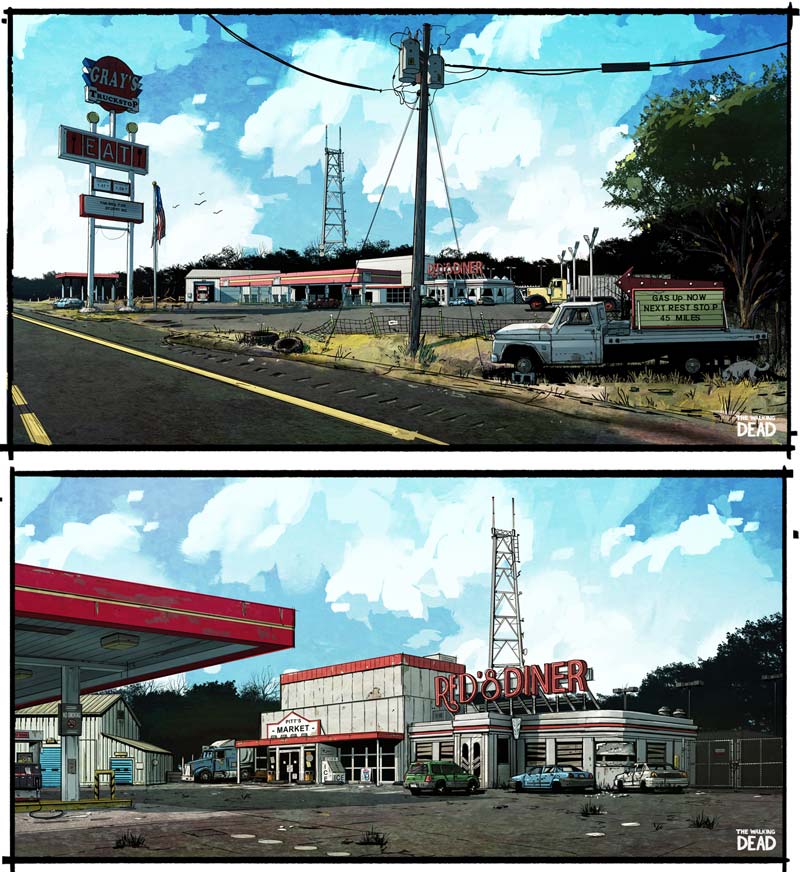
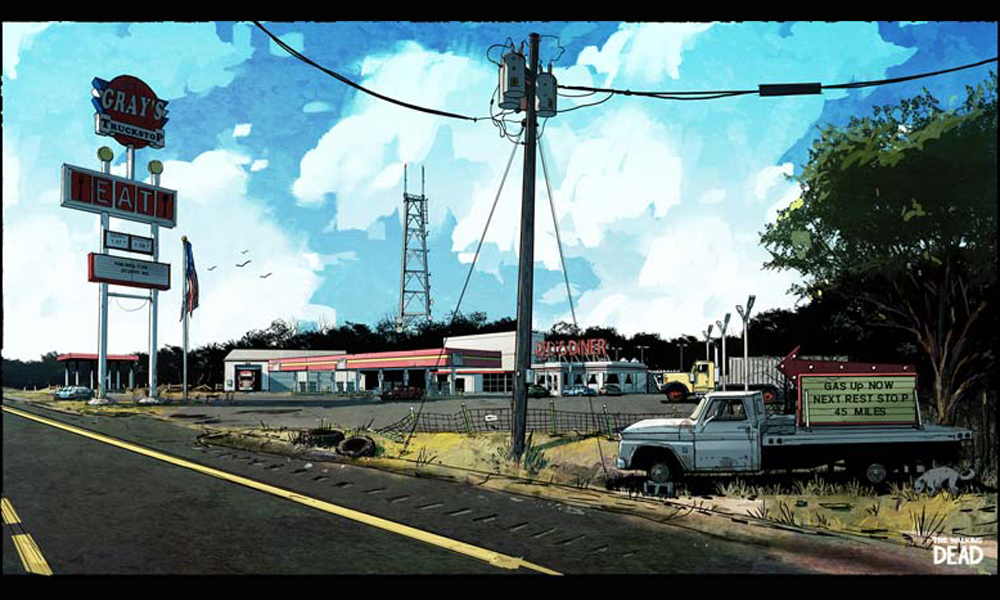
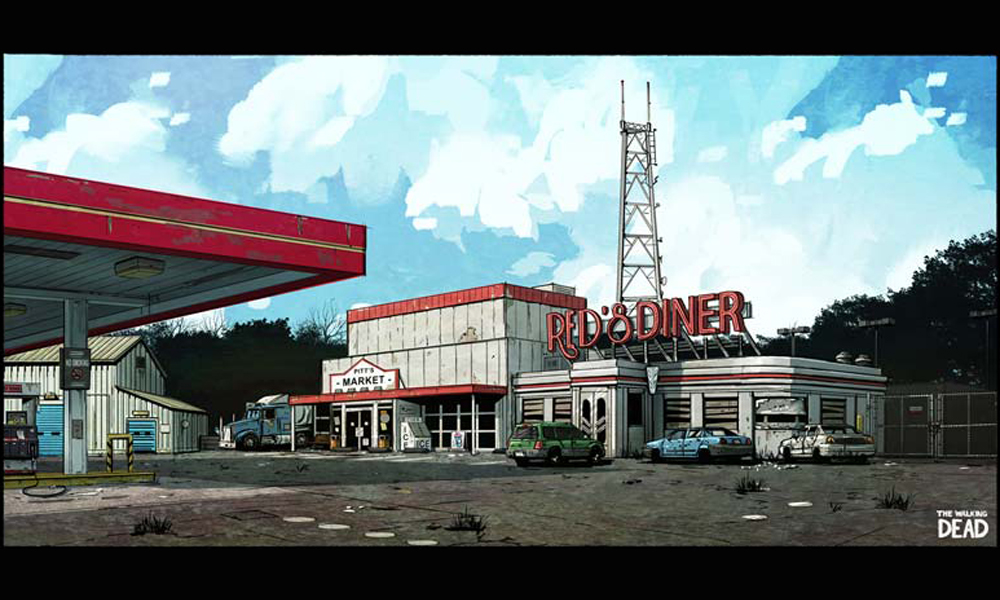
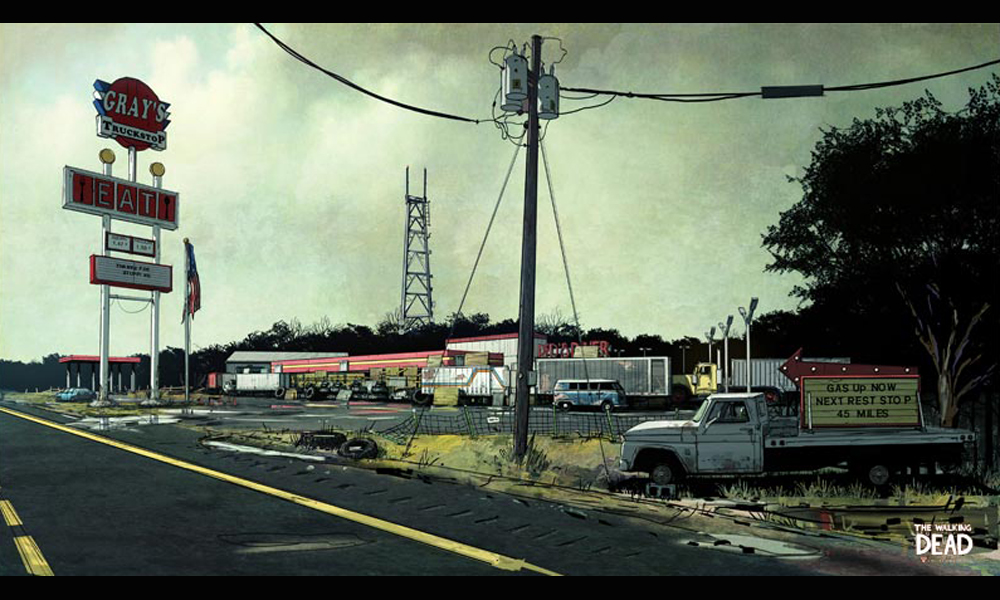
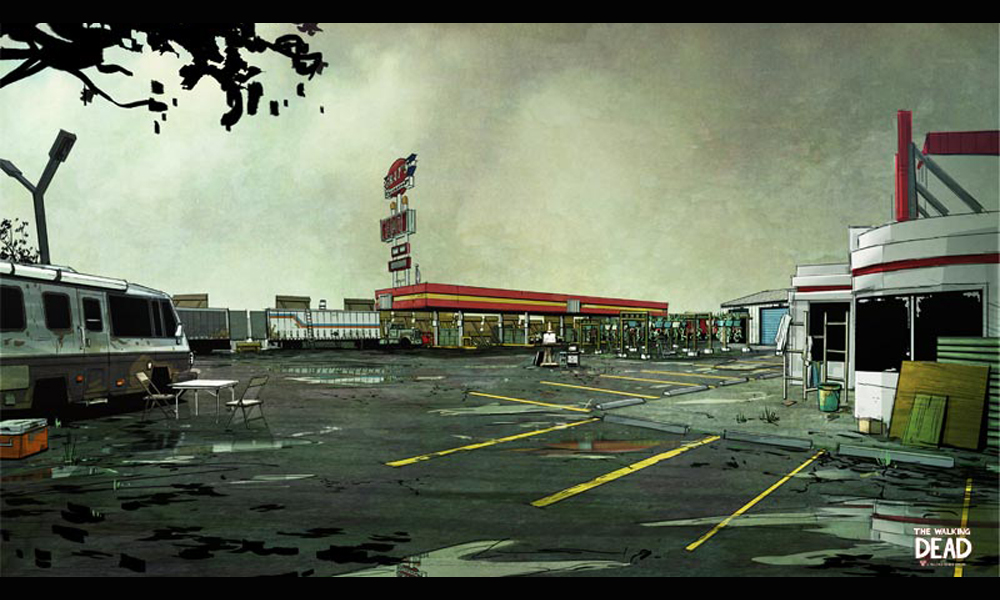
Two pieces depicting the truck stop, here still known as "Gray's Truckstop". In the final game, it appears as "Gil's Pitstop". Most of the other signage, such as the "eat" and "Red's Diner" signs remained identical from concept to final. For the bottom piece, the light blue truck on the left is still shown as part of the barricade there in the final game, but at no point are there are cars shown in front of the diner like this. |
 |
Jessemaccabe wd400Days truckstopConcept01A.jpg |
Same as above, but only the top piece. |
 |
Jessemaccabe wd400Days truckstopConcept01B.jpg |
Same as above, but only the bottom piece. |
 |
Jessemaccabe wd400Days truckstopConcept01C.png |
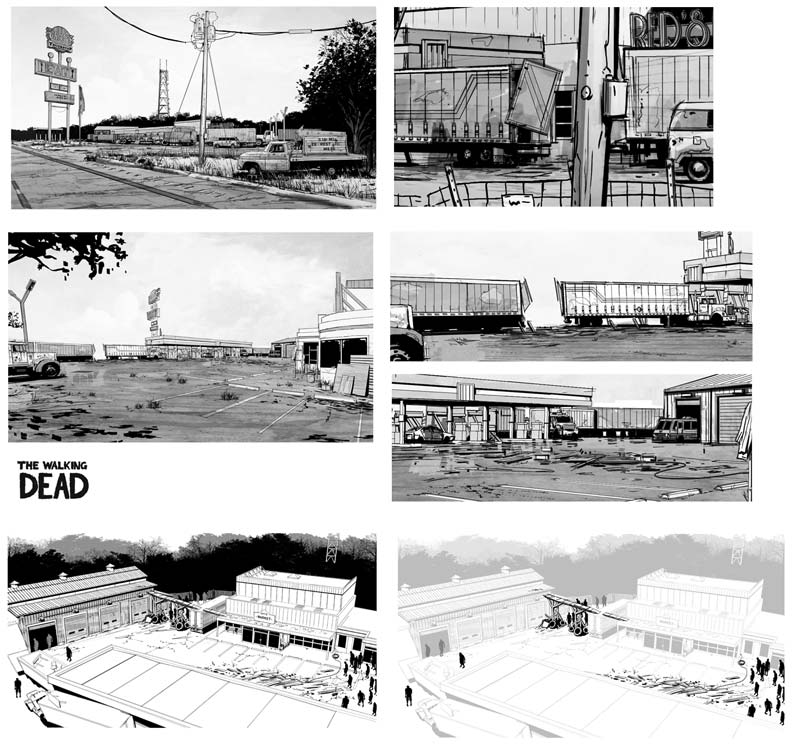
These pieces depict the truckstop once again, but now in the post-apocalypse, after Shel's group has taken residence there. The top artwork shows the barricade made around the truckstop. The hanging plants also appear here as seen in the final game. The sign still bears the name "Gray's Truckstop". The bottom artwork is more interesting, as it depicts a raised walkway from the roof of Pitt's Market to the neighboring garage, while also going over a stationary truck. This walkway is completely absent in the final game, and the garage door is never shown opened. |
 |
Jessemaccabe wd400Days truckstopConcept02.jpg |
The top piece of the truckstop art, but now with a purple-ish tint. |
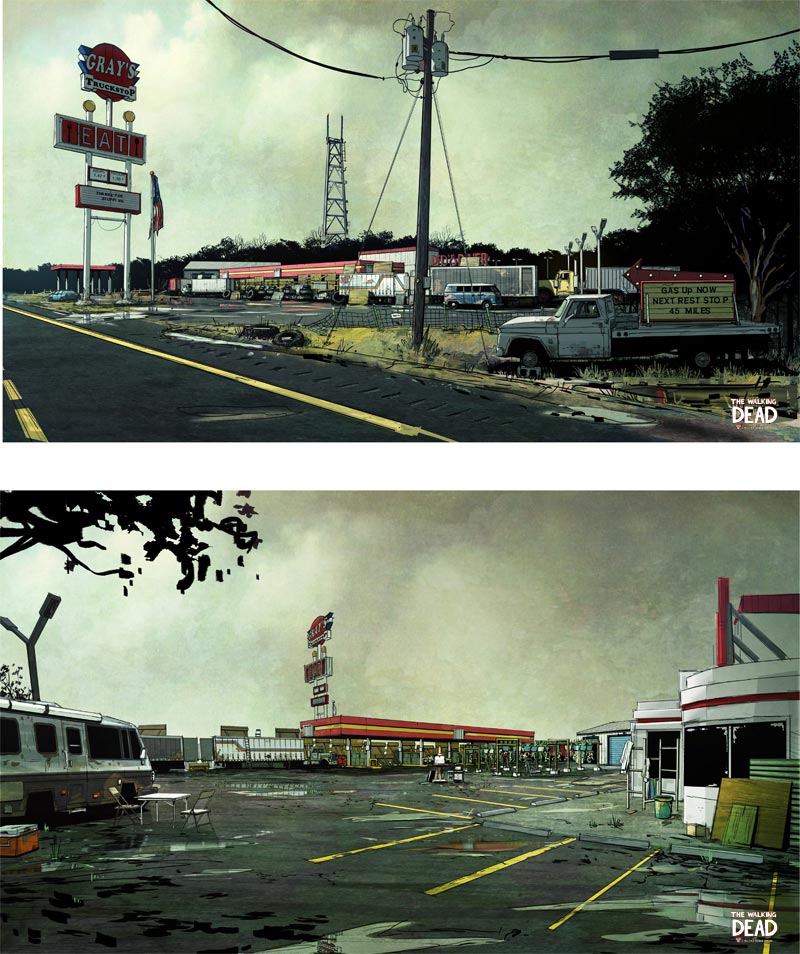 |
Jessemaccabe wd400Days truckStopConcept03.jpg |
Two pieces of truckstop art, now in a greenish tint very similar to how it actually appears in the final game. |
 |
Jessemaccabe wd400Days truckStopConcept03A.jpg |
Same as above, but only the top piece. |
 |
Jessemaccabe wd400Days truckStopConcept03B.jpg |
Same as above, but only the bottom piece. |
 |
Jessemaccabe wd400Days truckStopConcept04.jpg |
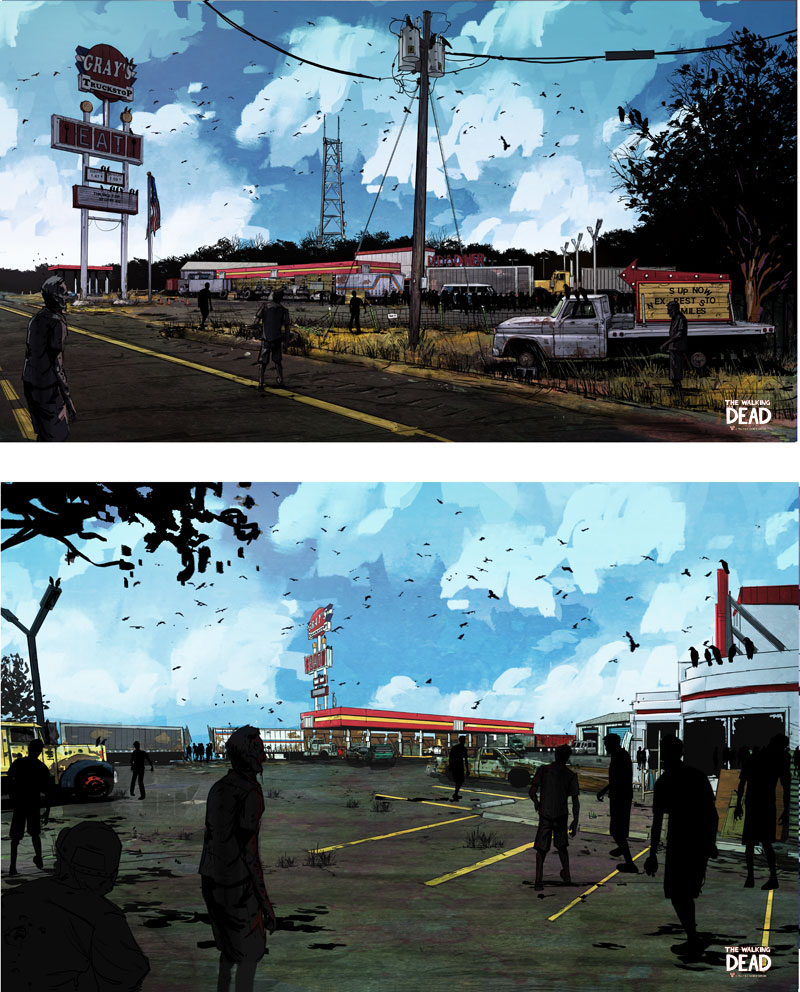
Two pieces of truckstop art, with natural lighting, but depicted as overrun with walkers. Very notable is the fact that the RV to the left is now gone. In the final game, Shel only leaves the truckstop with said RV based on choices made. |
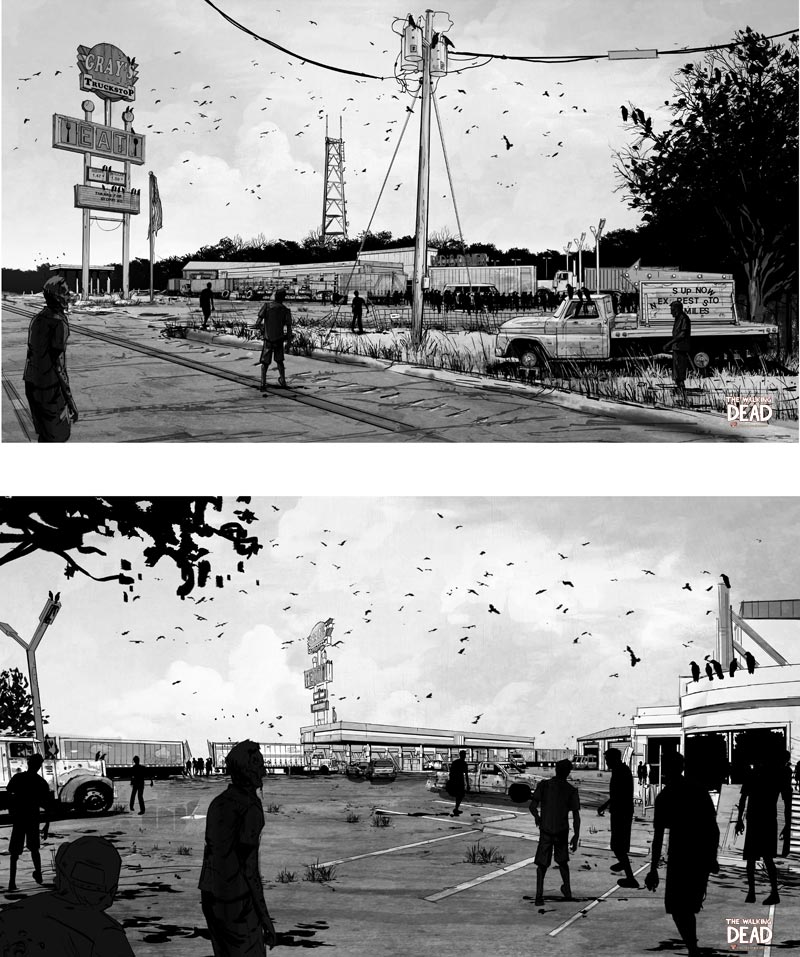 |
Jessemaccabe wd400Days truckStopConcept05.jpg |
Same as above, but lacking color. |
 |
Jessemaccabe wd400Days truckStopConcept06.jpg |
Various black-and-white pieces of truck stop art. The top and middle left pictures appear above, but without walkers and flies. The bottom left and right pictures depict the same scene as above, with the walkers and the raised walkway. The left picture is unaltered, the right highlights just the walkers and walkway. The three other pictures on the right appear to be close-ups on parts of the artworks on the left. The top one is a zoom-in on a hole in the barricade wall, seen from the outside. The middle artwork also depicts this hole, but seen from the inside, and the third one depicts debris all over the place, notably also showing the RV parked in the garage door with an opened door. This placement seems to suggest that in the other images with the walkway, the garage door is open because the RV has driven away, the debris in the second variation seems to imply that the RV (presumably driven by Shel) would've gone right through the plant/garden setup. Another small difference is the fact that the vending machine appears properly against the wall in the art, whereas it's pulled away from the wall in Shel's story. |
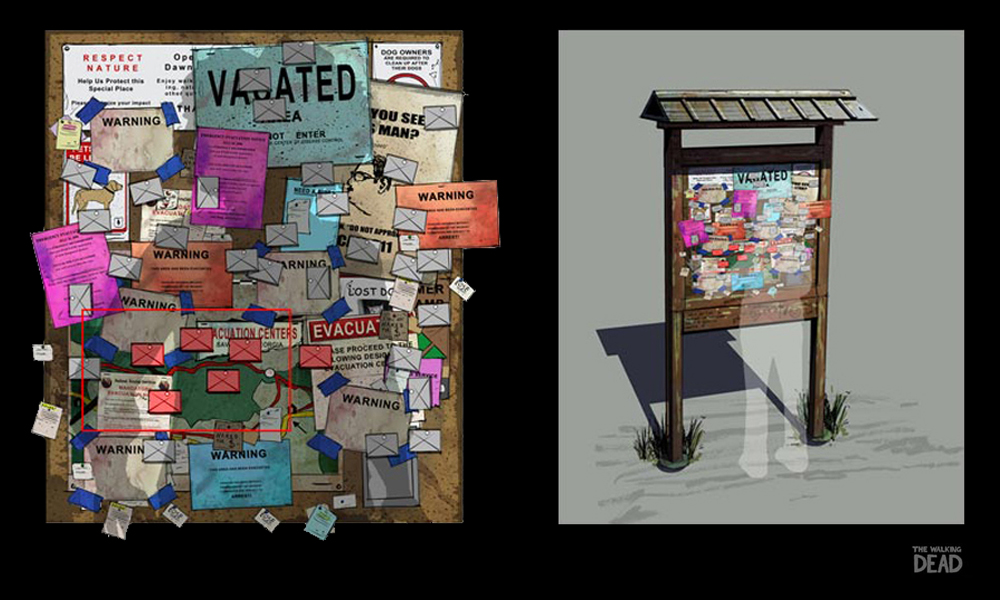 |
Jessemaccabe wd400Days noticeBoard01.jpg |
The notice board from which you pick your characters. According to Jesse Maccabe, he created all the interactable 2D art for this asset. Also present is a silhouette for Tavia. |
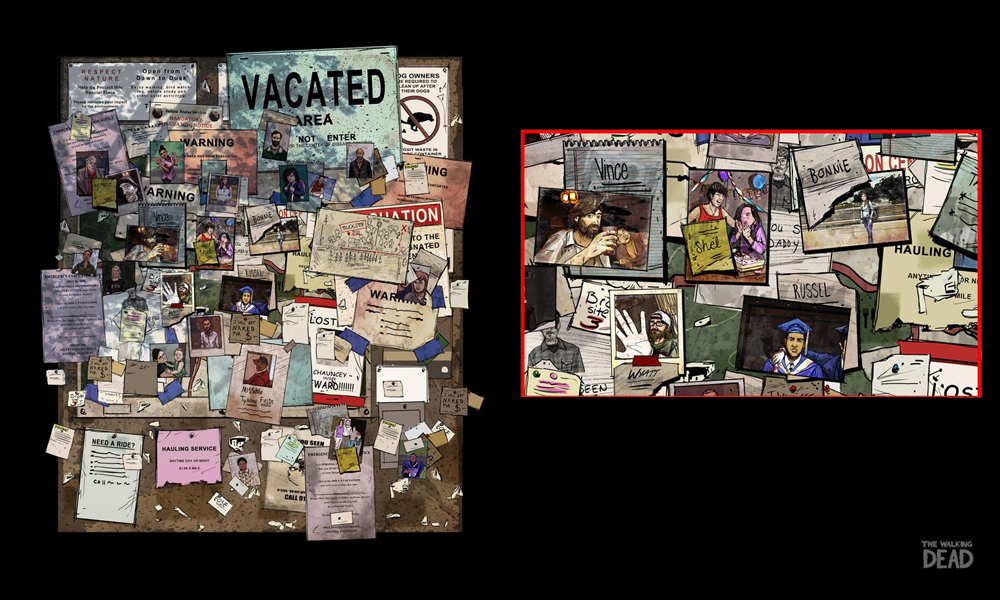 |
Jessemaccabe wd400Days noticeBoard02.jpg |
A more detailed look at all the notices pinned up. While the layout remains mostly identical to how the board appears in the final game, there are numerous small differences.
|
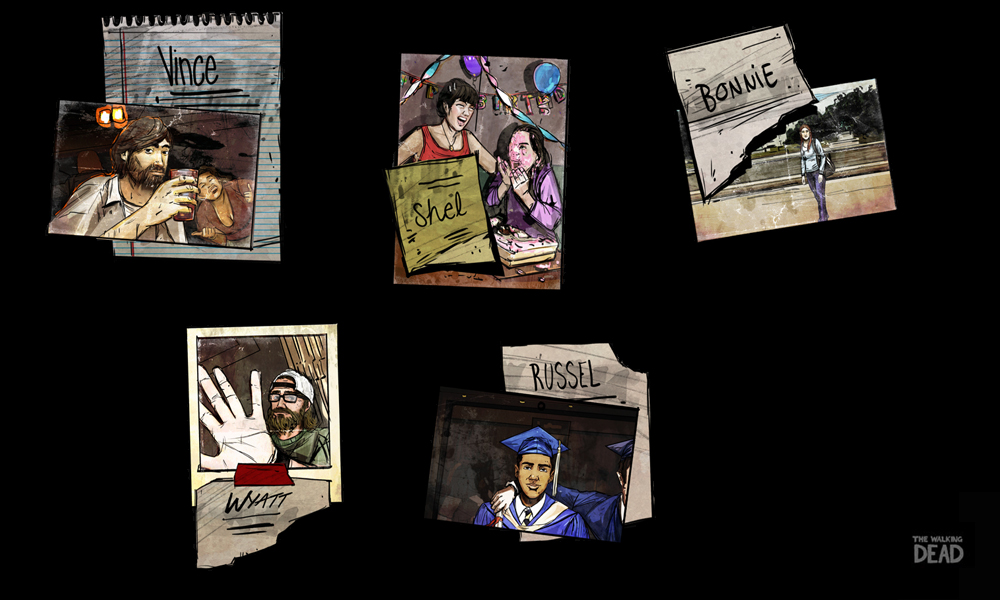 |
Jessemaccabe wd400Days photos.jpg |
A separate look at the protagonists' pictures, showcasing their design changes more clearly. Wyatt's early picture still appears in the final game, as at the very end of the DLC when the protagonists burn their pictures, Wyatt's early design can be seen briefly. |
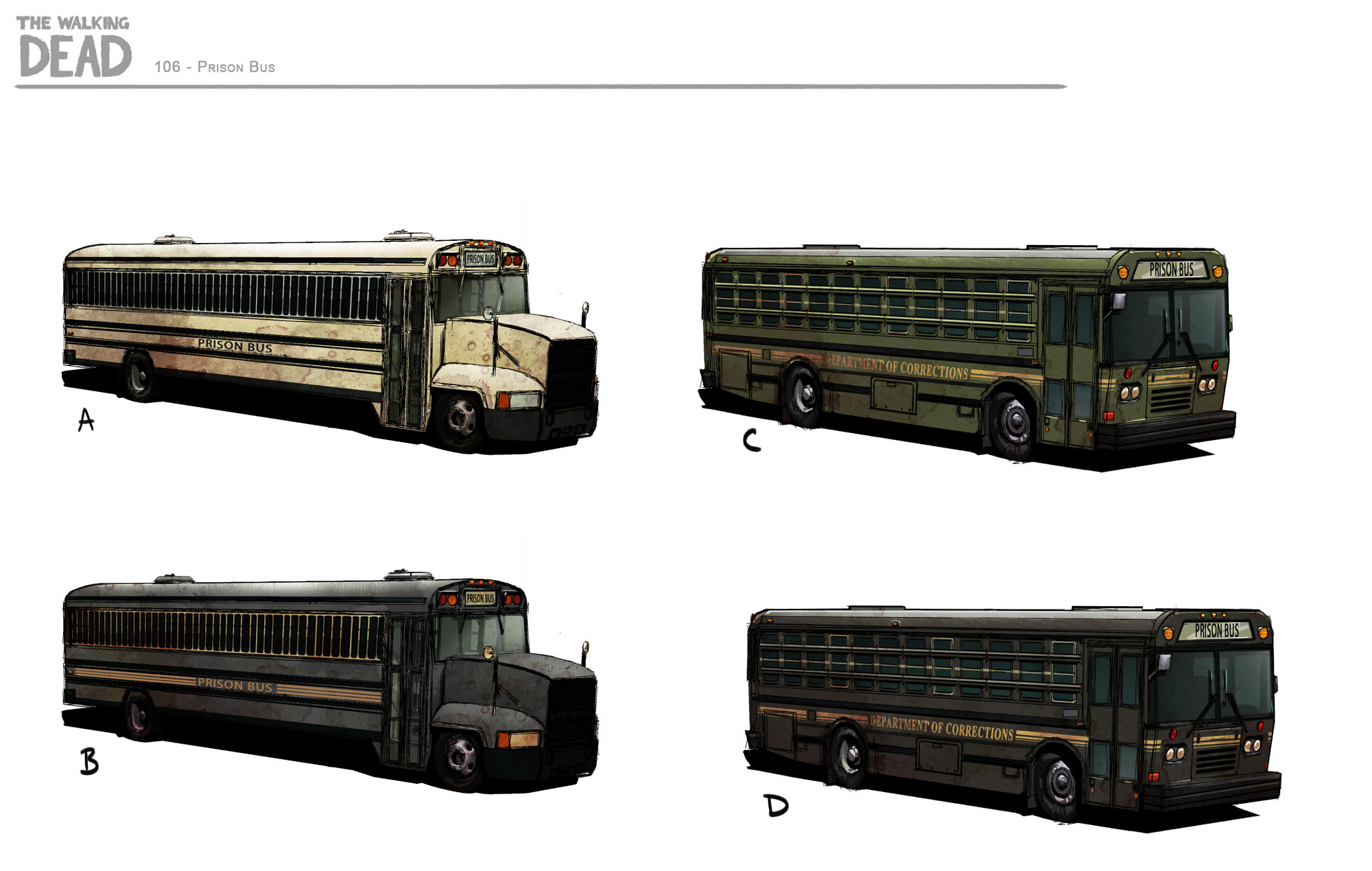 |
Jessemaccabe wd400Days prisonBusConcept.jpg |
Design variants for the prison bus in Vince's story. Design B appears in the final game. |
 |
Jessemaccabe wd400Days prisonBusConcept.jpg |
Designs B and D, as well as the layout of the bus' inside. |
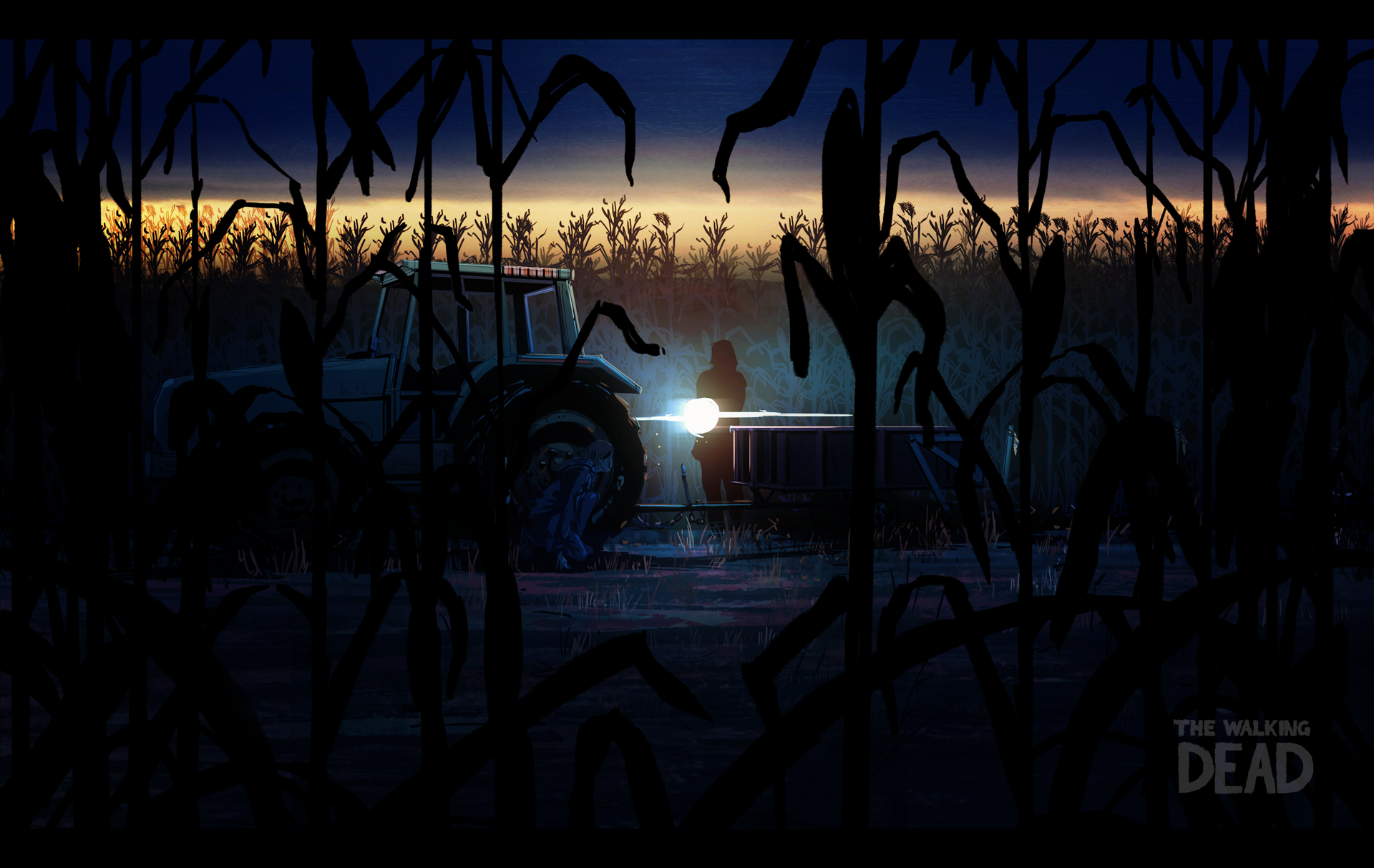 |
Jessemaccabe wd400Days cornField01.png |
This piece depicts the penultimate scene from Bonnie's story, where she hides from her unseen, flashlight-wielding assailant behind a tractor in a cornfield. Once again, Bonnie is depicted in a jacket more similar to her concept art, rather than the one she wears in the final game. |
The following pieces of concept art are sourced directly from The Walking Dead: The Telltale Definitive Series' concept art gallery:
Art |
File Name |
Notes |
|---|---|---|
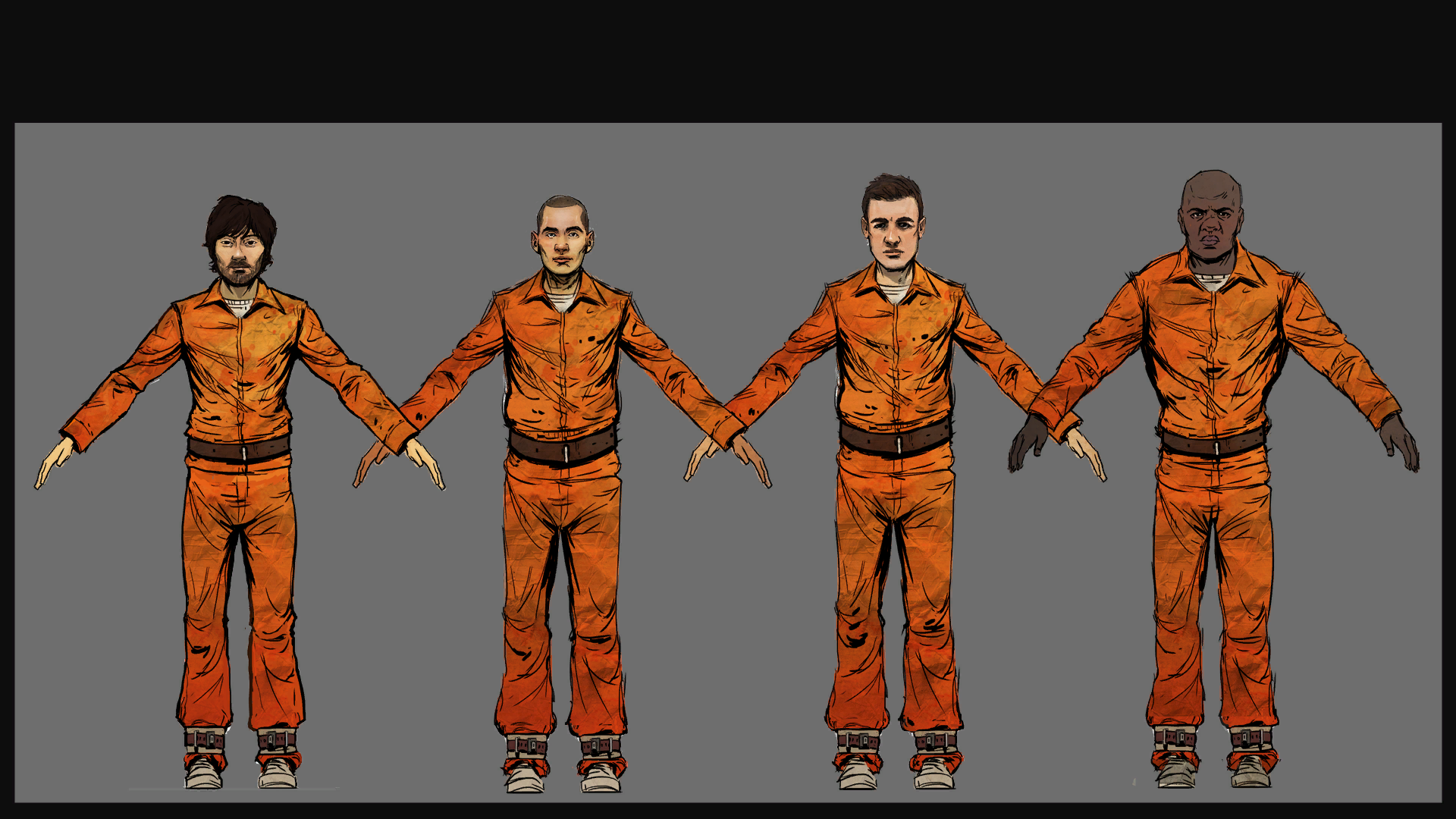 |
Concept 106CharactersVinceDannyJustinMarcus.png |
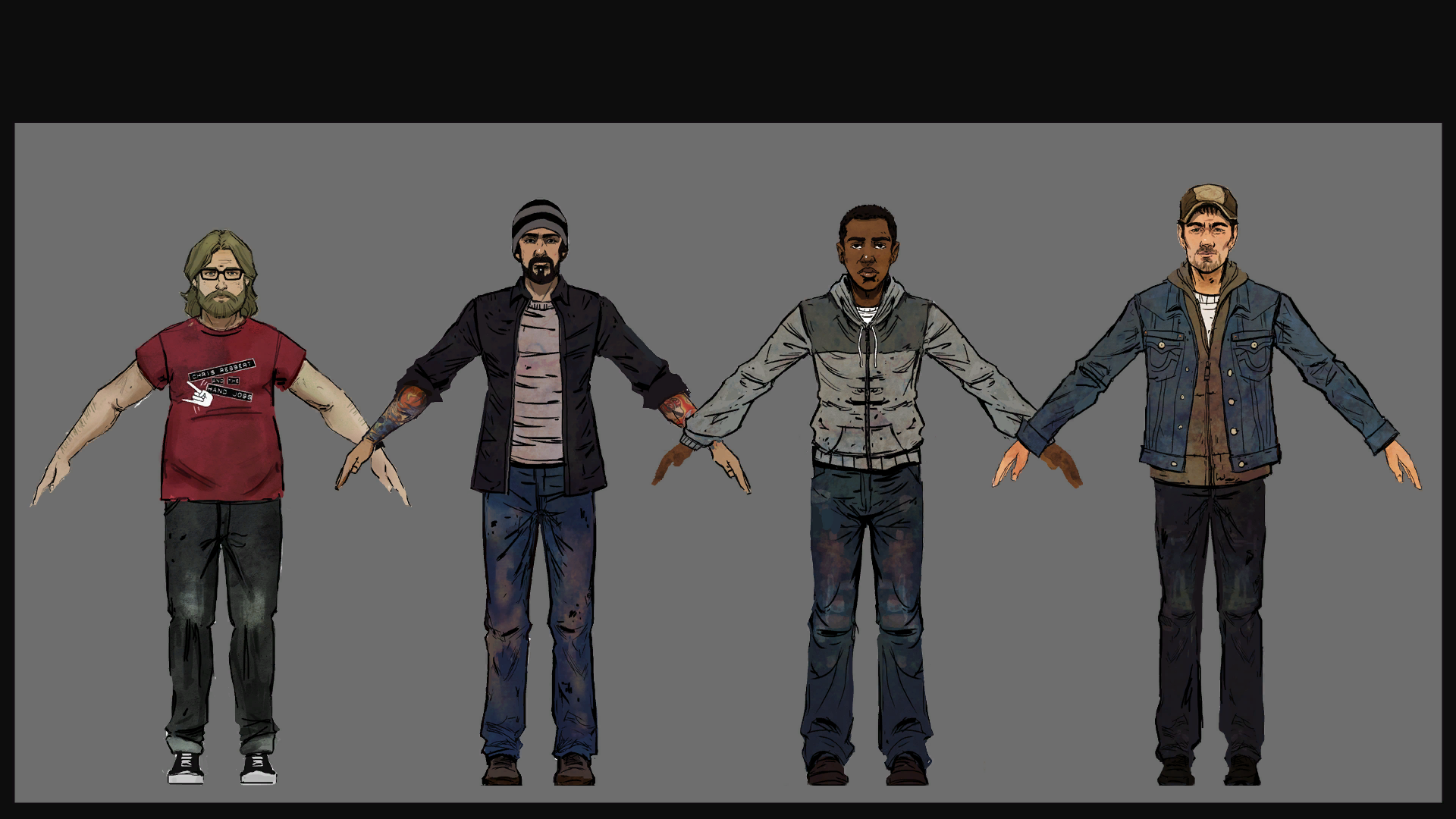
Some of the major characters in Vince's story. Vince himself looks quite a bit different, and more so resembles the concept art of his photograph, as seen above, rather than his finalized appearance. Danny looks a lot younger, and has a shaved head and is clean shaven. Justin also looks younger, and has a more broad face overall, as well as a more bulbous nose. Marcus Crabtree also looks to be younger, as well as clean shaven, and he has a more bulbous nose as well. The gallery names this piece as Vince, Danny, Justin, Marcus. |
 |
Concept 106CharactersWyattEddieRusselNate.png |
The major characters in Wyatt's and Russell's stories. Wyatt himself looks pretty much identical, except that his shirt was a way more vibrant red originally. Russell's face looks a lot different, and he looks generally older. This face was also seen in the concept art for his photograph, but it would ultimately be reworked by the time of the final game's release. Eddie and Nate look unchanged in comparison to their final game counterparts. The gallery names this piece as Wyatt, Eddie, Russell, Nate. |
 |
Concept 106CharactersMollyLelandBonnieChuckStranger.png |
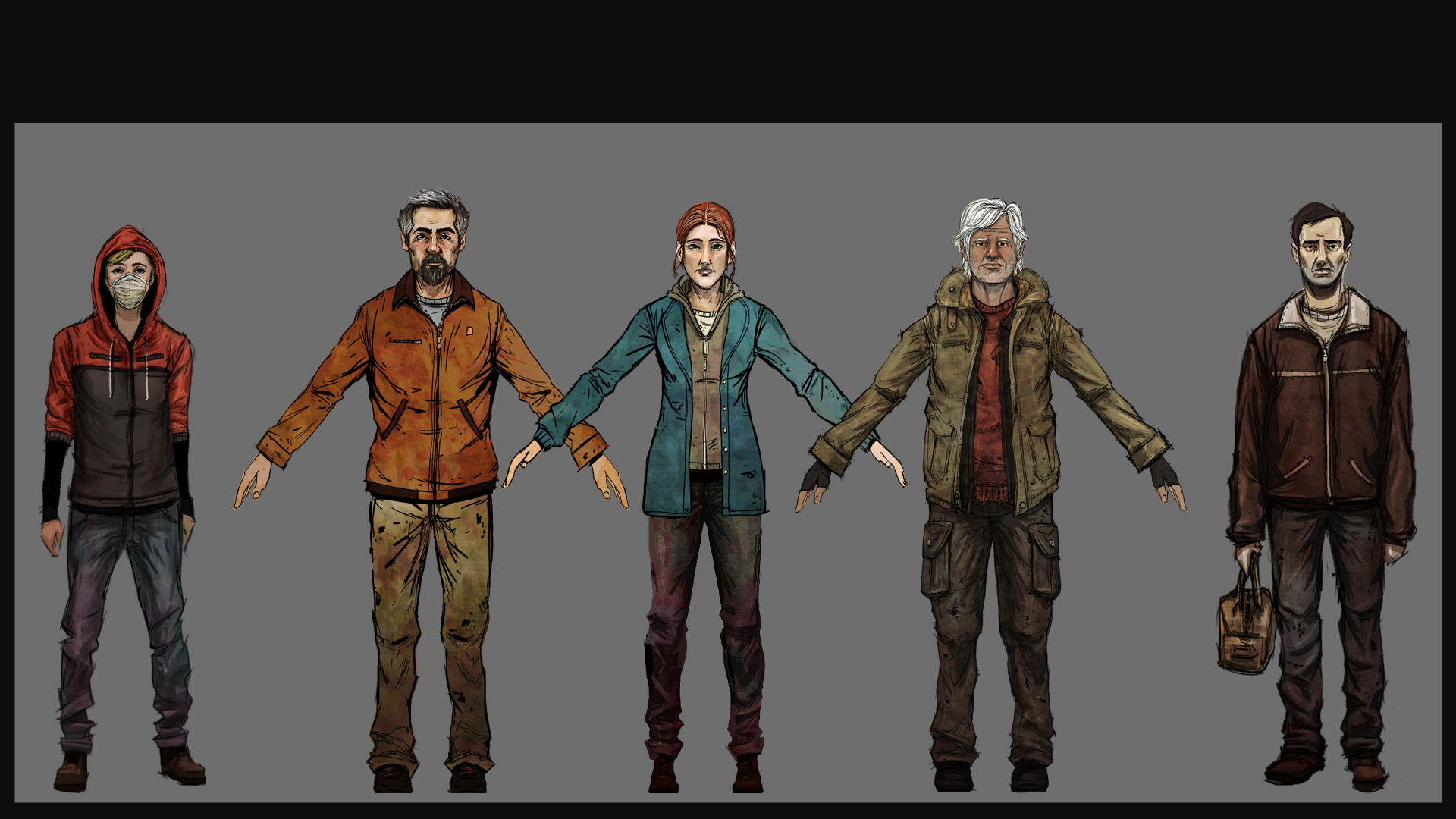
This artwork depicts Leland and Bonnie from the 400 Days DLC alongside Molly, Chuck's early design, and The Stranger from Season One. Whether this implies that Bonnie and Leland were conceptualized alongside these characters, or if their art was just put together for this release, is unknown. While Leland appears pretty much the same, Bonnie is shown with quite a different face, loose strands of hair hanging in front of it, and a completely different jacket than what she wears during her story, which is just a retexture of Carley's. The gallery names this piece as Molly, Leland, Bonnie, Chuck, Stranger. |
 |
Concept 106CharactersCliveJoyceBoydVernon.png |
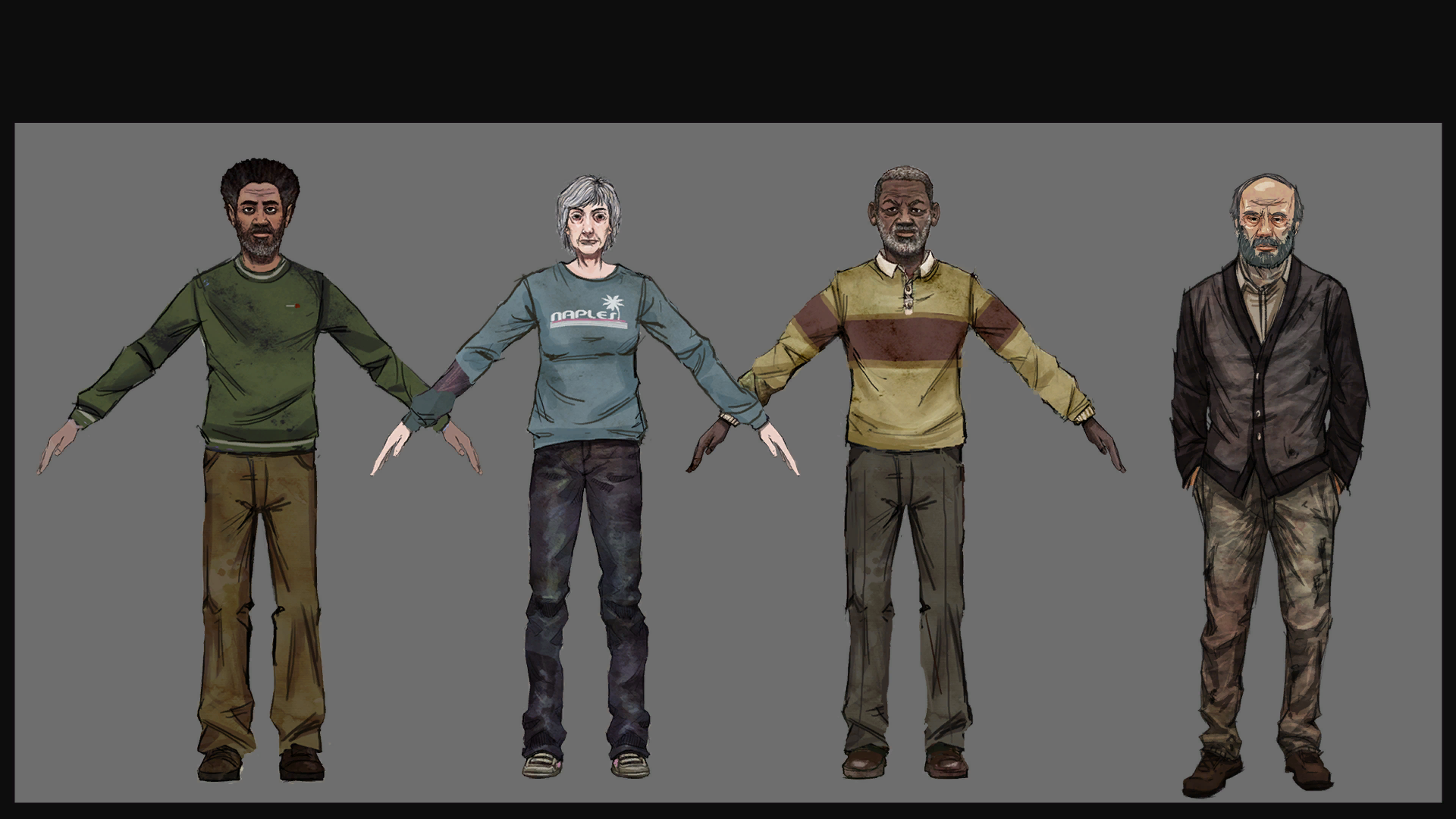
These are the cancer survivors first encountered in Season One. However, in the gallery's files, they're identified as "106" characters. 106 standing for "Season One, Chapter Six", which is in actuality the 400 Days DLC, as there is no sixth chapter. Another strange thing about this artwork is the fact that Vernon is included, seeing as he doesn't make a physical appearance in the DLC. His artwork already existed before the release of the DLC, as confirmed by its presence on concept art for the notice board. However, it's unknown if the other survivors already had artwork at this point. Their outfits depict their 400 Days appearance, as they wore different clothing in the base game, but if you look at Joyce and Boyd's intersecting arms, it's clear that the artwork was painted over at some point. The colors visible match the clothes they were depicted with in Season One, implying that this art was just their Season One concept art painted over. This wouldn't be that hard, as their clothes in the DLC are just retextures of their clothing from the first season, as well. The gallery names this piece as Clive, Joyce, Boyd, Vernon. |
 |
Concept 106CharactersBeccaShelAnnieTavia.png |
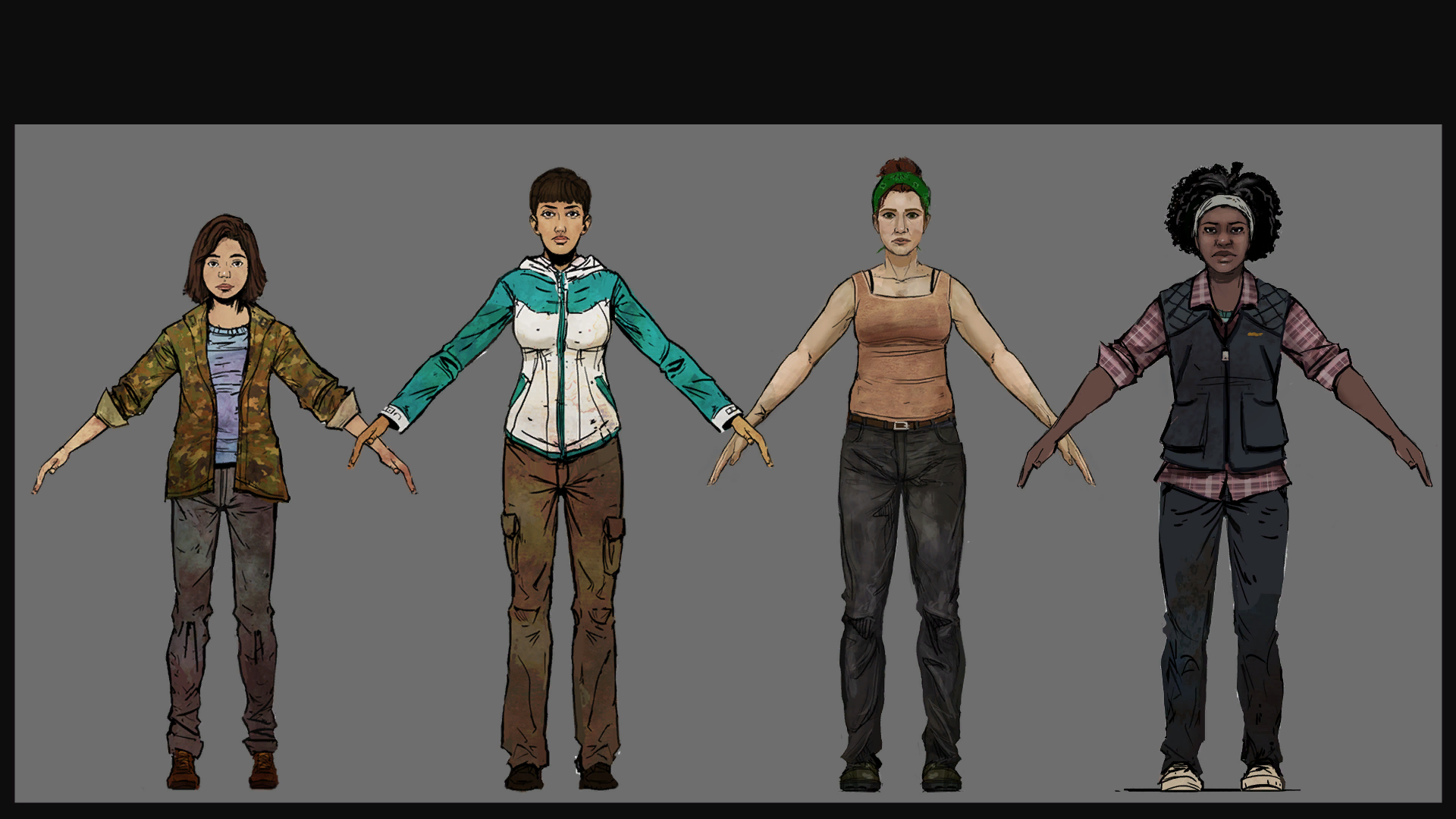
Quite a notable assortment of character art. First is Becca, who appears mostly the same as her final game appearance. However, when we first meet her, and in the epilogue, her undershirt is red. When she's in the RV after the attack in Shel's story, her undershirt is white. At no point is it ever purplish-blue like her artwork. Shel is only seen in the artwork outfit after the attack on the truck stop, never before or after. Strangely enough, "Annie" is a character that goes almost completely unused. She does actually appear in-game at the very beginning of Vince's story, alongside Shel and Becca. However, there, she's quickly bitten and killed by walkers on the highway as the sisters escape. She was originally intended to be a companion character in Tavia's story, where the two would explore the truckstop together, before Tavia would make a nasty fall, breaking her back, and forcing Annie to save her. Even stranger is the fact that all of her files in the final game refer to her as "Stephanie". Meanwhile, the used Stephanie seen in Shel's story, is internally referred to as "Annie". Tavia also appears slimmer in the art than she does in-game, and her shirt was originally a darker red plaid, rather than the more washed out light variant as it appears in the final game. The gallery names this piece as Becca, Shel, Annie, Tavia. |
 |
Concept 106PrisonBus.png |
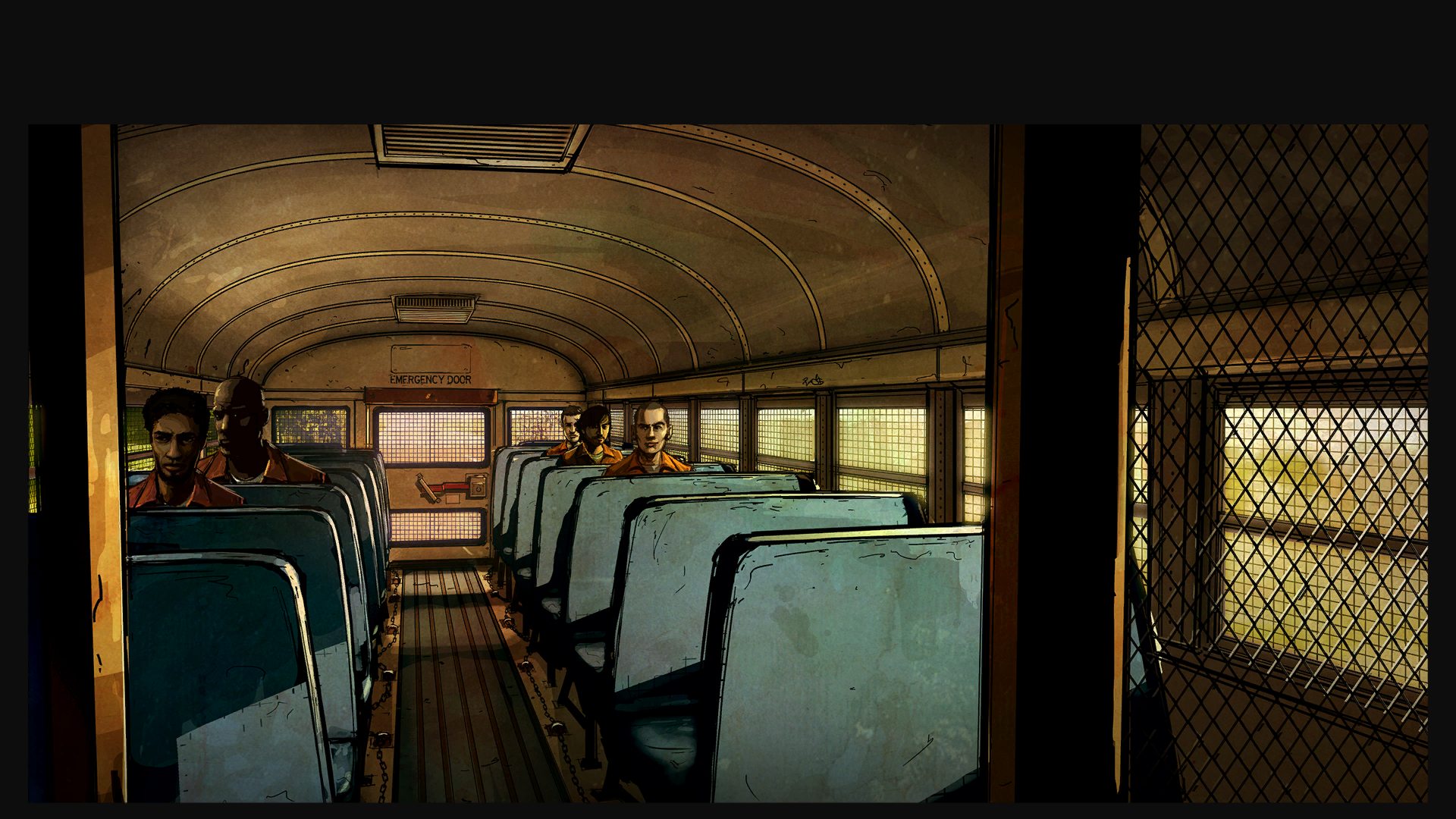
The interior of the prison bus in which Vince is seen in his story. Both Vince and Marcus Crabtree (the bald Afro-American) look a lot closer to their final designs in comparison to their character art. However, Justin and Danny still look quite similar to theirs. Jerry, the prisoner in front of Marcus, looks completely different to his final appearance. Here, he's depicted as having a medium-length afro and a chinstrap beard. In the final game, he has a shaved head and a dark goatee. He also appears older, with a lot more wrinkles and texture in his face. The gallery names this piece as Prison Bus. |
 |
Concept 106DinerInterior.png |
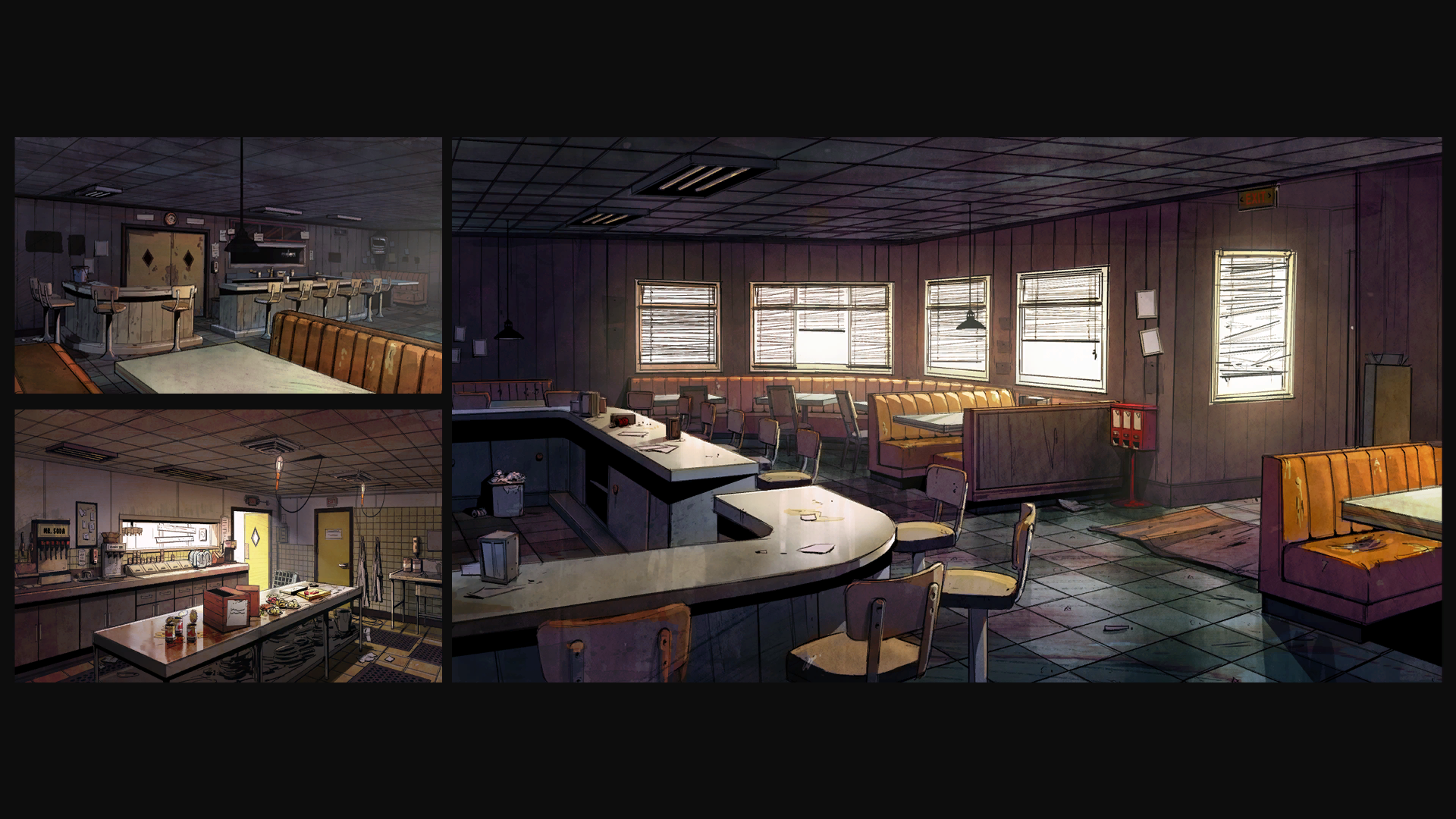
The interior of Red's Diner, as shown in Shel's story. The bottom left picture shows a lot of (canned) food present on the countertop. This is likely a leftover of a removed portion where Shel and Becca would make soup together, which still has leftovers in the final game's files. The gallery names this piece as Diner: Interior. |
 |
Concept 106TruckStop.png |
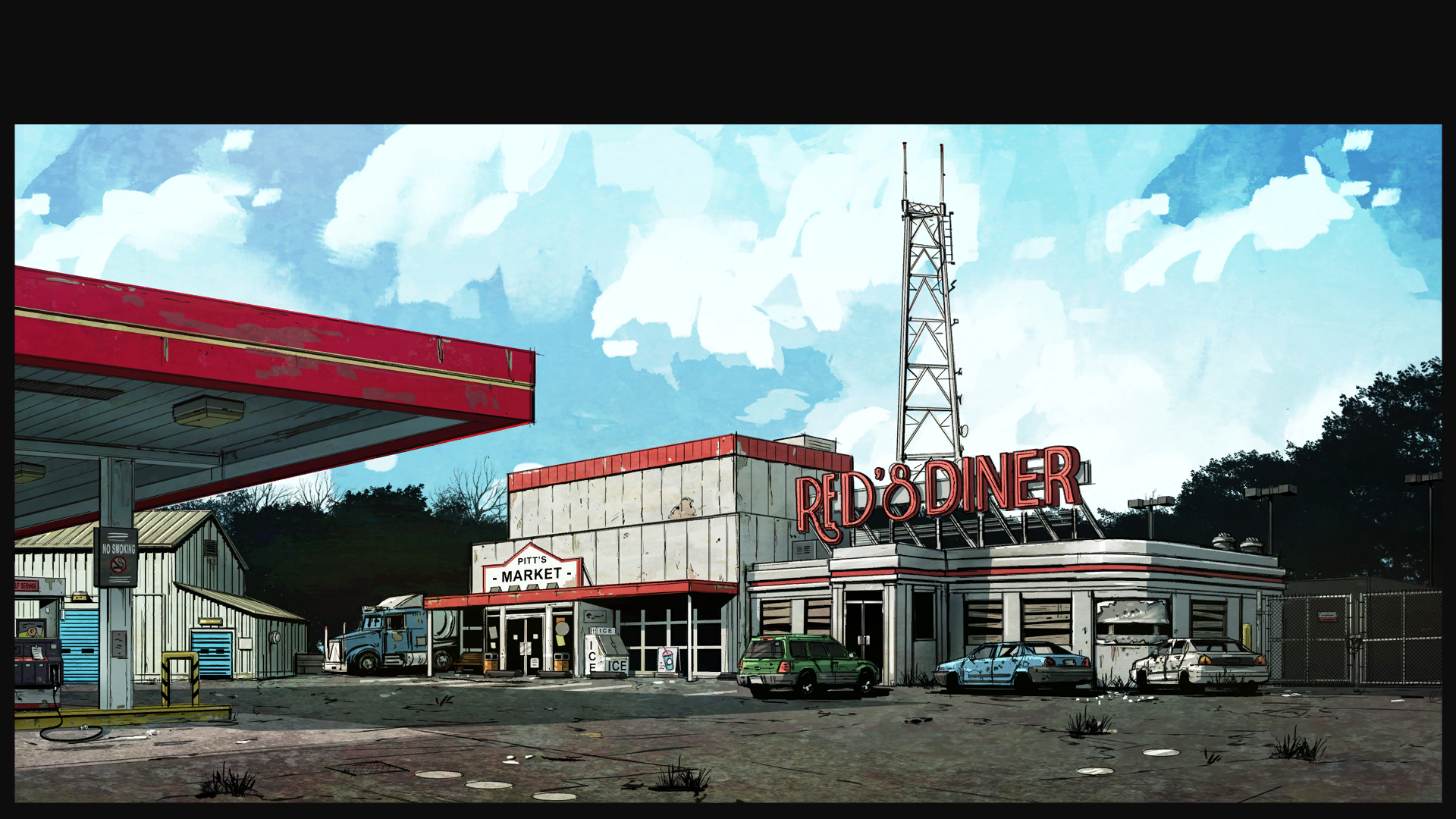
The exterior of the truckstop. The gallery names this piece as Truck Stop, it's identical to Jesse Maccabe's work seen above. |
 |
Concept 106ForestCamp.png |
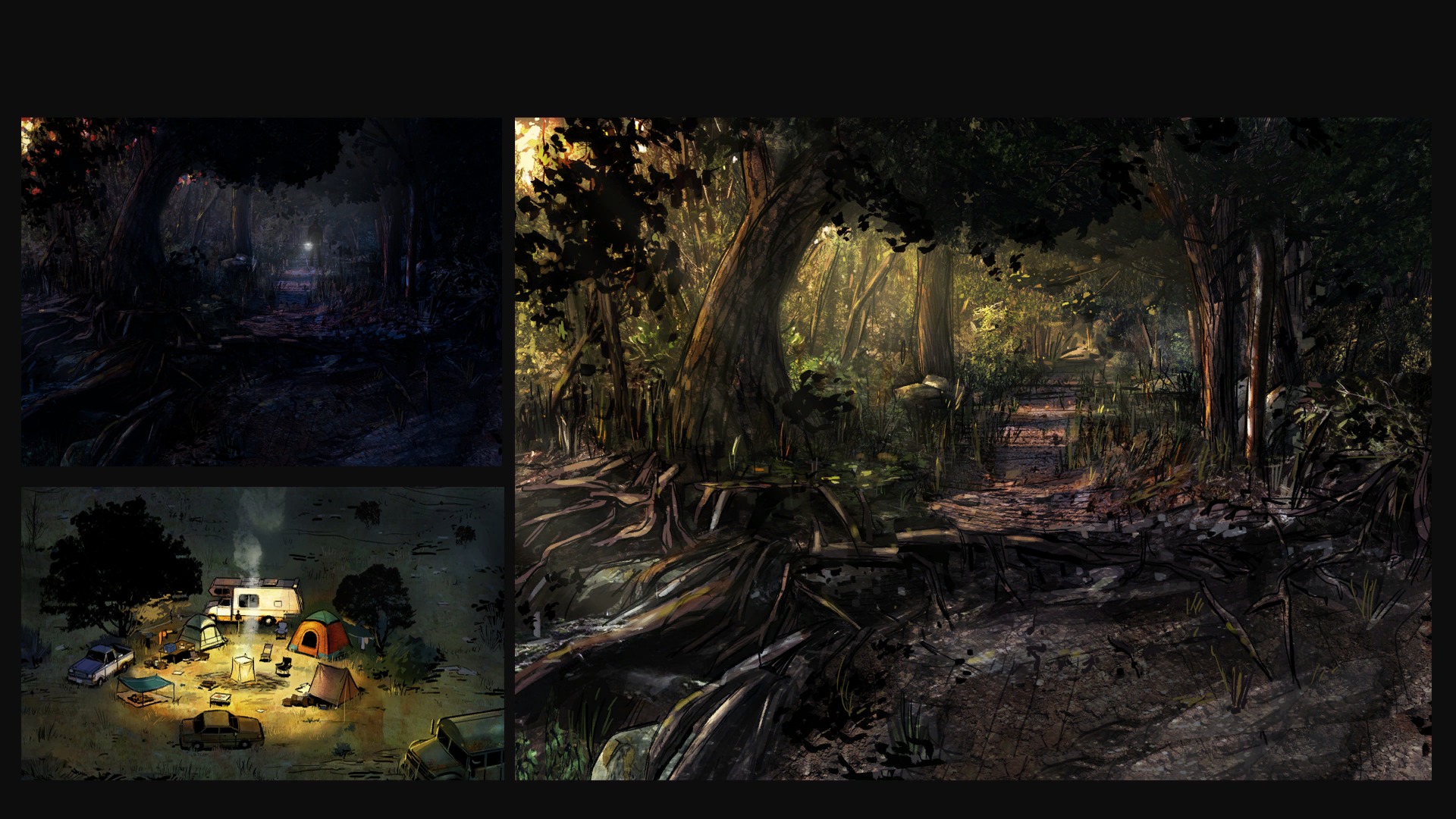
Three different pieces. The top left and right pictures depict the forest path Bonnie is shown on during her story. The left picture fittingly features a silhouette holding a flashlight, while the right picture has a daytime setting that's never depicted in-game. Meanwhile, the bottom left picture depicts the makeshift camp all the protagonists are shown in at the very end of the DLC, during the epilogue. Some small details are different to how they appear in the final game. The RV and Eddie's car are depicted as present, which in the final game is determinant on your player choices. The pickup truck to the left that's always present is blue in the art but red in-game. The art depicts the RV in the middle of the two trees, while it's further back in the final game. The art also shows more clutter, such as a washing line with clothes attached to an orange tent next to the RV. This tent doesn't exist in the final game, and instead, a different shaped tent appears to the right of Eddie's car. The small green tent gets moved accordingly. There are also multiple chairs present, as well as loose pieces of firewood, that don't appear in the final game. The campfire also appears covered, which isn't the case in the final game. The most noteworthy difference, however, is the fact that the prison bus appears at the camp in the artwork. This is a leftover of Tavia's original story, where she and her friend Annie would escape from the truck stop with the prison bus, and would later come across the other survivors. The gallery names this piece as Forest Camp. |