 This article has a talk page!
This page details pre-release information and/or media for The Legend of Zelda: Majora's Mask.
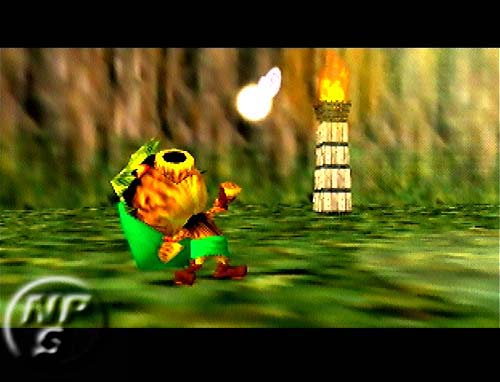
A minute-long trailer was shown at the Spaceworld '99 convention. It showed off much of the gameplay that was available to play in the demo.
Specifications#
Release Date#
The game was expected to be released in Japan in March 2000. The Spaceworld guide mentioned in the Story section below stated that the game was 50% complete.
Story#
Plot#
The following story outline appeared in the Spaceworld '99 guidebook, and was also published to the Spaceworld '99 section of Nintendo's official website.
Several months after returning peace to Hyrule in Ocarina of Time, the previous game, Link once again set forth on a new adventure.
One day, while deep in the woods, Link encountered a lone Skull Kid wearing a curious sinister mask. The Skull Kid snatched Epona, the beloved horse Link was riding, and fled beyond a door at the end of a twisted tunnel. Link gave chase and passed through the door, only to find... a curious world that seemed somehow familiar. The people living there seemed somehow familiar, too. But the one thing that was certainly different was the giant moon in the sky, plummeting slowly towards the earth.
"In a matter of days, the world will end..."
So said the people living there. But whether or not they stood around, time marched cruelly on.
"That curious mask-wearing Skull Kid. If you track him down, maybe you'll find some clue to fixing all of this."
In order to stop the moon from falling, and to return to his own world, Link embarks on a new adventure.
There is only a little time left until the world is destroyed. The remaining hours are marked by the merciless ticking of a giant clock tower. Can Link save the world in the time that remains to him?
(Source: GlitterBerri (Translation))
A similar summary appeared in IGN. The only major difference is that the reporter mentions that Link will be accompanied by "his trusted friend Navi".First Zelda Gaiden Details Exposed - IGN.com, August 19, 1999
Cutscenes#
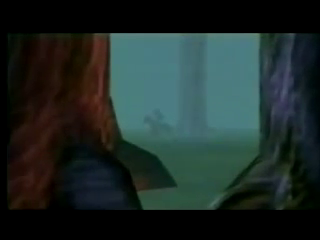
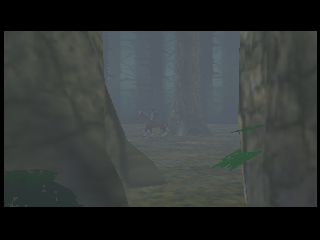
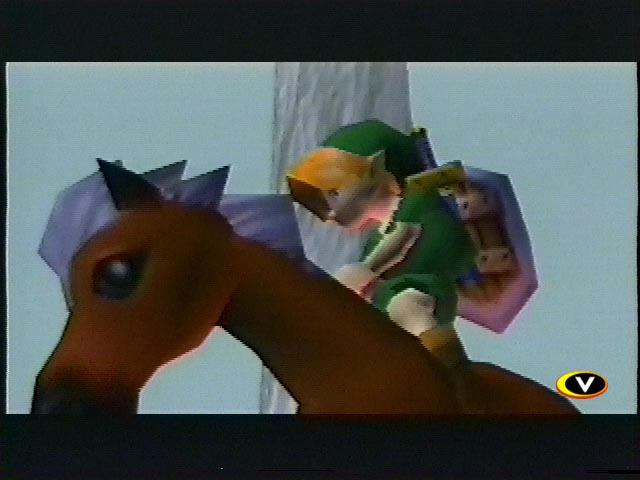
Intro#
|
Prototype |
Final |
|---|---|
|
|
|
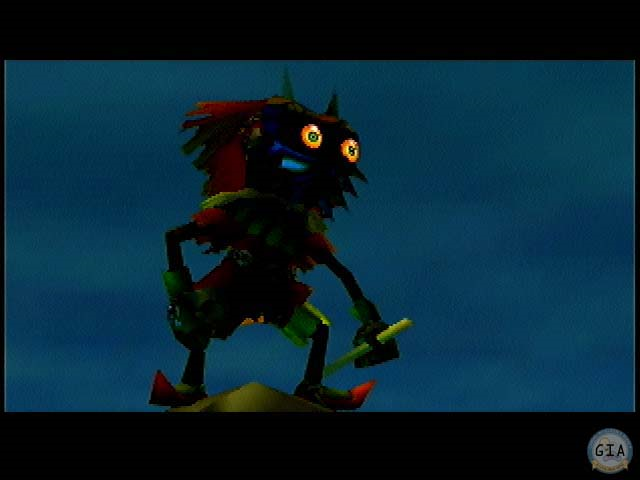
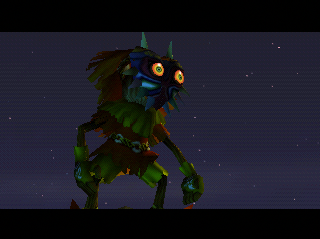
Intro cutscene from Spaceworld, Aug. '99 |
Final |
|---|---|
|

|
The treed background is missing and the modeled trees aren't as nice looking.
Interface#
Timer#
The game will progress in real-time. There is a meter at the bottom/middle of the screen now that shows the position of the sun or moon at all times. It is believed that the time that passes during gameplay affects the outcome and story of the game much more than in Ocarina of Time.
The timer does not appear in some screenshots. In the final game, it is present in virtually every area.
Actions#

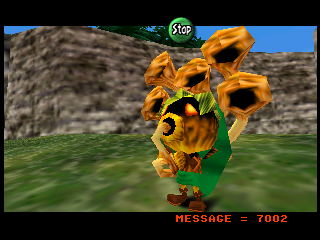
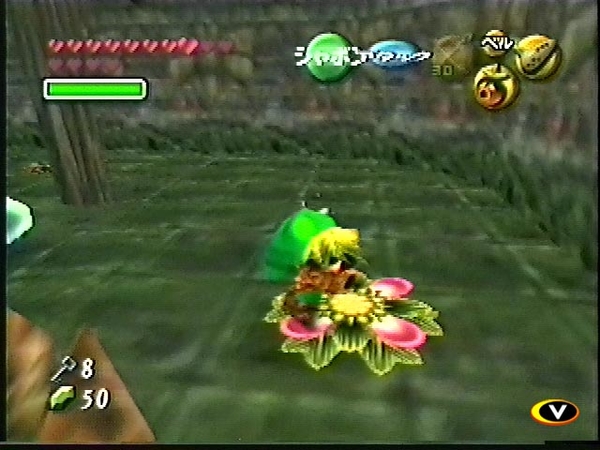
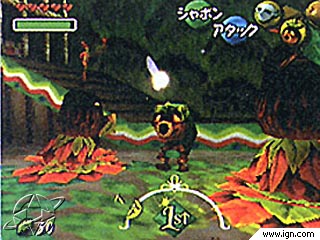
At one point in the trailer, Link runs as though he does not have his sword and shield drawn. Curiously, the B Button text reads "Bubble" (シャボン), which should ordinarily only appear as Deku Link.
Items#
Hero's Shield and Kokiri Sword#
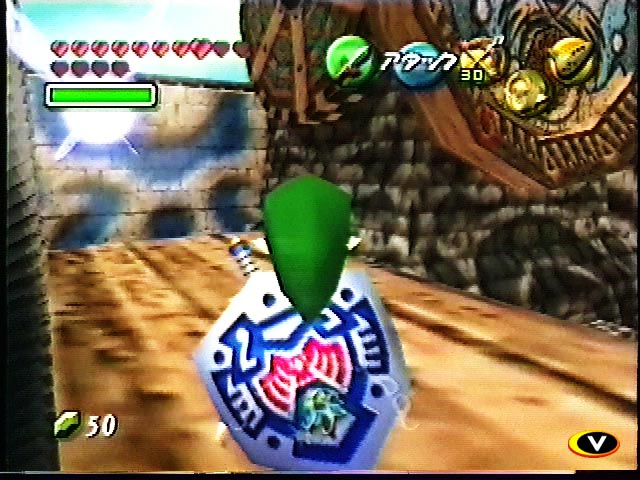
By now, new footage and screenshots stopped showing Link with his Deku Shield and Kokiri Sword from Ocarina of Time. However, the icon for the Kokiri Sword has not yet been updated.
I was the one who designed the shield for that game. In Ocarina of Time, child Link couldn't equip the Hylian Shield [sic]. I could have had him continue to use the Deku Shield in Majora's Mask, but it was a new title, so I wanted it to stand out. That's why I designed something new. I thought that if I put a bird on it, it would be reminiscent of the Hylian Shield, but since the world of the game was on the dark side, I decided to design it with a nocturnal bird, which is why I went with an owl motif.
Hammer and Boomerang#
Many of the classic Ocarina of Time weapons and items are back, including the hammer, the bow and arrow, hookshot, the boomerang, the ocarina, the bombs, and the dagger -- only that young Link can now use all of them.
Hammer and Boomerang do not appear in the final game. Instead, their functions were merged with the abilities of the Goron and Zora forms, respectively.
Masks#
The use of masks has been greatly expanded over Ocarina of Time. Link will be able to use the power of certain masks to change his appearance and give him special abilities. For example, one mask turns him into a Zora, enabling him to swim underwater. Another mask will turn him into a Goron, allowing Link to curl up into a ball and roll around. Yet another mask will turn Link into one of those annoying Deku Nut guys and allow him to fly with the use of a flower in a hang glider-like fashion.
Link Mask#
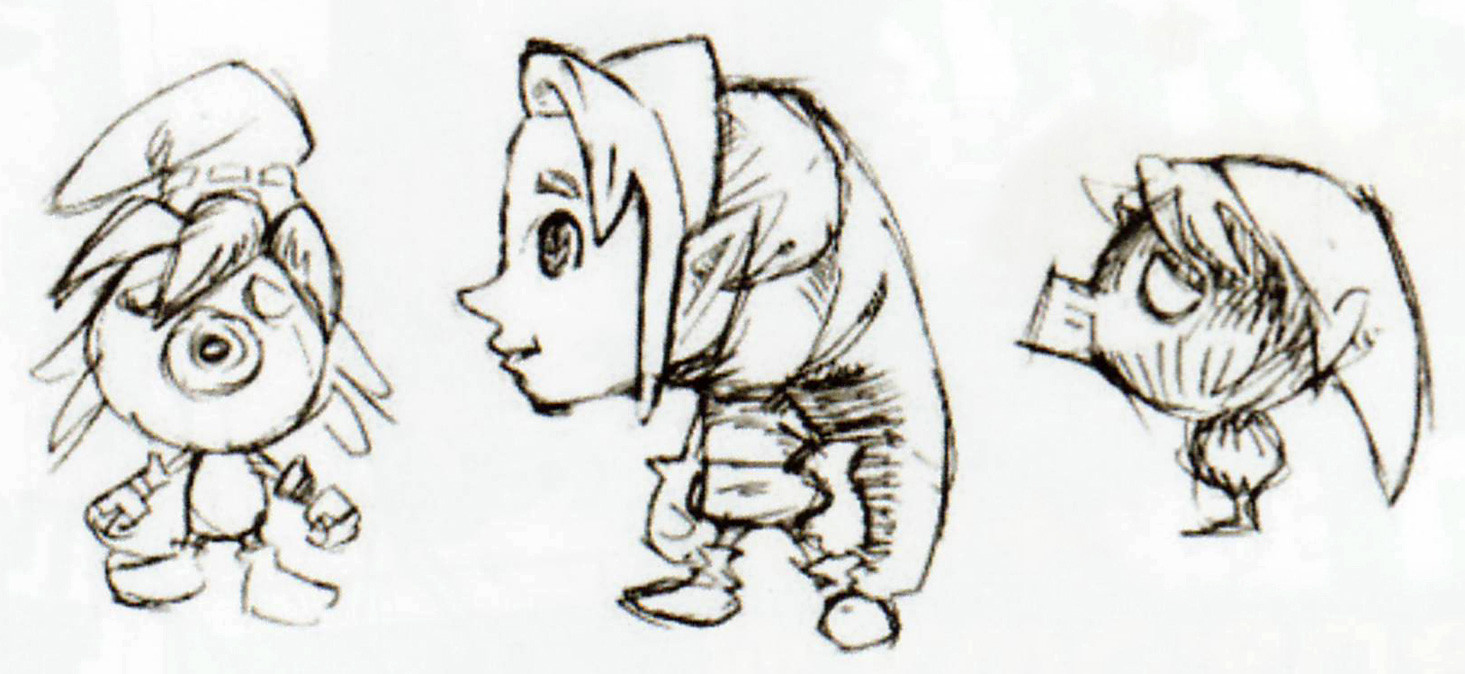
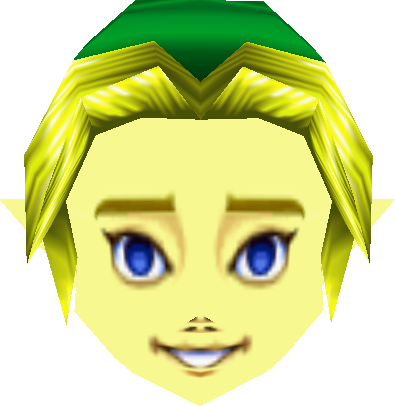
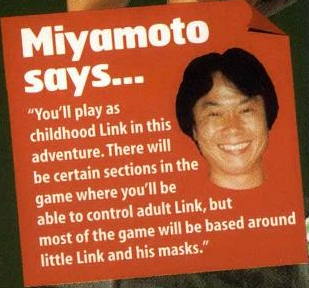
Link is sometimes shown equipped with a mask bearing his likeness that doesn't appear in the final game. It's possible this was a mask that allowed Link to return to his human form, or an early idea for the Fierce Deity Mask, in which Link would transform into an Adult form. Curiously, seemingly none of the press reports from this period acknowledge the existence of this mask despite it being seen in the trailer and many screenshots. Instead, reporters only note Goron, Deku, and Zora as transformation masks. A sprite for a mask resembling Link can be found with yaz0 compression in bbgames-master\z_majora\data\shape\cube_MJ_TEXTURE2\JAPAN\ICON_ITEM2\icon_item_test.raw0, an early item icon file.
May be related to a "Link mask" model that still exists in the game's code.
Concept art |
|
|---|---|
 |
|
|
Adult Link Mask |
Fierce Deity Mask |
|---|---|

|

|
Deku Mask#
|
Prototype |
Final |
|---|---|

|
|
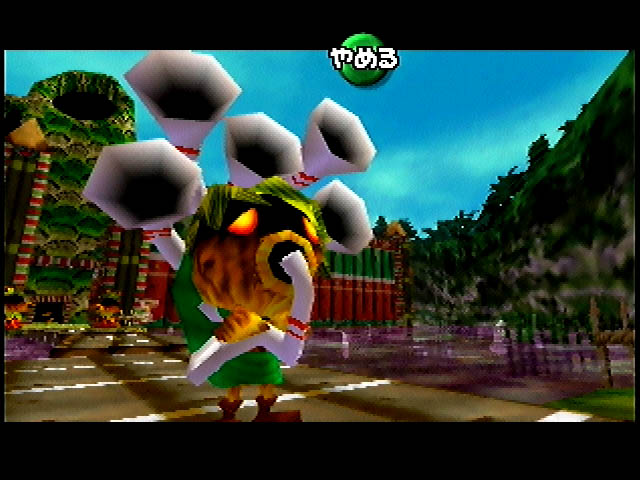
These white pipes underwent a reskin for the final game.
Characters#
Tatl and Tael#

An early design of Tatl and Tael. This is still present as an unused object in the final game.
Adult Link#
IGN64: Are you overseeing Zelda Gaiden?
Miyamoto: From time to time at important milestones, I have to take a look at it. But I'm always trying not to be involved with the politics very deeply so that I'm not, for example, writing specifications or setting deadlines.
IGN64: We played Gaiden a short while ago and it's very impressive. But we're curious, will Link grow up in Gaiden?
Miyamoto: I actually don't know, but I heard that the adult Link will probably appear this time too. Also, if you say that Gaiden on the show floor is really good stuff I can feel very comfortable because that means my staff members have already become better than me when it comes to game creation.
— Interview with Shigeru Miyamoto, August 27, 199918
Enemies#
Gaiden features completely new, big bosses. While the specifics of all the bosses in the game are still being kept secret, we do know of at least three: a Gohma-like creature, an oversized frog and a giant warrior.
Environments#
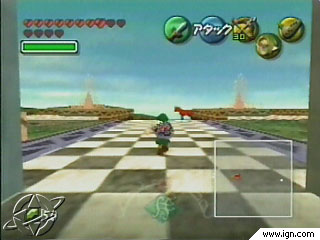
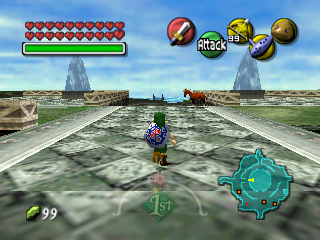
Revisited - Termina Field#
|
Prerelease |
Final |
|---|---|
|
|
West Termina Field. The different fountains are very clearly visible here. The object for these is still in the final game, but unused.
|
Prototype |
Final |
|---|---|
|
|
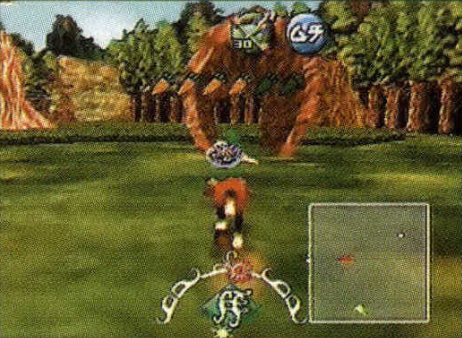
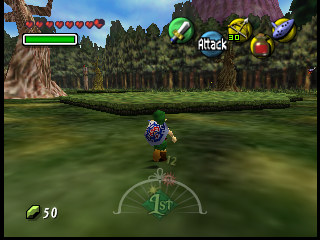
The tree trunk where Skull Kid goes for shelter from the rain in one of the cutscenes is in another location, or there were more tree trunks like that on Termina Field at this point.
Southern Swamp#
Early |
|
|---|---|
 |
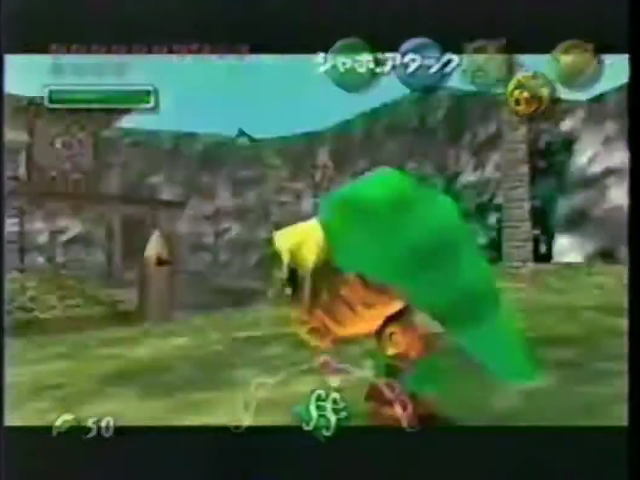 |
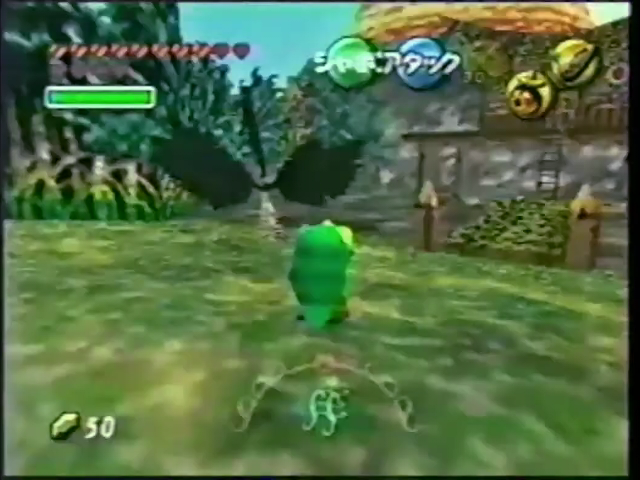
- Both the Big Octo and Business Scrub were missing. This is because both were added after this trailer. Big Octo's object was added on August 30th, 1999, and Business Scrub's on November 25th, 1999.
- Those tiny trees that are only seen outside the Swamp Shooting Gallery in the final game were used more frequently.
- No lily pads. They were added to the game on September 27th, 1999.
- The color of the Woodfall mountain was changed from orange to purple.
- The wooden spear that's part of the map geometry wasn't added yet.
Deku Palace#
|
Prototype |
Final |
|---|---|
|
|
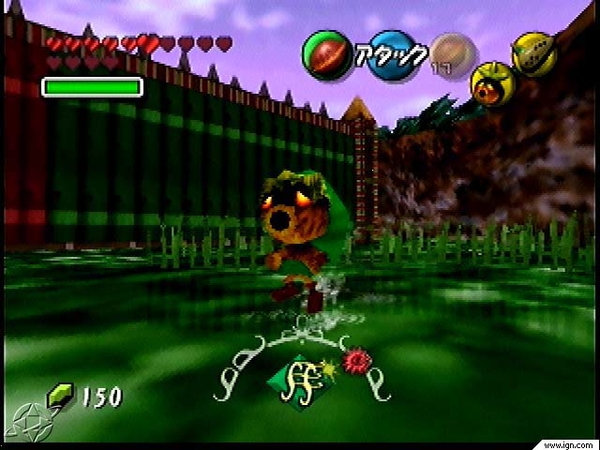
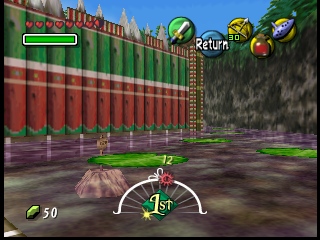
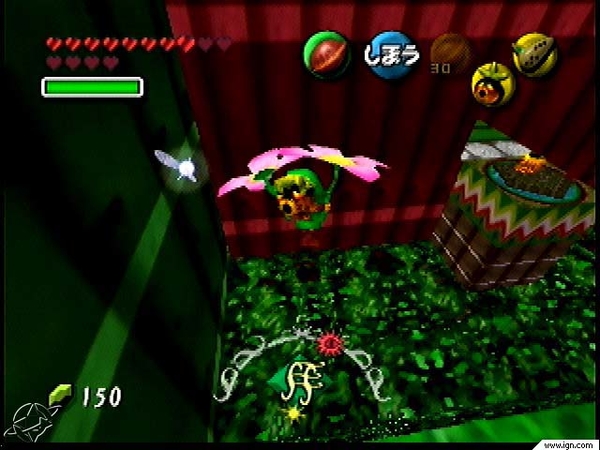
There are seemingly no lily pads to hop on, so Deku Link might've been able to hop infinitely. The wooden walls that surround the palace have worse texture work, and the poisoned water around Deku Palace looks very different. Interface-wise, Deku Link has Deku Nuts on B (without a counter oddly enough), despite not flying.
|
Prototype |
Final |
|---|---|
|
|
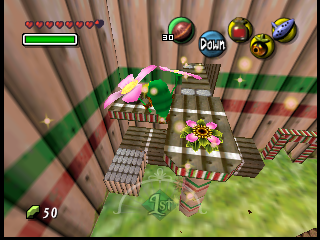
The inner garden of the palace is almost unrecognizable from the final release. What appears to be a Deku Flower looks entirely different from the design we see in the Spaceworld '99 trailer footage.
|
Prototype |
Final |
|---|---|
|
|
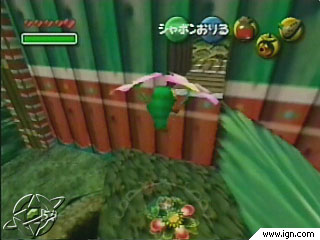
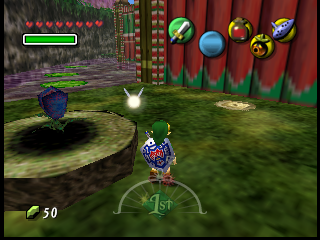
A screenshot that was taken from the Spaceworld '99 trailer. Instead of finding out where the Magic Bean Salesman is, you'd just use a Deku Flower, so that's something they thought to create afterwards.
Woodfall Temple#
Early |
|---|
 |
There are no Chuchus in the final Woodfall Temple. The only two rooms with this layout respectively contain Snappers and the Dinofos mini-boss.
Mountain Village#
|
Prototype |
Final |
|---|---|
|
|
|
Prototype |
Final |
|---|---|
|
|
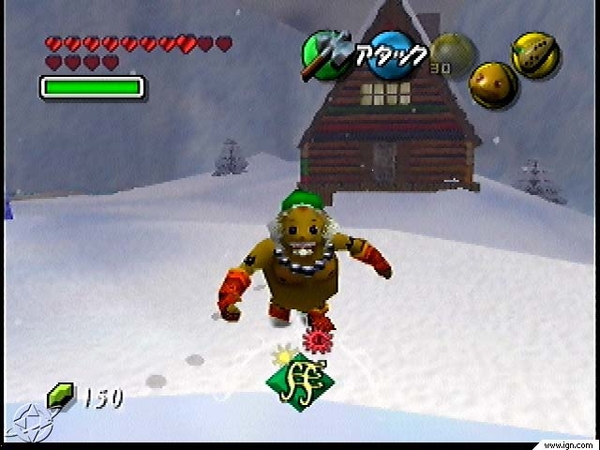
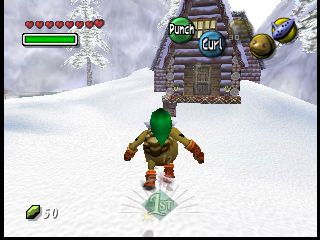
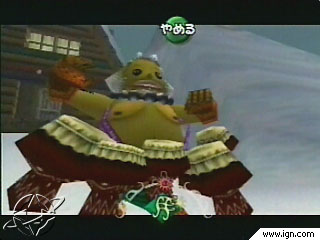
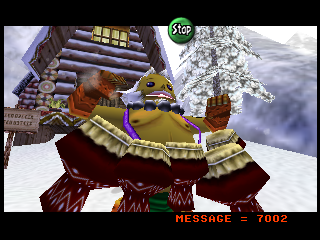
The blacksmith's house, as well as a lot of the scenery here in Mountain Village, looks very different from the final.
Goron Racetrack#
|
Prototype |
Final |
|---|---|
|
|
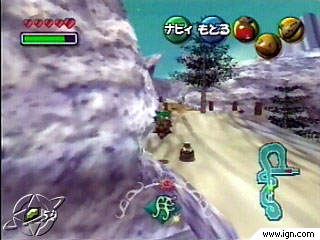
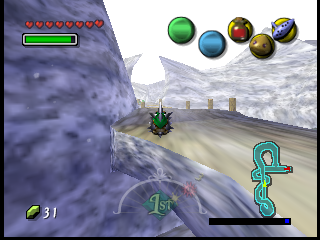
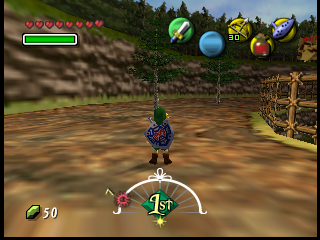
There are no standard pots on the final racetrack map; instead, there are only those that give you magic. These types of trees aren't in the final racetrack map either.
Waterfall Rapids#
|
Prototype |
Final |
|---|---|
|
|
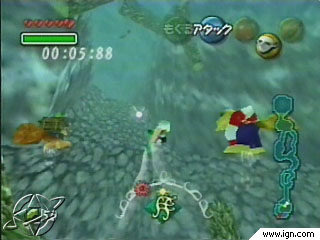
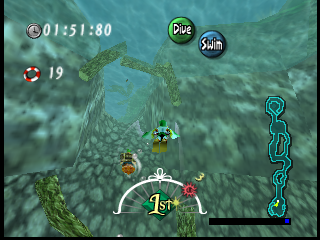
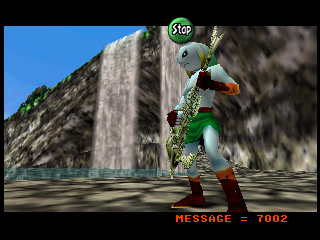
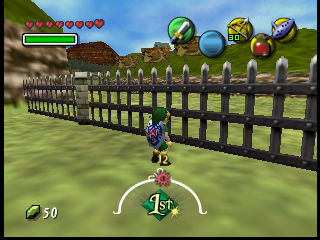
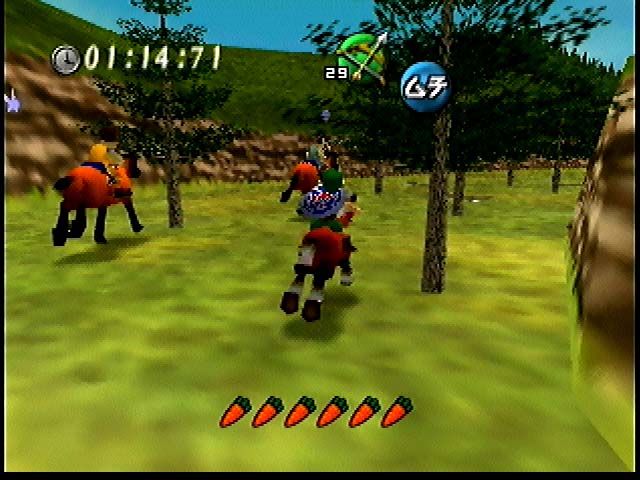
Zora Link racing against both beavers at once doesn't happen in the final version. In the final release, you race them separately. There's no ring counter in the interface.
|
Prototype |
Final |
|---|---|
|
|
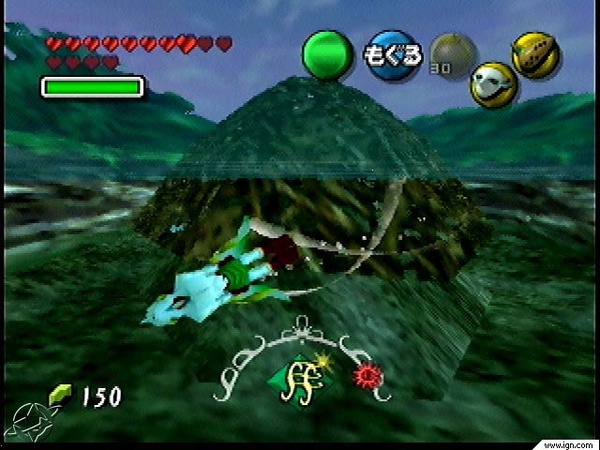
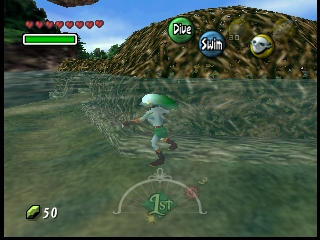
The haymow where the race ends used to be smaller. It's also different on the minimap.
Stone Tower#
|
Prototype |
Final |
|---|---|
|
|
|
Prototype |
Final |
|---|---|
|
|
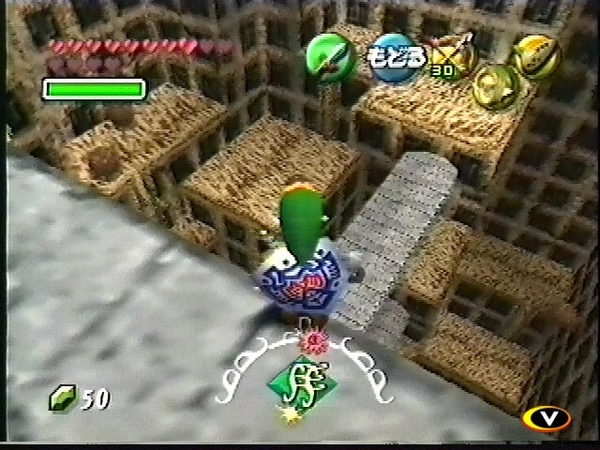
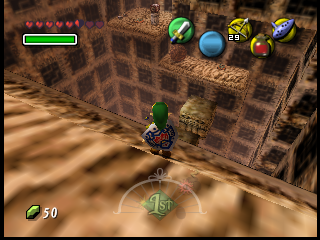
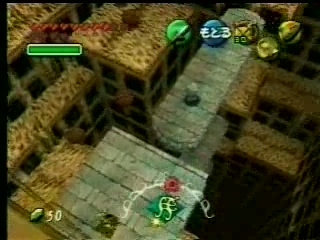
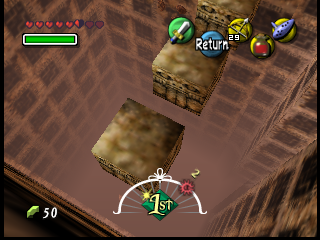
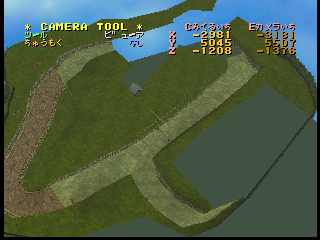
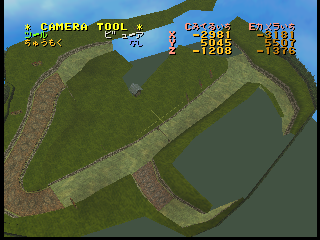
Stone Tower has a vastly different layout to what is seen in the final game. The square platform and the longer platform seen in the screenshot are both still present as unused objects in the final game.
Unknown 1#
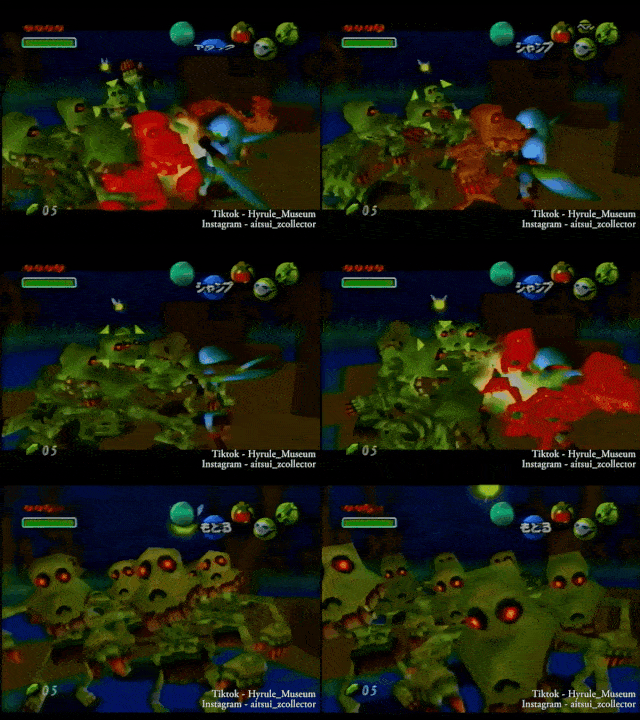
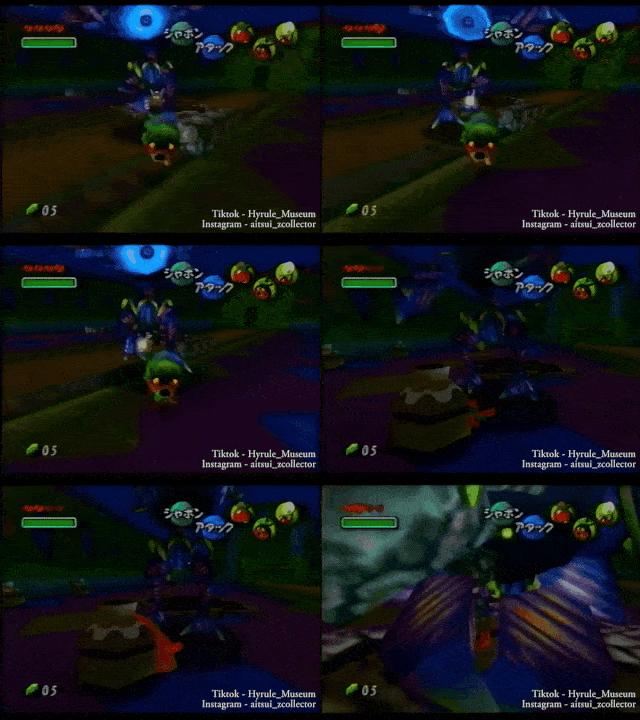
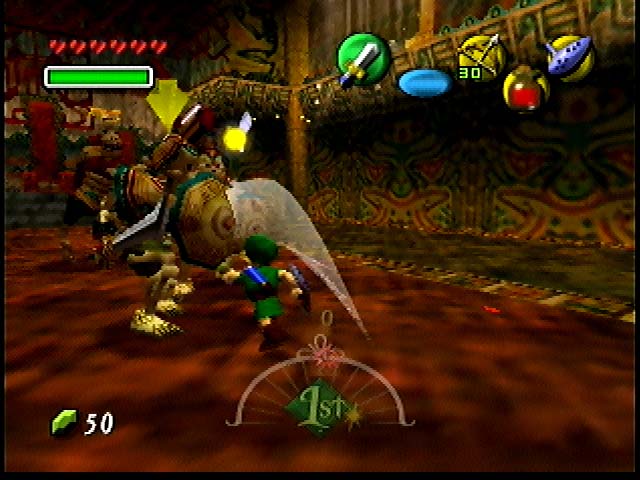
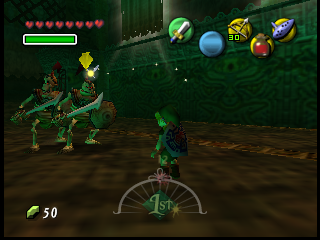
This dungeon, seen in the Spaceworld trailer, doesn't seem to exist in the final game at all. It may have been some sort of testing ground for different enemies, as the same area can be seen in other screenshots as well. The room seems to feature Stalchildren in different positions (sitting on crates, walking around, swinging from a branch) that are found in the final game in areas such as Ikana Graveyard and the Oceanside Spider House.
An excerpt from the .gif above that shows the room Link just came from, which features wooden crates and pots:
Prototype |
|---|
 |
Unknown 2#
|
Prototype |
Final |
|---|---|
|
|
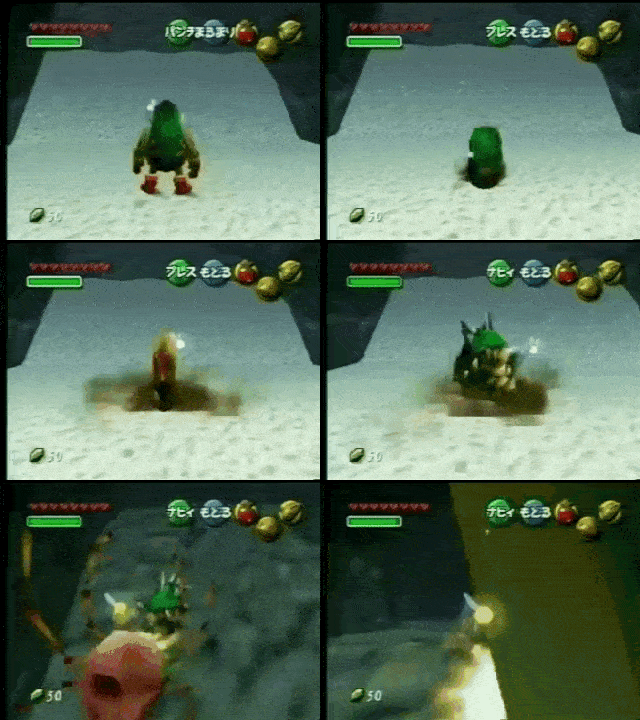
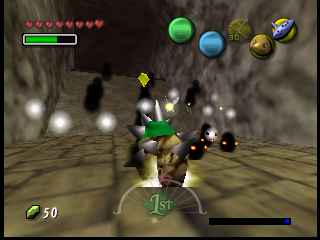
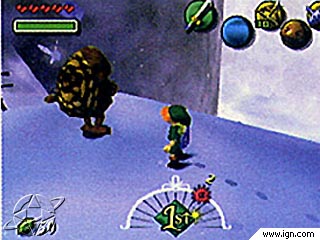
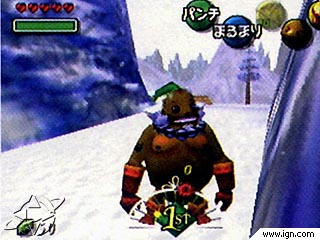
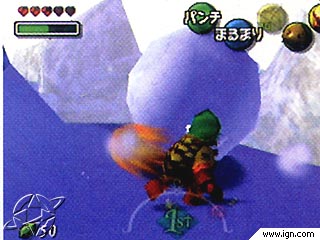
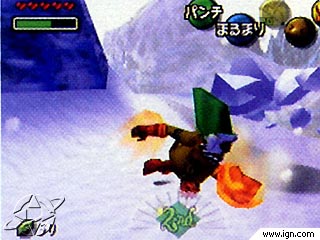
Another unknown area was shown on the Spaceworld '99 promotional trailer. It's a snowy cave with steep hills that only Goron Link, with his rolling skills, can climb while taking care of some of the enemies in his way. An area that's most similar to it in the final game is the shortcut that leads to the Goron Graveyard in Mountain Village when it's spring.
Reports (info yet to be sorted)#
August 19
Gamespot's reports (via Famitsu Weekly)
- Basic plot detailed.
- Plays like OoT, but there is now a gauge in the lower middle of the screen. Nintendo has yet to reveal how this gauge will come into play. Gamespot speculates that it has to do with measuring time (ding ding!).
- Masks will play a major role in the game, allowing Link to turn into other characters and alter his abilities.
- Game will need Expansion Pak to display more enemies, better enemy AI, and more advanced special effects.
- Expected to release in Japan in March 2000.
August 20
IGN's reports (via Famitsu Weekly).19
- Miyamoto confirms in an interview that 64DD’s Ura Zelda and cartridge-based Gaiden are two separate projects.
- Wanted to make a new game based on Zelda system, that took advantage of the memory pak.
- Won’t be a game where “the locations of the dungeons are simply changed around”.
- Miyamoto did note that "The 64DD 'Ura Zelda' is moving along on its own," but was not willing to divulge further details regarding the game.
- “The 64DD adventure is said to enable gamers to revisit areas and dungeons of Ocarina of Time and experience new adventures in familiar surroundings”.
- Currently no plans to unveil the 64DD-only Ura Zelda at Space World.
IGN reports, again (via same Famitsu Weekly interview).20
- Gaiden takes place only a few months after The Ocarina of Time left off. The world as Link knows it temporarily seems fully restored and at peace, but something goes wrong.
- The moon above the land is gradually falling from its place in the sky. "If left alone," says Miyamoto, "the world will come to an end in a matter of days. If the moon were to fall all the way down to the earth, that would be it for the people."
- The game utilizes an improved version of the Ocarina of Time engine that utilizes the added RAM of the RAM Expansion for more detailed environments and a greater number of enemies on screen.
- Link's physical appearance may change whenever he dons a mask now. In a style similar to that of Rare's Banjo-Kazooie, players will need to determine which character (or mask) to use in specific scenarios.
- The number of masks has increased greatly. Players will be able to carry multiple masks, rather than exchanging them for different ones.
- In Gaiden, child Link will be able to ride a young Epona. "Things that people wanted to do in the last game, we are trying our best to include them this time around," says Miyamoto.
- The sun moves in real-time, as we reported yesterday. But there is more to it. Just as the sun moves, so does the moon above the earth, which is slowly falling downwards onto the planet. So players cannot waste time lounging around the environments and staring at the sun. Miyamoto comments, "This time, if you just sit around and look at the sun, the world is finished (from the moon crashing on the sun). It's that type of game."
August 23
IGN reports (via Famitsu Weekly).21
- The fishing sequence present in Ocarina of Time will be enhanced. Miyamoto comments, "Rather than taking the fishing part of the last game to extremes, we want to do something new with it. Like 'Jabu Jabu' fishing." Miyamoto, unwilling to reveal all the details surrounding the enhanced fishing mini-game, did offer Famitsu this: "If you catch the 'Jabu Jabu,' it may cause things like stopping the fall of the moon." The fishing mini-game will offer a means of earning Rupies in Zelda Gaiden.
- In Gaiden, real-time progress will play a much more integral role than it did in Ocarina of Time. As a moon above Link's planet slowly falls towards the earth, players will have to accomplish all of their tasks before time runs out. Lazy adventurers, though, will be happy to learn that time, it seems, is not without its price. "They say 'Time is money,'" elaborates Miyamoto. "You will be able to buy time using Rupies. There will be a merchant who sells time."
- According to Miyamoto, Zelda Gaiden's engine is already finished. "I would say [the game is] about 50% complete," comments the designer. "All that is left is the second half of the data."
IGN reports (via Famitsu Weekly).22
- "Zelda Gaiden and the upcoming Donkey Kong 64 will use the memory differently (than Turok 2 or Episode I Racer," game designer Shigeru Miyamoto told Famitsu Weekly. "Of course the graphics will look better, but the memory will be used for improving framerates."
- Additionally, the enhanced memory will allow for more enemies on-screen (with a smooth framerate), smarter enemies and, according to Miyamoto, "the text will be more detailed."
IGN publishes 3 new screenshots (via Dengeki 64).
August 27-29
Space World '99 (August 27-29, exact date unknown): Nintendo Power Source interviews producer Miyamoto.
- "Ura Zelda" (Master Quest) will use the 64DD to add content to OoT's cartridge, making dungeons different and relocating items. (Sounds Second Quest inspired?) However, "Zelda Gaiden" (MM) is a completely different game using OoT's system. Most of the staff is concentrating on Zelda Gaiden.
- Miyamoto wanted the next game to come out sooner than a typical 3 years.
- Miyamoto measures his involvement with Zelda Gaiden at about 20%.
- Miyamoto decides the overall direction of the game, but nothing specific. He helps set development priorities and makes staff recommendations.
- Miyamoto says that Zelda games will come out more frequently if Zelda Gaiden turns out to be fun to play.
- Miyamoto had several ideas for OoT that didn't make it that he gave to the MM staff.
- Miyamoto wants players to feel like they played something unexpected.
- They are trying to make something new and improve the density of the world, fitting in as many events as they can in the 3 days. The memory expansion is needed to handle all of the simultaneous events in the world.
- Miyamoto is aiming for just under 30 masks in the final game (Total ended up being 24).
- There is a running man 4 times taller than the one in OoT (Captain Keeta?)
September 1999
September ??
Nintendo Power September Issue #124 gives a Space World '99 preview in the Pak Peeks section on page 158.
- Zelda Gaiden made its world debut at Space World '99.
- The word "gaiden" means sequel.
- First 3 screenshots are shown.
September 22
IGN reports a bunch of stuff (via 64 Dream).23
- The version of Gaiden shown at Spaceworld was roughly 20% complete, though Miyamoto commented that "the main engine was about 80% complete."
- The game, according to Miyamoto, will take about the same amount of time to complete as Ocarina of Time did, though the story itself will progress in about half of the time.
- The game will not support the GB Camera to create masks for Link.
- Miyamoto: "Whether or not we release [Ura Zelda], we are still working on the game."
- There will be no version of Gaiden for the 64DD. "We have made various changes to the engine, so it is only going to work on cartridge," said Miyamoto.
- The title might support the GB Camera to create masks for Link. Miyamoto hinted of this possibility in a 64 Dream interview. If this does turn out to be true, gamers will be able to create their own masks in Talent Studio and implement them into Ura-Zelda.
October 1999
October ??
Nintendo Power October Issue #125 covers Space World '99 in the Pak Wrap section on page 138.
- Three screenshots and one artwork shown.
- "It was evident that the framerates and graphics had improved".
- Basic plot detailed.
- Story takes place months after the end of OoT.
Cutscenes#
Revisited - Intro#
|
Prototype |
Final |
|---|---|

|
|
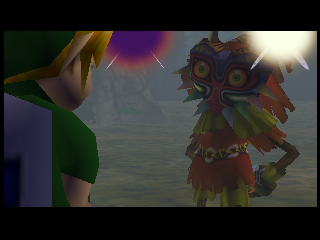
Link's arm was broken in this cutscene, in fact it was so bad that you could see the backside of Hero's Shield. This was fixed in the final version.
|
Prototype |
Final |
|---|---|

|
|
Environments#
Revisited - South Clock Town#
|
Prototype |
Final |
|---|---|
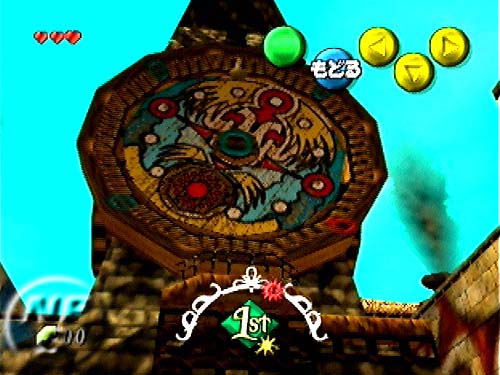
|
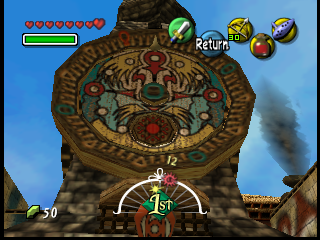
|
Revisited - Southern Swamp#
|
Prototype |
Final |
|---|---|
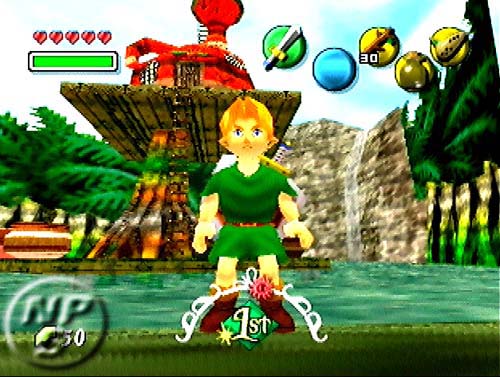
|
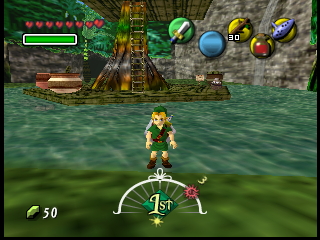
|
The camera outside the Potion Shop in Southern Swamp was more zoomed in than it is in the final game. The small pots might've been missing, but it's also possible they were destroyed before the screenshot was taken.
|
Prototype |
Final |
|---|---|
|
|
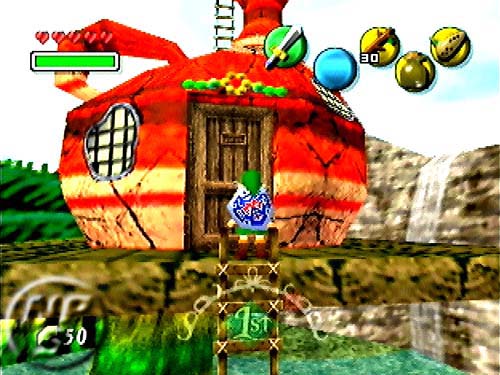
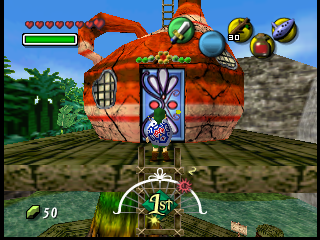
The teapot house's door wasn't designed yet, so it used the wooden door from Ocarina of Time. The skybox was more cloudy too.
Magic Hags' Potion Shop#
|
Prototype |
Final |
|---|---|

|
|
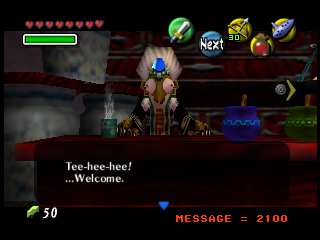
In the final game, Kotake is placed behind the left side of the table.
Revisited - Deku Palace#
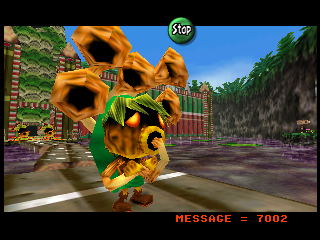
October 1999 |
Final |
Final |
|---|---|---|
 |
 |
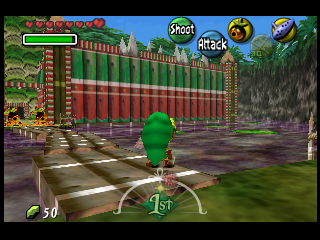 |
- The shortcut back to Woodfall was still not a thing. It was also missing on the minimap in the screenshots of the game's Space World 2000 demo.
- The fence before the wooden platforms was shortened, likely in order to make it easier to reach the shortcut.
- The platforms that lead to the palace were longer.
- No lily pads because they were added to the game in February 2000. Deku Link was likely able to hop across the water infinitely.
- There's an unknown object in the poison water. Whatever it is, it seems to have a sharp tip.
Revisited - Romani Ranch#
|
Prototype |
Final |
|---|---|
|
|
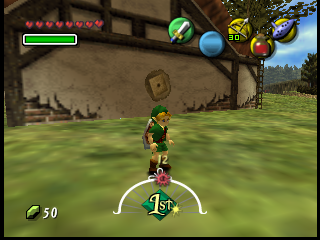
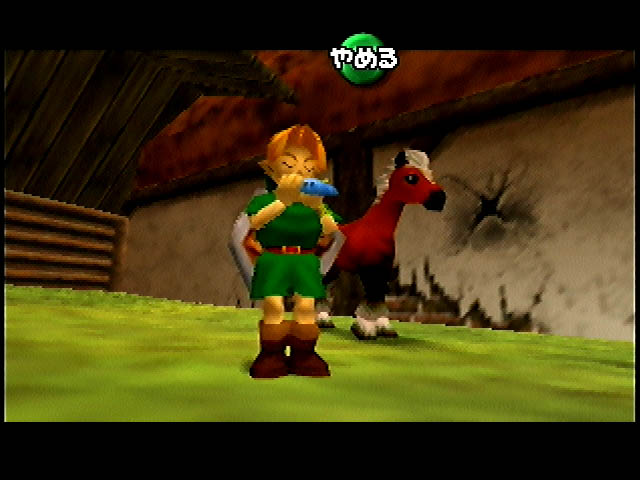
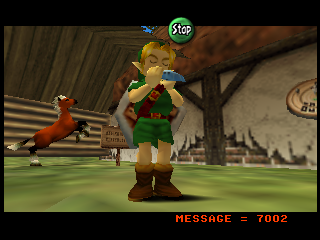
The soft soil on one of the ranch buildings was moved to the other side of the building, and its type was changed from the crack variant to the ground one. Some of the alternate scene setups still have the soft soil right by the ranch sign.
Revisited - Goron Racetrack#
|
Prototype |
Final |
|---|---|
|
|
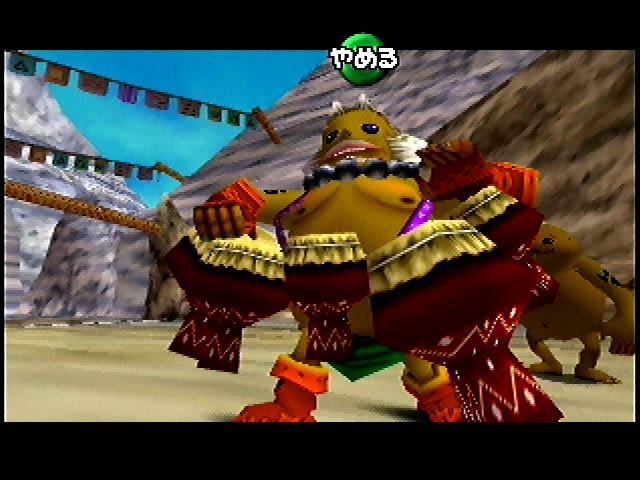
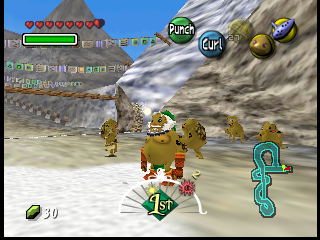
There are fewer Gorons around the racetrack, as only one can be seen behind Goron Link in this prerelease screenshot. A wall on the right after the finish line has strange geometry and texture mapping. During the race, there were Gorons who cheered for the racers in front of this wall.
Revisited - Waterfall Rapids#
|
Prototype |
Final |
|---|---|
|
|
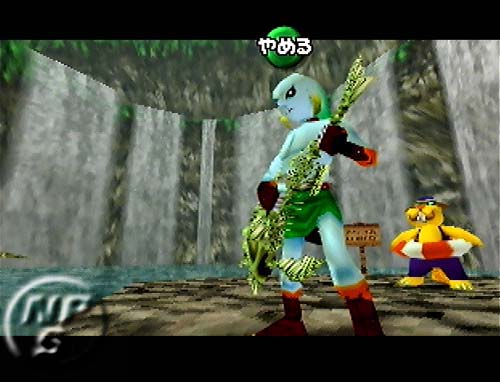
Waterfall Rapids still looking rather different.
November 1999
November 4
IGN reports that Gaiden will get a holiday season, 2000 release in the US.
Masks#
The following mask models were added to Link's updated Majora's Mask object on November 20:
- Gerudo Mask
- Keaton Mask
- Bunny Hood
- Spooky Mask
- Skull Mask
- Mask of Truth
The four transformation mask models were added to his skeleton shortly after on November 24:
- Goron Mask
- Zora Mask
- Deku Mask
- Adult Link Mask
December 1999
December 14
IGN reports on TP, Gaiden (via Super PLAY):
- Among the most notable items discussed was a new Zelda title -- the true follow-up to Ocarina of Time -- which Miyamoto states is already underway.
- "The Zelda which will be based on a new system compared to Ocarina of Time, you have to wait five years for," said Miyamoto. "We are developing it for the Dolphin right now. But when we discussed it, we concluded that five years is an awfully long time. Those who played Ocarina of Time in college will have graduated when the Dolphin game is released! We think that's a long time. So we wanted to use the existing Ocarina of Time engine and the Expansion Pak to make a sequel to Nintendo 64 in the meanwhile."
- Editor's note to readers: the translation, particularly the excerpt "the Zelda which will be based on a new system compared to Ocarina of Time," is fairly vague. We ask that you bear in mind that Mr. Miyamoto may in fact be saying that Nintendo is working on a completely different "system"-- meaning control setup and genre -- (from Ocarina of Time) for the Zelda franchise and it is this that will arrive in five years. He does not indicate whether or not another Zelda game featuring a similar genre and control system to Ocarina of Time will arrive for Dolphin first, but this could very well be the case.
December ??
N64 Magazine discusses a playthrough.
Masks#
The following mask models were added to the Link's updated Majora's Mask object on December 11:
- Gibdo Mask
- Garo Mask
- This mask is called "Json" internally, short for Jason (Voorhees), a mask-wearing horror character whose visage it somewhat resembles.
- Kafei's Mask
- Great Fairy's Mask
Interface#
Revisited - Timer#
|
October 1999 |
December 1999 |
|---|---|
|
|
|
December 1999 marks our first sight of hours being marked on the clock display.
Trailer (Nintendo 2000 New Line Up)#

|
To do: |
A roughly two-minute-long trailer from a Japanese store promotional video, unearthed in July 2024. The footage seems to be from late 1999 or early 2000, since the clock display is final.
- The forest in the opening cutscene is darker with a much thicker and bluer fog, creating a very different mood from the final product.
- The grass and trees in the intro forest have different textures.
- Tatl and Tael are colored yellow and navy blue instead of cream and purple.
- An early version of the moon crash cutscene is present, with different camera angles and lighting. Interestingly, the moon is depicted without a face throughout the trailer.
- What may be an early version of the intro cutscene is featured, depicting NPCs from throughout the game. The postman's outfit appears to be different, primarily red instead of white.
- Curiously, Anju is seen on the East Clock Town map, but in the part where South Clock Town is supposed to be. This is apparent because there is missing geometry for the walls.
- Footage is shown of a dungeon unseen in the final game, possibly from a showroom demo. It notably features Stalfos, an enemy type that appeared in Ocarina of Time but is absent in the final version of Majora's Mask. The throne behind them may imply this is an early version of the battle against Igos du Ikana and his flunkies. Other rooms appear to have featured battles against an Eyegore and Garo. Subsequent footage features battles against enemy Stalchildren and Odolwa in rooms with similar textures, though it's unclear if they were part of the same area.
- The ending scene from the opening demos where Skull Kid stares up at the moon uses different lighting and slightly altered camera angles. The pseudo-randomly generated night sky doesn't appear to have been implemented yet. Skull Kid is holding his fife; the textures for it still exist in the final game's ROM, unused.
Environments#
Deku King's Chamber#
|
Prototype |
Final |
|---|---|
|
|
|
|
Prototype |
Final |
|---|---|
|
|
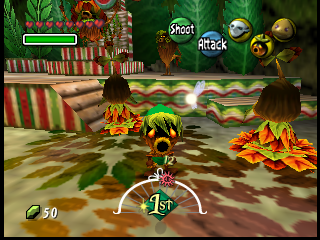
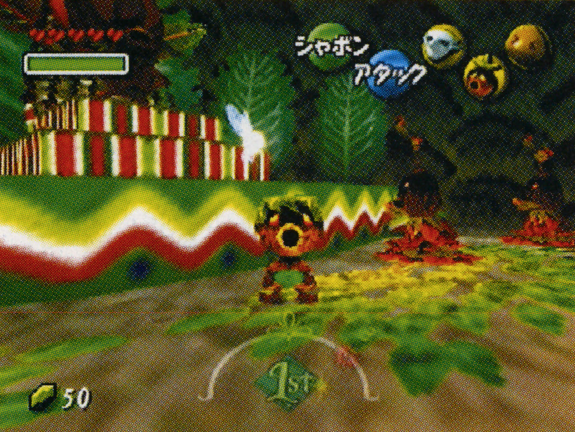
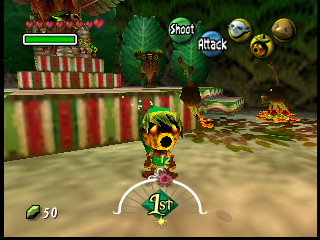
The platform where the Deku King stands was redesigned and Deku Butler wasn't added yet.
Revisited - Goron Village#
|
Prototype |
Final |
|---|---|
|
|
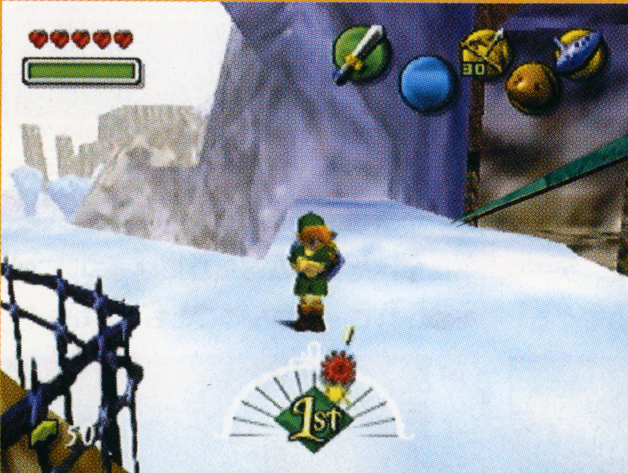
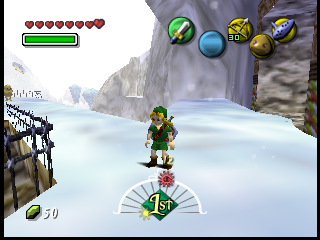
There's strange geometry behind the Lone Peak Shrine that doesn't exist in the final version. It might've been the Stone Tower Temple in the distance. 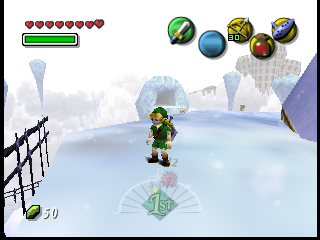
Dec. '99 |
Final (JP) |
Final (JP) |
|---|---|---|
 |
 |
 |
|
Prototype |
Final |
|---|---|
|
|
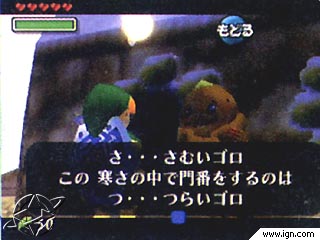
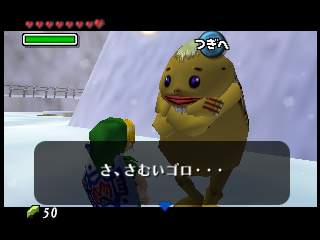
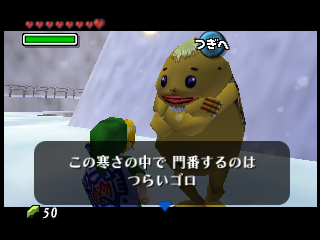
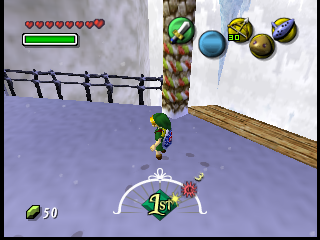
The gatekeeper Goron seems to have been placed in another location. His dialogue is the same as in the final version, but formatted differently and condensed into one text box instead of spread across two.
Early:
Speaker |
Japanese |
Translation |
|---|---|---|
Goron |
さ…さむいゴロ この 寒さの中で門番をするのは つ…つらいゴロ |
I... it's cold, goro. It's h... hard to be the gatekeeper in this cold, goro. |
Final:
Speaker |
Japanese |
Translation |
|---|---|---|
Goron |
さ、さむいゴロ… この寒さの中で門番するのは つらいゴロ |
I-it's cold, goro... It's hard to be the gatekeeper in this cold, goro. |
(Source: Translation - GlitterBerri)
Snowhead#
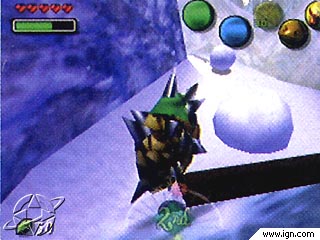
A scrapped icon for the Goron Drums can be seen on the C-right button. It's also unused in the final game.
Revisited - Unknown 1#
This dungeon was first shown in August '99 screenshots and the Spaceworld '99 trailer. Link is seen battling various enemies, most of whom are found in Ikana in the final game. It's unknown whether it was connected to a section of the game's Spaceworld 1999 demo that was described as a "battlefield area".
Prototype |
|---|
 |
 |
January 2000
January 3
- Gamespot reports that the official name of Zelda Gaiden is Zelda: Mask of Mujula and that it will use the N64 Expansion Pak for added detail and enemy counts.
Masks#
The following mask models were added to Link's updated Majora's Mask object during this month:
- January 6:
- Giant's Mask
- January 11:
- Romani's Mask
- January 15:
- Postman's Hat
Items#
Kokiri Sword#
|
Early |
Final |
|---|---|

|

|
The Kokiri Sword icon was changed to be shorter and was now final.
Environments#
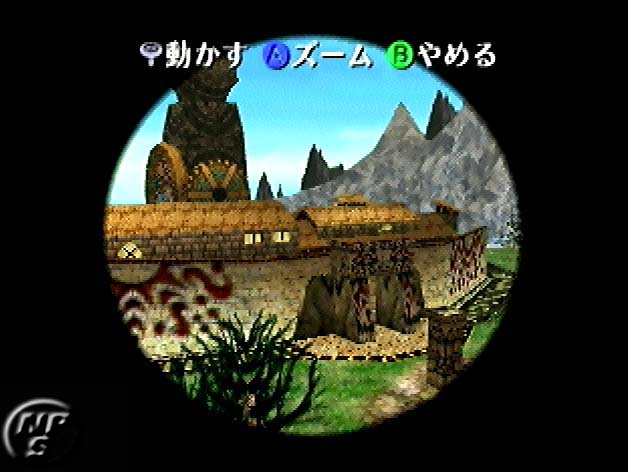
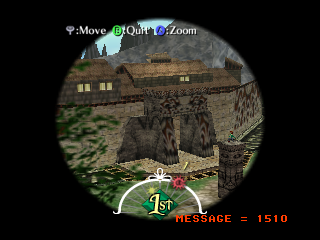
Termina Field#
|
Prototype |
Final |
|---|---|
|
|
Originally, one of the trees seen in front of the Astral Observatory was shaped like the tree used in the adult version of Kakariko Village in Ocarina of Time. Besides this tree, there are differences with how zoomed the telescope was and the man who stood above the pillar to mark a secret was missing.
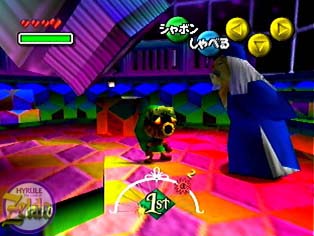
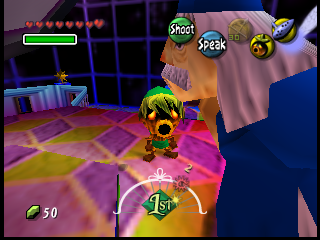
Astral Observatory#
|
Prototype |
Final |
|---|---|
|
|
The stairs continued to wrap around the observatory leading to a slightly elevated spot. This was simplified for the finished game.
|
Prototype |
Final |
|---|---|
|
|
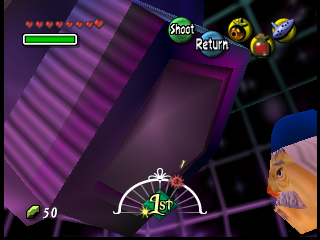
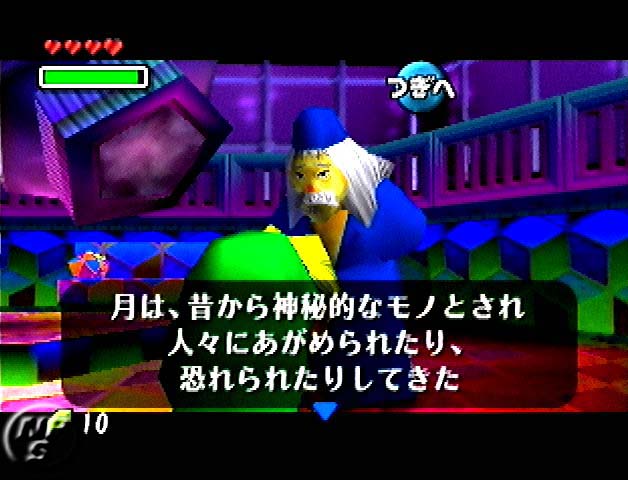
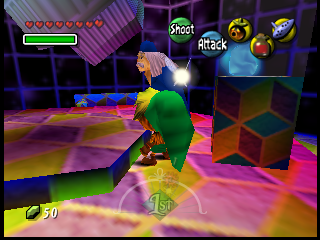
The scrolling space effect was less impressive looking and the telescope's lens texture changed. Professor Shikashi didn't have Moon Tears next to him as decor.
Revisited - Deku King's Chamber#
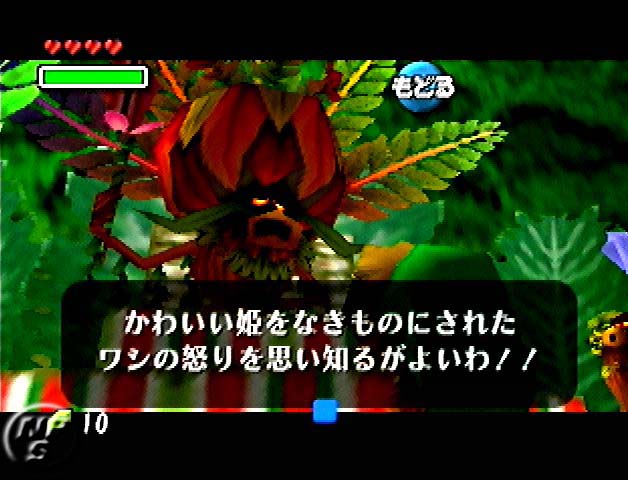
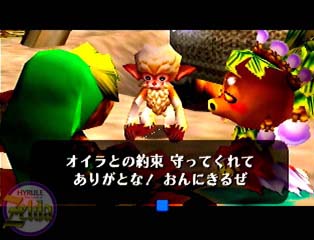
 Deku Butler who was missing in the December 1999 screenshots is now seen here.
The cauldron that's in the Royal Chamber is removed in the final game after the King found out what actually happened.
Woodfall#
|
Prototype |
Final |
|---|---|
|
|
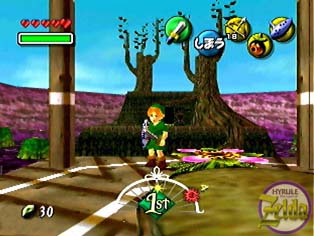
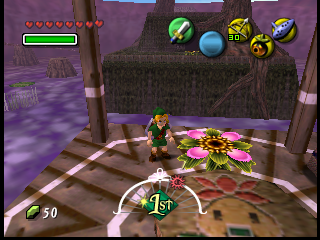
The Deku painting indicator was missing on the spot where you play Sonata of Awakening. The logs were also using another texture.
|
Prototype |
Final |
|---|---|
|
|
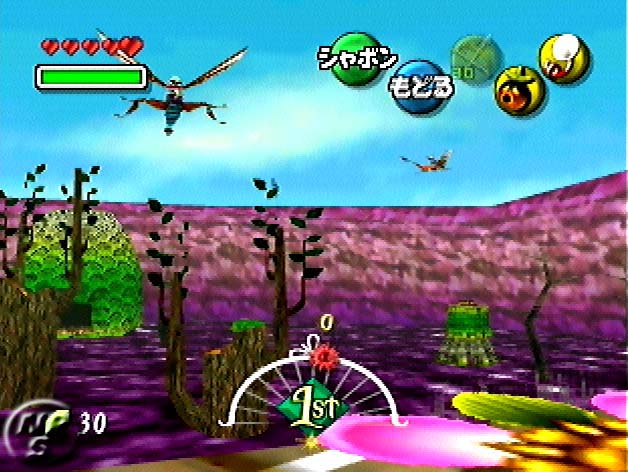
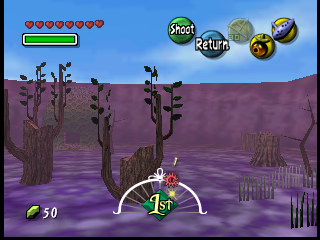
The Ocarina icon would've changed when changing forms and, for some reason, was cut. These icons still exist unused in the final game. Woodfall's fog settings were tweaked to be more murky.
Fairy Fountain (Woodfall)#
|
Prototype |
Final |
|---|---|
|
|
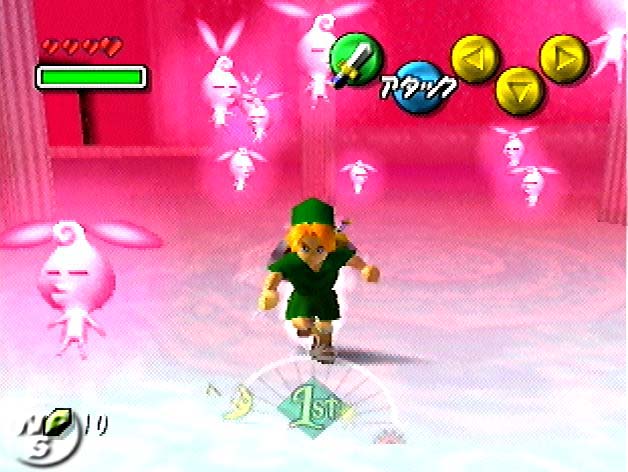
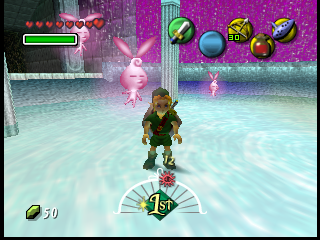
The amount of light the stray fairies emitted was considerably toned down.
Goron Shrine#
|
Prototype |
Final |
|---|---|
|
|
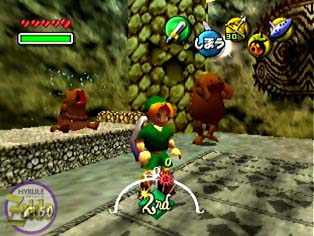
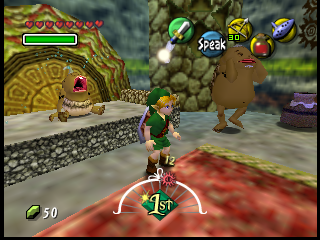
Elder's Son's bed got a decorative backrest and the carpet was changed from a Goron's Ruby pattern to a soft red carpet. The Goron model wasn't updated yet and was still the same as Ocarina of Time's.
Revisited - Waterfall Rapids#
Prototype |
|---|
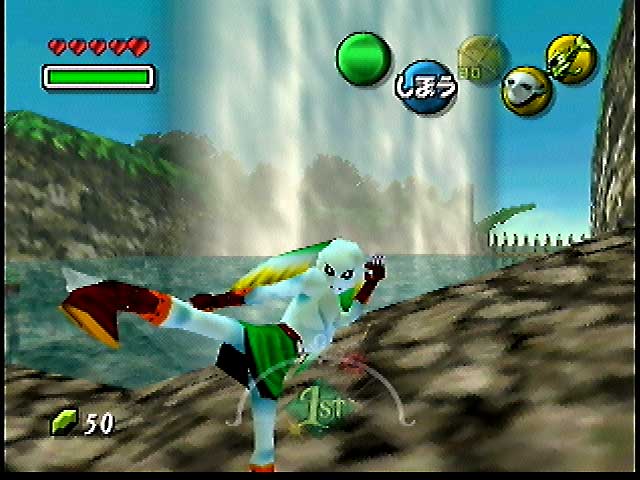 |
Yet again, Waterfall Rapids is shown, now looking as it does in the released version. Wearing a mask used to cause the Ocarina icon to change to the forms' respective instruments at this point in development. These unused icons still exist in the final game's data.
Pirates' Fortress (Entrance)#
|
Prototype |
Final |
|---|---|
|
|
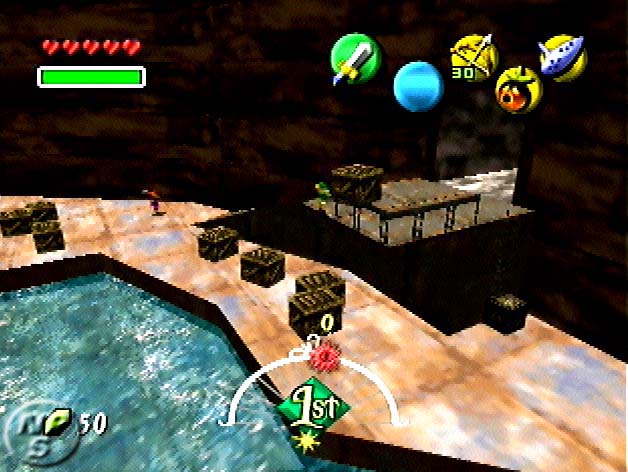
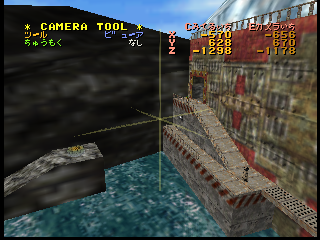
Pirates' Fortresses entrance seemed to go through a massive overhaul for the final game. It resembled the inside part of the fortress more and had no pirates patrolling in their boats. It's possible they wanted to redesign this area to utilize more of Link's transformation masks like Goron Link and Zora Link.
The area designer for Pirates' Fortress, Yoshihisa Morimoto, mentioned in an interview with 64Dream that the areas he was in charge of were changed a lot during the game's development.
As this was the first time working on a household (console?) game, there were many things that had me feeling left out at sea (Entered company during September of 1999). So, it was difficult at first to even remember the names and faces of the Zelda team, the tendencies of the N64 hardware and understanding the makeup of it. It wasn't until near the end when I started to really get a good grasp of the N64. I changed the areas so often that in the end the best product was finished.(Source: 64Dream Issue 46)
Pirates' Fortress (Inside?)#
|
Prototype |
Final |
|---|---|

|
|
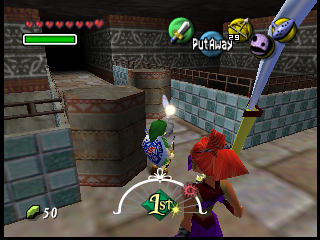
This area in the final game resembles the area seen in the pre-release screenshot the best.
February 2000
February ??
Magazine 64 has a little blurb on MM.
February 29
IGN reports (via NoJ PR chief Yoshio Hongo in The 64 Dream).
- Nintendo's Ocarina of Time follow-up, Legend of Zelda: Mask of Mujula, was previously announced by Nintendo to arrive in Japan April 27th. Hongo-san confirmed the release date and explained that Nintendo is releasing the Mujula in late April so that Japanese players can enjoy the title during their Golden Week holiday, which begins the first week of May. According to Hongo-san, debugging is said to start at the end of February, so the game shouldn't have any problems making its scheduled April release date.
- Commercials for Mask of Mujula will begin airing in Japan in April.
Masks#
The following mask models were added to Link's updated Majora's Mask object during this month:
- February 14
- Troupe Leader's Mask
- Stone Mask
- February 16
- Bremen Mask
- February 21
- Don Gero's Mask
- All-Night Mask
- Couple's Mask
- Kamaro's Mask
- Blast Mask
- Mask of Scents
Additionally, the Gerudo Mask and the Spooky Mask were removed from Link's object on February 21.
Environments#
Revisited - Mountain Village#
|
Prototype |
Final |
|---|---|

|
|
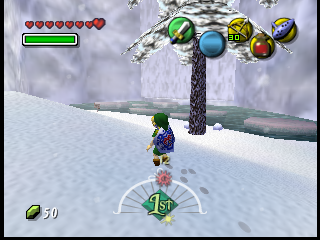
A snowball that's near the water is missing. It's possible they weren't added yet.
Path To Goron Village#
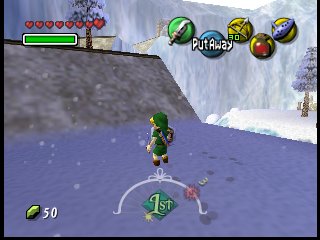
|
Prototype |
Final |
|---|---|
|
|
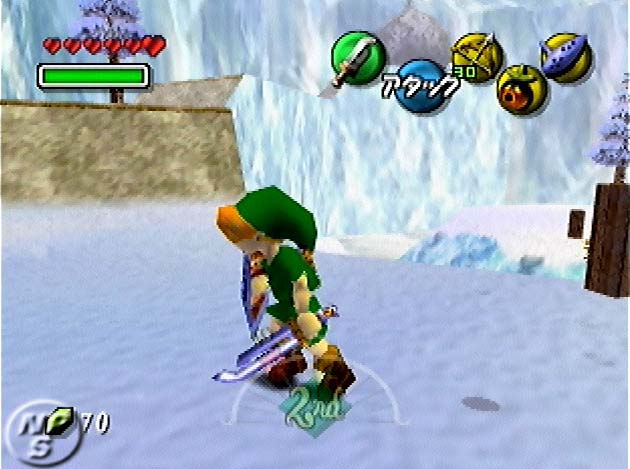
The bridge which is normally closer to the entrance was closer to the slope.
|
Prototype |
Final |
|---|---|
|
|
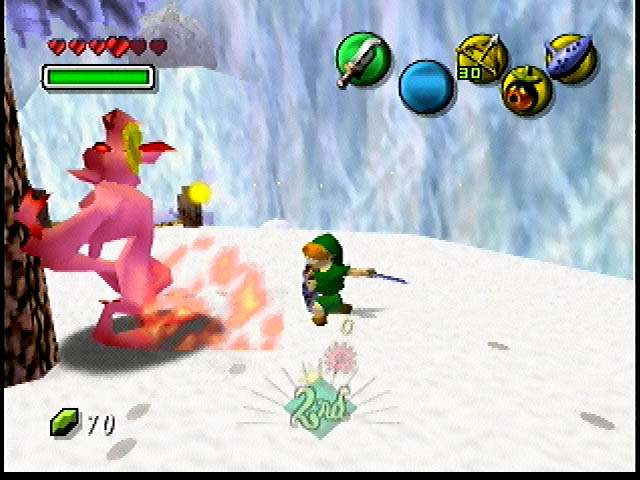
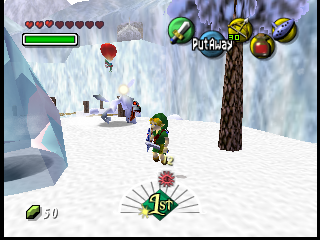
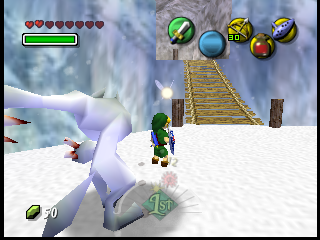
Tingle wasn't selling you any maps yet. How does he manage to stay warm with the garments he has anyway?
|
Prototype |
Final |
|---|---|
|
|
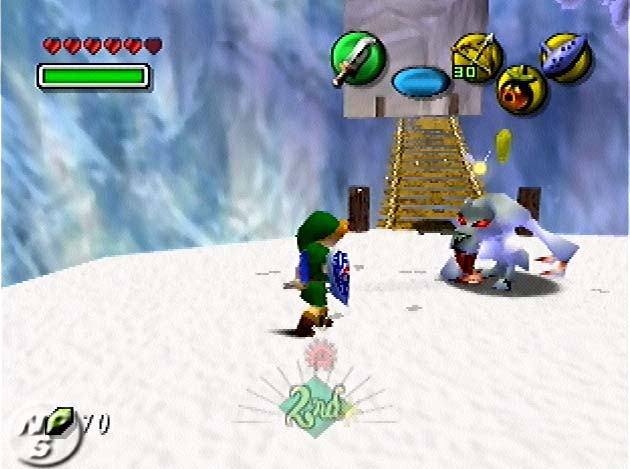
The tree was positioned where a grotto would later be, so your only source of Hot Spring Water would've been by Darmani's grave.
March 2000
March 6
- IGN reports (via Nintendo Power Source) that Majora’s Mask is tentative English title, publishes new screenshots from Famitsu.
- Gamespot reports that Majora's Mask is tentative English title and that one of the screenshots they previously posted shows an adult link mask on the bottom C slot, speculating that Adult Link plays a small role in the game. Miyamoto commented that he was not sure if adult Link is in the game or not. Game will release in Fall 2000.
March 28
- IGN unveils Japanese box art, claims that “two versions of the game, one with and one without the 4MB Expansion Pak, will be shipping in that country.”
March 31
- Magazine 64 publishes all they know on MM up till now, includes early info.
- Japanese 1.0 version build date.
Characters#
Link#
|
February. 2000 |
March. 2000 |
|---|---|
|
|
|
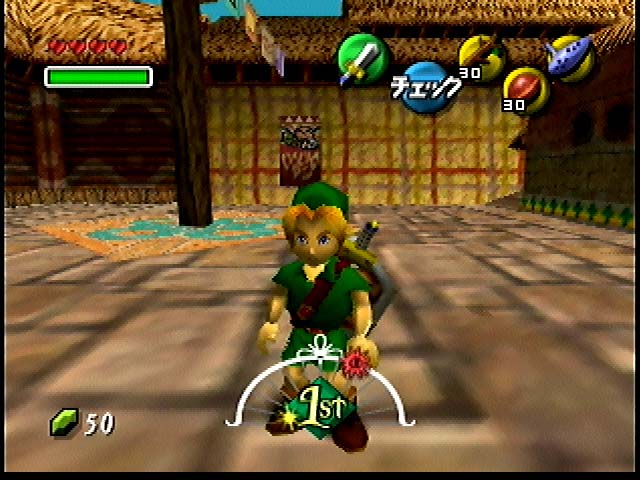
Link's model was updated from Ocarina of Time's.
Business Scrub#
South Clock Town#
Prototype |
|---|
 |
Speaker |
Early Japanese |
Translation |
|---|---|---|
Business Scrub |
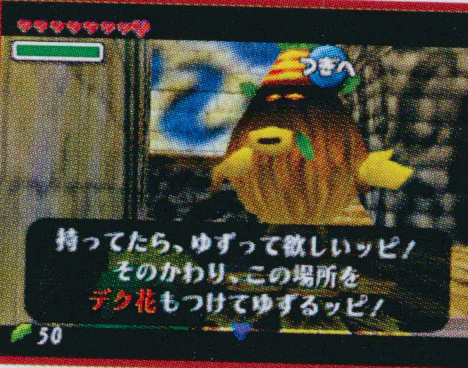
持ってたら、ゆずって欲しいッピ! そのかわり、この場所を デク花もつけてゆずるッピ! |
If you have it, I want you to transfer it to me, pi! In return, I'll transfer you this spot with a Deku Flower attached, pi! |
Business Scrub |
そいつを持ってたら、 ゆずって欲しいッピ! そしたら、この場所を デク花もつけてゆずるッピ! |
If you have that thing, I want you to transfer it to me, pi! Then, I'll transfer you this spot with a Deku Flower attached, pi! |
(Source: Translation - GlitterBerri)
Revisited - Southern Swamp#
Prototype |
|---|
 |
Speaker |
Early Japanese |
Translation |
|---|---|---|
Business Scrub |
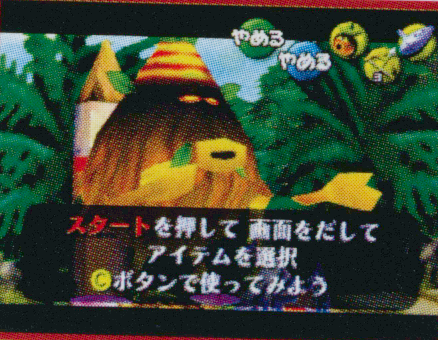
かわりに、この大地のケンリ ゆずるッピ! |
In exchange, I'll give you the title to this land, pi! |
Speaker |
Final Japanese |
Translation |
Business Scrub |
かわりに、ここの土地 ゆずるッピ! |
In exchange, I'll give you this land, pi! |
(Source: Translation - User:GlitterBerri)
Cutscenes#
Revisited - Intro#
|
Prototype |
Final |
|---|---|
|
|
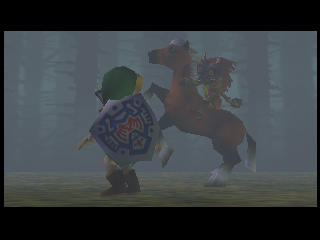
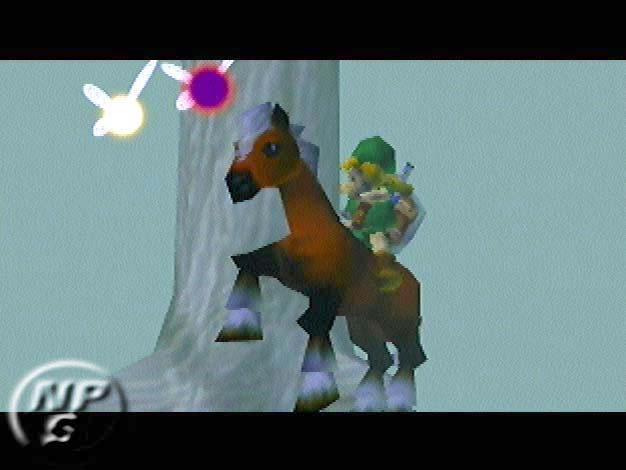
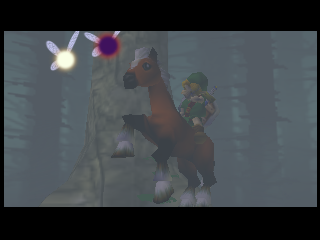
The intro bit where Link wanders through the Lost Woods and meets Skull Kid and the fairies is identical to the '99 screenshot media.
Title Screen#
|
October '99 |
March '00 |
|---|---|
|
|
|
October '99 |
March '00 |
|---|---|
|
|
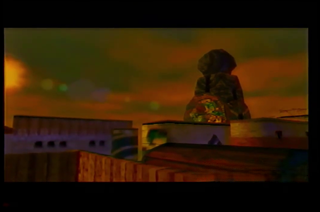
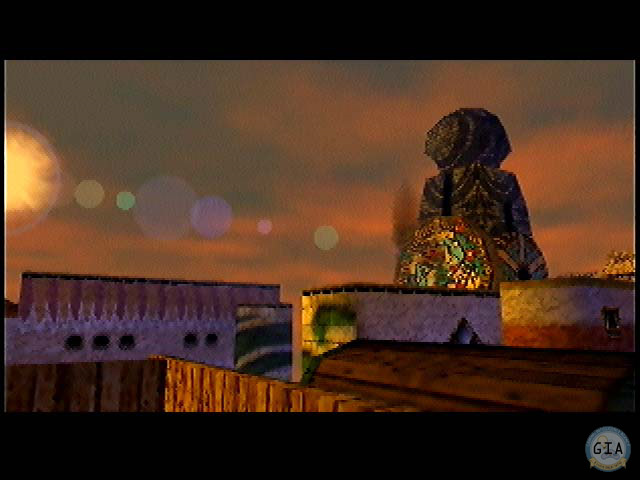
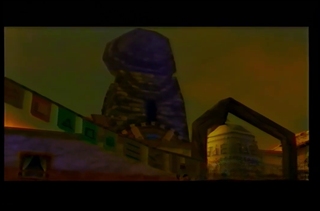
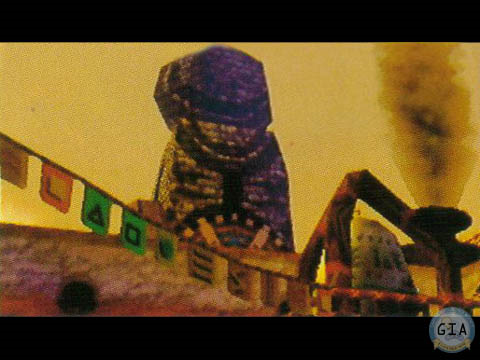
The East Clock Town cutscene on the title screen was completely remade for the final game. It was still the same as it was in the Nintendo 2000 New Line Up Promotional Video. The chinmey for Stock Pot Inn was added and the window texture was changed. The windows seen in October don't appear anywhere in the final game.
|
Prototype |
Final |
|---|---|
|
|
|
Prototype |
Final |
|---|---|
|
|
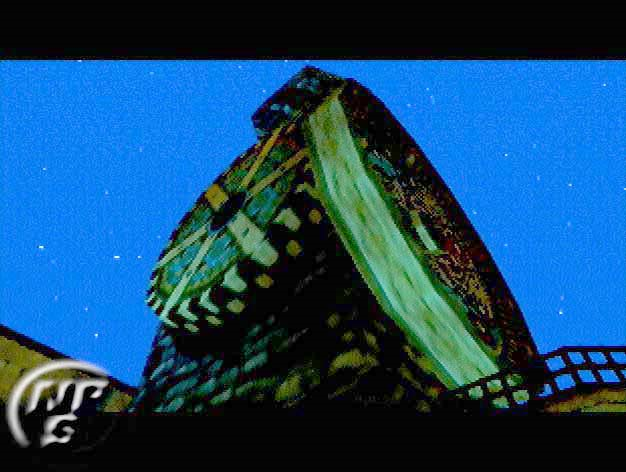
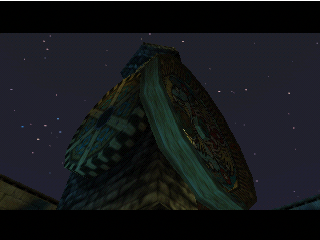
xxx
Environments#
Revisited - South Clock Town#
|
Prototype |
Final |
|---|---|
|
|
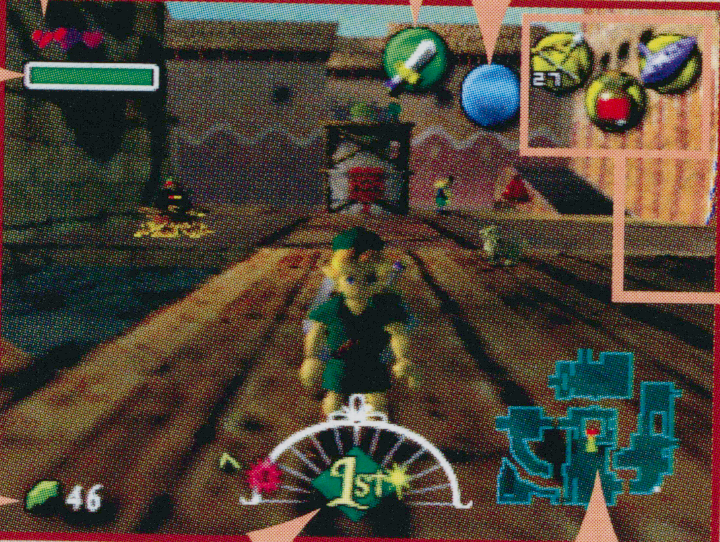
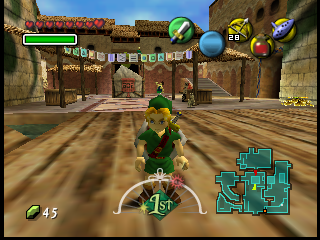
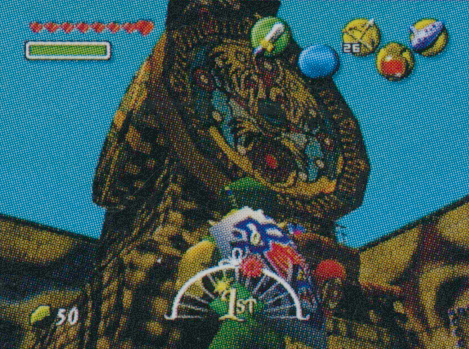
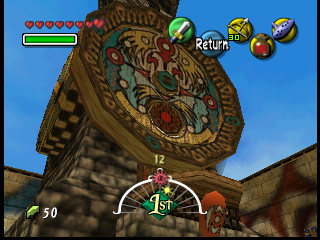
- The Deku Scrub Salesman and his flower was moved to the opposite side of the area.
- object_tokei_turret, which contains the flag strand and the thatch-roofed stalls, and its associated actors are missing. This object was added on 1999-12-16 and thus should have existed, so the reason for its absence is unknown.
- The carnival platform doesn't have crossed wooden beams on its side.
|
Prototype |
Final |
|---|---|
|
|
- The wooden balcony at the entrance to the Clock Tower has a little fence.
|
Prototype |
Final |
|---|---|
|
|
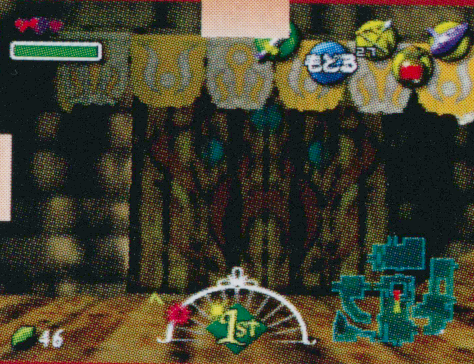
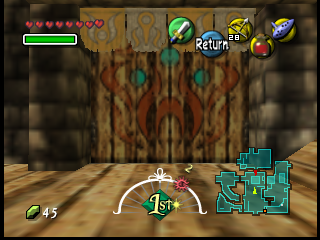
- There's an extra flag on either side of the flag strand.
- The minimap of Clock Town is different.
- The left side of North Clock Town is a different shape.
- There's no square representing the Stockpot Inn.
- The raised area where a chest with rupees is hidden at the bottom of South Clock Town is missing.
- The squares that represent buildings in the final game are empty instead of filled in with lighter blue.
- There isn't a break in the border lines at the exit between North Clock Town and East Clock Town.
|
Prototype |
Final |
|---|---|
|
|
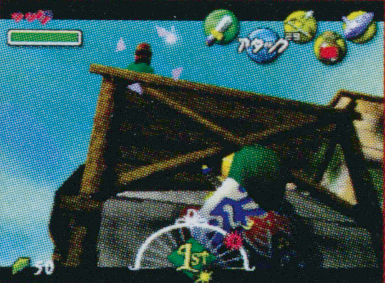
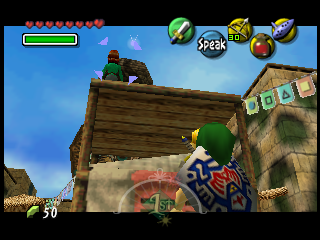
- The carnival platform doesn't have crossed wooden beams on its side.
- The flag strand coming off the side of the platform is missing, for the reason mentioned above.
|
Prototype |
Final |
|---|---|
|
|
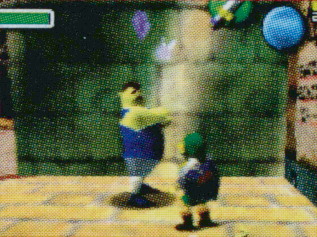
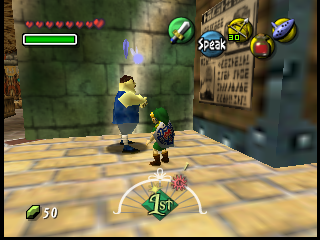
- The poster on the wall is the same as what's found at the entrance to the Treasure Chest Game.
- The carpenter laughing at the poster wasn't a thing since the poster had nothing to do with the festival plans.
East Clock Town#
|
Prototype |
Final |
|---|---|
|
|
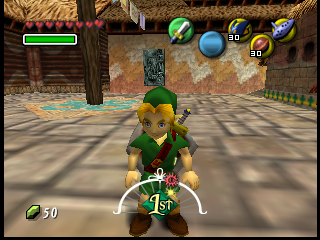
|
A wall texture was changed to a better one.
|
Prototype |
Final |
|---|---|
|
|
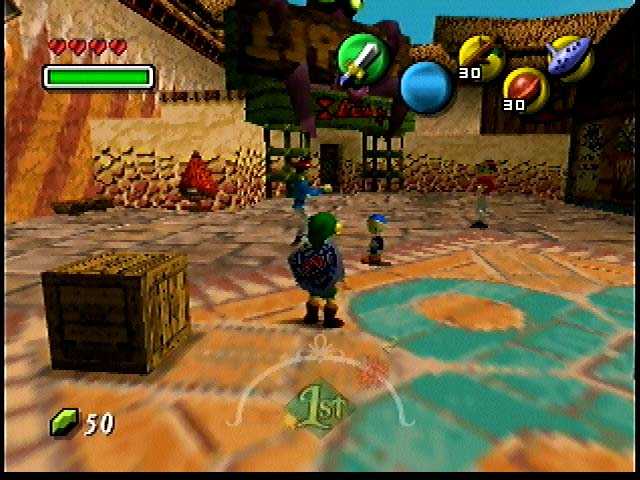
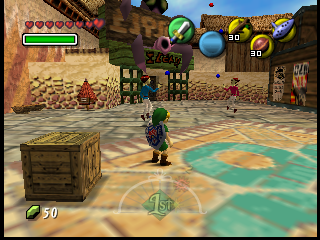
4th kid from the Bomber group who's placed closer to the Treasure Chest Shop in final used to stand closer to the two jugglers. These jugglers weren't juggling together.
|
Prototype |
Final |
|---|---|
|
|
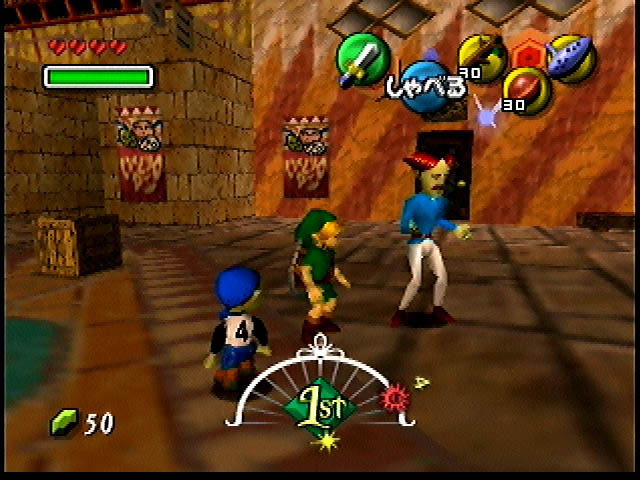
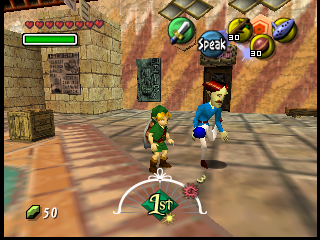
Posters of more generic kind were attached to Clock Town's walls instead of posters telling about The Indigo-Go's upcoming concert on the festival day.
|
Prototype |
Final |
|---|---|
|
|
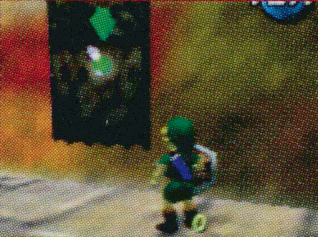
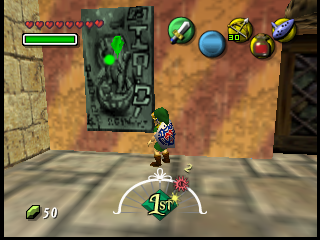
A screenshot that seems to be closer to release shows that the Indigo-Go's concert posters were torn. This was likely changed because the posters couldn't have been that old.
Mayor's Residence#
|
Prototype |
Final |
|---|---|
|
|
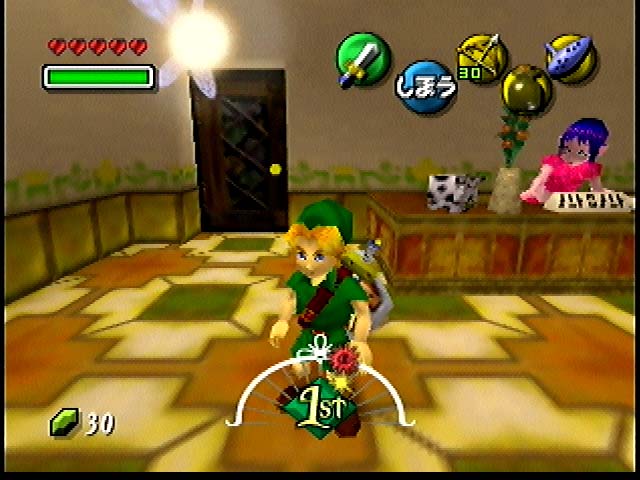
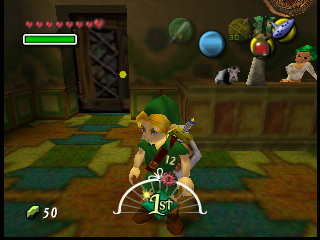
The receptionist from Mayor's Residence was the Treasure Chest Game owner. Interestingly, in the final game, both the receptionist and the Treasure Chest Game owner share the same object (object_bg), with index 0x0129.
|
Prototype |
Final |
|---|---|
|
|
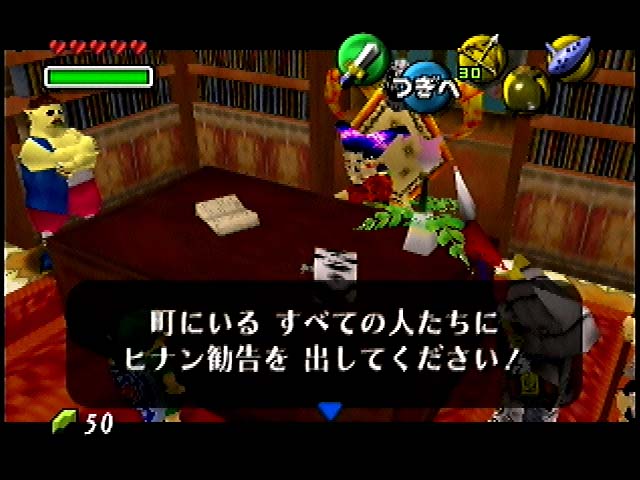
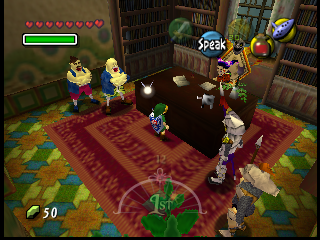
The carpenter moved closer to his boss in the room where Mayor's meeting takes place.
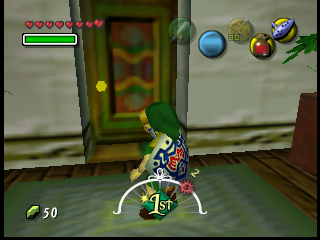
Stock Pot Inn#
|
Prototype |
Final |
|---|---|
|
|
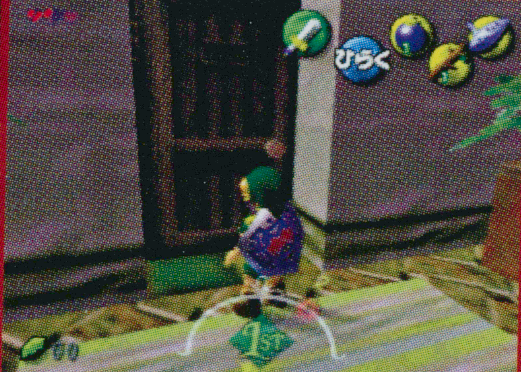
The interior of Stock Pot Inn was renovated just before the game's release.
North Clock Town#
|
Prototype |
Final |
|---|---|
|
|
|
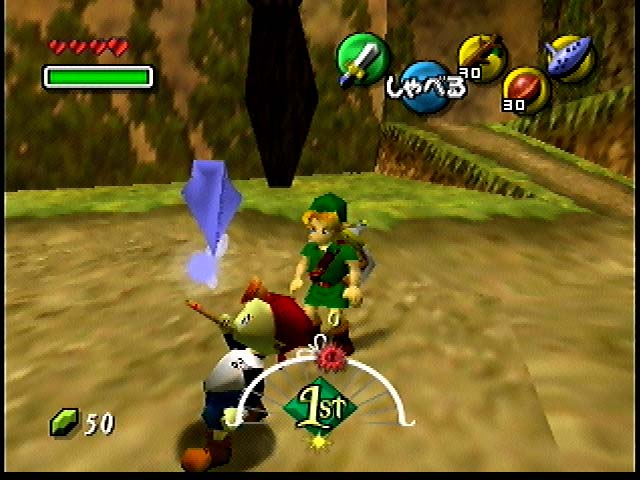


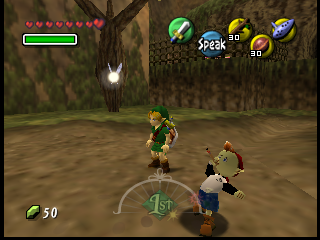
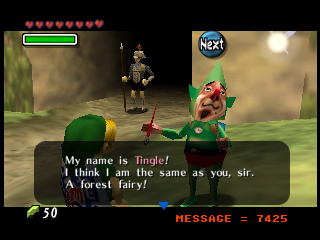
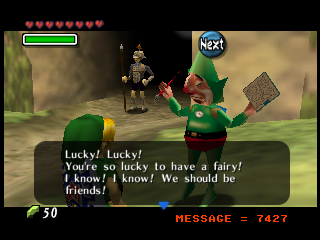
This March version of the North Clock Town was found in the leaks. Tingle didn't close his eyes when jumping with joy.
West Clock Town#
March. 2000 |
Final |
Final |
|---|---|---|
 |
 |
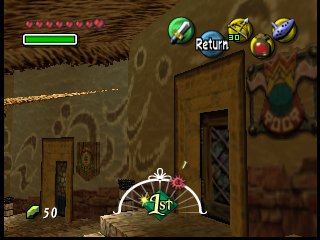 |
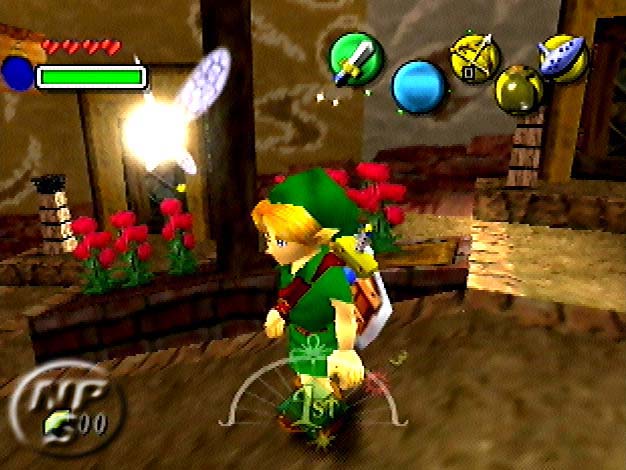
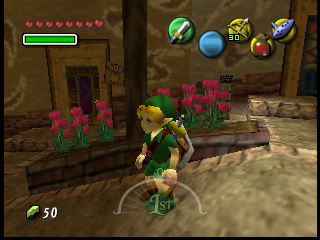
Some of the shops in West Clock Town were reorganized. Before release, the Curiosity Shop was the Bomb Shop, and the sign (which differs from the final's) for it is on the left instead of right from the door. More door designs were created later on, so all of them wouldn't look the same.
|
Prototype |
Final |
|---|---|
|
|
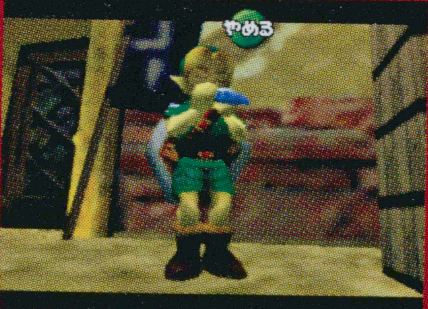
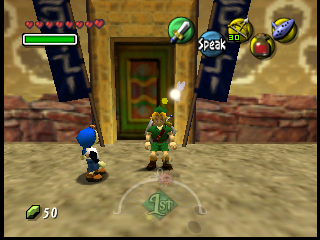
A torch that was placed between the Swordman's School and Post Office was removed. This is still present in an Alternate Scene Setup for the map.
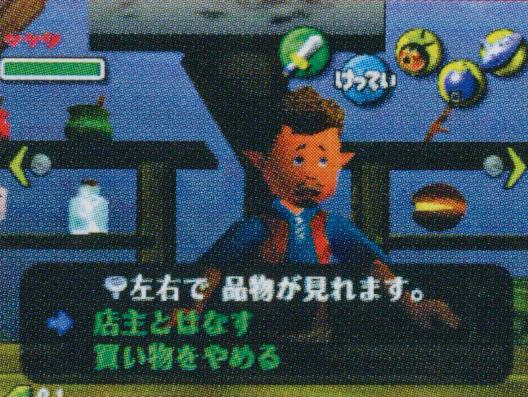
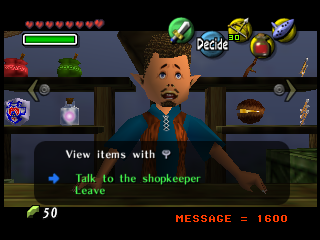
Trading Post#
|
Prototype |
Final |
|---|---|
|
|
Swordsman's School#
|
Prototype |
Final |
|---|---|
|
|
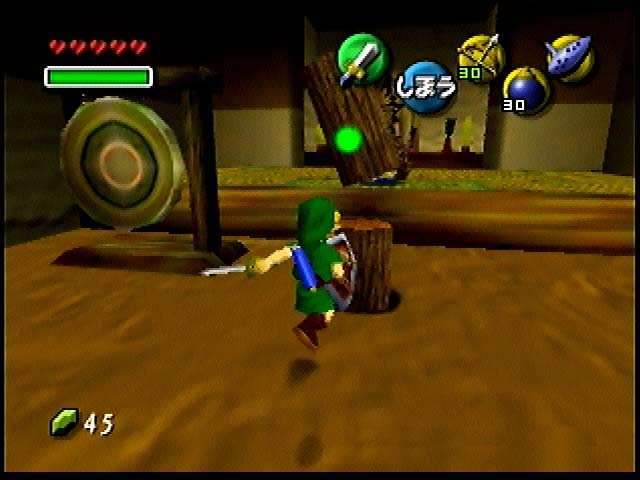
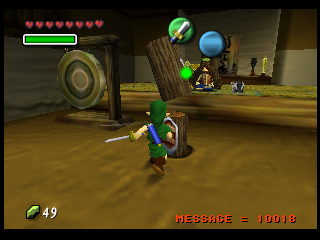
The Cow Figurine beside the Swordman was missing.
Revisited - Termina Field#
|
Prototype |
Final |
|---|---|
|
|
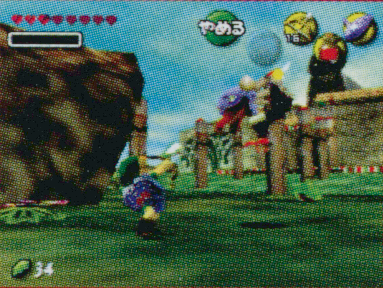
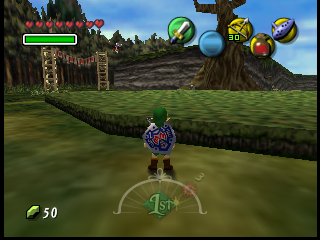
The Thief Bird was moved closer to where the Milk Road is.
Revisited - Romani Ranch#
|
Prototype |
Final |
|---|---|
|
|
|
Prototype |
Final |
|---|---|
|
|
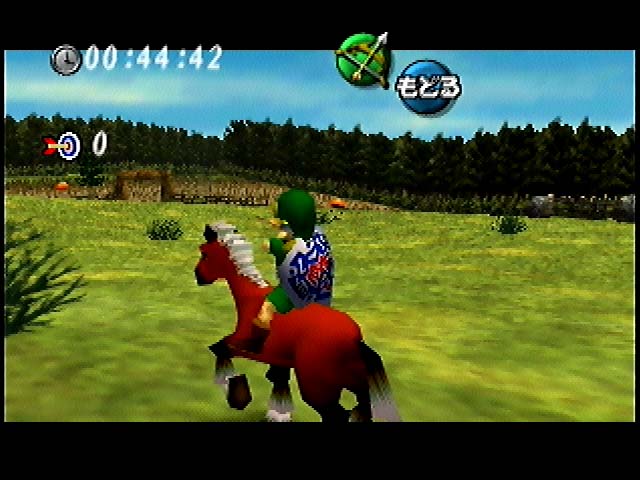
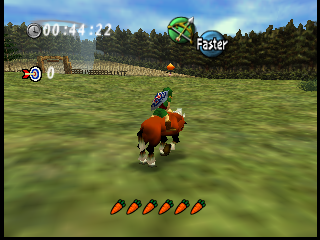
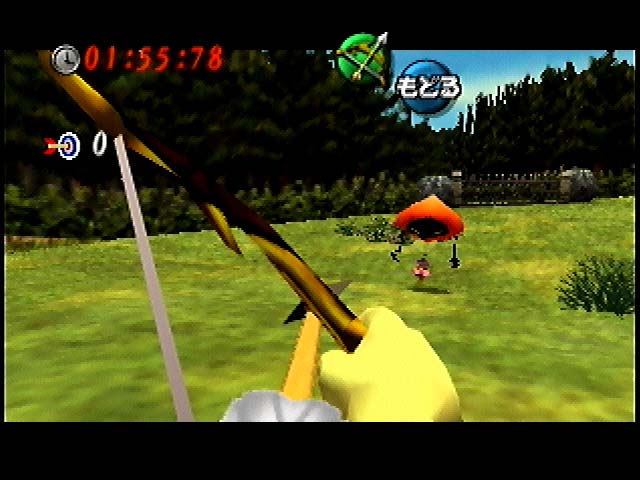
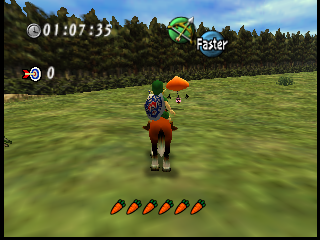
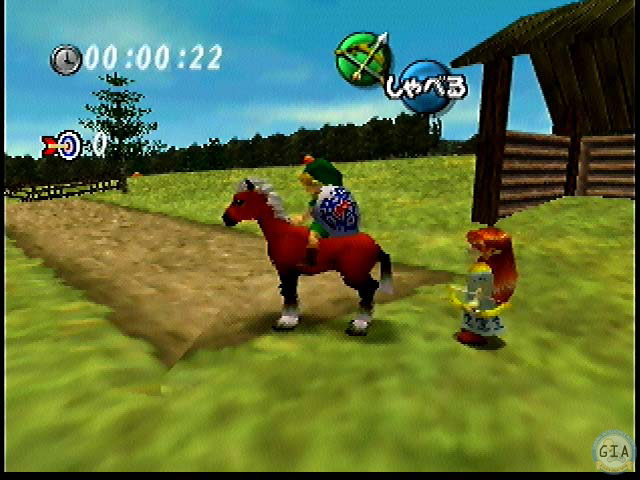
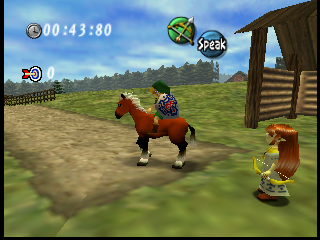
Romani Ranch used to have three exits instead of just one. It's not known where they would've led, but it's likely they would've led to the Cucco Shed and Dog Racetrack maps. The Woodfall mountain backdrop was also missing.
|
Prototype |
Final |
|---|---|
|
|
Some trees moved.
Aug. '99 |
Mar. '00 |
Final |
|---|---|---|
 |
 |
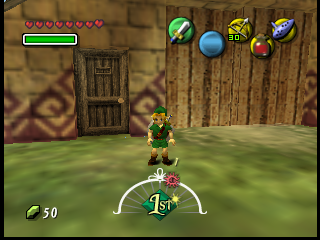 |
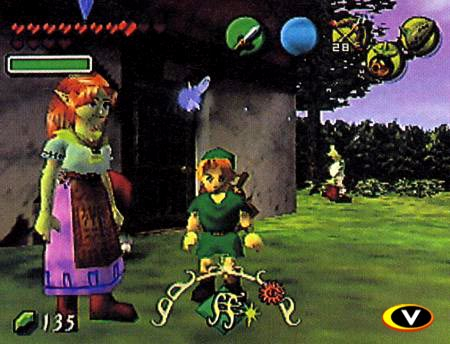
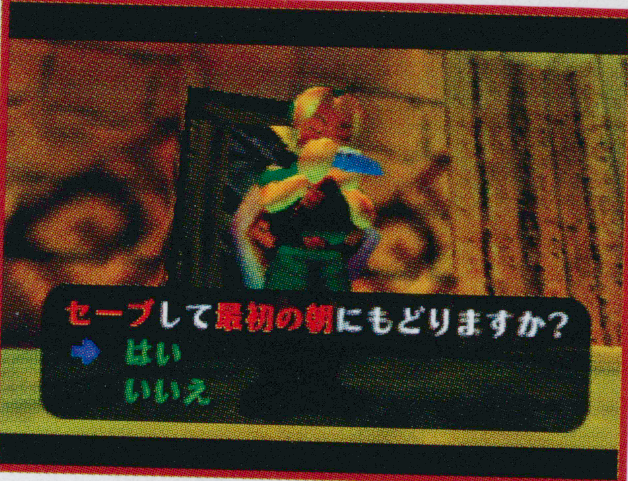
The developers weren't sure what kind of wooden door would suit Romani Ranch better.
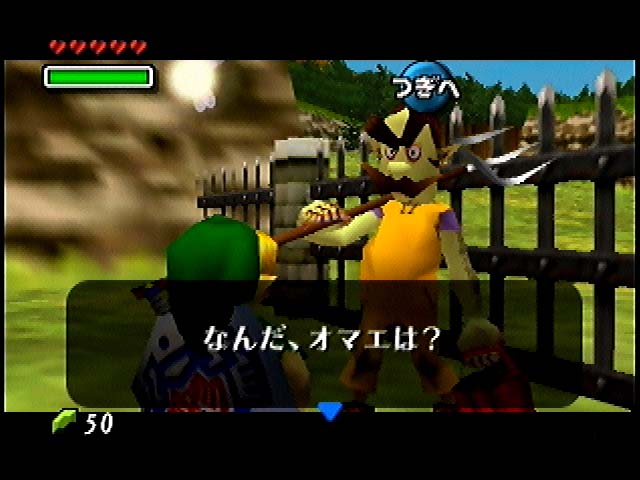
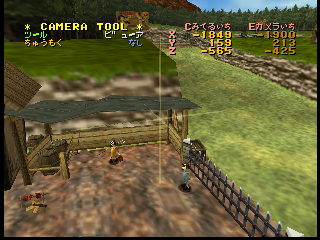
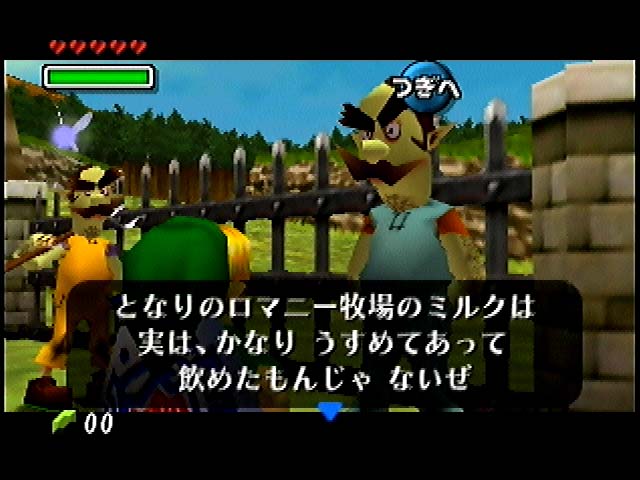
Gorman Track#
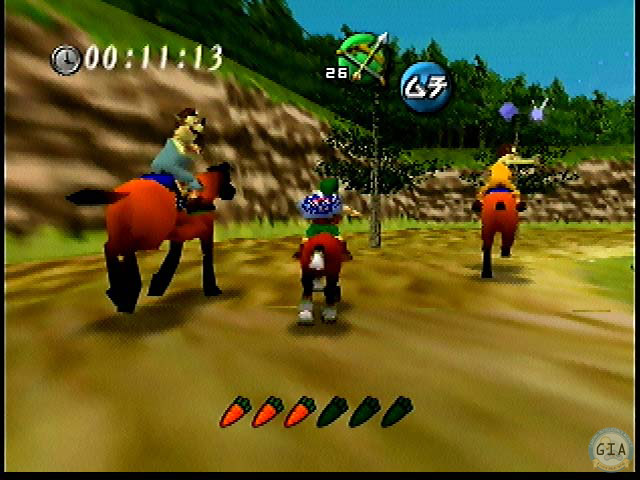
|
Prototype |
Final |
|---|---|
|
|
|
Prototype |
Final |
|---|---|
|
|
Early Exits | Final Exits |
|---|
 |
 |
|
Prototype |
Final |
|---|---|
|
|
|
Prototype |
Final |
|---|---|
|
|
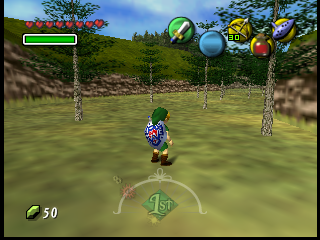
Some trees were reorganized.
Final |
Final |
Final |
|---|---|---|
 |
 |
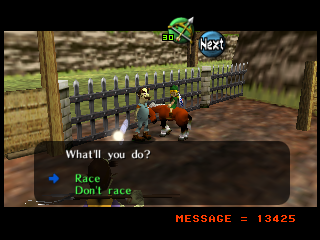 |
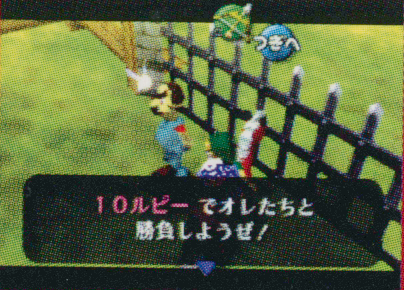
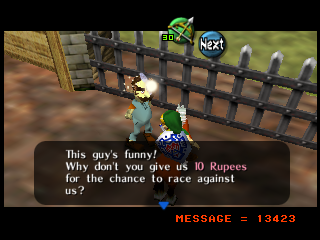
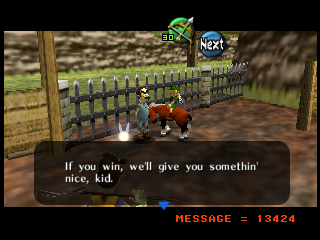
The stall that was missing in early March screenshots is here now, but the grass texture wasn't changed to dirt yet. The text before the race used to just be "Race against us for 10 rupees!", too.
Mountain Smithy#
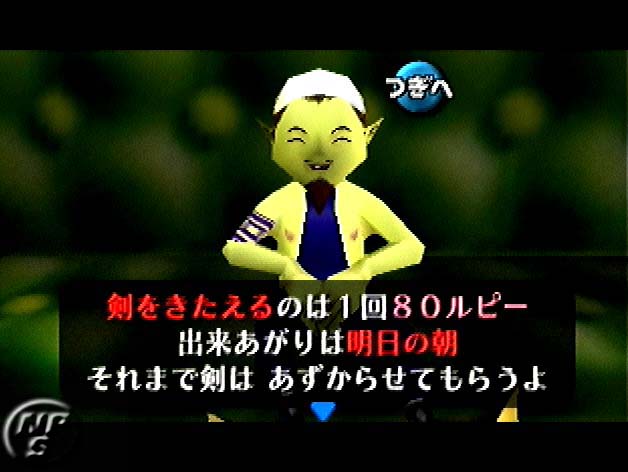
Mountain Smithy's Zubora and Gabora in Mountain Village offered to upgrade your Kokiri Sword to a Razor Sword for 80 rupees and not 100 rupees like in the final game. This means you were able to afford it without getting a Wallet upgrade.
Snowhead#
|
Prototype |
Final |
|---|---|
|
|
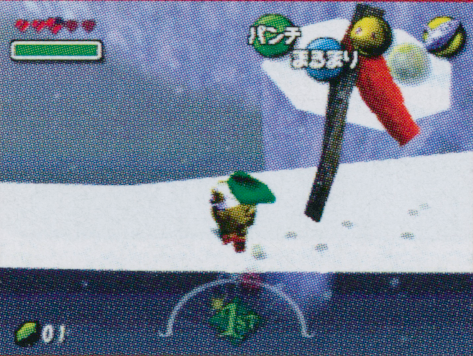
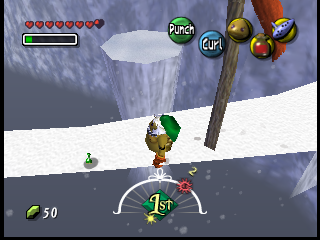
A platform that's just a background element was made smaller to make it impossible to reach.
|
Prototype |
Final |
|---|---|
|
|
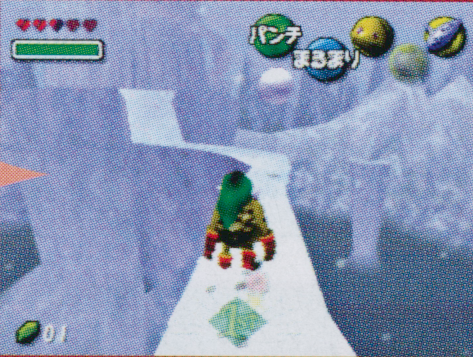
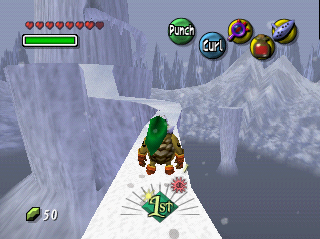
xxx
Snowhead Temple#
|
Prototype |
Final |
|---|---|
|
|
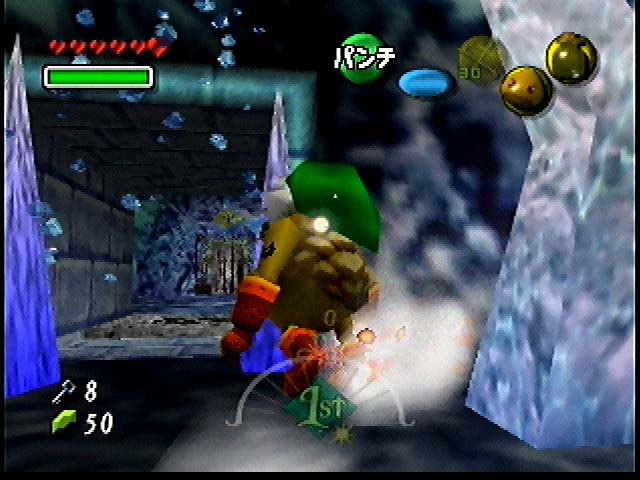
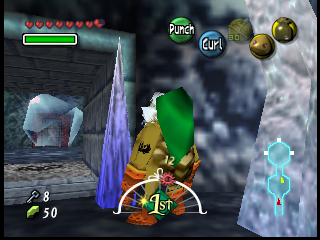
The door wasn't covered by a chunk of ice and the door was locked by a frozen eye switch instead.
|
Prototype |
Final |
|---|---|
|
|
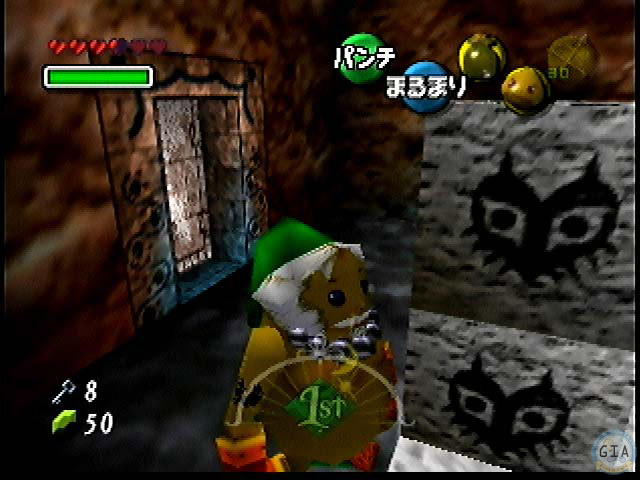
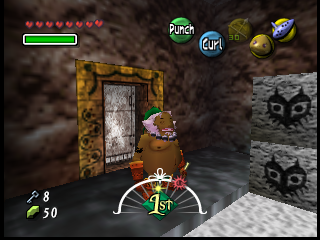
It seems that differently colored door frames weren't a thing. These were added to make it easier for the player to memorize where they've been and where they haven't.
|
Prototype |
Final |
|---|---|
|
|
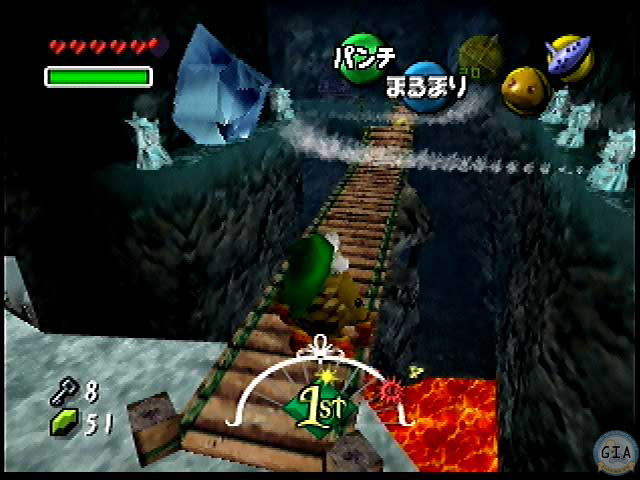
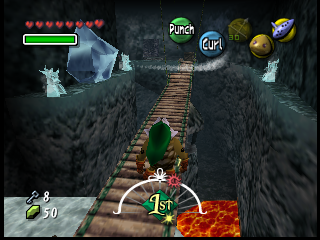
Few Freezards didn't make it in the final game.
|
Prototype |
Final |
|---|---|
|
|
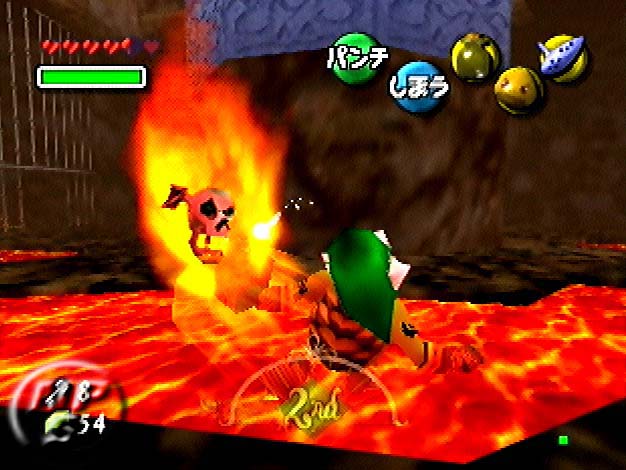
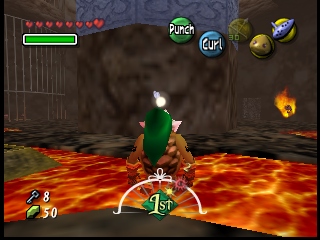
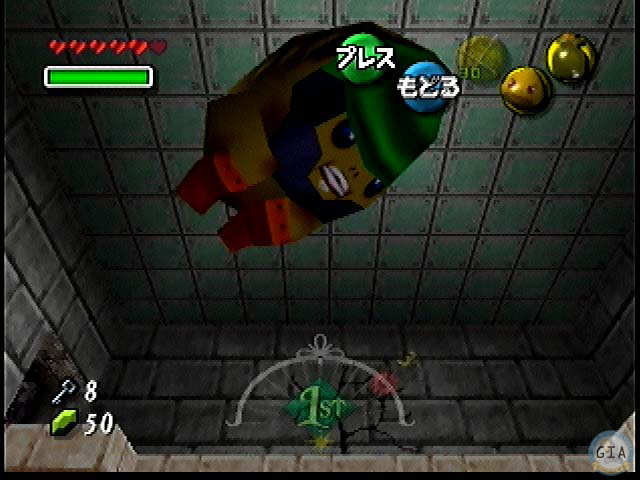
The switch only Goron Link can push down with his weight was missing. This switch spawns a chest nearby, where one of the dungeon's 15 Stray Fairies hides. Most likely the chest was already just there without pressing any switches.
|
Prototype |
Final |
|---|---|
|
|
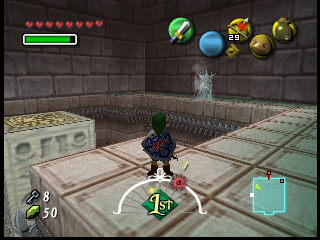
A lot of changes were made to this room (09) in Snowhead Temple. The frozen eye switch was likely placed behind the bombable wall and there's also a staircase which would've led to an unknown area of the dungeon.
Revisited - Pirates' Fortress#
|
Prototype |
Final |
|---|---|
|
|
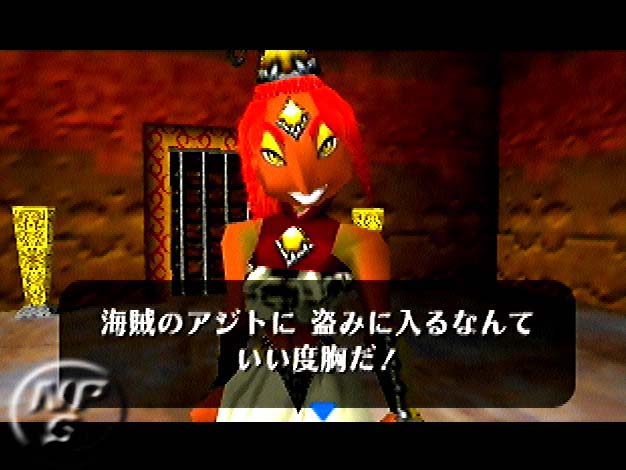
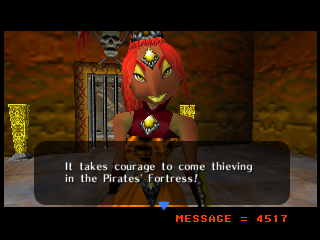
- The orange Gerudo Pirate used to wear white clothes.
- The door was a familiar shutter door from OoT and not the new door designed for this area.
- The skull texture above doors didn't exist.
Zora Hall#
|
Prototype |
Final |
|---|---|
|
|
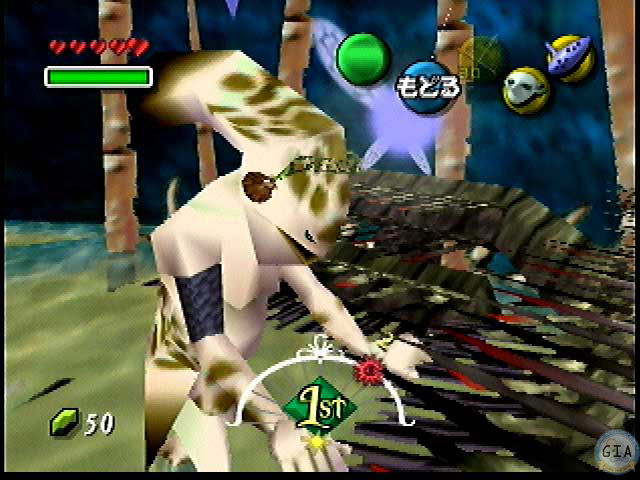
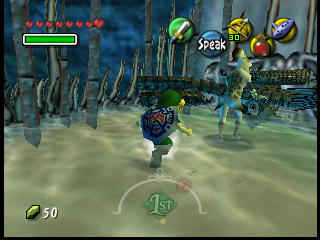
The collider for Evan's actor was increased, possibly to prevent a way to clip out of bounds.
Zora Cape#
|
Prototype |
Final |
|---|---|
|
|
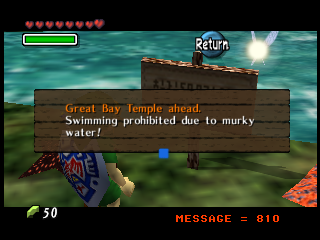
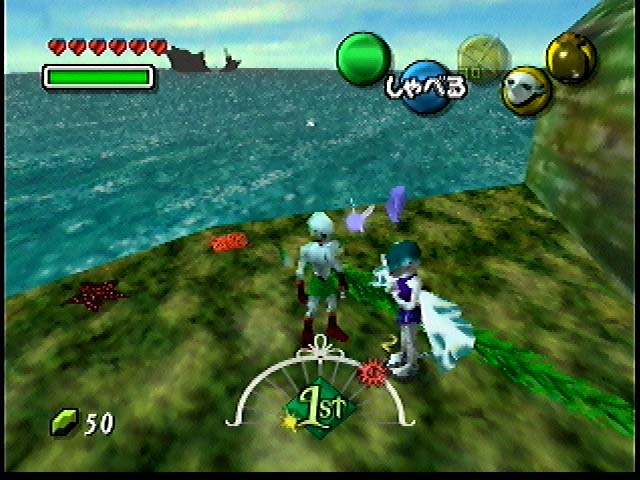
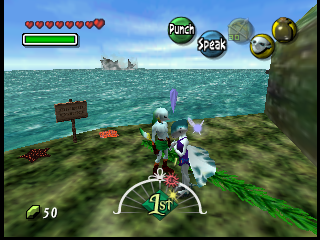
The water barrier protecting Great Bay Temple wasn't visible from this distance and the sign was missing.
Great Bay Temple#
|
Prototype |
Final |
|---|---|
|
|
|
Prototype |
Final |
|---|---|
|
|
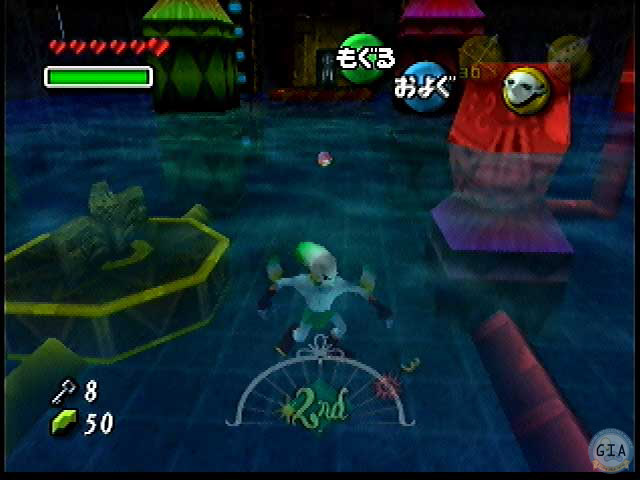
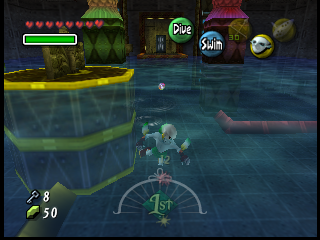
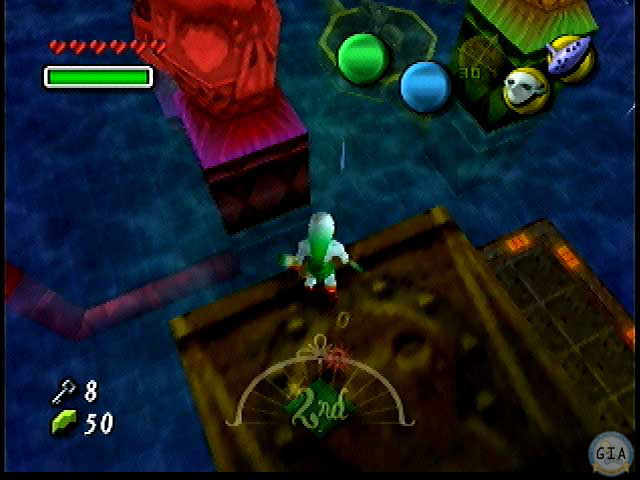
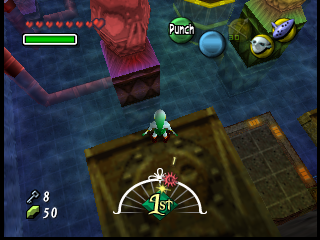
- The yellow platform with a valve was changed to not be underwater for the final game.
- The red pipe system was changed slightly before the game's release. The 2nd red water-based elevator is located near the top left of the room in the finished temple.
|
Prototype |
Final |
|---|---|
|
|
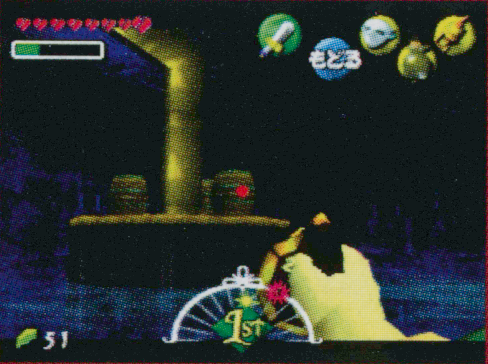
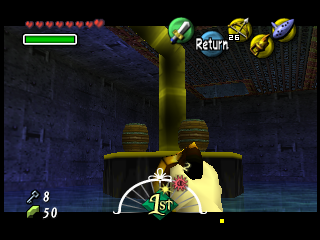
The barrel on the right was moved slightly to the left to prevent the player from using the hookshot on the barrel in the back, which would have caused Link to clip through the right barrel first.
Ancient Castle of Ikana#
|
Prototype |
Final |
|---|---|
|
|
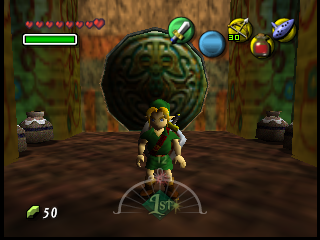
The boss room in Ancient Castle of Ikana used the same lighting settings as the pre-boss room when the curtains were closed.
Items#
Bombers' Notebook#
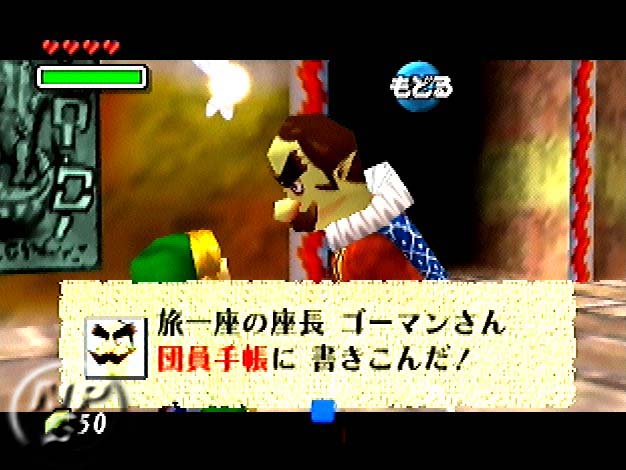
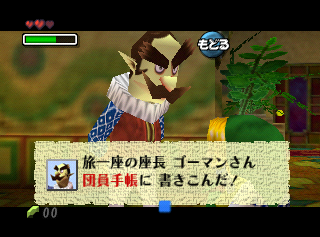
Gorman's icon in the Bombers' Notebook seems to have been a model render on a white background. The final version shows an image of Gorman in an outdoor scene.
|
Prerelease24 |
Final |
|---|---|
|
|
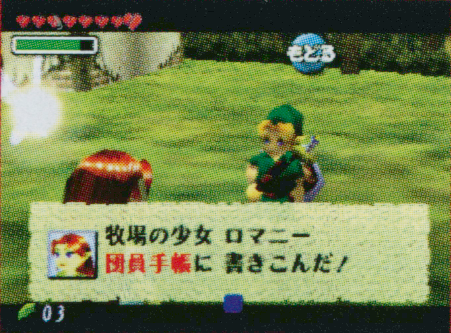
Romani's Bombers' Notebook icon was also updated.
|
Prototype |
Final |
|---|---|
|

|
April-August 2000
April 5
IGN shares some JP MM commercials.
April 6
NoA shares a bunch of screenshots.
April 13
IGN reports (via Famitsu)
- The back flip and side jumps will return and feature the same controls. This time, there will be a long jump as well, during which you are unable to attack. Attacks with your sword are the same, with slashes, thrusts, jumping slash and the spinning attack all back for more.
- Deku nuts Link is a bit shorter than boy Link, so he'll have trouble reaching certain places. He will have the ability to perform a Deku flower jump, which is where he stands on a special flower and then uses the flowers like a hang glider. Also, he will have a bubble projectile attack. Finally, Deku Link can skip over water for a maximum of five jumps.
- The game will flow in real time, but the clock stops when you're talking to other characters or using the item menu screen. Also, while the adventure does progress in real time, in actuality, one hour of game time is a bit shorter than one hour of real time.
- The time meter is quite simple, with 1st, 2nd and Last being displayed in the middle. This is the day that you are currently on. The sun or moon moves across the half-circle and when it has gone and come back, that is one day. There is a number above the sun/moon to tell you what time it is. Day is from 6am to 6pm.
- While Ocarina of Time showed you a map in the bottom right corner of the area you were in, this time, you will have to find the maps of fields, towns, etc. in order for them to be displayed in Majora's Mask.
- When you first start the game, there will be no magic gauge on your screen and you won't be able to do any magic. You must do something specific in order to receive magic ability from one of the great fairies.
- The ocarina will play an important part in this game too. The controls are the same. When you start the game, you don't know any songs and have to learn them like you did in Ocarina of Time. When wearing the different masks, you'll play the instruments of that people, eg. Deku Link plays some kind of horn/bagpipe.
- The scheduler (see the screenshot) is used to keep track of the different people in the land and to help them. You receive the scheduler from a group known as the Bombers after proving your worth to them.
- Similar to Ocarina of Time, there will be a number of minigames as well. Mini games will cost money to play, and some familiar ones like the treasure box guessing game and archery ranges will return. Also, there appears to be a Deku Link minigame as well, where you must fly around using your Deku flower collecting rupees within a certain time limit.
- Depending on the time of day, different enemies will appear, with the stronger ones coming out at night. There will be a noticeable difference in visibility during the dark, making it difficult to fight the monsters that appear.
- In the last game, you could save anywhere you wanted to. This time, you will be limited in when and where you can save. This should help up the fear/nervousness factor, while at the same time heightening the frustration factor. In this game, you can only save in certain situations. If you do a certain thing (it's still a secret), you can turn back time, but only then can you save freely. In addition, there are instances where saving will cause you to lose certain items. This means you'll have to plan your saves wisely.
- Mentions that there are new screenshots in their preview of the game.
April 27
Game released in Japan. Towards the end of development, Aonuma got angry when Miyamoto told him he could delay the game because they were already set on their goal.
Characters#
Moon#
Spaceworld '99 Concept Art |
Jan. 2000 |
Apr. 2000 / Final |
|---|---|---|
|
 |
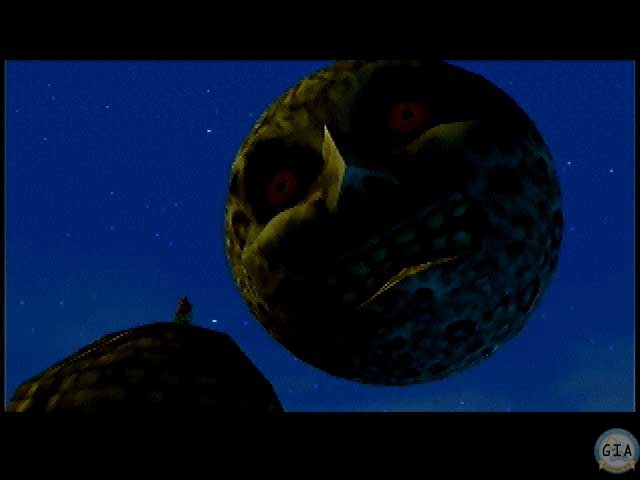 |
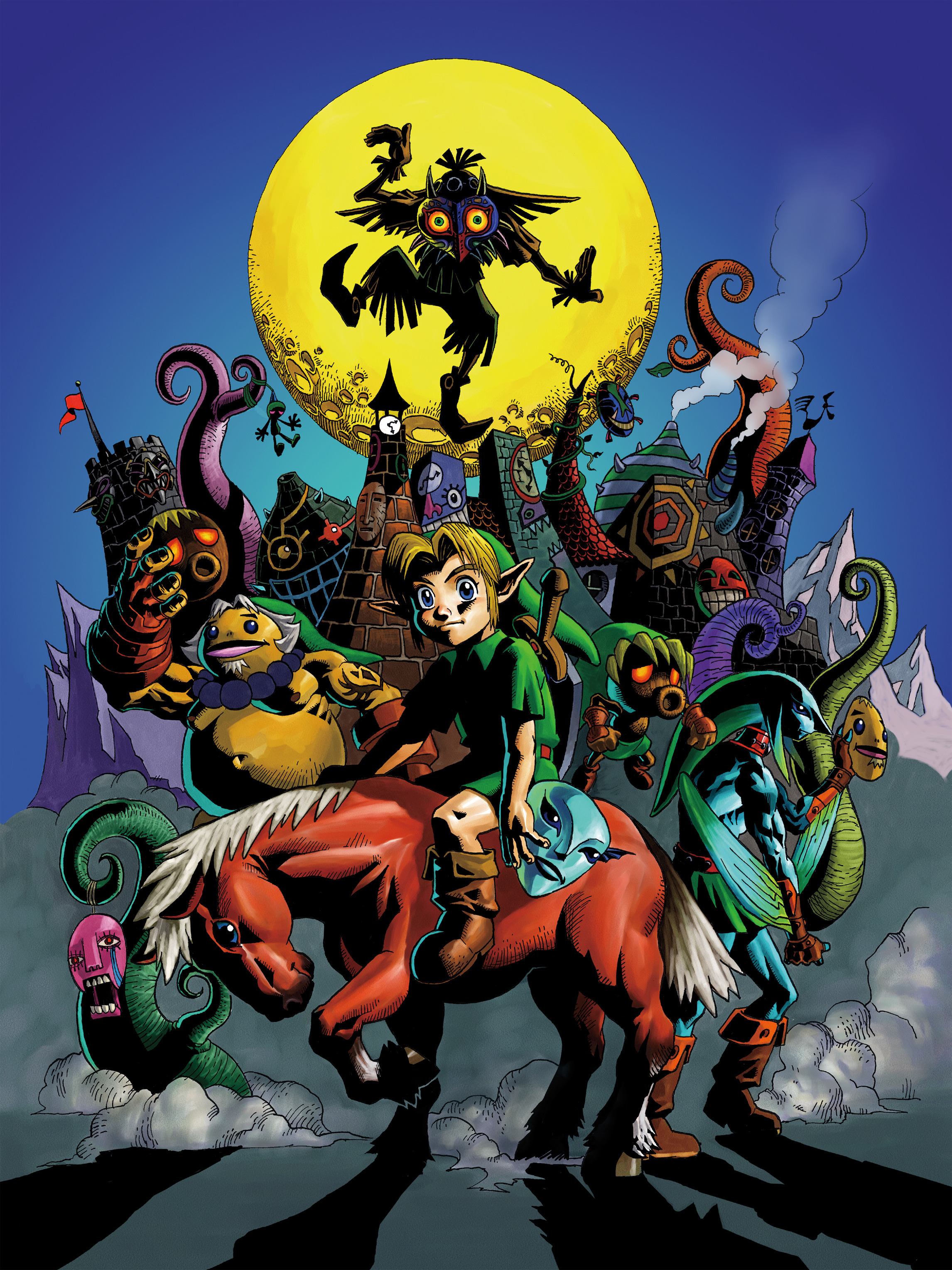
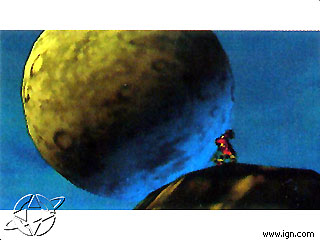
Initially the Moon in Majora's Mask had no face. The moon was first revealed at Spaceworld '99 in an artwork as well as a demo of the game which could be played. In-game screenshots of it were first published in January 2000.
Environments#
Treasure Chest Shop#
|
Prototype |
Final |
|---|---|
|
|
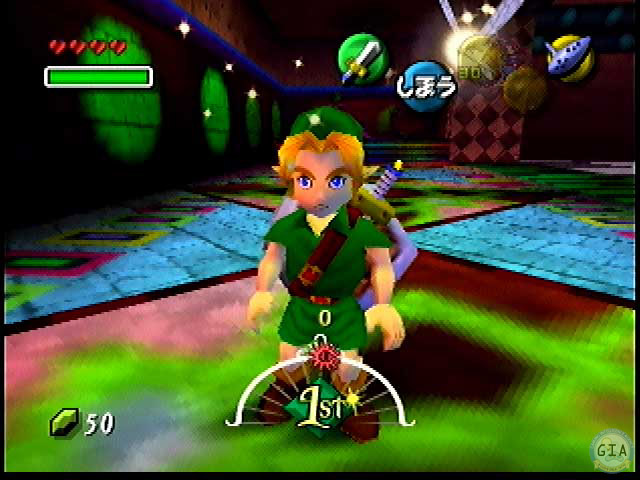
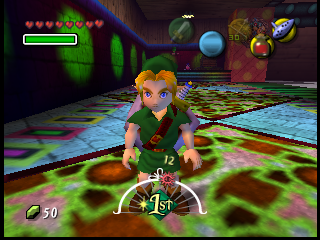
Some texture changes ahoy!
Ikana Canyon#
April. 2000 |
Final (Alt Scene) |
Final |
|---|---|---|
 |
 |
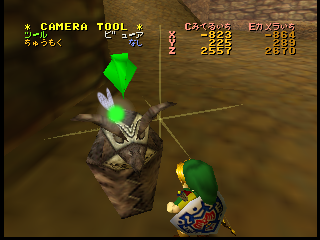 |
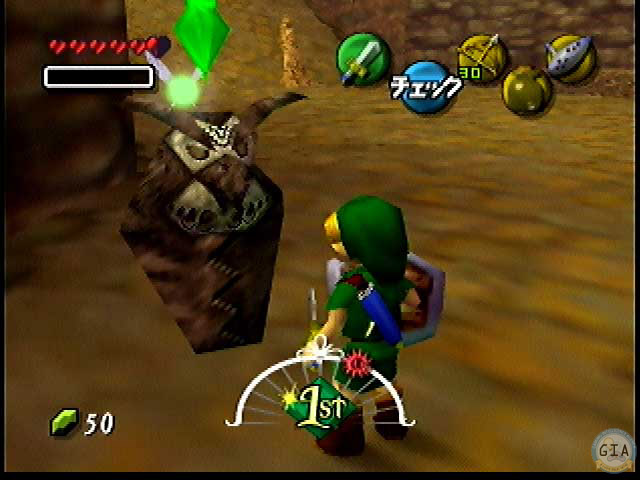
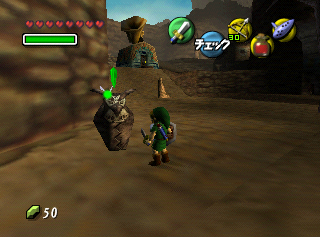
The small withered tree was removed. It can still be spotted in alternate scene setups.
|
Prototype |
Final |
|---|---|
|
|
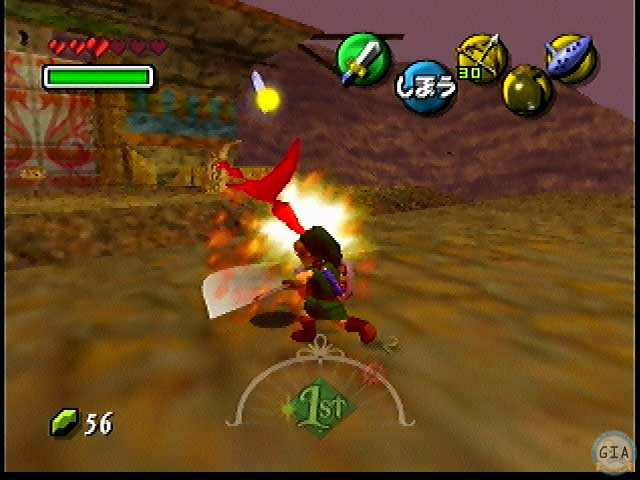
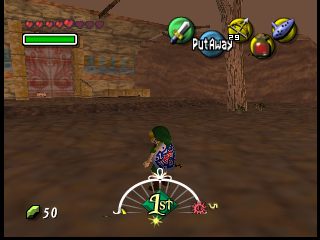
The sign at Ikana's Castle's doors was closer to the center of the doors. No dead tree was placed near the ledge.
E3 2000 Trailer#
|
Prototype |
Final |
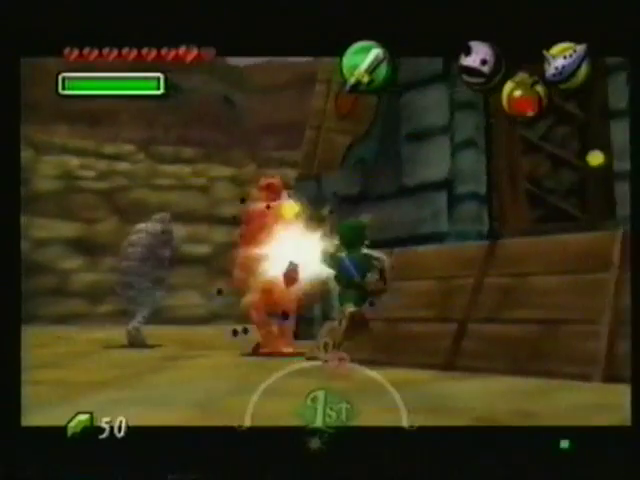
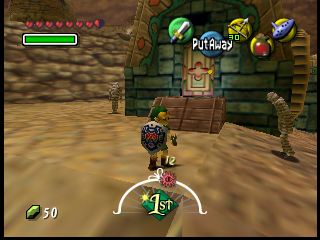
|---|---|
|
|
Music Box House's door was just a plain wooden door.
May 16
GIA plays a demo at E3.
E3 2000 Localization Changes#
Mask Names#
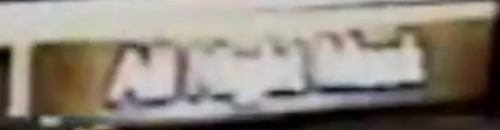

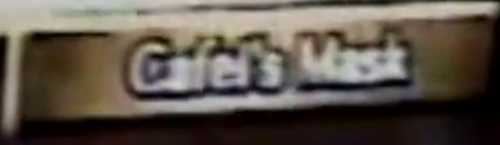
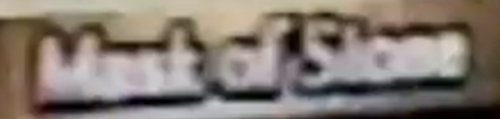

- All Night Mask -> All-Night Mask
- Don Guero's Mask -> Don Gero's Mask
- Cafei's Mask -> Kafei's Mask
- Mask of Stone -> Stone Mask
- Inspector's Mask -> Circus Leader's Mask
Song Names#
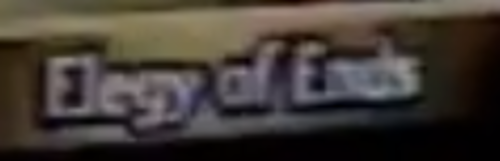
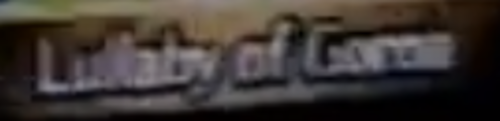
- Elegy of Ends -> Elegy of Emptiness
- Lullaby of Goron -> Goron Lullaby
(Source: E3 2000 Footage)
May 26
GIA reports (via GameInformer) that Miyamoto does not intend to make the game "easier" before the U.S. release, but intends to take advantage of the time between the Japanese and U.S. release to tweak the gameplay. Miyamoto said that the game would undergo an "adjustment of information," which implies more than the usual localization process.
July ??
Nintendo Power July Issue #134 covers MM on pg. 52-56
- Images shown: Main artwork, 3 Link artworks, Deku Link artwork, Goron Link artwork, Zora Link artwork, Skull kid artwork, Odolwa artwork, Cremia and Romani artwork, Zora band artworks, 35 screenshots, and one IRL photo.
- Called "The most innovative adventure game of all time".
- MM is a mystery instead of an epic quest like OoT. Think of Link as the detective.
- Lots of details about the plot and gameplay of the entire game.
- Between now and release on November 24, only the final English translation needs to be completed by Jason Leung.
- Nintendo Power interviews Aonuma, Miyamoto, and Tezuka (From E3 May 2000).
- After seeing Toy Story 2, Miyamoto realized that MM was similar in that it expanded on minor characters.
- Miyamoto compares MM's world to a small garden.
July 31
US version 1.0 build date.
August 24
Nintendo Online Magazine interviews Main/Supervising Director Aonuma.
- Aonuma created the dungeon-related story and worked on the activities in Clock Town.
- At some point, they felt that they could tell a grander story with a more compact game. As the game became more compact, they realized that there would be different happenings in the same place, so the idea of reverting time came up.
- Aonuma: There were probably twice as many ideas for items than those that made it into the game.
- Aonuma asked the Art Director, "I want you to make me a strange character that has a balloon on his back" and he drew Tingle as a result.
- Feedback on OoT influenced MM.
- The simultaneous, continuous activity of the characters was the reason the Memory Expansion Pack was needed.
March 2015
March 13
Miiverse Miiting interview with an unnamed developer (implied to be Aonuma)25
- Aonuma said, "The mask salesman is the absolute shadiest person. There's nobody quite so fishy as someone who goes around saying he sells happiness! So we call him the Happy Mask Salesman."
- Deku Mask was made from the Deku Butler's Son.
- "By adding spiky thorns to the beautiful land pure shape that is a heart, we tried to strongly convey the mask's sinister nature".
- Early on, the developers thought it would be interesting if the light that reflected off the shield created a pattern that looks like a face, so they modeled that face after one of the masks on Happy Mask Salesman's backpack.
- Majora's name comes from the game's art director, Takaya Imamura. He combined "mura" from his name and "ju" from the film "Jumanji" to make "Mujura".
Homeless Info
- Aonuma was thinking about a scene for the Dekus, so he thought about it at home and he had a nightmare about Dekus, causing him to wake up screaming. At work the next day, Kawagoe, the cutscene director, had finished making a cutscene for the Dekus, and it was exactly like Aonuma's nightmare.
Gamers like the fact that we use a familiar engine, don't you think? I believe that the gamers won't feel as if they are playing on the old engine. As a matter of fact, when it comes to game design, we have come up with many new ideas. And in the future too, once we have established a 3D action game engine, we may use it again. It is possible that even for Dolphin we may use a similar type game engine from now.
- Aonuma was in charge of the entire overworld. Aonuma tried to make a fantasy atmosphere, while Koizumi tried to create realistic lives for the characters. When Aonuma saw how serious Koizumi's Clock Town was, he decided to make the overworld more light-hearted
Their goal is to present something mysterious rather than scary
64Dream Strategy Guide
64Dream Magazine was permitted to create a licensed Strategy Guide for the game, and it had a section with a developer interview. In this developer interview multiple interesting mentions about the game's development were made. The following comments from this Guide were translated by GlitterBerri.
|
|
To do: |
Game Concept#
How did you come to decide on the concept of “replaying the game over and over within a limited amount of time” that’s featured in this Zelda?
Aonuma: As Miyamoto was saying previously, if we’d opted to create a massive game, it there’s no way it would have been possible for us to finish it within a year. We had no choice but to go with something compact. As a result, the game has four dungeons, and we figured we could probably accomplish that much within a year. If you make a game compact, though, it’s just going to end up being small, so we wanted to do something more with it… We asked ourselves whether we couldn’t create a system in which the same type of events occur in the same places, but throwing something different into the mix would allow you to experience them in a different way. That’s when the idea of “game ends after 3 days -> return to the beginning and do the same thing all over again, but make a little progress” came about.
Miyamoto: At first, the time limit was a week. We called it the “one week system”, and discussed organizing the game within that framework. Three months after we started, we found ourselves thinking “Hey, this is a little much…” and rethought our strategy, changing the limit to three days… Even then, I felt it was a lot. For example, Ocarina of Time had about 60 hours of playtime, right? As such, we always have people asking “How long is this Zelda going to be?” If we told them “About 80 hours…” their next question would be “So, the Dolphin version is going to be 100 hours?” and we’d be like “I guess so…!”, so we were afraid that we’d be setting ourselves up for endless work. [Laughing] With this game, we want to say “We can’t tell you how long it is, the playtime will be totally different depending the person playing.” We talked about it being Nintendo’s job to figure out what the best game system would be in order to accomplish that. As such, the current system was decided on relatively unanimously. It’s not a game where, say, Ganon makes an appearance, having become even more villainous. Putting together various elements, such as the skillful use of the three day system, and a world in which it isn’t weird for characters from the previous game to appear in new roles, inevitably resulted in the current scenario… It was also a challenge of how we could integrate everyone’s creativity.
A scenario with more than four dungeons#
Shigeru Miyamoto: We scrapped the first version of the scenario when it was finished in March, 1999. "At that time, there were 8 dungeons..."
Tougher Bombers#
"Originally the places where the Bombers escaped to were different every day, and they would disappear when it turned to night."
A change regarding the Wizzrobe enemies#
"Originally, if you messed up and dealt damage to an offshoot of the Wizzrobe, it would turn into Ice Keese if it was ice, Fire Keese if it was fire and if its magic hit the floor, it would spawn Freezards or three Fire Keese"
Tatl's and Tael's original names#
Tatl and Tael used to be named Bell and Mondo but ended up renamed.
The Cutscene Creator believed that the unused Great Fairy cutscenes don't exist unused in the ROM#
Cutscene Creator: "Originally there was a scene in which the Great Fairy took hold of Link's arms and legs to teach him the spin attack, but in the end, we couldn't put it in the ROM. Too bad!"
Game Over#
At some point in development, the Game Over screen would've brought you to title screen. The testing team (assumbably Mario Club Co., Ltd.) thought it was the game's ending scene and asked it to be changed.
(Source: GlitterBerri)
Miscellaneous Screenshots
Spaceworld Trailer
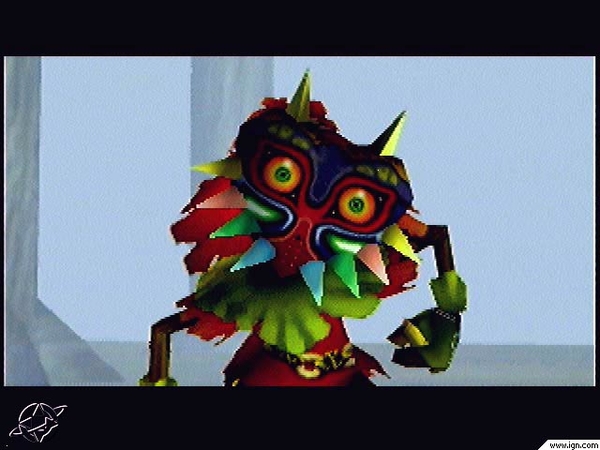
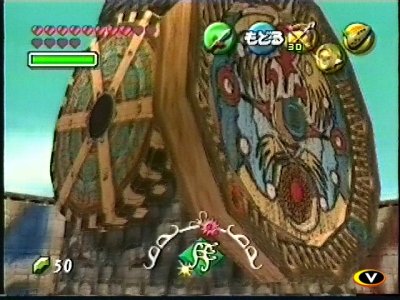
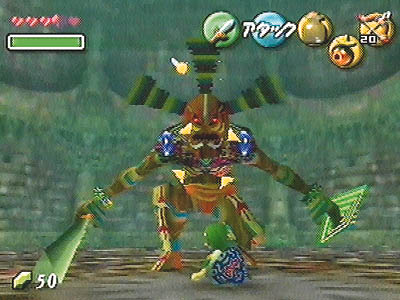
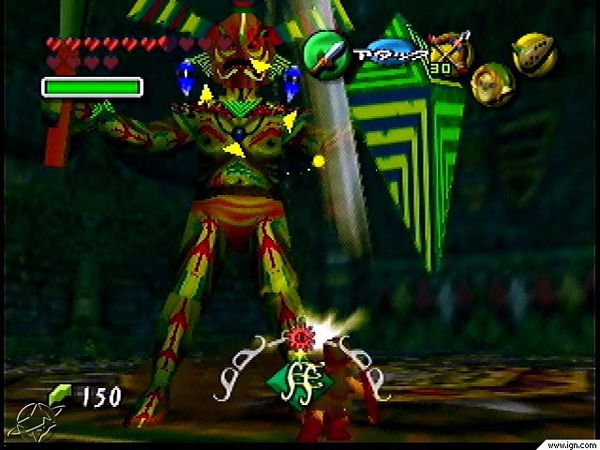
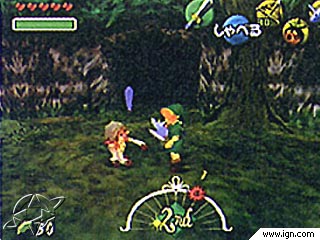
October 1999


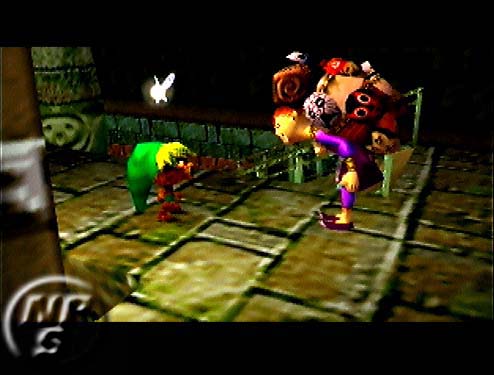

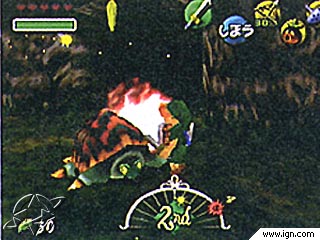
December 1999
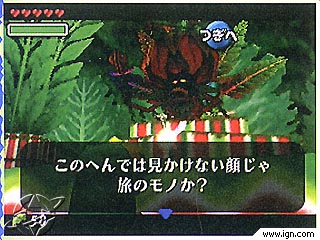
References
Help/Info Sources
- Majora's Mask Prerelease Screenshots
- Same Tbh [Archived]
- IGN Coverage
- ZeldaLegends Interview Compendium
- Majora's Mask Footage
- Hobonichi Staff Interviews
- The 64DREAM magazine’s Dream Hint Book 4 Staff Interview
- Hyrule Historia Concept Art & Story Pages
- Spaceworld 1999 Fan Play Report
- Spaceworld 1999 Guidebook Entry
- 1101 Developer Interview
- 1101 Spaceworld Info
- Spaceworld '99 Footage
- The Armchair Empire - Shigeru Miyamoto Tele-conference
- Interview:GG8 November 12th 2000 - Zelda Dungeon Wiki
- nsidr / The Making of the Game: Legend of Zelda - Majora's Mask
- Interview in "The 64DREAM(2000-08) Saddle Stitched Appendix The Legend of Zelda: Majora's Mask Strategy Tips Book 3"
- https://news.denfaminicogamer.jp/english/170609b/4
- https://goodblood.games/mmstaff64dream
- https://goodblood.games/majorasmasknotebook
- [Interview: Takaya Imamura] Star Fox, Majora's Mask, and F-Zero Designer - Gamescom 2024
- Nintendo Company Guide 2000 has some screenshots - possibly not new ones though

References#
- Zelda DD Action in '98 - IGN.com, November 24, 1997↩︎
- Zelda Is Always Bringing Something New to the Table - 1101.com, May 17, 2000↩︎
- Zelda DD: The Other Adventure - IGN.com, November 17, 1998↩︎
- Iwata Asks: Nintendo DS - Nintendo.com, December 3, 2009↩︎
- Iwata Asks: The Legend of Zelda: Majora’s Mask 3D - Nintendo.com, February 13, 2015↩︎
- The Legend of Zelda: Art & Artifacts (2017), p. 414-415↩︎
- Jason Leung (Author of English Screen Text) Diary "Behind the Mask" - Nintendo.com, 2000↩︎
- Majora's Mask E3 Miyamoto and Aonuma Interview - Nintendo.com, May 2000 Mirror↩︎
- Interview: Miyamoto & Aonuma - IGN64.com, June 5, 2000↩︎
- Nintendo Sequel Rumblings - IGN.com, May 11, 1999↩︎
- Ed's Rumor Report - IGN.com, May 21, 1999↩︎
- Zelda Sequel Confirmed - Gamespot.com, May 26, 1999↩︎
- Miyamoto, Aonuma, and Koizumi Interview: Part 2 - 1101.com, May 25, 2000↩︎
- Zelda Sequel Invades Spaceworld - IGN.com, June 16, 1999↩︎
- First Screenshots of Zelda Gaiden! - IGN.com, August 4, 1999↩︎
- Gaiden to Pak Mighty Punch - IGN.com, August 18, 1999↩︎
- Expansion Pak for Zelda Gaiden - Gamespot.com, August 18, 1999↩︎
- Mr. Miyamoto Speaks - IGN.com, August 27, 1999↩︎
- Gaiden and Ura Zelda Split - IGN.com, August 20, 1999↩︎
- More Details on Zelda Gaiden Surface - IGN.com, August 20, 1999↩︎
- Believe it or Not... - IGN.com, August 23, 1999↩︎
- Expanding on the Pak - IGN.com, August 23, 1999↩︎
- More Zelda Details Surface - IGN.com, September 22, 1999↩︎
- Insert Title Here - Nintendo.co.jp, circa March 2000↩︎
- https://archiverse.app/posts/AYMHAAACAAADVHjGDkmRww↩︎