 This article has a talk page!
This page details pre-release information and/or media for Shrek (Xbox).
Development Timeline#
May 2001#
- May 17, 2001 (E3 2001): Early gameplay video clips are showcased by IGN.
July 2001#
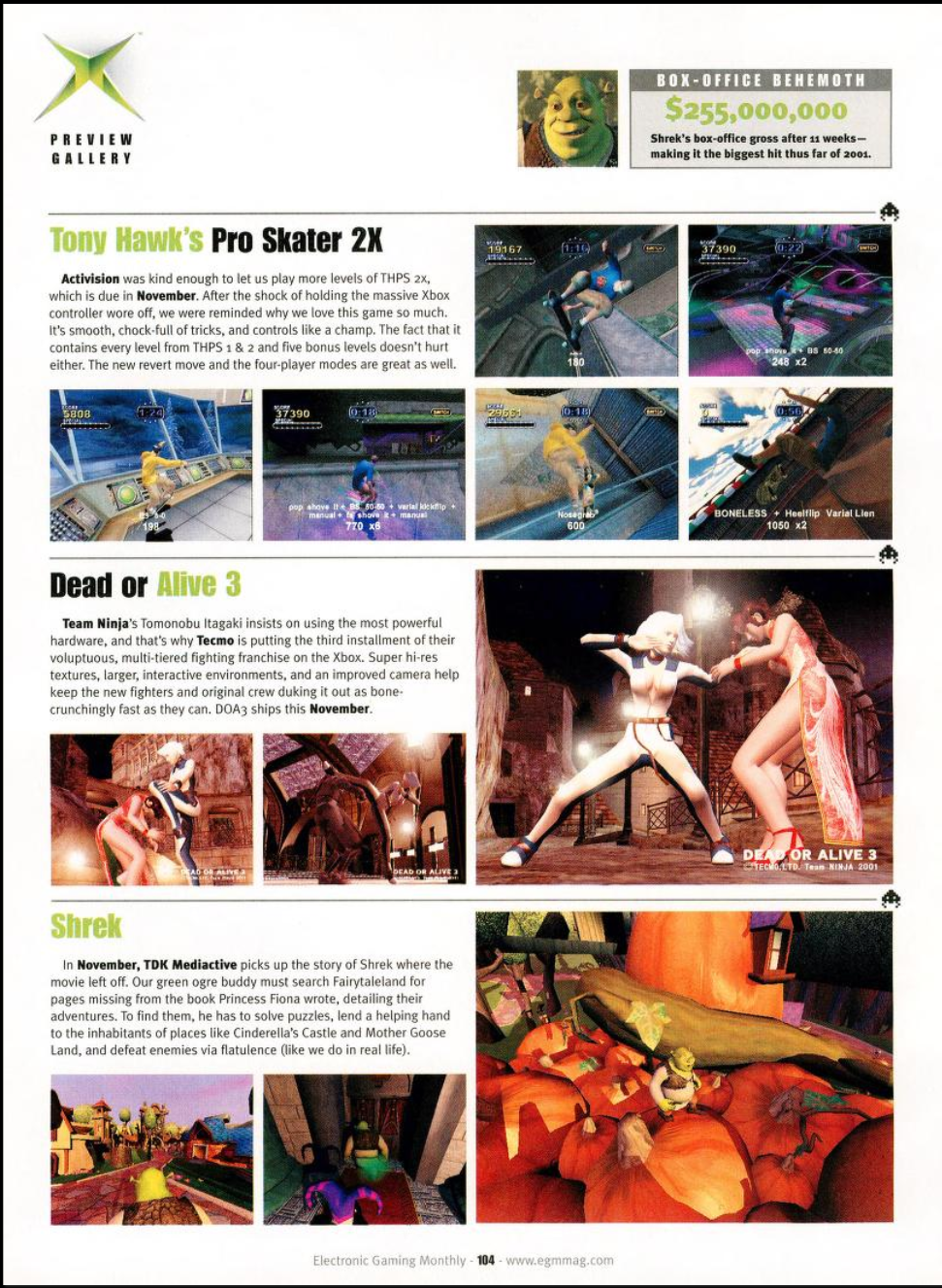
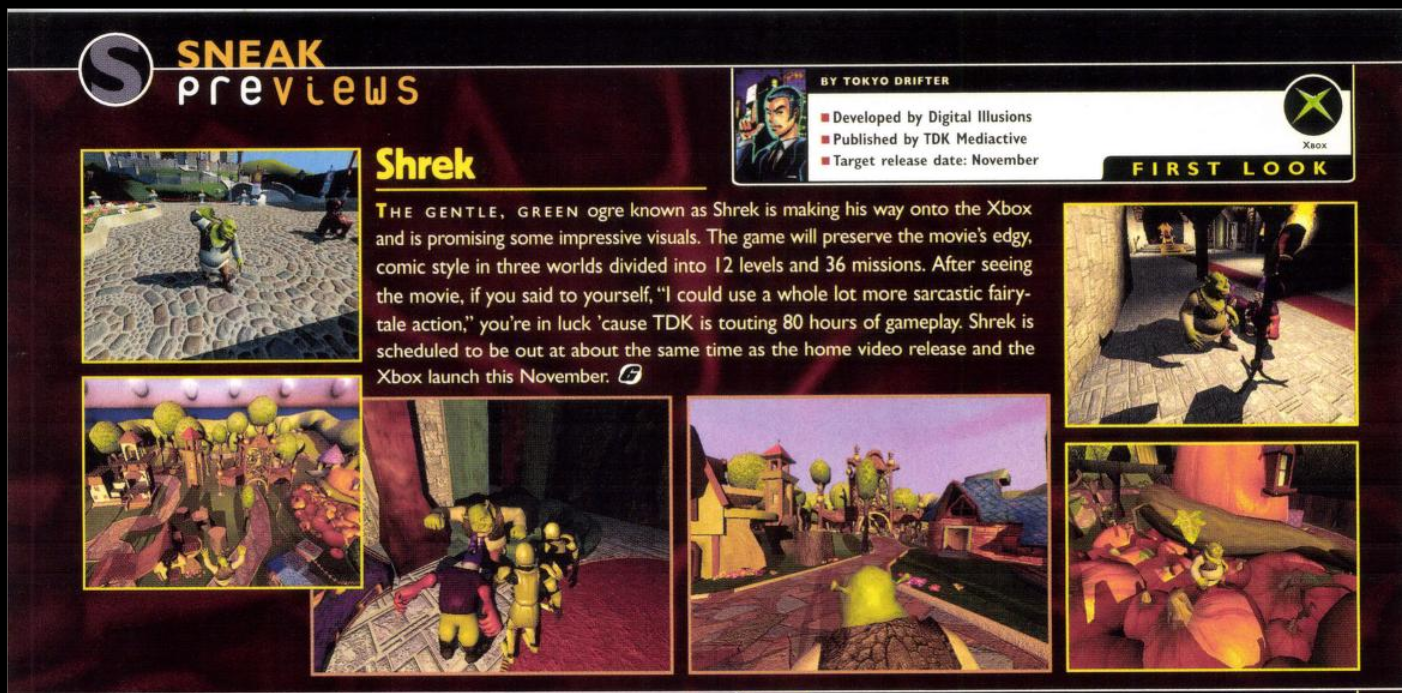
- July 2001 (Electronic Gaming Monthly #144): First major magazine preview.
August 2001#
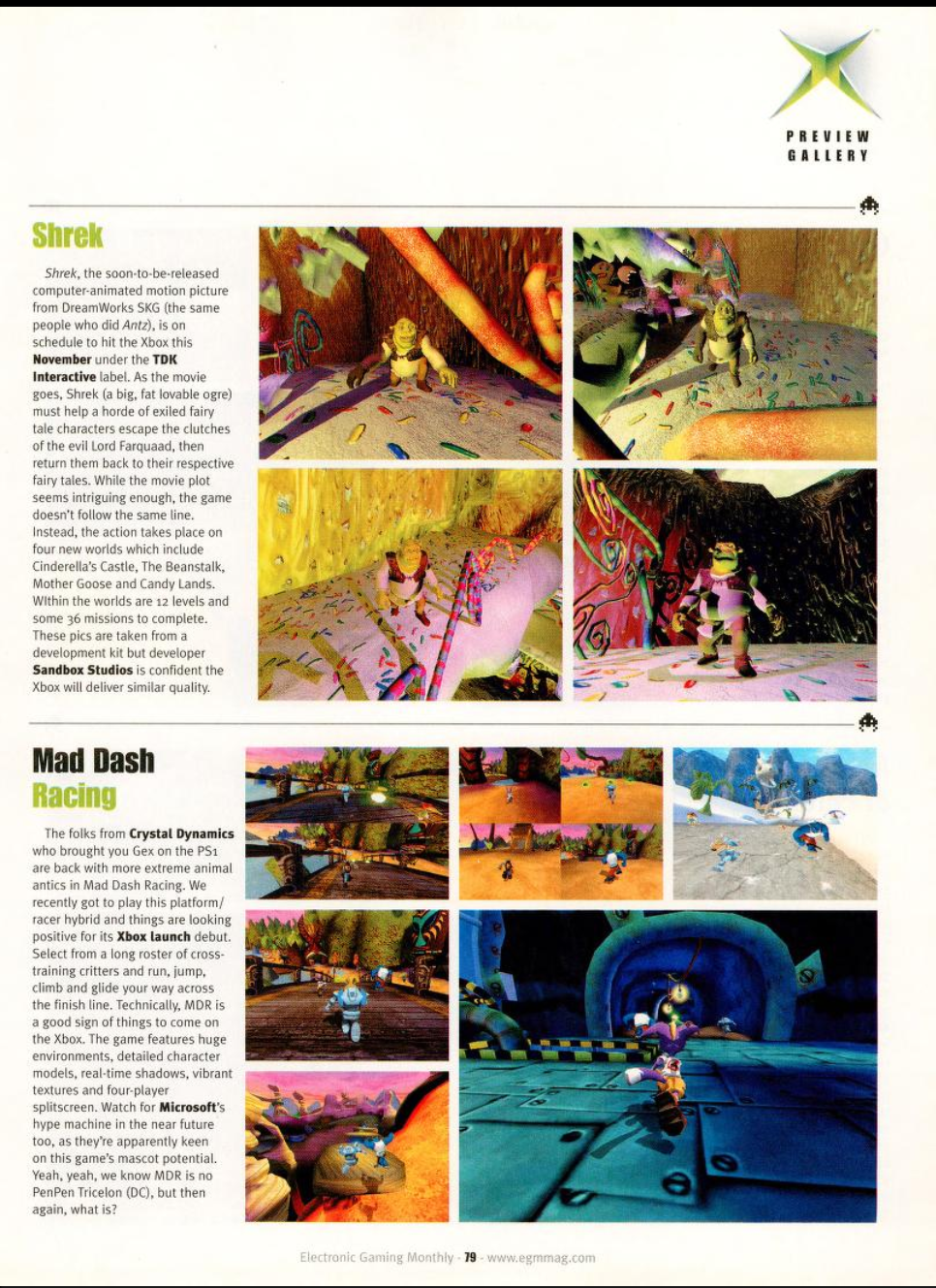
- August 2001 (Electronic Gaming Monthly #145): Preview focusing on the castle/village environments.
September 2001#
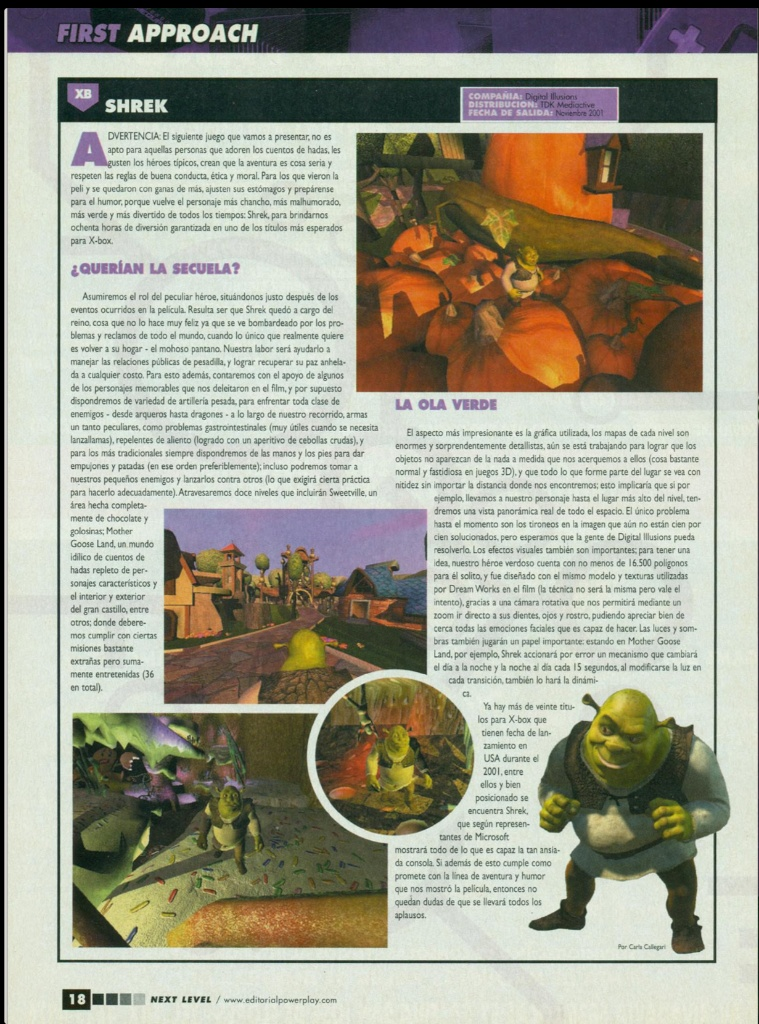
- September 2001 (Next Level):
October 2001#
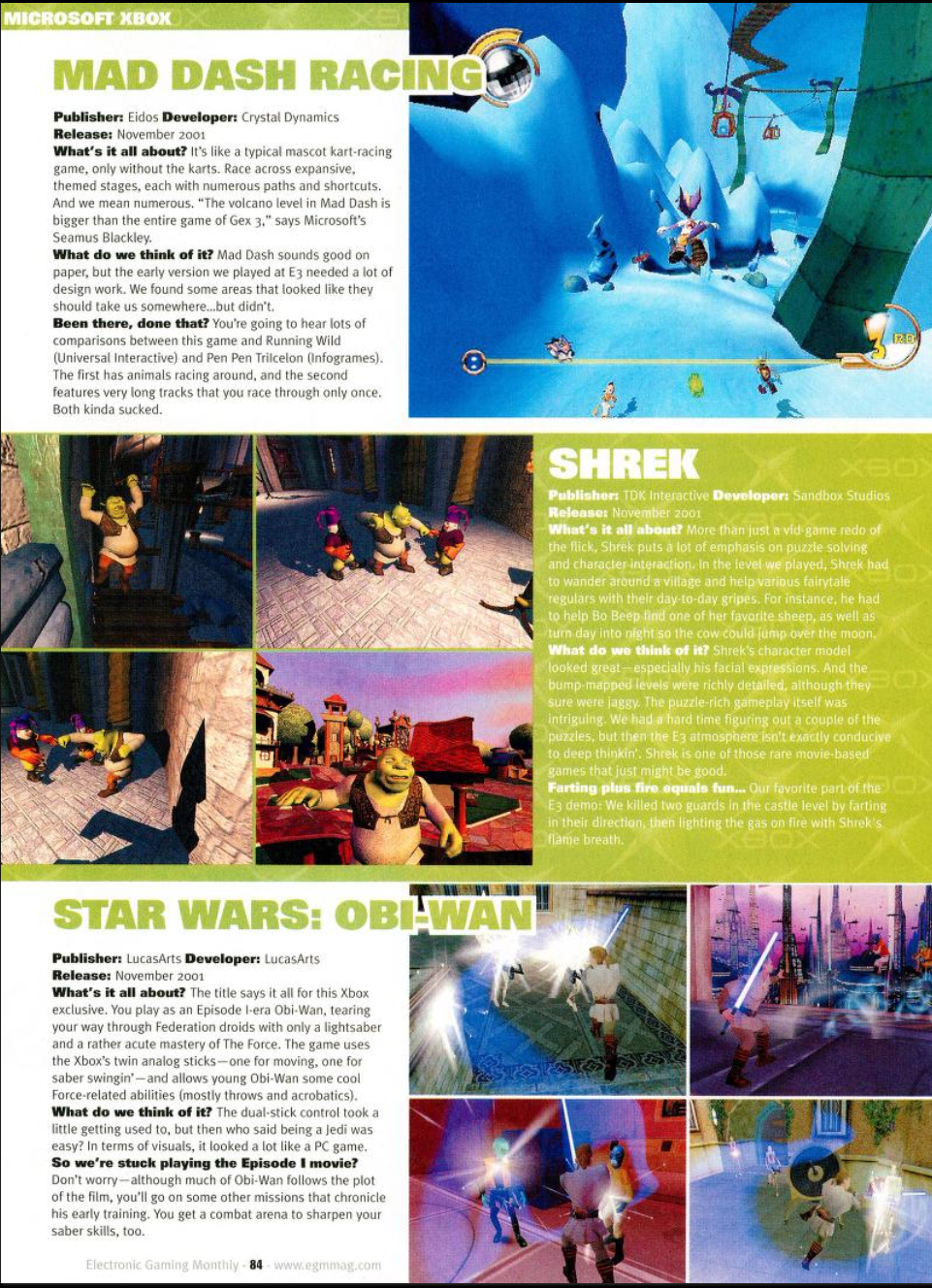
- October 2001 (Electronic Gaming Monthly #147): Late-stage preview build.
November 2001#
- November 2001 (Retail Marketing & UK Review):
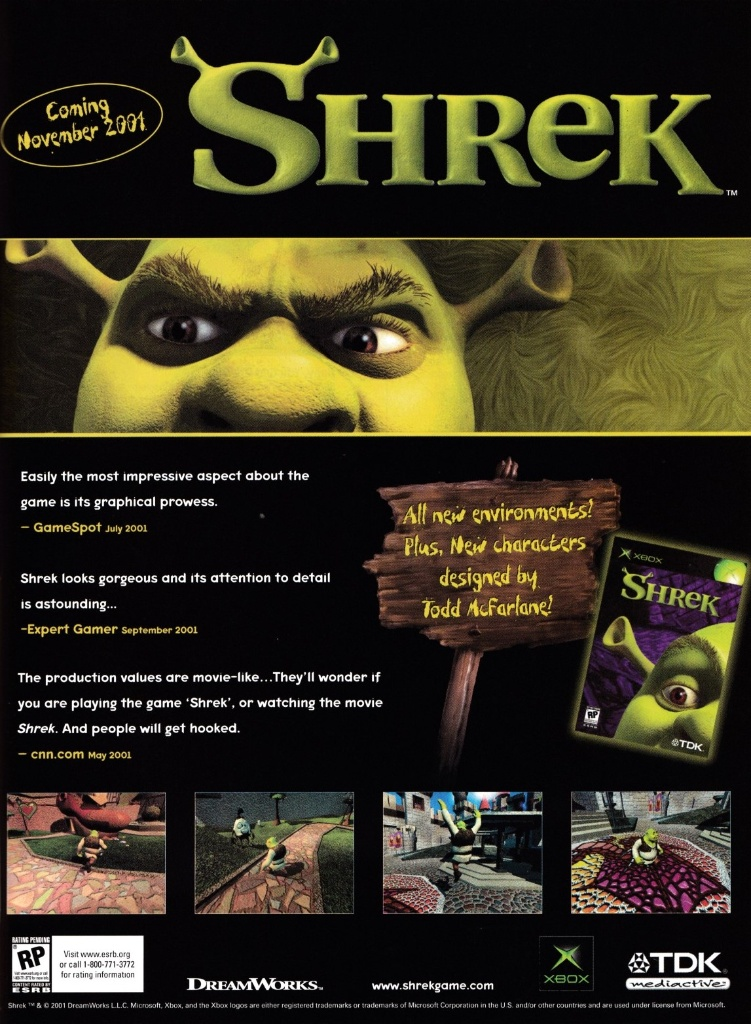
- An official US print advertisement is distributed, showcasing a wooden sign promoting cut fairy tale characters designed by Todd McFarlane.
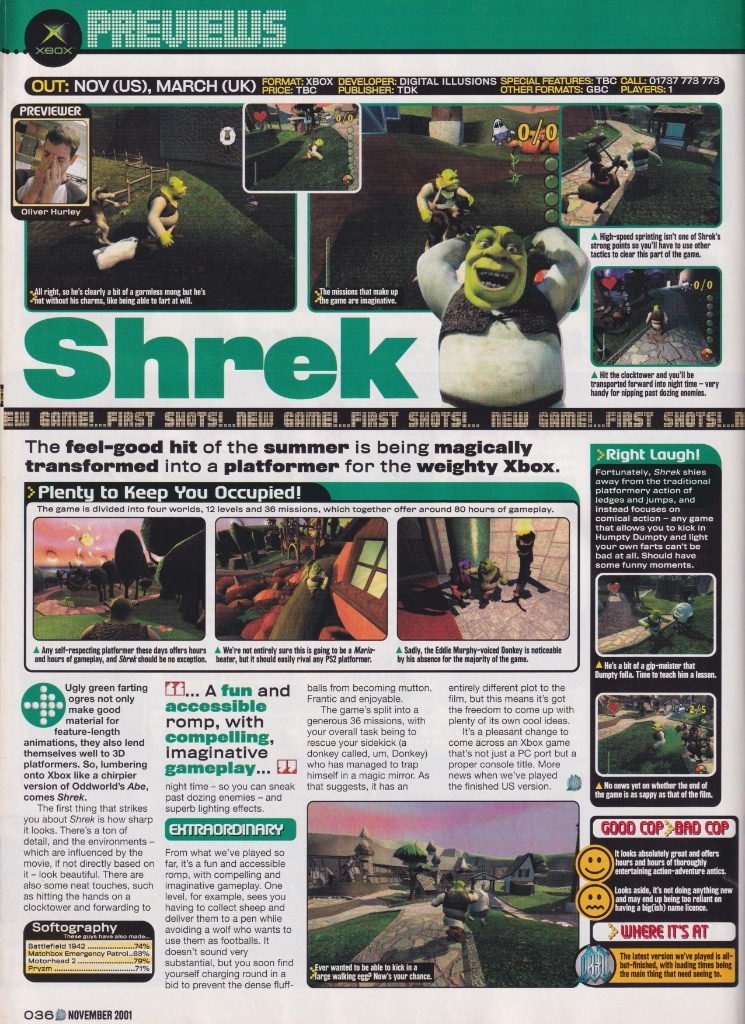
- Official Xbox Magazine UK reviews a near-final build.
- November 15, 2001: The game officially launches in North America, establishing the final narrative of rescuing Fiona from Merlin's Dark Tower.
E3 2001 IGN Videos#
The following video clips were released by IGN on May 17, 2001, showcasing various early states of gameplay, level design, and mechanics.
Watch on YouTubeWatch on YouTubeWatch on YouTubeWatch on YouTubeWatch on YouTubeWatch on YouTubeWatch on YouTubeWatch on YouTube
Differences#
the E3 2001 footage reveals that the game was in a much more primitive state than previously thought, showcasing a build that differs drastically from the retail release:
- Shrek's Character Model: Shrek's early 3D model appears noticeably unpolished and features a much rougher, lower-fidelity appearance compared to his finalized retail model. His facial expressions, textures, and mesh structure were significantly improved later in development.
- Audio and Sound Effects: Shrek utilizes a completely different set of grunt sounds, vocalizations, and physical audio cues when moving, jumping, or falling. None of these early sound effects made it into the final version of the game.
- Missing Music: There is absolutely no background music playing during gameplay throughout these clips, with only ambient environment and character sound effects present.
- Early Mother Goose Land Layout: The level shown in the village footage is an early prototype version of Mother Goose Land. This early layout features several environmental assets, paths, and structural geometry that were completely cut and never seen in the final game.
- Altered Enemies (Humpty Dumpty & Knights): The Humpty Dumpty enemie and the armored knights feature different, less detailed textures and designs. Furthermore, their AI is primitive: they move at a much slower pace than their final counterparts.
- Missing Damage Mechanics: The combat and hazard physics are incomplete. When enemies collide with Shrek or attempt to attack him, they do not trigger a hit-reaction animation, knockback, or cause any visible damage to his health bar.
Magazines & Promotional Posters#
 |
 |
 |
 |
 |
 |
|
|
Prerelease Differences#
Developer Misattribution#
- During the early preview phase in July and August 2001, several American publications, including Electronic Gaming Monthly, credited the development of Shrek for the Xbox to Sandbox Studios. This was later clarified as a misattribution stemming from a corporate transition. While Sandbox Studios was initially contracted ** for the project by TDK Mediactive, the company was acquired by Digital Illusions CE (DICE) in April 2001 and renamed Digital Illusions Canada. Consequently, subsequent US issues and European gaming magazines corrected the credit to Digital Illusions, who finalized the game for the console's launch.
Narrative and Plot Discrepancies#
- International press outlets frequently misreported the game's core storyline due to early promotional materials.
- Electronic Gaming Monthly stated in October 2001 that Shrek's goal was to retrieve missing pages from a diary written by Princess Fiona.
- The UK's Official Xbox Magazine reported in November 2001 that the main objective was to rescue Donkey, who had accidentally trapped himself inside a magic mirror. In the final retail version, the player must perform good deeds to clear a magical fog, confront Merlin, and rescue Princess Fiona.
Level Count and Names#
- Multiple preview articles from July to November 2001 confidently stated the game would feature 12 individual levels spanning across 4 unique worlds. The retail release contains only 9 individual maps in total, which includes the hidden, out-of-bounds test dungeon.
- Early world and level names were altered or replaced entirely during production:
- "Sweetsville Industrial Park" was originally designated as "Candy Lands" in early US builds and simplified to "Sweetville" in Spanish media.
- A world named "The Beanstalk" was openly listed as an accessible area in July 2001 but does not appear in or match any structural layout found within the final retail game.
Visuals and Environment Design#
- Most screenshots published throughout mid-2001 reveal significantly different 3D models and terrain layouts compared to the final retail maps.
- Environmental lighting passes went through noticeable iterations late into development.
HUD and UI Alterations#
- In the preview featured by the UK's Official Xbox Magazine, the dynamic HUD layout exhibits a unique colored gradient bar for Shrek's flatulence meter. In the retail Xbox version, this UI component was simplified into a solid green that turns red exclusively when the meter is completely depleted. You can also see this HUD in the trailer at minute 00:45 and 01:12