 This article has a talk page!
This is a sub-page of Prerelease:Banjo-Kazooie/Banjo-Kazooie.

|
To do: |

|
This page or section needs more images. |
In 1998, the game rapidly reshaped into its final form.
Early 1998
After Spaceworld 1997, but before the various near-final builds. Several press release images came out in early 1998 after the wave of Spaceworld 1997 coverage had finished, primarily starting in the March 1998 issues of magazines, up until May. This is where central parts of the game that connect the worlds, such as cutscenes, the Spiral Mountain tutorial, and the Witch's Lair, begin to appear.
General#
- Tooty is named "Tootles" in these builds. Bottles may also have been named "Boogles" according to German Club Nintendo, but no screenshots of the game verify this, also this implies to Grunty, in the Gamefan magazine Gruntilda named "Broomhilda" for some reason.
Intro Cutscene#
|
February 1998 |
Final |
|---|---|

|
|
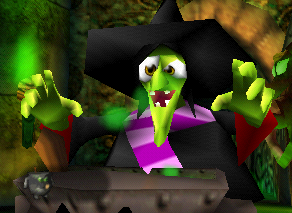
This screenshot is from a March 1998 issue of N-Zone, and is one of the first looks at the intro sequence.
- Grunty's sleeves and the red insides are more simply modeled.
- No torch is on the wall yet, and the wall has less detailed textures and vertex shading.
Mumbo's Mountain#
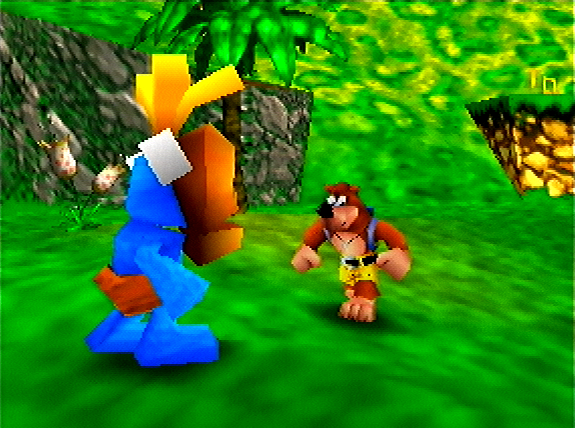
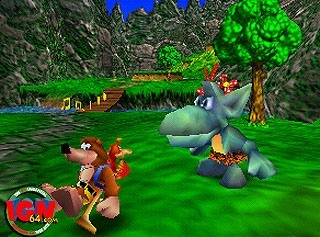
Mumbo's Mountain still uses its old textures, but with a few minor changes.
E3 1997 to SW97 |
Early 1998 |
Final |
|---|---|---|
 |
 |
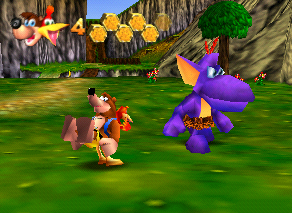 |
The Mumbo-like enemies are now Grublins, with a blue-green skin color. They're purple near the late stages of development.
- The trees became deciduous trees, but were still 2D billboard sprites instead of 3D models.
|
Early 1998 |
Final |
|---|---|

|
|
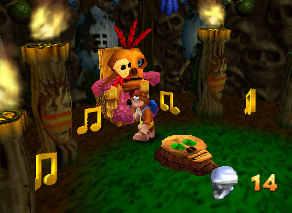
- While E3 1997 had nothing for Banjo to stand on when he transforms, a "button" that is basically a flat texture of Mumbo's face was introduced at this point. It was changed to a more elaborate and flashy button model in the final.
|
February 1998 |
Final |
|---|---|

|
|
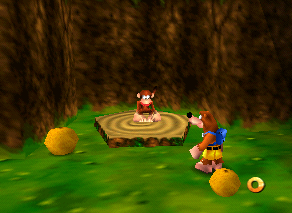
It's unclear why, but instead of oranges, it seems that Rare had Banjo bring Chimpy a coconut instead for in indeterminate period of time in development. They were oranges before, and oranges after. There is a leftover talk sprite of a coconut in the final game that seem to match to this scene.
Freezeezy Peak#
Audio Debug Display#
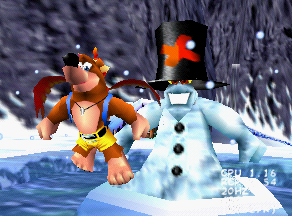
A debug display seen in a screenshot of Freezeezy Peak that displays some info such as CPU/RSP usage and cycles per second which appears to be part of a larger music/sound-debugging function. It's unknown if any part of the functionality still exists in the final game, but the text displayed here exists in the late 1997 64DD development disk's RAM dump, as well as what seems to be a truncated version in the final game (missing the final "(K)").
In the transcription below, "#" denotes an unreadable character.
CPU 1.16
RCP 2.54
20HZ
##
#K (37K)
(Source: Ferrox, Catstorm)
Spring 1998 Preview Builds
A build (or multiple builds) of the game was sent out to game magazines for press coverage around the second quarter of 1998. The contents of the game appear to predate E3 with some notable differences. Magazine issues that reviewed the build(s) were mostly published between June and July of 1998.
General#
- Bottles' talk sprite still has black goggles, but his ingame model has red goggles now.
- Mumbo's Hut still uses the old exterior model with no feathers/chimney. Can be seen in Mumbo's Mountain, Freezeezy Peak, Bubblegloop Swamp, and Click Clock Wood screenshots. Seemingly replaced by the final model late enough that level renders used in guides and the official website have the old hut design.
Intro Logos#
|
Early 1998 |
Final |
|---|---|
|
|
|



- As seen in the Nintendo Power preview VHS for Banjo-Kazooie (dated to around this same time), the N64/Rare logo cutscene originally took place atop a cloud. In the final game, this cutscene takes place in mid-air.
HUD/Menu#
Early |
Early (Manual) |
Final (restored) |
|---|---|---|
 |
 |
|
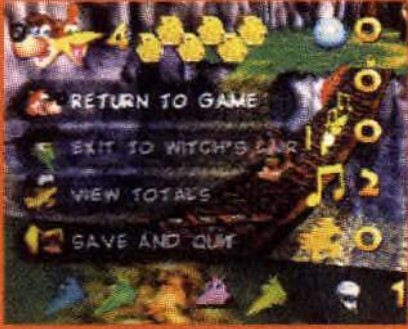
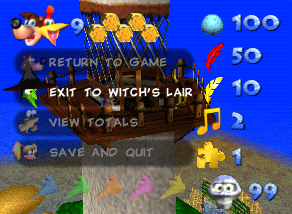
- The "Exit to Witch's Lair" pause menu option is available. This option was disabled in the final game.
- The Mumbo token counter icon is smaller than in the final game, even though the menu appears to be set up to accommodate the final sprite's size. This isn't the case in the manual.
Banjo's House#
Intro Cutscene Map#
|
Early |
Final |
|---|---|

|
|
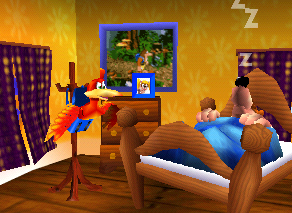
The textures and lighting in Banjo's house are completely different. The house feels more rustic and cabin-like compared to the bright modern look in the final.
- The vertex lighting in the room is much darker, with a bright spot at the top, and some light coming from the window.
- Banjo's blanket is green instead of blue, and the checker texture is much sharper than the final game's soft quilt pattern. The mattress is a soft yellow color.
- The walls are brick with arches made of larger stones. There is a defined upper ceiling level that seems to be a plain yellowish texture.
- The two walls meet at a larger angle than the square 90-degree walls in the final, seemingly matching the exterior of Banjo's house; however, there isn't a window behind Banjo's bed yet.
- Tooty's portrait is a little more to the right, making it flush with the edge of the dresser. This was probably moved to the left in the final for aesthetics.
- There is a purple rug on the floor, partially beneath the bed.
- The flooring is stone instead of wood.
- The wood textures on the furniture are rougher; the final gives them evenly-spaced grooves.
- An extra window and a picture of Banjo in the original concept test level was added in the final game.
- The windows don't have their blue glass texture yet.
Another photo from what appears to be a slightly later revision appears in the July 1998 issue of Hobby Consolas:
|
Early |
June 1998? |
|---|---|
|
|

|
Banjo's mattress is white now, and the wood grain on the furniture is smooth like in the final. The wall textures appear to have been moved a bit horizontally, and that's not a bedbug - the blanket appears to be partially clipping through the front of the mattress.
File Select#
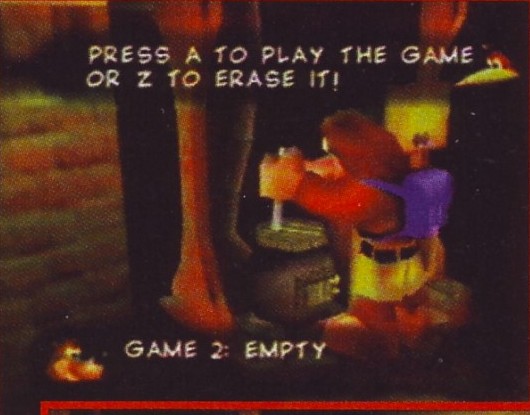
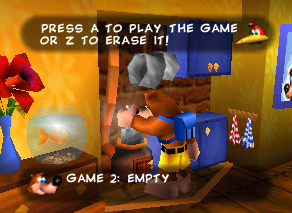
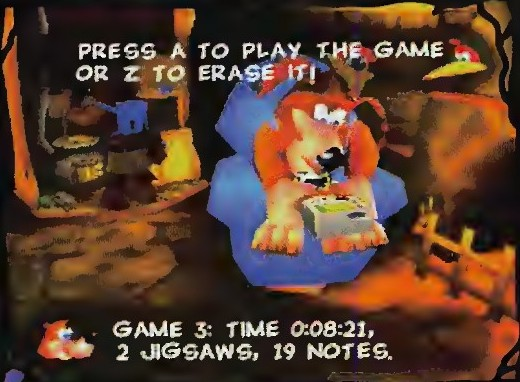
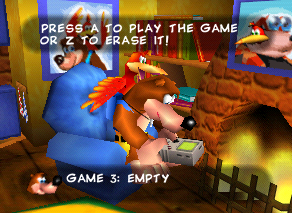
The design of the file select room appears to be the same as the "later" iteration as seen above. The size of the room was smaller, which is evident from file 3's perspective; they seemed to have lengthened the room in that section for the final game.
File 1#
|
Spring 1998 |
Final |
|---|---|
|
|
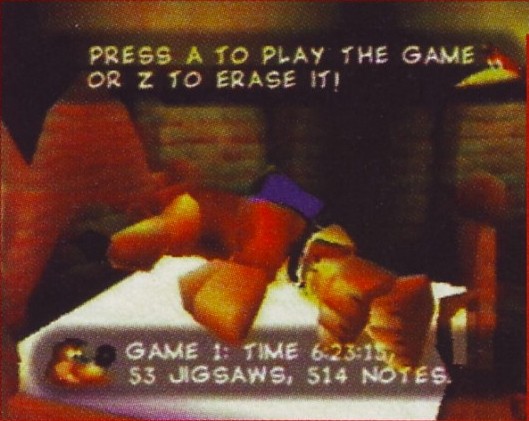
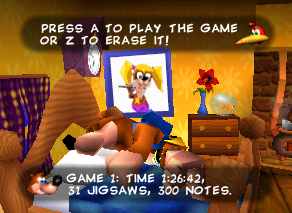
- Banjo sleeps on a bare mattress with no blanket or pillow, and there are no decorations behind him. The screenshot is too zoomed in to tell if the window by his bed is there or not, however.
File 2#
|
Spring 1998 |
Final |
|---|---|
|
|
- The kitchen lighting is nearly pitch-black, making it hard to see the back wall. In the final game, Banjo's kitchen is much better lit, and the final kitchen wall seems to use the brick texture from the other early walls. The rack of pans above Banjo is missing, and the cupboard is yellow instead of blue. There are two wooden frames on either side of the kitchen and a circular base, which may indicate that it was built with the uncommon file select animation where the wall rotates already in mind.
- Banjo is stirring directly into the stove's grate/opening, rather than stirring a pot on top of it. The stove seems to have something green inside; in the final, you can't see what Banjo's making, and the stove door is orange.
- The stovepipe matches the stove's gray color in the proto, and is orange in the final.
- No dishcloths.
- The kitchen tiles are aligned vertically (from the camera's perspective) instead of horizontally.
File 3#
|
Spring 1998 |
Final |
|---|---|
|
|
- As a result of the smaller space, Cooking Banjo is visible completely behind Game Boy Banjo when File 3 is selected.
- There is no portrait hanging over the fireplace.
- Banjo's couch is facing more towards the front than in the final. 1
Spiral Mountain#
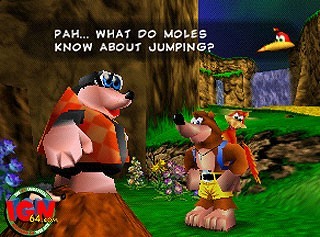
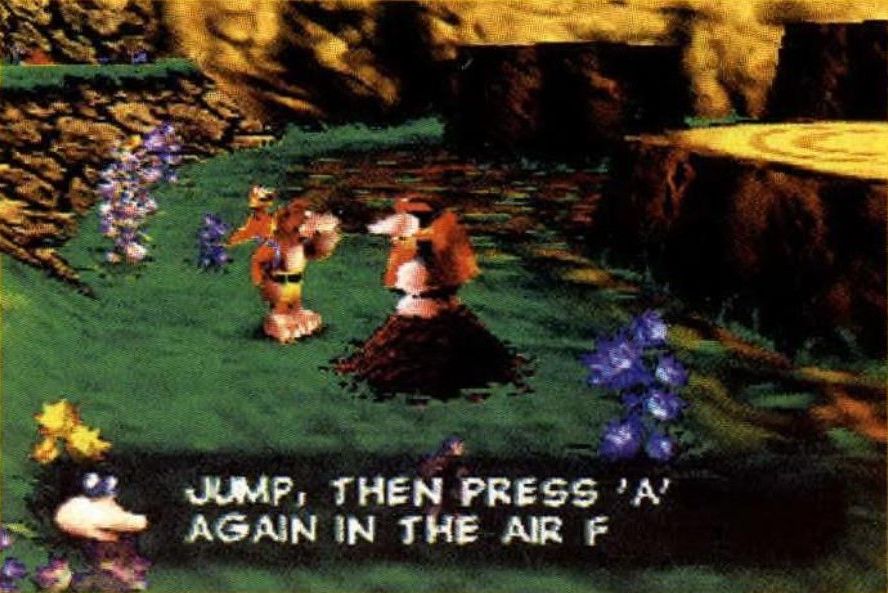
Bottles#
Spring 1998 |
Later 1998 |
Final |
|---|---|---|
 |
 |
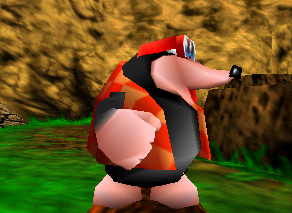 |
- Bottles' glasses were originally black. In the final game, they were changed to red likely to make them contrast more with his fur. His talk sprite was not updated until close to the release date.
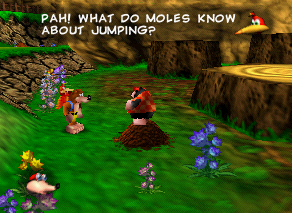
Also notable is the change in the fixed camera angle for the molehill interaction where you learn how to jump:
|
Spring 1998 |
Final |
|---|---|
|
|
|
The dialogue also got touched up. "PAH..." was changed to "PAH!"
Grunty's Lair#
Intro Cutscene#
|
Spring 1998 |
Final |
|---|---|
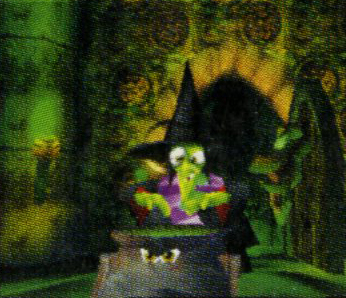
|
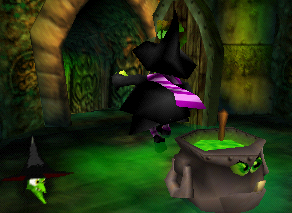
|
Dingpot has a simpler appearance, with no tooth, and generic angry eyes instead of his final, more tired expression.
|
Spring 1998 |
Final |
|---|---|
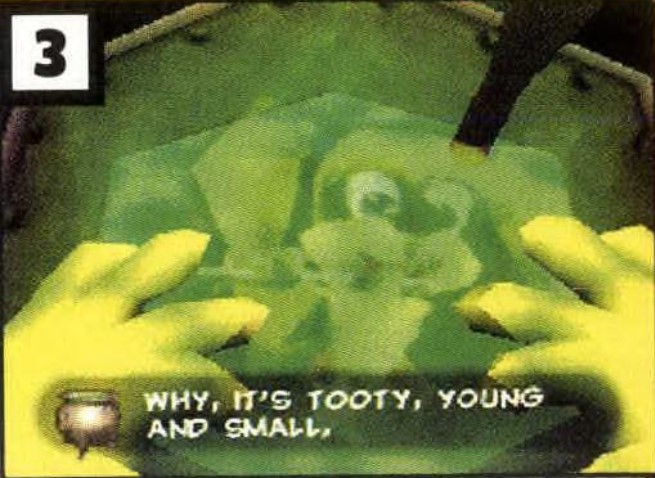
|
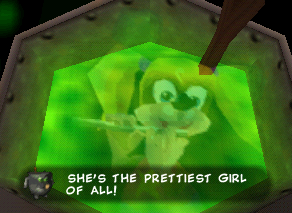
|
Unsurprisingly matching closely to his model, Dingpot's talk sprite is much more generic, with tiny eyes, no mouth, and no stirrer sticking out.
Mumbo's Mountain Lobby#
|
Spring 1998 |
E3 1998 to Final |
|---|---|
|
|
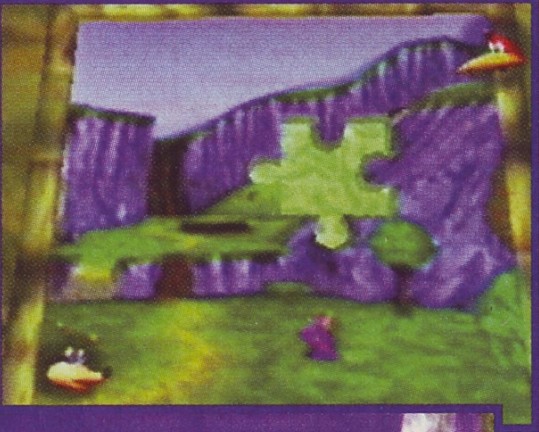
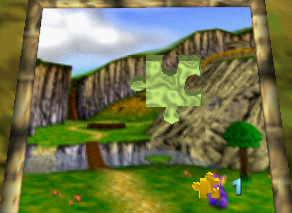
The mountain walls in the jigsaw puzzle picture of Mumbo's Mountain are very purple (use the Grublin in the image to compare). The render also seems to be from a slightly different camera angle/position, especially noticeable with the foreground trees. This may have been an interim or temporary design while overhauling the textures for this level.
Note Doors#
50 Note Door#
|
Early |
Final |
|---|---|
|
|

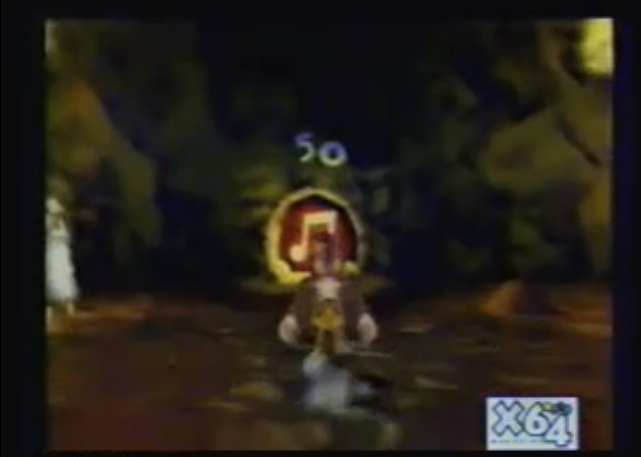

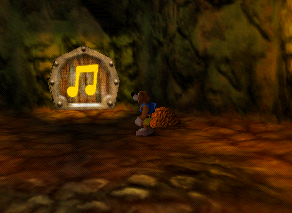
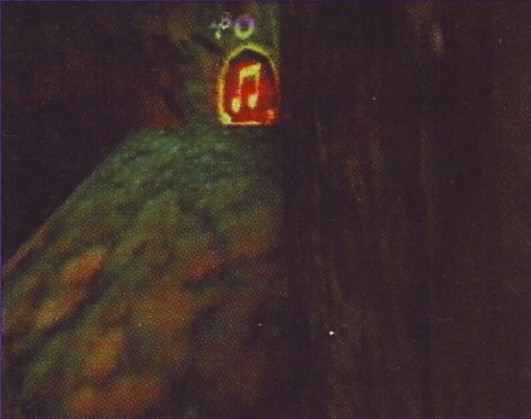
The original note door was red with gold trim, looking more regal than the final's wooden door with metal trim. The number of required notes was on the wall above the door, and a static note image on the door itself. In the final game, the icon on the door alternates between the required number of notes and the note image. The font for the numbers was blue, with varying size/rotation for each digit.  The note door opened as a 3D object, in a similar fashion to the door to Mad Monster Mansion. The final note door immediately fades away upon opening it.
180 Note Door#
|
Spring 1998 |
Final |
|---|---|
|
|
Treasure Trove Cove Lobby#
|
|
To do: |
|
Early |
Final |
|---|---|
|
|
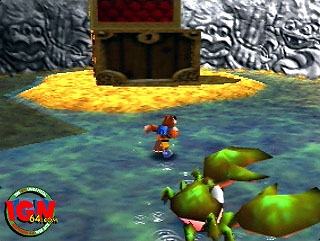
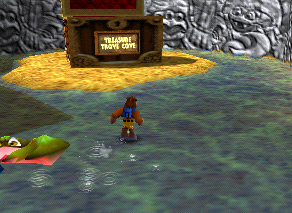
- There is no sign for Treasure Trove Cove despite the level being opened, implying that the signs with the level name signs originally didn't exist.
Bubblegloop Swamp Lobby#
|
Spring 1998 |
Final |
|---|---|
|
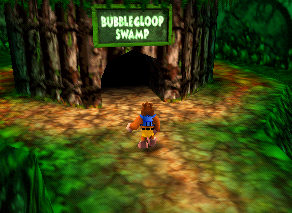
|
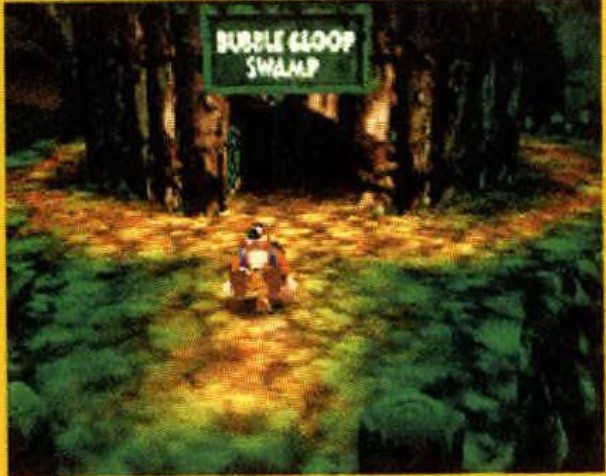
- The level sign has a slight space between 'bubble' and 'gloop'.
Mumbo's Mountain#
Several promotional materials use a particular render of Mumbo's Mountain with the old textures, but with gameplay screenshots using the final textures, indicating that the level map render was created before the redesign. The timeline of the texture change within the game in the spring of 1998 is still unclear, but it was clearly finalized by E3 1998.
Treasure Trove Cove#
TTC appears completely finalized at this point, with the only visible changes being to NPC talk sprites.
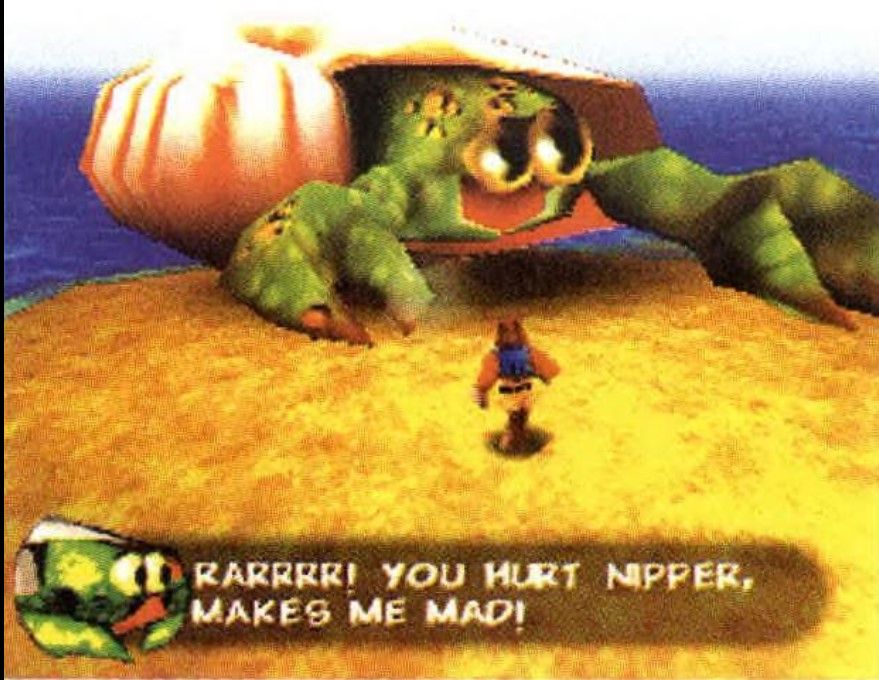
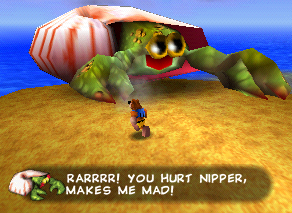
Nipper#
|
Spring 1998 |
Final |
|---|---|
|
|
- Nipper's talk sprite is rendered differently, being larger than most of the talk sprites and zoomed in on his face. The final has a nearly complete render of Nipper's full body and shell instead.
Other Differences#
Yum-yum's talk sprite uses Mr. Vile as a placeholder.
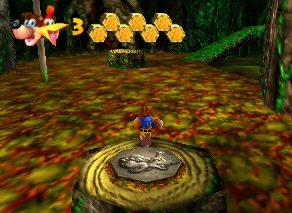
Bubblegloop Swamp#
|
Early |
Final |
|---|---|

|
|
- The start pads were originally tan in color with Banjo and Kazooie's head in color. In the final game, they use an embossed silver image of the same Banjo-Kazooie face logo. Several guides have a render of the color version of the pad.
Freezeezy Peak#
- The level render used in promotional materials has the old design for Mumbo's hut.
Boggy's Igloo#
|
May 1998 |
Final |
|---|---|
|
|
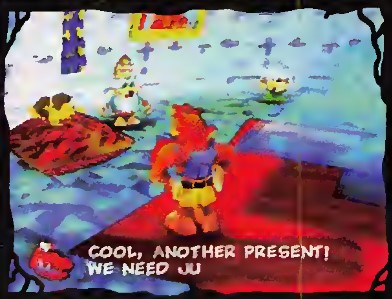
Boggy's kids (all three of them share the same talk sprite) are using Mr. Vile's talk sprite as a placeholder
Gobi's Valley#
Jinxy#
|
May 1998 |
Final |
|---|---|
|
|
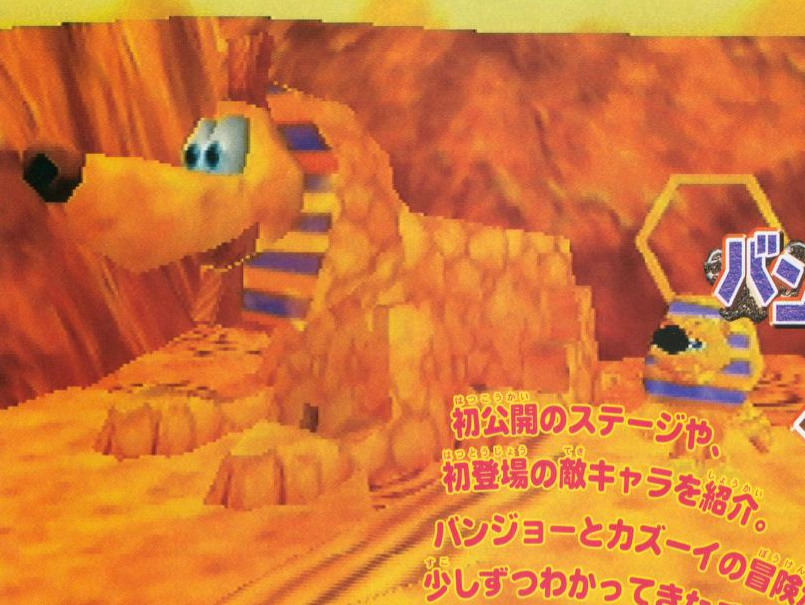
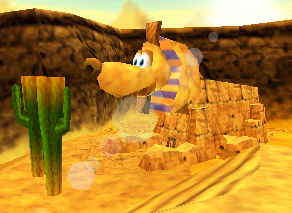
- Jinxy received extensive retexturing, replacing the cracked earthen texture with a stone block construction. Similarly, the perimeter of Gobi's Valley also showcases the lining of brickwork, rather than the bare hills and slopes from the earlier design.
Click Clock Wood#
- The renders of the Summer and Winter stages used in promotional materials use the old design for Mumbo's hut.
Grunty's Furnace Fun#
Intriguingly, both the Nintendo Power Player's Guide and a Club Nintendo issue use an in-engine full map of Grunty's Furnace Fun that has some differences. Because objects unload from far away, Grunty's podium, the prizes, and the warp cauldron aren't rendered, so they cannot be examined.
- The award display stand is white and untextured. The final stand is dark blue.
- While the ingame screenshots used in the magazines show the finalized Furnace Fun map, Nipper's early talk sprite appears nonetheless.
- The Joker card tile seems to have a placeholder texture that says "Joker" with yellow and red coloring.
- The pink tiles use a hand icon that is not seen in the final, replaced by the clock icon.
- The screen has a picture of Banjo and Kazooie instead of the game show's logo.
E3 1998 Demo
Watch on YouTubeWatch on YouTube
E3 1998 took place on May 28-30. The demo shows a nearly complete game and several levels are playable.
- Mumbo's Mountain and Spiral Mountain appear to be finalized.
- The Mumbo's Mountain puzzle picture uses the final version.
- Even at this point there are still differences: the E3 1998 presentation video hosted by Howard Lincoln shows the scene of Boggy disgorging the Jiggy, where he uses the placeholder Mr. Vile talk sprite (at 4:00 in this video.)
June 1998
The last possible dateable changes to the game occurred as it was being prepped for the shelves. Many of these are supplanted by numerous short IGN preview videos.
- Bottles finally has red goggles in both his model and talk sprite. 6/24/1998 IGN video
Banjo's House#
|
Early |
Final |
|---|---|

|
|
This image appears in the August 1998 issue of Magazine 64. Considering the later publication date and the near-final state, it was likely taken from a preview build from late June.
The rest of Banjo's house is finalized, but the picture of Tooty was originally a portrait of Donkey Kong taken from a Donkey Kong Country render.
This DK portrait is infamous for being an early clue as to the cross-game "links" in the mystery of Stop 'N' Swop, similar to the Ice Key fridge in Donkey Kong 64, but no evidence of special behavior appears to have been left in the final game, if any ever exists.