 This article has a talk page!
This page details development materials of Dragon Ball GT: Transformation.
Part of the the Video Game History Foundation's Digital Archive, the Mark Flitman papers, contains a CD of production files for DBGT:T. These files include game design documents, work in progress sprites and early builds of the game (sadly unavailable for viewing).
DBGT I Concept Summary V01#
V.01. According to the manifest, this is from 16th March 2004. 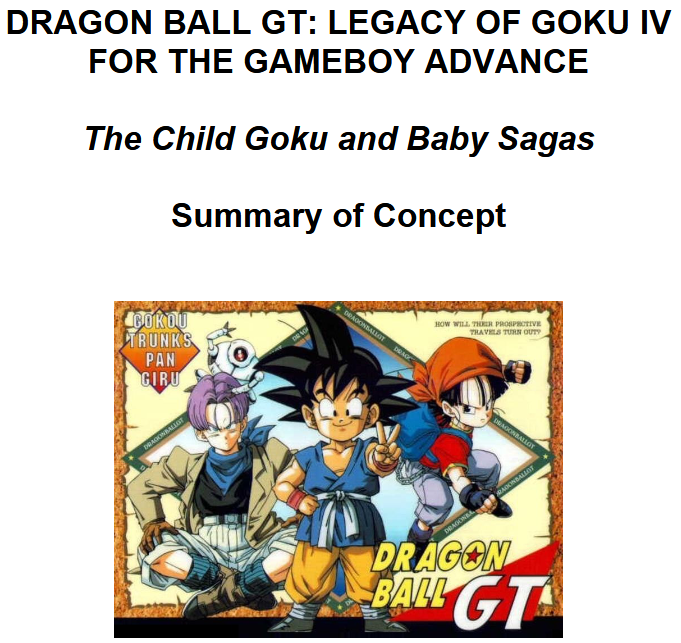
Throughout the first Concept Summary document, the game is consistently referred to as Dragon Ball GT: Legacy of Goku IV. The final release of the game dropped this connection to the Legacy of Goku series.
Seven playable DBGT characters with a variety of costume changes: Goku, Trunks, Pan, Goten, Gohan, Vegeta and Uub
Special bonus: play as Baby Vegeta to fight the Z-fighters in a bonus arena
The final roster for the game consists of Goku, Trunks, Pan, Uub, SS Goku, Piccolo, SS Vegeta, SS4 Goku and Super Baby Vegeta. Goten and Gohan are not playable, and there are no costume changes for anyone in the final game.
Ability to switch between Goku, Trunks and Pan and control the characters not being played;New to this game is the added feature of allowing the player to switch between Goku,
Trunks and Pan while all three are on screen. Part of the strategy of the game is to
determine which character you should be controlling at which time. Different quests or
battles require different characters for success. Once you have switched from one
character to another, the game AI automatically picks up the character and proceeds on.
For example, if you are playing as Trunks and begin the task of fixing a piece of
equipment but decide to switch to Goku, Trunks will continue to complete the task. The
player also has limited control over the other two on screen characters and can direct
them to perform tasks, a requirement for completion of certain quests. The player is able
to set the type of basic behavior of the AI for the other onscreen characters from a range
of behaviors, such as aggressive, strong, weak or intuitive etc.(This type of game play is
also found in “Secret of Mana”, “Lost Vikings” and “3 Dirty Dwarfs” and is quite fun).Specialized Text Portraits: As in the prior Legacy games, this game has unique
character portraits which reflect the emotion of the scene for all of the characters with
dialogue. A large number of expressions are included for Goku, Trunks and Pan, the
primary playable characters for the majority of the game. This will bring out the whimsy
and personality of these principal characters and help bring across the feeling of DBGTThe final game only uses one portrait for each character.
DBGTConceptV2-2004-07-06#
Dated July 6th 2004. V.02.
- The game has been renamed to Dragon Ball GT: Transformation.
Fighting enemies from Pilaf to Cardinal Mutchy MutchyPilaf only shows up in the opening cutscene and is never fought in-game.

Mock-up sprites for Goku and Trunks. While both are similar to their final versions in their poses, the sprites were completely redrawn.
If the player continues to do melee and chose not to use their special move they fill up
the bar a second time (the second bar overlays the first bar.) This time if the player
executes their special move, they do a devastating over the top move that damages
every enemy on screen. An example might be to see the character in a powering up
pose and then suddenly the player throws out their arms and screams while a giant
explosion of energy engulfs the screen.
Cut from the final game. It's not possible to fill the bar twice, and every character only has one special move.
In cooperative mode the player will be allowed to choose characters in addition to Goku, Pan, and Trunks.
Kid Goku
Super Saiyan Kid Goku
Super Saiyan 3 Kid Goku
Pan
Trunks
Super Saiyan Trunks
Uub
Majuub (Uub fused with Buu)
Adult (Blue Gi) Goku
Vegeta
Baby Vegeta
Super Saiyan 4 Goku
Goten and Gohan have been dropped from the roster, while SS Goku, SS3 Goku, SS Trunks, Majuub, Adult Goku and SS4 Goku have been added. Additionally, there is no mention of costume changes in the new doc, which may mean the new forms added as playable characters were originally planned to be costumes/transformations.
"It also gives marketing the opportunity to say “12 playable characters!” and it makes things fairer. Goku has 5 different forms in the series, but characters like Pan only have one. It would be impossible to come up with a way to balance multiplayer with Goku having so many forms, and Pan having so little."
ALTERNATE PATHS:
Since it is a game with fewer, but larger levels, things are kept interesting by adding in
alternate paths. Every major “zone” in the game has one or two branching points where
you can either go one way or another. So the player would be given a choice… Do I
walk up these stairs that take me to the top of a castle? Or do I jump down into this hole
that takes me into a catacomb?
A recurring theme throughout the concepts and design documents is alternate routes in levels, giving the stages extra levels of replayability. Unfortunately, the final game is completely linear, with all levels being a straight line from start to finish.
Commision List-3#
A document listing various portraits and cinematics artworks Webfoot Technologies needed to commission Toei to draw for the game.

Particularly notable among these is a sketch for a special win screen artwork for Super Saiyan Pan, who is not only not present in the final game, but as of writing has never appeared in any official Dragon Ball media to date! The list also includes a portrait under Medium Priority, "Pan (SS ) – Serious Smirking, Pending approval of SS Pan concept". It seems approval was not granted in the end.
DBGT Transformation Concept 2004-09-01 V2#
Dated September 1st 2004.

Although a mockup, there are some notable differences from the released game:
- The stage pictured does not appear in the final game. Whether this was a scrapped design for Planet Rudeeze or just a placeholder is unknown.
|
Mockup |
Final |
|---|---|
- The lifebars, meter and icons in the hud are completely different to the final design.
|
Mockup |
Final |
|---|---|
- Giru uses a completely different (and incorrectly colored) sprite.
|
Mockup |
Final |
|---|---|

|
- The underbelly, legs and much of the red shell of the Sandipede are missing shading.
|
Mockup |
Final |
|---|---|
- Pan has a completely different sprite for her super animation.
- No Machine Mutants in the game use the color variant in the mockup.
- The placement for enemy lifebars is different. In the mockup it's placed at the top center of the screen, while in the final they're in the bottom right. It also displays the name of the enemy being attacked, which isn't used for either enemies or bosses in the final game.
Team-based gameplay, with 3-4 hero characters onscreen at almost all timesThe player will, in the end, get the opportunity to pick from
playable characters such as:
* Kid Goku
* SS Kid Goku
* SS3 Kid Goku
* Pan
* Trunks
* SS Trunks
* Uub
* Majuub
* Adult Goku
* Vegeta
* SS4 Goku
* Baby Vegeta (villain)
* Baby (villain)Baby has been added as a playable character, but there's no sign of SSJ Pan. SS3 Goku, SS Trunks, Majuub, Adult Goku and Baby are not playable in the game, and Piccolo has not been added yet.
Each character has melee, jump, block, energy block, several energy attacks and super
moves (many of which are unlocked as the game progresses). Some characters, such as
Pan and Baby, have different moves which set them apart from the others and lead into
interesting, new gameplay modes. Pan has the robot Giru along with her, which she can
use as a helper to scan or fight enemies, or even steal powers from some enemies for a
limited time. Baby can possess any enemy and allow the player to fight other enemies as
that creature.
Fantasy Mode:
Fantasy Mode is a version of the single player game that detaches the game from the
story, and allows the player to choose from a much wider assortment of characters. As
characters are unlocked, they are available for use in the Fantasy Mode as well as all
Multiplayer modes. This way, the player has the ability to play through the single player
game with characters aside from the ones they are limited to by reason of being accurate
to the story. By playing through different levels of the game with different characters,
the players can gain access to other areas of a level that require using particular
characters. This aspect of the game is very obvious – any barrier that can only be opened
by a particular character would have an icon on it that matches with the icon representing
the character at the time they were unlocked (in the Secrets area). The player also will
have the opportunity to unlock more Fantasy Modes, with additional challenges.Multiplayer:
The multiplayer aspect of the game will be taken advantage of to create new, interesting
puzzles which will require both teamwork and cooperation in order to solve. There may
be rooms with switches on the ground, and a bonus appears only once all four switches
have been pressed, at the same time. Once the bonus appears, only one player can get it –
fostering competition, encouraging the “party” atmosphere. Other situations include
players coming to areas of a level where they are forced to split up into individuals rather
than as a party that can help each other – thus changing strategy on the player until the
time comes when the team is reunited.
There are multiple different Multiplayer modes which can be unlocked, to increase
variety. The players can get the opportunity to play the game completely competitively,
where the top player of each level (or the entire game) gets additional points bonuses.
Players will also be able to compete to see who can get the most combos / points /
powerups / kills for each level or for the whole game. Also, there is a Multiplayer mode
where the players simply attack each other in a fighting-game style arena.
Players will connect to each other using the Gameboy Game Link. Additionally, when
the second game becomes available, players will be able to use the Game Link to transfer
data such as points into the second game. They will also be able to unlock special
bonuses in the second game that are only made available if the first game was 100%
completed.DBGT-Design#
Dated October 15th 2004.
- Other than being first on a Wishlist for features, all mentions of AI controlled partners and having multiple playable characters on screen at once in single player have been removed or changed in the design document. For example, from the Key Features:
|
Proto |
Final |
|---|---|
|
AI helper characters during single player experience |
Team characters during single player experience |
- Fantasy Mode has been replaced with Standard Single Player mode, with character specific secrets and routes being dropped. The variety of different Multiplayer modes and unique features included has been dropped for a Standard Multiplayer, and Piccolo's Multiform mode has been added.
- The Controller Layout includes some differences from the final:
While Jumping: A Button – Fly
While Flying: A Button - Land
In the final, flying is performed by holding down the A button, and landing is performed by letting go of the button.
While Jumping: B Button near apex of jump – Dive KickChanged to Down + B while jumping. There is also no mention of being able to perform Air Energy Attacks while jumping, or performing airdashes.
While Being Knocked Down: A Button – Fall BreakerL Button + R Button – Group AttackNot present in the final. Further details on this mechanic:
Single Player
The player presses the L and R buttons together and holds them to initiate a group
attack. The player can only do this when their energy is full. The character does
the Special Energy Attack pose to charge up the attack, and there is some sort of
rippling energy effect on the ground underneath them. While charging, the player
is slowly losing energy, but can let go of the buttons at any time to cancel the
attack. The player is vulnerable to being hit by enemies at this time. After
they’ve held the buttons long enough, all action on the screen stops (enemies stop
moving, etc.) Any team characters that also have full energy bars jump onto the
screen next to the player character. They then all do a massive energy attack
together. After the attack ends, the team characters jump back off-screen. Any
characters involved in the attack lose all their energy.
Multiplayer
Since the “helper” characters are actually controlled by other players in the
Multiplayer modes, Group Attacks are handled a little differently. The first player
to press and hold the L and R Buttons is the “originator” of the attack. While
their attack is charging, any other players that want to join in can also press and
hold L and R. Doing this causes them to jump into position next to the originator.
When the originator finishes charging, any other players that are in position join
that player in the Group Attack. These players lose all their energy.
During a Group Attack, all map elements will disappear, so that the separate parts
of the Group Attack can be done with BG layers. The point of this is to make the
Group Attacks as large and impressive as possible.
NOTE: If a Group Attack is initiated by a player who is flying, that player drops
back to the ground before they start charging.
Modifiable Stats
Speed (1 – 10)
Determines the movement speed of the character while they walk, dash, or fly.
This also controls how fast a character’s attack animations are. Therefore, a
character with a higher Speed stat can perform more attacks in a shorter period of
time, leading to higher combos. While movement speed goes up every time
Speed goes up, attack speed only goes up for every two points in Speed.Cut from the final game, only Health, Strength and Power stats can be improved.
- The playable characters have cut SS3 Goku and Adult Goku, while Piccolo has been added. There are also extra details on how SS Trunks, Majuub and Baby would have played:
SS Trunks:
Special Attack: Burning Attack
Sequence 3 - Ducking palm strike, upwards
Sequence 4 - Left Forward Kick
Sequence 5 - Left High Kick
Sequence End - Sword Slash, with energy effects (much like Trunks'
sword slash, but flashier)
Victory - holds sword above head horizontally, wind is buffetting his
clothing/hair
Loss - kneels; sword is held with the tip of the blade in the ground and his
head and hands are resting on the handle's bottom.
The rest are the same as Trunks.
Majuub
Special Attack: Pink Beam
Dash – Teleport Dash - no slide. Instead, the player disappears in a blur
and 1/4 to 1/2 second later reappear further forwards (x number of pixels)
Sequence 3 - Left Elbow
Sequence 4 - Left Backfist, extended directly out from the Left elbow
Sequence 5 - Light Headbutt
Sequence End - Strong Headbutt
Spin Attack - Faces screen, clasps hands and slams down both fists in
front of him. Creates a wave of energy that spreads out for a short
distance on either side.
Dash Attack - Teleports to the backside of the enemy instead of front side
and punches (this can be done up to 3 times, the 3rd hit will knock the
enemy down)
Grab Attack - Spins the enemy around 720°, and then tosses the enemy.
Any enemies nearby are hit by the held enemy (same with while he's being
tossed).
Special Attack - Pink Beam. Works just like a kamehameha, except that
all enemies destroyed by this turn into candies/chocolates/etc. Anyone can
eat them to gain health.
Get Up - Bruce Lee-style
Victory - Spins around quickly, transforms into Papaya Man, and strikes a
pose
Loss - Beats the ground with his fists. Pieces of the ground rise up around
him, pushed up around a crater, created by the impact of his fists.Baby is considerably weaker physically than the other characters. He has low
health, is missing some attacks, and the player cannot recharge his energy by
pressing the L button.
However, Baby has a skill unlike any of the other characters: he can possess any
non-boss enemy in the game, and allow the player to take control of them. First,
the player must use a melee attack on the enemy they wish possess. Then the
player presses the L button to have Baby dive inside of the enemy. The player
then has control of that enemy, and can use that enemy’s unique attacks. The
player’s health bar changes to reflect the possessed enemy’s health. Once that
health is drained, the enemy dies and Baby pops out of it, allowing the player to
possess another enemy if they wish. Alternatively, the player can press the L
button to leave the possessed enemy. Baby also gains energy whenever he
possesses an enemy, to make up for his lack of Charging ability.
Submissions 3-15-05#

|
'...But what does it mean?' |
|
Proto |
Final |
|---|---|

|

|
A version of the Dragon Turtle boss with a different color palette. A color-corrected version that matches the final game can be found in folder "Submissions 3-21-05", along with an explanation for the change:
"Note: The Dragon Turtle's colors have changed. This is because when we were first designing him, we didn't have the DVDs for the Lost Episodes yet, and so only had low quality VHS dubs from the Japanese version of the show to work from for reference, in which the colors were shifted and desaturated.
Now that we have the DVDs, we have realized that the colors were incorrect, and have changed them to suit."
His eyes were also adjusted following feedback, presumably from Toei, as seen in Turtle 3-21-05. 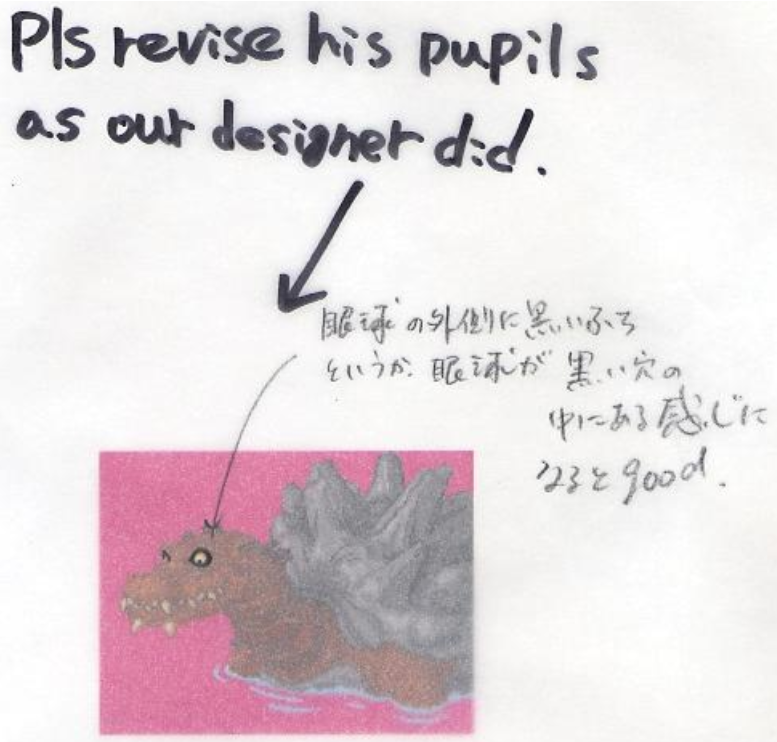
|
Proto |
Final |
|---|---|

|

|
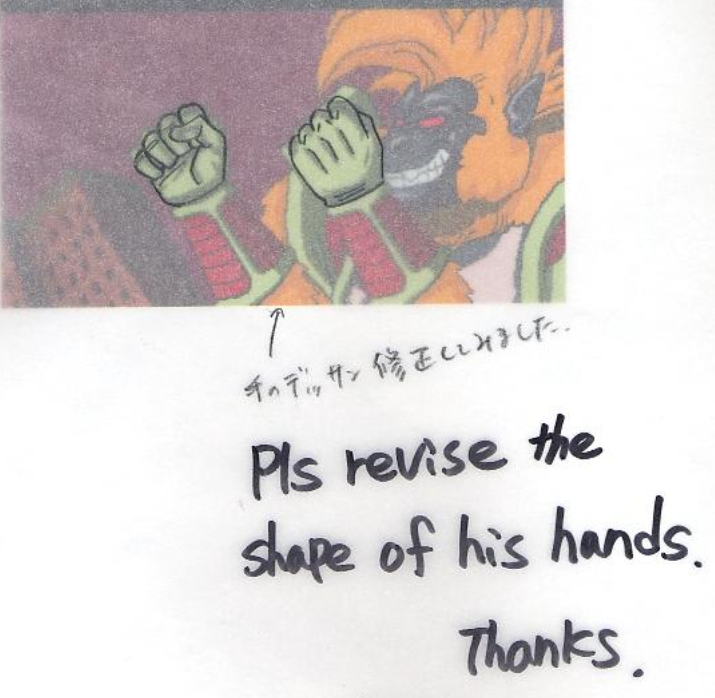
An earlier version of the Oozaru Baby sprites. The hands were completely redrawn and some shading was added to the bottom of the gloves. Oozaru 3-21-05 again shows some feedback and guidelines on how to fix the hands. The final version can be found in folder "Submissions 3-21-05".

"Description: The Super Luud Robot attacks the player(s) with its hands, mainly. It may smash the ground, trying to crush players, may sweep across the ground with a flattened plam (alternating between hands, and directions of sweeping), and may bring both palms together to try and squash the player(s) between them. Every so often, the robot will open its mouth. Inside its mouth is a glowing gem. The player must hit this gem in order to hurt the robot. After a few seconds of being vulnerable, however, the gem will begin to flash, and soon, a giant beam will be emitted downwards out of the mouth, which can greatly hurt the player if caught within it. After the Robot's health is depleted by 50%, it will turn red and become faster."
In the final game, the boss starts off in the red Level Three state, leaving the base color palette unused.