Konami's answer to R-Type and X-Multiply, and one of the most graphically advanced games of its time - so advanced that it didn't get a console port until the release of Salamander Portable in 2007. The only other notable appearance it made is in Ganbare Goemon 2: Kiteretsu Shogun Magginesu, where its Stage 2 is featured as a mini-game.
Regional Differences#

|
To do:
|
Title Screen#
Japan |
US |
Europe/Asia |
|---|---|---|
 |
 |
 |
The registered trademark icon next to the Konami logo is absent in the Japanese version. The copyright text was also extended in the International versions, and the katakana below the Japanese logo was replaced with "XEXEX" (in case you somehow missed the giant XEXEX logo right above it). The US version has a unique title screen, but otherwise the gameplay is similar with the European and Asian versions. Despite the new title, the life restore items (see below) still retain the original XEXEX logo.
Due to the new title, the voice that shouts "XEXEX" had to be excised in the US version.
"PLEASE DEPOSIT COIN" was changed into "PLEASE INSERT COIN" in the International versions.
Attract Mode#
|
Japan |
International |
|---|---|

|

|

Due to the difference in weapon systems between both regions, the weapon description screen in the attract mode was replaced with the redundant ship system specs in the International versions. The weapon briefing screen is gone altogether.
|
Japan |
International |
|---|---|

|
|
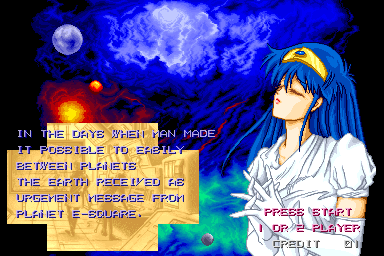
This intro screen appears when a credit is inserted. The Japanese text was translated for the International versions, but the narration was surprisingly left intact.
|
Japan |
International |
|---|---|
|

|
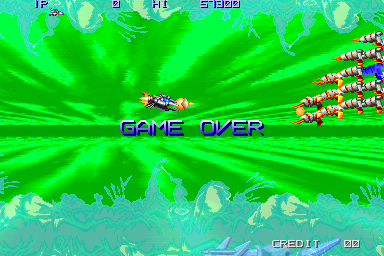
The International versions' demo is two-player cooperative, whereas the Japanese version is single-player. Not only that, their demo rotation is different as well, with the Japanese demo playing stages 1, 2, and 3, while the International versions plays stages 1, 2, 4, and 7. The former starts a little further than the starting point, while the latter version prefers starting right at the beginning of each stage.
|
Japan |
International |
|---|---|

|

|
The Konami logo screen in the Japanese version has a white background with a cutesy voice saying "Konami!". This was replaced with the Flintlock spinning against a black background, along with a few rocks.
|
Japan |
International |
|---|---|

|

|
The high score screen in the International versions has the same spinning Flintlock in the background. The Japanese version's is plain black, and has two extra blocks after the player's initials for their gender and Chinese zodiac sign.
Gameplay#
- The weapon system has been completely overhauled in the International versions. There are only two available weapons: a spread shot, which looks similar to the Round Laser, and homing missiles. Both are upgradeable.
- The Flint in the Japanese version can be detached in two ways: one is a simple detach, and the second shoots the Flint straight towards the enemy, which can be performed by charging the Flint and then pushing the detach button. The International versions always shoots the Flint forward, making it look more like R-Type.
- The autofire function after detaching the Flint is nonexistent in the International versions, making fights a bit more tedious.
- Enemy patterns are different in the International versions. This can be seen as early as stage 1.
 Due to the change in life systems between regions, the 1up icon in the Japanese version was changed into a life refill in the International versions. Various secret points that contain these 1up icons or other random powerups in the Japanese version were changed to hide the life refills, and conveniently marked with weird flickering dancing men.
|
Japan |
International |
|---|---|

|

|
- Some of the bosses' routines were modified, most notably the stage 6 boss. There are now two satellites instead of one, which has the unfortunate side effect of causing the game to slow down until either one of the satellites is destroyed.
- The Flintlock in the International versions has an energy bar as opposed to explode after getting a single hit, and energy recharge powerups were added in various areas. However, there are no lives, so every bar equals one credit.
- In the Japanese version, the Flintlock disintegrates into small pieces when hit and recomposes itself in the next life and when continuing. In the International versions, the Flintlock simply explodes and reappears completely intact, as it does at the beginning of the first level, when continuing.
- In the International versions, the player starts where they died instead of going back to a checkpoint.
- The International versions can be played in two-player cooperative mode. The second player's ship has a new look, and gains the regular-colored Flint from the Japanese version.
- The Japanese version ends after two loops while the International versions loops indefinitely.
Other Differences#
|
Japan |
International |
|---|---|

|

|
- The Flint's core is blue in the International versions.
- Stage intros in the International versions now show the planet names, whereas the Japanese version encourages you to "CHARGE THE ENEMY".
|
Japan |
International |
|---|---|

|

|
- The Japanese subtitles for cutscenes were translated.
|
Japan |
International |
|---|---|

|

|
- In the Japanese version, the continue prompt appears on a separated screen with a 3D spinning Flintlock underneath, whereas in the International versions, the continue prompt appears on a freeze-frame in the moment where you died.
- In the Japanese version, you have 10 seconds to continue, whereas in the International versions, the amount of time is doubled to 20.
Staff Roll#
The game displays different staff credits depending on the region. The Japanese version mostly uses abbreviated names for the staff, while the International versions replace these entirely with fun and creative aliases.
One small note: the "Special Thanks" section is completely removed from the International versions' credits.
Japan |
International |
Real name |
|---|---|---|
TEAM XEXEX |
||
GAME STAFF |
||
DIRECTORED BY |
||
T.TAKATORI |
TOM MURCHIE |
Toshiaki Takatori |
PROGRAM DESIGN BY |
||
T.TAKATORI |
TOM MURCHIE |
Toshiaki Takatori |
T.FUJII |
BAUMANN |
Tatsuo Fujii |
T.WADA |
WADY TEITS |
Tetsuya Wada |
GRAPHIC DESIGN BY |
||
M.MACHIGUCHI |
MICKEY |
|
K.KAKUWA |
JAMES K KARK |
Kuniaki Kakuwa |
C.HANANO |
CHA HEIFETZ |
Chiyoko Hanano |
SOUND DESIGN BY |
||
M.FURUKAWA |
CAROL QUEEN |
Motoaki Furukawa |
H.MAEZAWA |
MICHAEL OLDRIVER |
Hidenori Maezawa |
S.MIYAWAKI |
ROSETTA STONE |
Satoko Miyawaki |
A.HASHIMOTO |
SHANGHAI MANMOS |
Ayako Nishigaki |
HARDWARE DESIGN BY |
||
D.KONISHI |
JEAN SIMONS |
Dendou Konishi |
TITLE DESIGN BY |
||
T.NISHIMURA |
NISSY BALVOA |
Takashi Nishimura |
ANIMATION STAFF |
||
CHARACTER DESIGN BY |
||
KEN.HEINE |
Ken Heine |
|
ART DIRECTED BY |
||
MAGURO BANBA |
||
SPECIAL DESIGN BY |
||
NORI TAMA |
||
SPECIAL EFFECT BY |
||
SCREAMING MT. FUJI |
||
SUB SPECIAL EFFECT BY |
||
TAMAYA JP |
||
SCREEN PLAY BY |
||
COSZO GI KEN |
||
PLANNING PRODUCED BY |
||
STUDIO SUMONO |
||
CAST |
||
IRENE LA TIAS... |
||
SUMI SHIMAMOTO |
Sumi Shimamoto |
|
KLAUS PACHEL BEL... |
||
‑???‑ |
||
SPECIAL THANKS |
||
M.INOUE |
Absent from |
Masahiro Inoue |
K.BAN |
||
K.HASHIMA |
Keisuke Hashima |
|
BENLY YAMAMOTO |
Koji Yamamoto |
|
TEAM PIGS |
||
THANKS FOR PLAYING. WE CONTINUE TO |
||
PRESENTED BY KONAMI |
||
(Source: MobyGames, Dag (VGMdb - Ayako Nishigaki))
References#
- Domestic and Overseas Arcade Game List 1971-2005↩︎
- AAMA LEADING EDGE - Electronic Gaming Monthly, Issue 30, January 1992↩︎