Elemental Gearbolt is a light-gun game that's different from the others at the time due to its emphasis on story, no hostages to worry shooting and getting penalized for it, no reloading, and a trade-off system that trades points into experience points used to level you up and make you tougher to kill.
Due to these advantages, it's a relatively easy game that's mostly focused on its unique aesthetic and atmosphere... unless you live in the US.
Debug Mode#

At the main menu, using a standard controller, move the cursor away from the menu options and press Up, Up, Down, Down, Right, Left, Right, Left, Square, Triangle, Circle, X, X, Circle, Triangle, Square, Left, Right, Left, Right, Down, Down, Up, Up, L1 + L2 + R1 + R2 + Start. This will open the Options menu with all items temporarily unlocked, add CPU performance gauges and stage counters to the right edge of the screen, and add the following controls to gameplay:
- Triangle: Increase health and destroy everything on screen, including item/fairy containers and coins, and increase level by 1. No points are gained for anything destroyed this way. Health can be increased well above the normal maximum by holding this button down, and collecting a potion will decrease back to your actual current maximum if it's above it. Note that pressing this button to destroy the boss before its life bar appears on screen will result in a softlock. The Time Over screen will eventually display and the game will lock up.
- Circle: Decrease health and decrease level by 1.
- R2: Fast forward.
- Select: Enter free camera mode.

The free camera mode allows moving through the currently loaded section of the level. Enemies will go through their normal behavior and timing. This mode has a 3D cursor with markers that can be placed, but their purpose is unknown. The camera and cursor coordinates are printed at the top of the screen. This mode has its own controls:
- Left/Right: Move camera left and right.
- Up/Down: Move camera in and out.
- L1/L2: Move camera up and down.
- Select + Left/Right: Pan camera left and right.
- Select + Up/Down: Tilt camera up and down.
- Select + L1/L2: Rotate camera.
- X/Circle/Triangle/Square: Move the cursor along the XZ plane.
- R1: Place a marker at the cursor position.
- R2: Hold for faster camera movement.
- Select + Square/Circle: Unknown. The fourth line of text may change with each press, but their meaning is unknown.
- Select + Triangle: Jump to next level section. Pressing these buttons at the final section of the level will cause the game to stall until the end of the current music track, at which point the Stage Clear screen will appear, and then the game freezes after it fades to black.
- Select + X: Jump to previous level section. Pressing these buttons at the first section of the level will jump to the previous level, or restart level 1 if done at the beginning of level 1.
- Start: Exit free camera mode and return to the beginning of the current section of the level.
Entering the Options menu will remove the performance gauges unless the code is entered again, but all other debug features will remain.
(Source: GameFAQs (_0blivion_))
Regional Differences#
Yep, it's Working Designs time again.
Difficulty#

|
Please elaborate. |
The Japanese version is quite easy; a player of average skill can probably beat it on the highest difficulty with a few hours of practice. Unsurprisingly to anyone remotely familiar with them, this didn't sit well with Working Designs.
The US version is much harder, to the extent that its lowest difficulty is probably harder than the Japanese version's highest one.
- Enemies do more damage. A side effect of this is that the low health siren is less likely to play, because your health total has less chance to enter the threshold for it as enemy damage from slightly above this level is likely to kill you outright instead.
- Fewer experience points are awarded. To partially compensate, the newly added chalices offer an added source for score and/or experience (see below).
- The lowest difficulty level was renamed from "Easy" to "Training", and ends the game after the third stage when playing on this setting.
- Only three continues are allowed on difficulties below Master. This introduces a glitch: Each time an attract mode cycle plays the gameplay demo, one of these credits is used. Starting a game afterward will result in one fewer credit for each gameplay demo before the game was started. If four or more demo loops are allowed to play, starting a new game will result in an instant game over after the opening cutscene, with glitched graphics on the Game Over and the score results screens. Curiously, this also impacts Master difficulty, even though it disallows continues altogether even in the Japanese version. Getting a game over or exiting to the title screen will properly reset the credit amount. Strangely, doing this glitch will also unlock any extra options associated with the difficulty level this is done on, i.e. getting a glitched Game Over on Master difficulty unlocks everything.
Options Menu#
|
Japanese Version |
US Version |
|---|---|

|
|
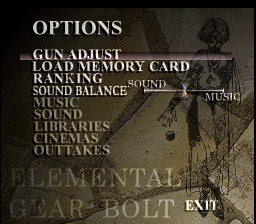
- The Japanese version contains an audio drama "Side Story" in the Options menu, unlocked after beating the game on any difficulty, which provides some much-needed expansion on the game's backstory. Working Designs ditched this in favor of their omnipresent dubbing Outtakes, relegating the plot to a summary in the manual. The undubbed audio for the drama is still present on the US disc.
- The US version also changes "Balance" to "Sound Balance" and "Movie" to "Cinemas" and rearranges the menu options. The Sound and Music labels in the Sound Balance slider reverse vertical positions so the Music and Sound selector numbers will fit in their new positions.
High Scores#
|
Japanese Version |
US Version |
|---|---|
|
|
|


- The US version adds two hidden chalices to each stage, which must be shot with a specific weapon to reveal and then again to collect. They are worth 100,000 points each and restore some health. The game clear screen adds a "Secrets" field for the number of these chalices collected. The high score screen changes the fairies count to a single number rather than a number out of 120 to fit a new column for chalices collected, and condenses the Combo record in the top three scores for the same reason. Working Designs held a high score contest with a grand prize of $10,000 for runs that collected all twelve chalices. The contest ran until January 15, 1999, roughly six months after its US release.1
- The US version changes the default scores to be set at Normal difficulty instead of Easy/Training difficulty.
- For the top three scores, the player can sign their name with a small picture drawn using the controller or light gun. The US version adds a Clear button to the entry screen to erase the picture completely.
Other Changes#
- The Japanese version shows a tutorial screen on the Trade Off system after completing the first stage. The US version removes this screen and most of the text summarizing this system in the Trade Off screen, as it's somewhat self-explanatory and fully explained in the manual.
- The Japanese game refers to the levels as "Scenes". For whatever reason, the US version renames them to "Acts".
- In the US version, some of the sound effects are different.
- In the Japanese version, when the game is paused, the screen freezes except for the animation in the weapon selector. In the US version, the screen dims and a new pause menu allows returning to the title screen.