 This article has a talk page!
This page details pre-release information and/or media for Ys: Ancient Ys Vanished Omen (PC-88).

|
To do: |
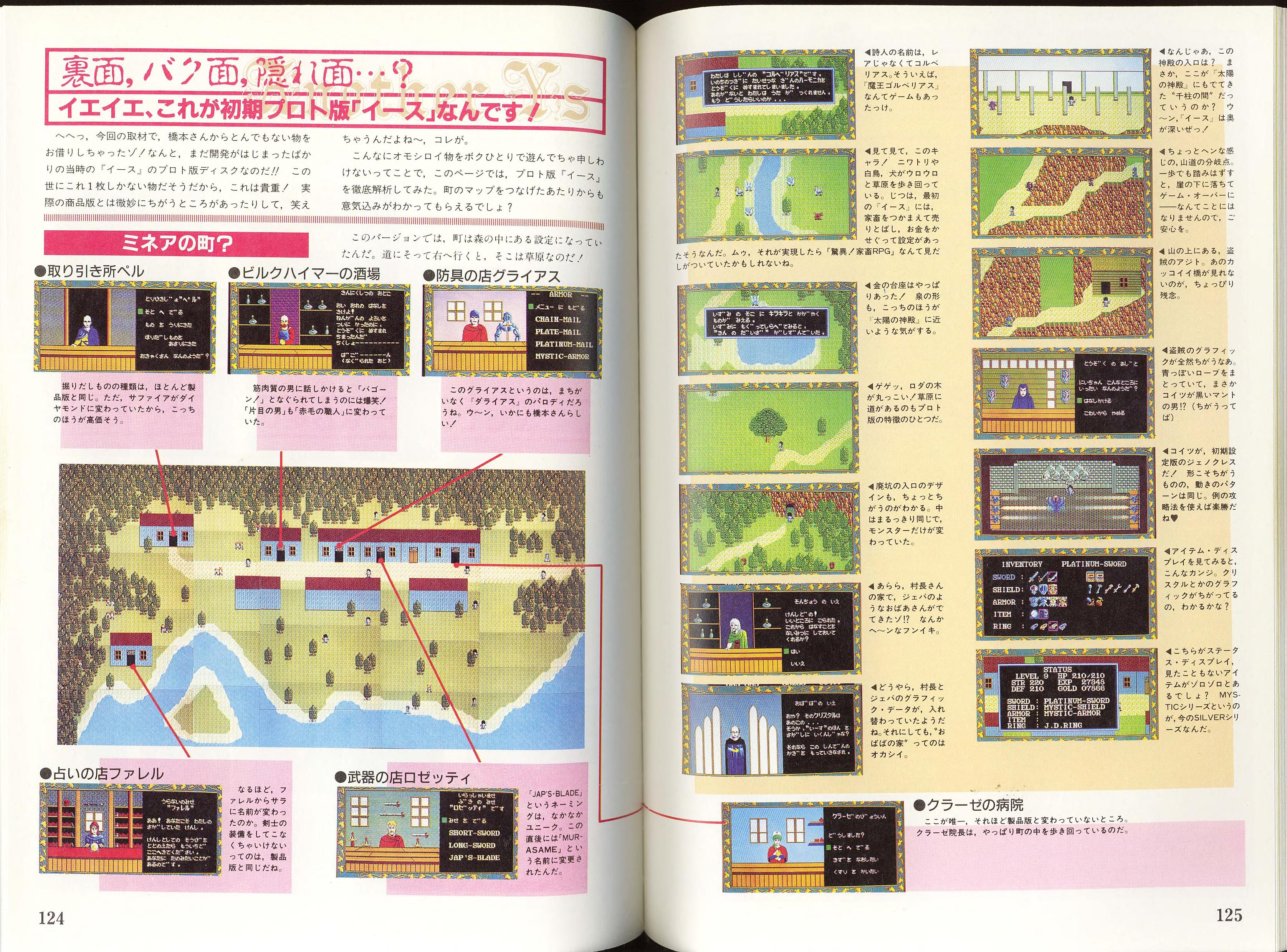
A mid-development prototype shared with Japanese gaming magazine Challenge! Pasokon A.V.G & R.P.G III (チャレンジ!!パソコンA.V.G&R.P.G III).
Minea Map#
Other Differences#
Location |
Image |
Notes |
|---|---|---|
Trading Post |
This opening menu is mostly the same, though it looks like originally Pim (or Peru, as named here) was bald. |
|
Bar |
This is quite different from the bar in the final version of the game (there is not even a border around the text box yet). Orman was called Berukuhaima (ビルクハイマー) |
|
Armor Shop |
Dios is Guraiasu (グライアス; which may be a parody of Darius/ダライアス). All the Armor is 'Mail' in this version, except for the 'Mystic Armor' |
|
Fortune Teller |
Apparently, Sara's original name was... Pharrell (Fareru/ファレル)? |
|
Weapon Shop |
Rosetti looks nearly identical to his retail counterpart, except he has bright blond hair. The Talwar is named "JAP'S-BLADE" (the magazine article indicates this would also be changed to "Murasame" at some point). |
|
Bard |
Rhea was named Koruberiasu (コルベリアス) in this version; perhaps a parody of Golvellius? |
|
Field |
In addition to a black-haired protagonist, we can see chickens, swans, and dogs in the grasslands (which may be leftover from an earlier build when you could make money by doing farming tasks). |
|
Golden Daiza |
The shape of the spring here is closer to the one in Templo del Sol (Asteka II: Temple of the Sun) here than it does in the retail release. |
|
Field |
The shape of the Roda Trees is more rounded in this version than the retail release. |
|
Abandoned Mine |
The mine entrance is also slightly different from the retail release. |
|
Mayor's House |
This character would be used for Jeba in the retail release while the wardrobe and words remain for the Chief of Zepik. |
|
Grandma's House |
This character [not including wardrobe] would become the Chief of Zepik in the retail release (you can see the face is the same, but the hair has not been drawn yet). The text here (which has "おばばのいえ" or "Grandma's House" as its header) is almost identical to Jeba's in the retail version when she recognizes Sara's crystal. The background here looks more like a church. |
|
Temple Entrance |
A black-haired Adol wanders near the entrance to the temple at the top of the mountain. This may be resembling "The Hall of a Thousand Pillars" from Temple of the Sun. |
|
Mountain Fork |
Rather than a straight (albeit rickety) bridge we see in the retail version, there is a dangerous looking curvature to the mountain path. |
|
Thieves' Den |
Entrance to the bandits' hideout. |
|
Bandits' Hideout (とうぞく の あじと) |
This character graphic is completely different from the retail version. Interestingly, the leader is wearing clothing that seems inspired by Ali Baba and the 40 Thieves; could an NPC have mistaken him for "the man in the blue/black cloak"? |
|
Jenocres |
The sprite design here is a lot more colorful than what we see in the retail release. |
|
Inventory |
The Inventory screen is nearly identical to the final version, though some icon graphics may vary slightly. We also see the item "PLATINUM-SWORD" here. |
|
Status |
This early version of the Status screen looks identical to the final, but reveals the original names of the Silver equipment as "Mystic". We also see the J.D. Ring equipped here. Falcom also uses these initials for "JDK Band", though they haven't officially revealed whether the letters actually stand for anything specific or not. |
|
Hospital |
This looks nearly identical to the retail version. |