 This article has a talk page!
This page details pre-release information and/or media for Xenogears.

|
To do: |
Development Timeline#
1994
- Spring - Tetsuya Takahashi, Soraya Saga, and Tetsuya Nomura conceptualize ideas for Final Fantasy VII together.1 Saga proposed a "soldier of fortune with multiple personalities" as the main protagonist.2
- Winter - Towards the end of development on Chrono Trigger, Tetsuya Takahashi presents a draft synopsis to Hironobu Sakaguchi. While he considers it "too dark" for Final Fantasy, he allows it to be used as a sequel to Chrono Trigger.
1995
- Takahashi pushes for full 3D graphics in comparison to the 2D background in place for Final Fantasy VII.
- Summer - Kunihiko Tanaka is first approached as a character designer for Xenogears, but was hesitant to take the role.3
1996
- Tetsuya Nomura, Takahashi's original choice for a character designer, was reassigned to Final Fantasy VII by Sakaguchi.4
- April - Kunihiko Tanaka accepts Takahashi's offer as character designer.
- July 8 - Trademark for Xenogears is registered.Xenogears trademark application
- Autumn - Lahan Village, camera system and controls are showcased. Around this time, it is decided that Tanaka's designs would not work in 3D. Direction shifts from models to sprites whilst keeping the environments in 3D. A decision is also made to focus exclusively on Episode V rather than covering both it and Episode IV.
1997
- September 5 - Xenogears is shown at the Fall Tokyo Game Show. A representative from the show initially stated that an international release was not planned due to cultural sensitivity over the game's themes.5
- October 16 - Yoi Ko to Yoi Otona no. PlayStation Taikenban Vol. 1, which has a demo for Xenogears, is released in Japan.
- Winter - Original release window for Xenogears in Japan, as seen in a September 1997 Famitsu advert. Pushed to early 1998. 6
1998
- January 29 - Initial Japanese release date for Xenogears, as seen in a November 1997 Famitsu advert. Pushed back to February.7
- February 10 - Patents for the battle system8, field movement9, and screen navigation10.
- February 11 - Xenogears is released in Japan.
- April 28 - Xenogears is announced for North American release, despite earlier statements.11
- September 10 - Square Soft 1998 Collector's CD Vol. 1, a bonus disc bundled with Parasite Eve that has the English demo for Xenogears, is released in North America.
- October 22 - Xenogears is released in North America.12
Developer Documents#
On February 11, 2024, Yasuyuki Honne shared three development documents. The first was a sketch of Aveh during early stages of development.
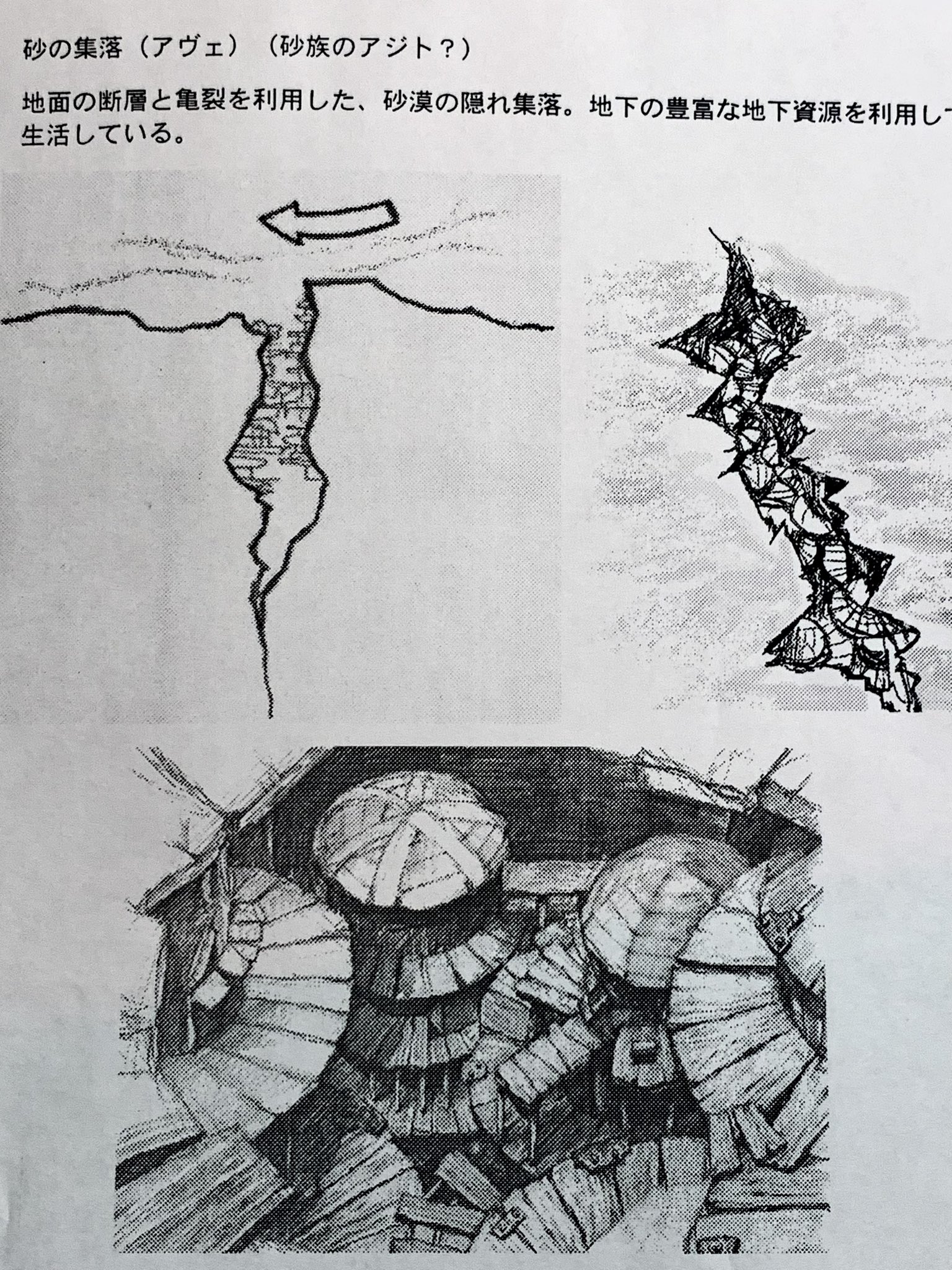
The second was a development document by Tetsuya Takahashi for lore concerning Aveh.

A translation is provided below.
Why is [Grahf] the Count of Solaris? He seems to be working alongside Myyah exclusively, not with the Emperor or the Ministry. Grahf knows about Myyah's purpose and what she intends to do with the world. It's the reason he decided to work with her. Myyah has 4 other Guardian Angels besides Grahf, working behind the scenes across the world.

Av: One of the Great Powers of Ignas

A fortified city-state, located in the vast desert stretching from south to south western sides of the main continent. Formerly, the country had a monarch, but after a coup, is now controlled by Prime Minister Laverne's military regime. Av used to be a peaceful nation, centered in an oasis, but after Laverne's usurpation, they began invading other countries, in search of more fertile land.

Ramsus, one of the Four Heavenly Kings, is currently in the area, having entered an alliance with Av on behalf of Solaris. Av is at war with Iyar, but so far there haven't been any direct invasions into each other's countries. Even so, there have been non-stop battles between the three kingdoms.

Prime Minister Laverne was formerly of Iyar, same as Bishop Stone, although the two wouldn't appear to be from the same country. After being forced out of Iyar, Laverne effectively infiltrated Av's politics, gradually gaining power. For him, this invasion is about more than simply gaining resources or land, he wants revenge on Iyar for his exile. In order to facilitate his invasion, he allied with Solaris. Neither Av nor Iyar stand a chance against Solaris. He's a selfish ruler who only seems to care about his prideful ambitions. He would stop at nothing to quash even the slightest perceived mutiny from a trusted subordinate. Laverne has reached the point of no return, choosing now to act with tyranny.

Bart and his comrades are the last remnants of Av's old monarchy. They're working to take back the country, though they don't seem to have much interest in restoring a King to the throne.
Based on this, several of the relationships between the antagonists were in place early into development, such as Grahf and Miang's uneasy alliance and Miang secretly working against the Emperor. Bart's ambivalence towards restoring the monarchy was also in place.
Some differences in the scenario are also prevalent. Aveh would have been at war with Iyar, a country that doesn't appear in the final game, but uses the Hebrew calendar naming scheme that the other areas use. As the document describes three warring kingdoms, it is unknown whether it would have existed alongside Kislev, or it was reworked into it. The translation also found mention of an unused country called Tevet, which is also a month in the Hebrew calendar. Along the same lines, the music file and debug room name for Tammuz (incorrectly translated to Thames in the English version) is Heshvan, which confirms that its name was changed during development. This is further proven by concept art using the original name on page 49 in Perfect Works.13
Shakhan would have been called Laverne, which is also the name of Edgar and Sabin's uncle in their backstory 14. His role in the narrative was largely the same, but he would been forced out of Iyar, which is where Bishop Stone would have also come from here. While Ramsus' role in Aveh is the same as in final, he would have been one of Four Heavenly Kings rather than the Commander of Gebler.
The final document was a sketch by Honne of a job class idea which originated from when Final Fantasy VII was in development for the SNES.
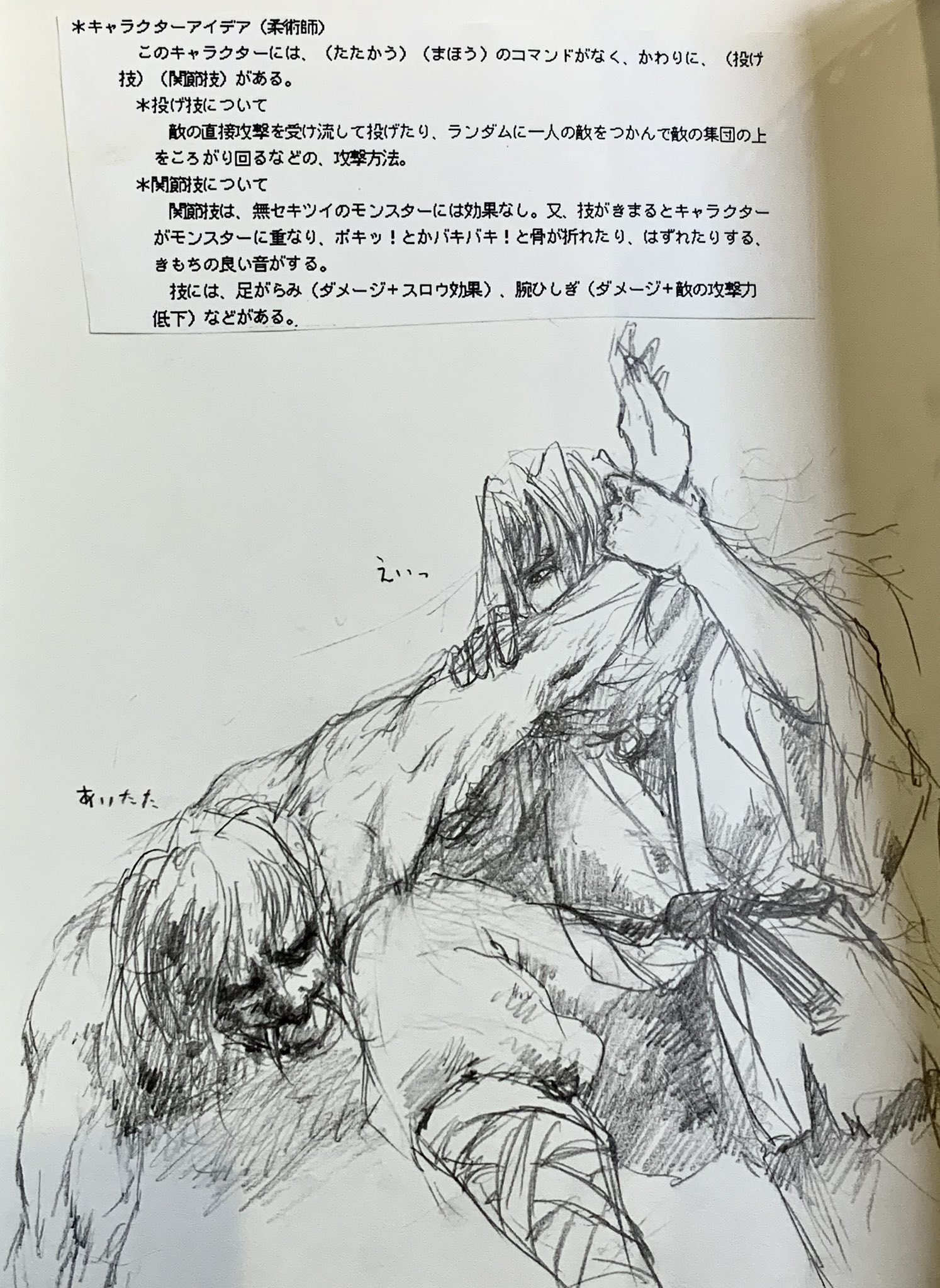
(Source: Yasuyuki Honne)
(Translations: Will Bill)
Concept Art#
Art drawn by Soraya Saga that depicts members of the cast with designs that differ drastically from the final game. According to a rough translation, these designs pre-date the final versions done by Kunihiko Tanaka.
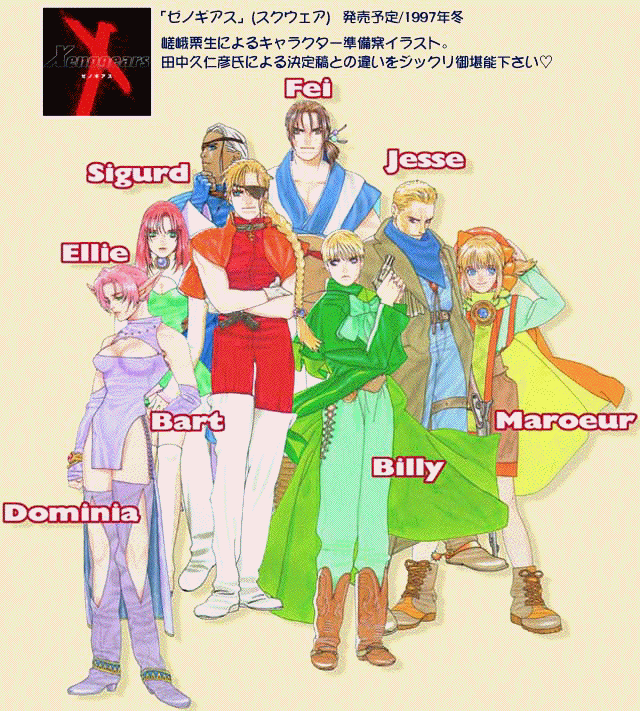
Several differences can be seen here compared to the final designs:
- Fei has a shorter sleeved shirt and shorter hair with less prominent bangs and no clear ponytail. His hair also sports unique accessories not seen in the final game.
- Elly has pink hair as opposed to auburn. Her attire is green rather than white and lacks sleeves. The collar features a large blue jewel that isn't present in the final game.
- Bart has noticeably lighter skin. He wears an orange jacket rather than the red one in the final game, red attire over black, and long white boots as opposed to pants.
- Sigurd's hair is straighter and primarily blue as opposed to white and purple.
- Margie's hair is blonde rather than brown. The colours are mostly similar, but the underneath of her cape is yellow rather than green. The white chest plate is missing, with a long strip of her coat in its place.
- Billy's general design is mostly identical, only his coat is green rather than blue and his pants are teal as opposed to brown.
- Jessie's hair is blonde rather than white, and his necktie is blue instead of red. He wears a brown coat rather than a black one. His face lacks the scars seen in the final game.
- Dominia has pink hair rather than white, which lacks a hairband here. Her skin is lighter and wore purple attire which was noticeably skimpier.
Famitsu #455#
The September 5, 1997 issue has some early images of Xenogears, five months before the game's release.
Title Screen#
Pre-release |
Final |
|---|---|
 |
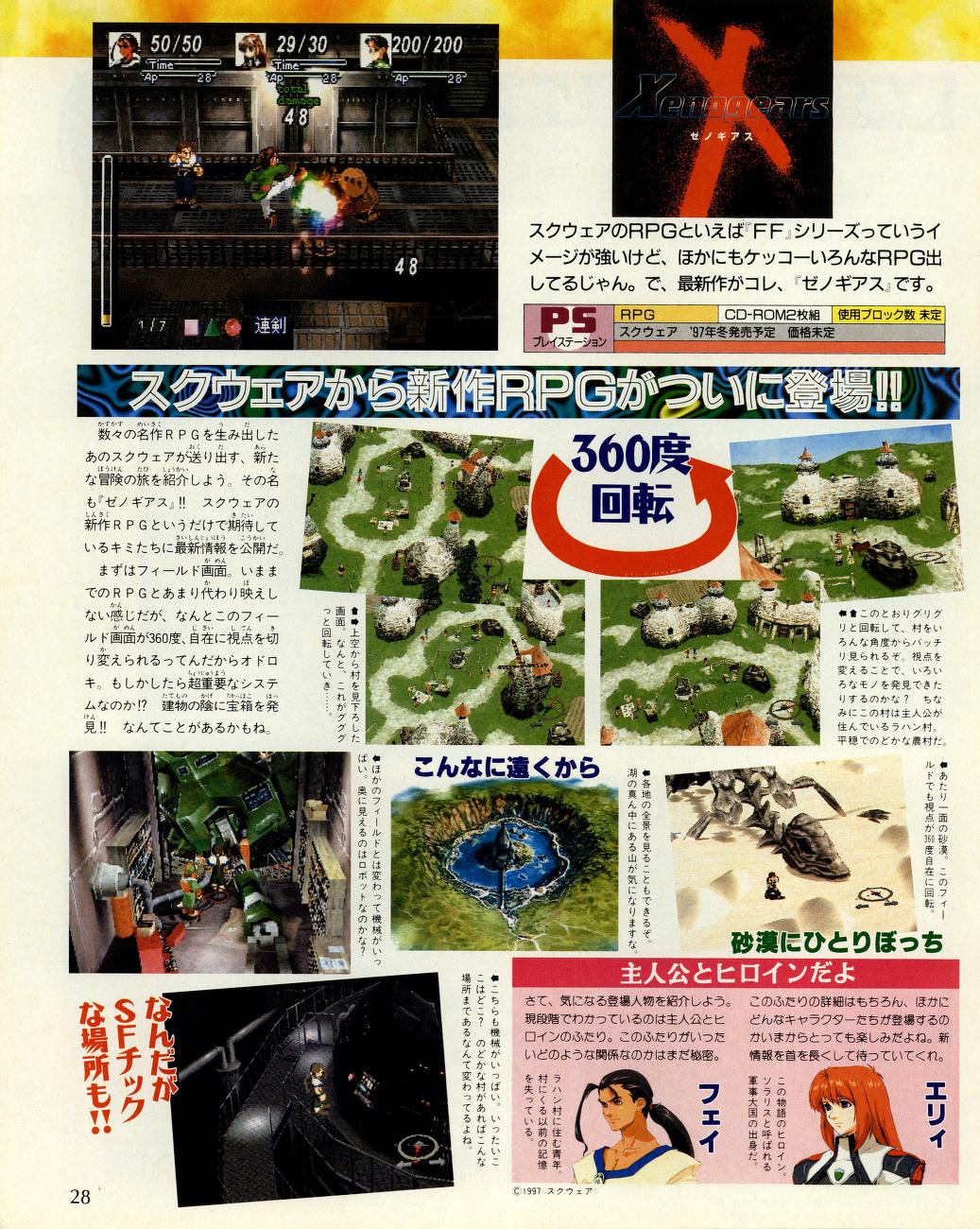
The logo is in a gradient of varying shades of blue.
Battle Portraits#
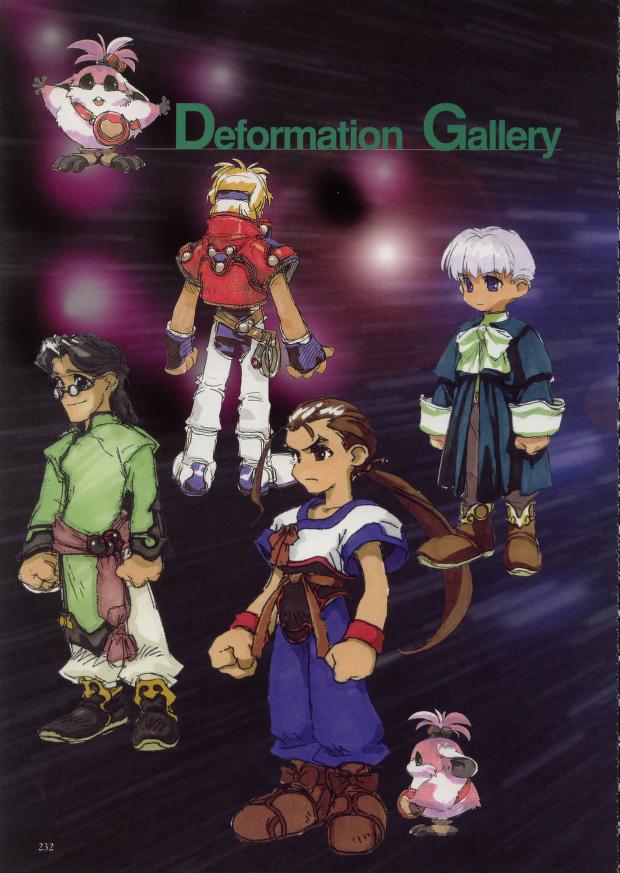
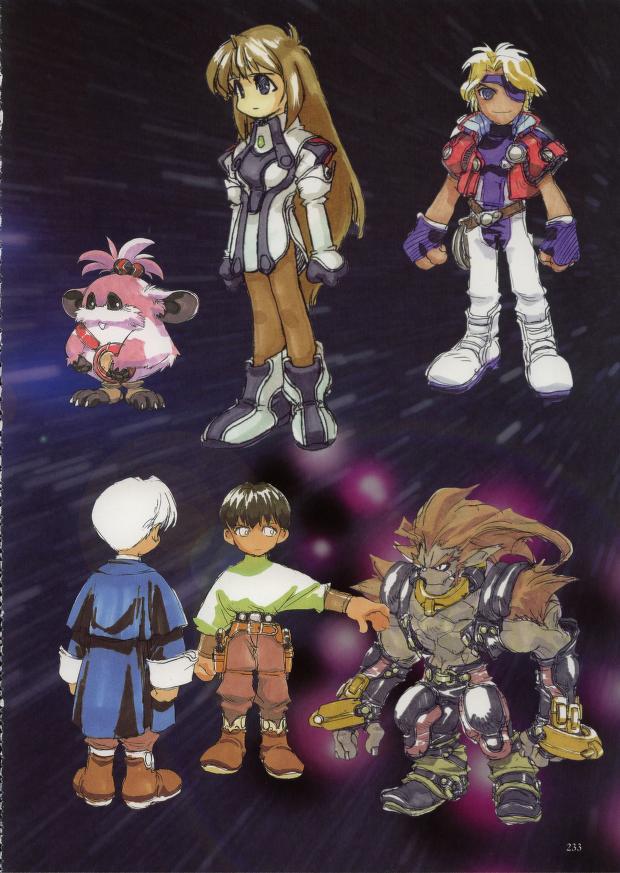
Fei Fong Wong, Elly Van Houten, and Citan Uzuki have different battle portraits. Additionally, the battle font appears to be white rather than blue.
The battle portraits in particular appear similar to the character art featured in the Xenogears Perfect Works "Deformation Gallery":
Pre-release |
Perfect Works |
|---|---|

Compass#
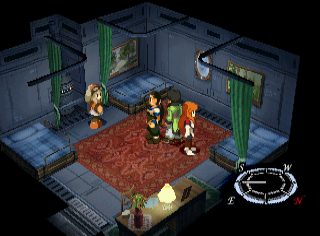
The design for compass was changed before release. The core design is rudimentary compared to the final version, though there are also arrows at the bottom, possibly indicating the player's direction when moving or turning the camera.
Pre-release |
Final |
|---|---|
 |
 |
(Images: "Famitsu" #455, Page 28)
Field Sprites#
Compared to the final version and the October 1997 demo, the stance for Fei's sprite is noticeably more slouched.
Pre-release |
Final |
|---|---|
 |
 |
(Images: "Famitsu" #455, Page 28)
Battle Sprites#
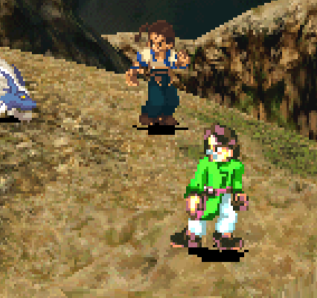
While some of the screenshots show Fei using his final battle sprite, there are others which depict him and Citan in static poses that are not used in the final release or the October 1997 demo.
Pre-release |
Final |
|---|---|
 |
 |
(Images: "Famitsu" #455, Page 29)
Meanwhile, Elly's battle sprites are identical to the October 1997 demo, which were changed in the final release.
Pre-release |
Demo |
Final |
|---|---|---|
 |
 |
 |
(Images: "Famitsu" #455, Page 29)
Battle Interface#
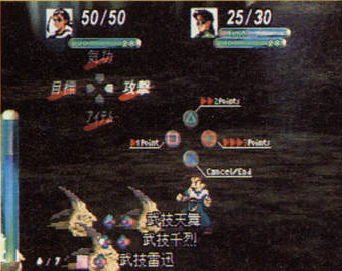
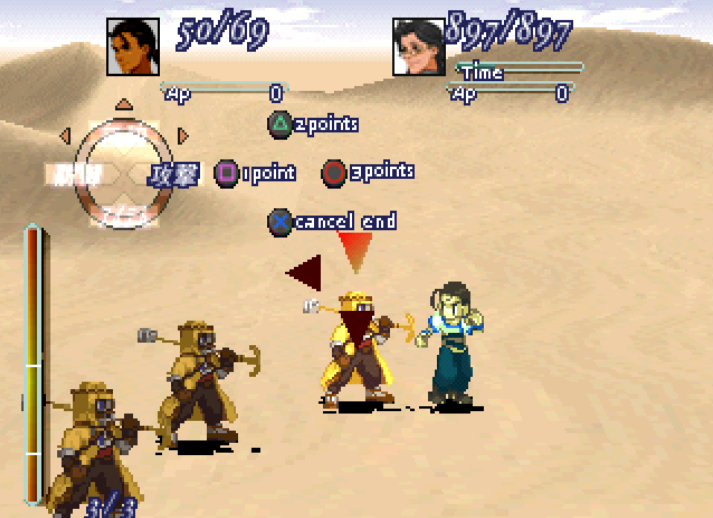
The battle interface shown in some of the screenshots is rudimentary compared to both the final release and the October 1997 build. The finished command list is more stylized and does not use the D-pad to indicate directions for each option. Attack button inputs do not have arrows or a white underline in the final game. The attack point meter is blue here, whereas it was changed to a red to yellow gradient in the final release. The text for both the Time and AP bars uses a border that lacks contrast with the filled bars, which are thicker than in later builds.
Pre-release |
Final |
|---|---|
 |
 |
(Images: "Famitsu" #455, Page 29)
Gear Interface#
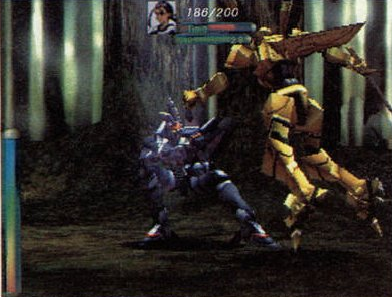
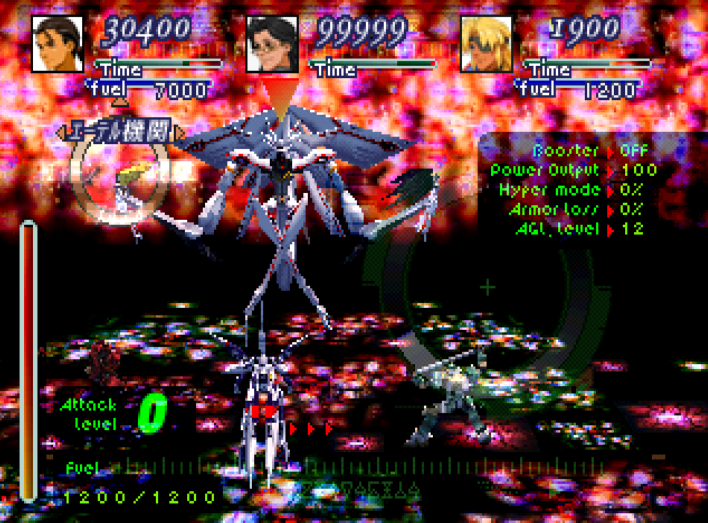
The gear battle interface appears to be from an even earlier build than the ground combat screenshots, as evidenced by an older font style for the HP stats. Interestingly, AP is used in the second bar instead of Fuel.
Pre-release |
Final |
|---|---|
 |
 |
(Images: "Famitsu" #455, Page 29)
The PlayStation Vol.72#
Released on September 5th 1997. Several of the screenshots shown are the same as in Famitsu #455, though some differences from the final game are unique to it.
Overworld Map#
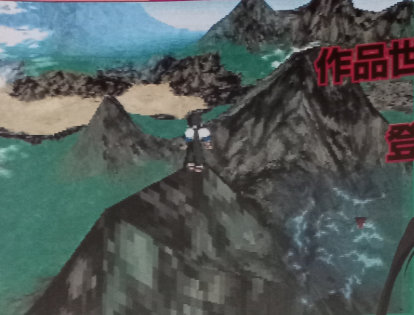
A noticeable oddity on the overworld map is that Fei is able to stand on the mountains, something which he couldn't do in the final game. Presumably, the map was in a preliminary state during that stage in production.
Field Sprites#
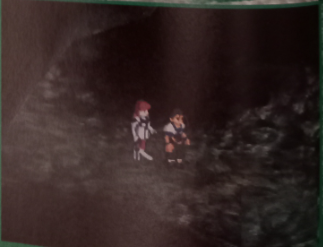
A rough version of Elly's field sprite is featured. It is in a unique pose which pre-dates the one used in the 1997 demo. Interestingly, her and Fei are in the Stalactite Cave, presumably through debugging.
Locations#
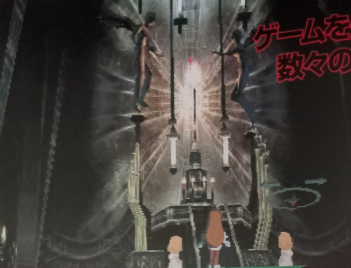
A screenshot shows Elly at the Nisan cathedral. Little girls are used as placeholders for the sisters.
FMVs#
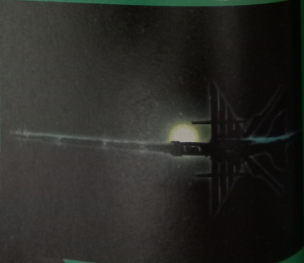
An unused shot of the Eldridge against the sun is shown here.
(Images: The PlayStation Vol.72, Pages 20-27)
Famitsu PS Issue No.28#
Released on October 17th 1997.
Graphical Differences#
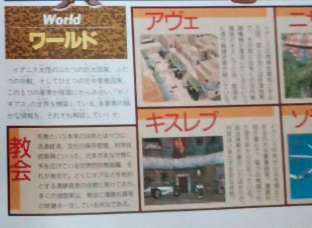
In a group of screenshots showcasing the game's setting, Kislev seems to use a different angle compared to the final game.
General Differences#
Story#
A notable scenario difference is that Elly appears to be in the party at Dazil. When translated, her dialogue is the same as her line referring to Fei as a "suspicious surface dwelling Lamb" after he saves her in the Blackmoon Forest. As both the Magical Rod and Arcane Rod can be purchased at Dazil, it can be assumed that Elly's departure after the Rankar sequence was moved later into development. This screenshot will continue to be used by Famitsu post-release.

(Images: Famitsu)
(Images: Famitsu PS Issue No.28)
The PlayStation Vol.77#
Also released on October 17th 1997. Differences shown are later depicted in VJump (11/1997).
Graphical Differences#
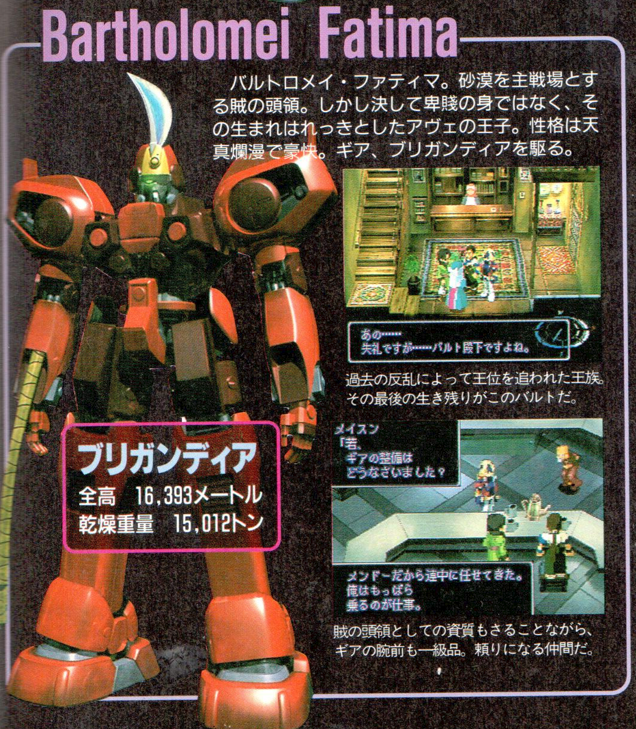
In a screenshot showcasing Bart's Lair, Chief Lee's sprite is used as a placeholder for Maison.
(Images: KadMony)
General Differences#
Story#
What appears to be a conversation between Fei and Billy in Nisan is shown. A scene like this never appears in the final game. 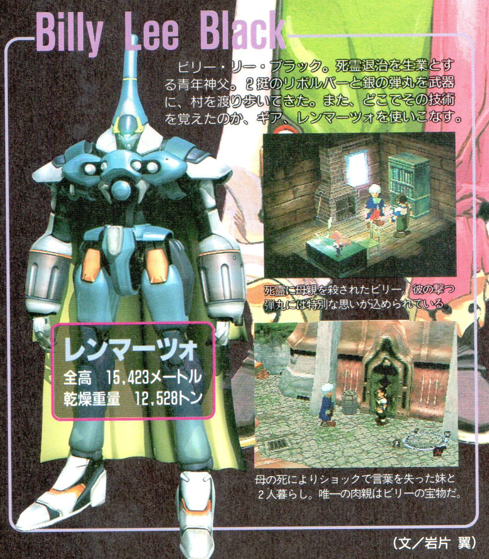
(Images: KadMony)
Dengeki PlayStation D5#
The trailer is dated to 22nd October 1997. It was made after the Yoi Ko to Yoi Otona no. PlayStation Taikenban demo was built, yet footage from an older build seems to be used.
- Shots of Weltall during the attack on Lahan are shown that do not appear in the final game. This is where the unused text block 28 from the Lahan attack would have been used. It can be assumed that the FMV was used in its place.
- Different gear designs are used for the reinforcements when Alpha Weltall first appears. These designs are also used in the Japanese demo.
- Angles are slightly different when Weltall knocks down a gear.
- Dan uses concept art in place of his portrait, presumably as it wasn't finished yet. The villagers are in different placements in the scene compared to the final game.
- Intro to the Duneman Isle has the camera pan more to the left.
- Elly's sprite uses a different pose that can still be seen in the overworld map. Her gun sprite for her first meeting with Fei is presumably not ready.
- Fei uses his full scale sprite on the overworld map of the Thames.
- A different NPC sprite is used near the buggy in Nortune.
- Shakhan Square is empty.
- White font from the September 1997 Famitsu issue is used.
- Battle portraits use the official artworks for Fei, Elly, and Citan.
- Reveal of the Mother of Humanity in the intro is unfinished.
- The gear UI uses features a "Temp." parameter which was replaced with Hyper Mode in the final game. An Ether converter option is shown at the top, which was scrapped by the time of the 1997 demo.
- Triangle attacks cost 50 fuel, which was changed to 20 by the 1997 demo.
- Circle attacks cost 100 fuel, which was changed to 30 by the 1997 demo.
Japanese: PlayStation Magazine No.20#
Released on October 23rd 1997.
Graphical Differences#
A noteworthy difference is that Billy's portrait during battle is oddly flipped compared to the final release. Unlike the 1997 demo, the final design is used as opposed to concept art. As indicated by the date of publication in relation to the build date of the Yoi Ko to Yoi Otona no. PlayStation Taikenban Vol. 1 demo, the screenshots used are from a later build.

(Images: Famitsu)
(Images: Japanese: Plaustation Magazine No.20)
The PlayStation Vol.80#
Released on November 11th 1997.
General Differences#
Story#
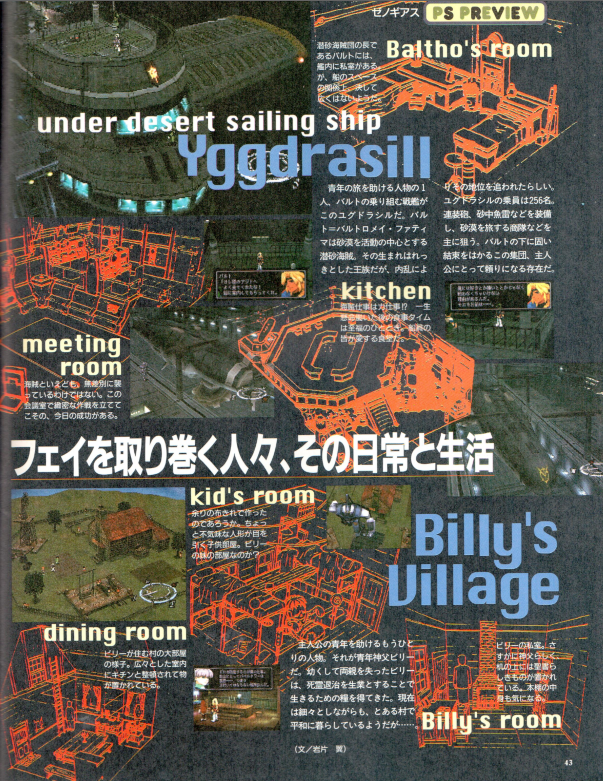
The magazine calls the Orphanage "Billy's Village". This lines up with the terminology used in Kigoshi's debug room.
(Images: KadMony)
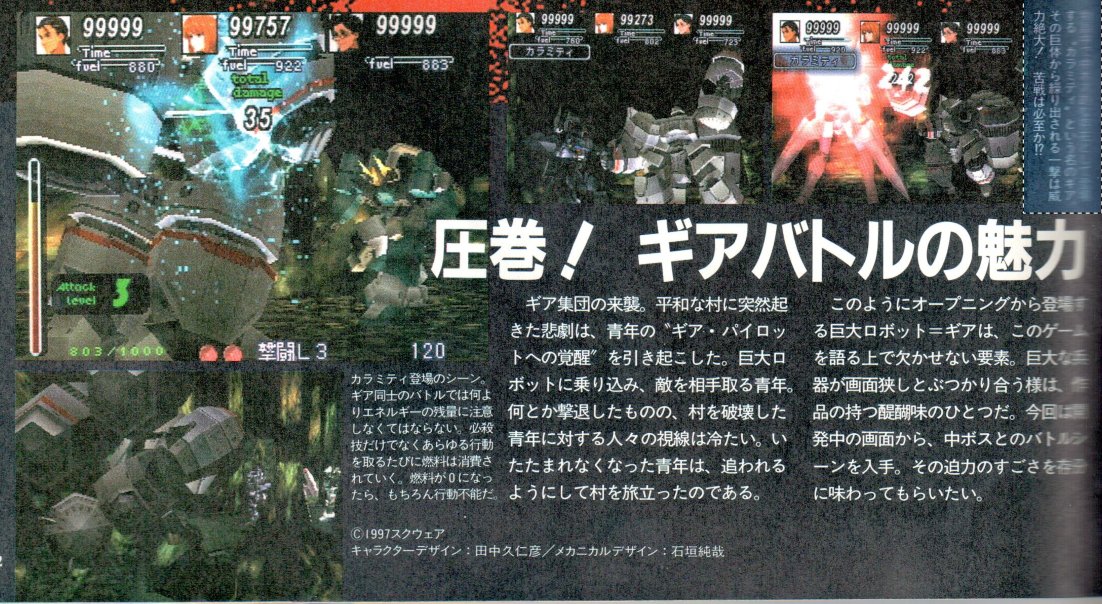
Gameplay#
Citan's Ougi is using a placeholder name which indicates its attack level.
(Images: KadMony)
The PlayStation Vol.82#
Released on November 21st 1997.
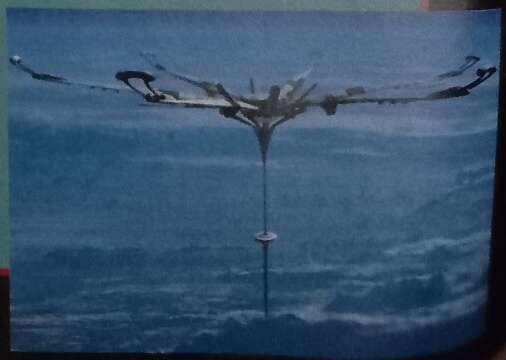
FMVs#
The lighting used when Razael's Tree is shown in the opening is darker than in the final game.

An unused still of Solaris before it is destroyed by Id.
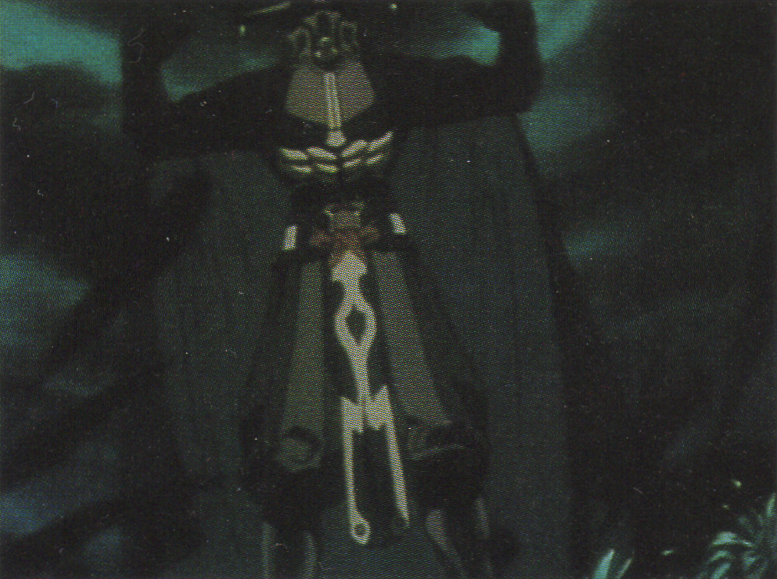
Footage of Grahf that was not shown in the final game. His stance indicates that the fight between him and Khan was to be shown here.
(Images: The PlayStation Vol.82)
Graphical Differences#
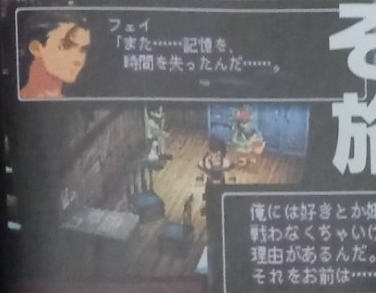
Lahan NPCs are used as placeholders in Solaris.
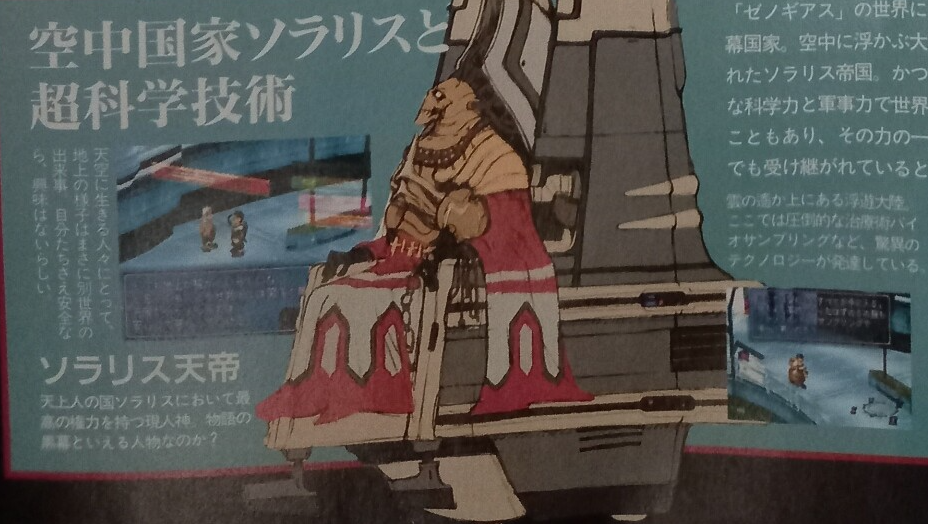
Hammer uses a rougher sprite that is also used in the 1997 demo.
(Images: The PlayStation Vol.82)
Famitsu #466#
Released on November 21st 1997. Most of the screenshots have already been featured in previous materials.
General Differences#
Story#
- Zohar is written as "Event Mutation Engine" rather than "Event Alteration Engine" like in Perfect Works.
- Zohar is described as having the capability to terraform planets. In the final game, only Deus is seen with terraforming capabilities.
Famitsu #467#
Released on November 28th 1997.
FMVs#
Screenshots of the Grahf, Khan, and Id fight showcase parts that were scrapped upon release. One screenshot in particular shows Khan in a fighting stance, indicating that the sequence may have shown his fight with Grahf.
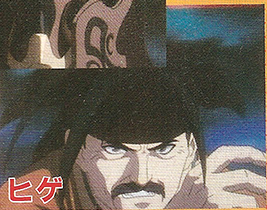
The text accompanying the screenshot also indicates that the placement of the scene was changed during development. At release, this FMV plays after Fei is arrested following the fight against Wyrm. However, the magazine states that this would have played when Fei leaves Citan's house, which explains why the background in the scene is a mountainous terrain. The original placement is further supported by its position as the first anime FMV in the final game's ROM and Saito's debug room in the Japanese version refers to the scene as "illusions on mountain roads".
(Images: "Famitsu" #467)

(Translation: linnaealyn)
Famitsu #474#
Released just over a month before launch.
FMVs#
This issue features screenshots of Alice and Dan that are never seen in the final release.
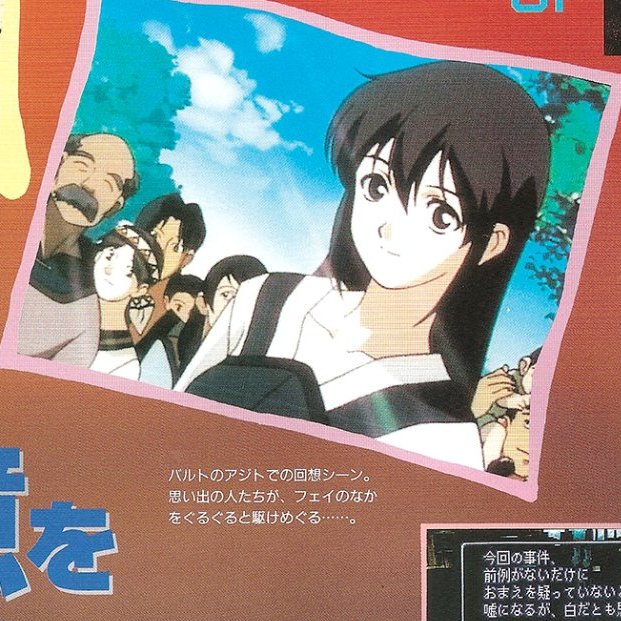
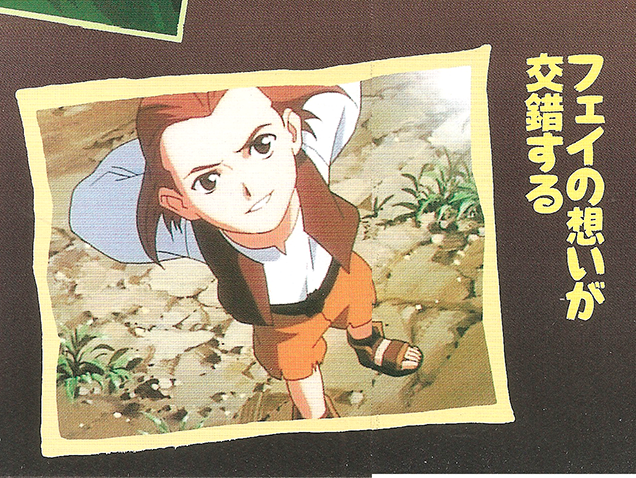
Translations of the captions accompanying the screenshots indicate that this was meant for an FMV that played in Bart's Lair. Text in the Japanese version of an entry in a FMV list in Saito's room can be translated roughly to "appreciation of friends", further supporting its purpose. This entry is between the sequence where Fei meets Grahf and when Id destroys Solaris, indicating where this would've been in the game's internal files.
There is also a screenshot of Elly and Sophia together in a sequence that is never seen in the final game.
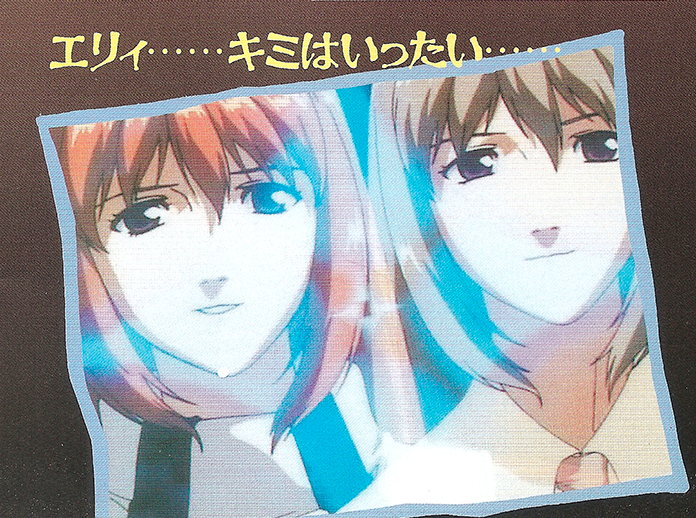
Translations of the caption for the screenshot read "Elly... who on Earth are you?" Between this and a lack of information in Saito's debug room in Japanese, it is unclear as to where this sequence would have played.
(Images: "Famitsu" #474)

(Translation: linnaealyn)
VJump (1/18/1998)#
Released just under a month before launch.
General Differences#
Story#
- In a section discussing Emeralda, Kim is referred to as Eric. According to Dengeki PlayStation volume 72, Kim is named after Kim Eric Drexler, who introduced molecular nanotechnology. Thus, it is clear that his middle name was used for Fei's Zeboim-era incarnation earlier into development.
- Elly was the one who piloted Weltall into Lahan, which would have crash landed due to her inability to pilot it. In the final game, it was piloted by an unnamed soldier, while Elly is using a generic gear that crash lands due to battle damage.
(Translation: linnaealyn)
GamePro (September 1998)#
Prerelease materials for Xenogears were donated to the Video Game History Foundation among other GamePro press assets between 1995 to 2004. While these were used for the game's North American launch in October 1998, there are several screenshots from earlier builds.
A screenshot shows an unfinished version of the sequence after Vierge is defeated. 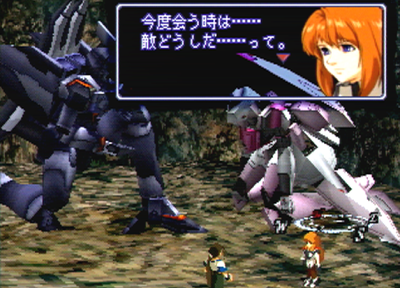
The compass is erroneously included despite a lack of gameplay in the sequence, and Elly is using her 1997 demo sprite.
A collection of screenshots showcases a beta Lighthouse. 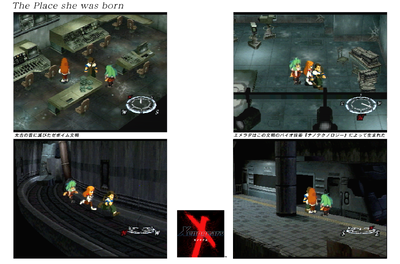
Elly is using her 1997 demo sprite, much like in the above screenshot.
This collection of screenshots shows Shevat and Elly at Taura's House. 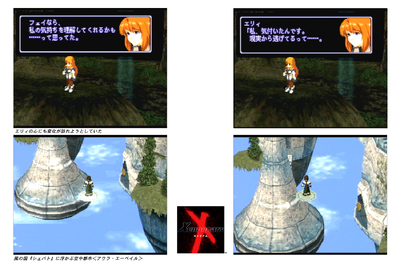
As is the case with the above screenshots, Elly uses her 1997 demo sprite. Oddly, Citan is not present in the Taura's House scenes unlike in the final game.
Another screenshot shows a clearly unfinished version of the unfinished Sophia portrait. 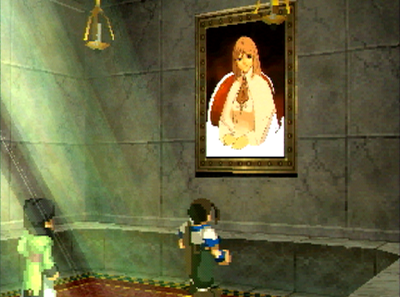
In this collection of screenshots, of note are the unfinished sprites for Elly, Rico and Hammer during the Goliath sequence. 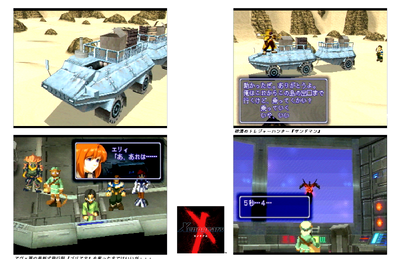
While Hammer's sprites match the one found in the 1997 demo's debug room, Elly's is noticeably cruder.
This collection of screenshots shows cruder sprites for Ramsus and Shakhan. Meanwhile, Miang is using Yui's sprite, presumably as a placeholder. 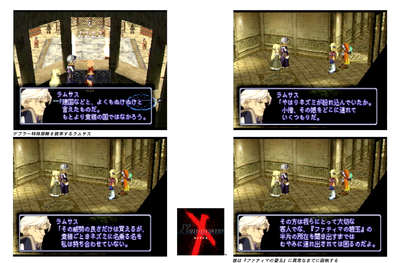
This collection showcases Weltall 2 and Andvari. 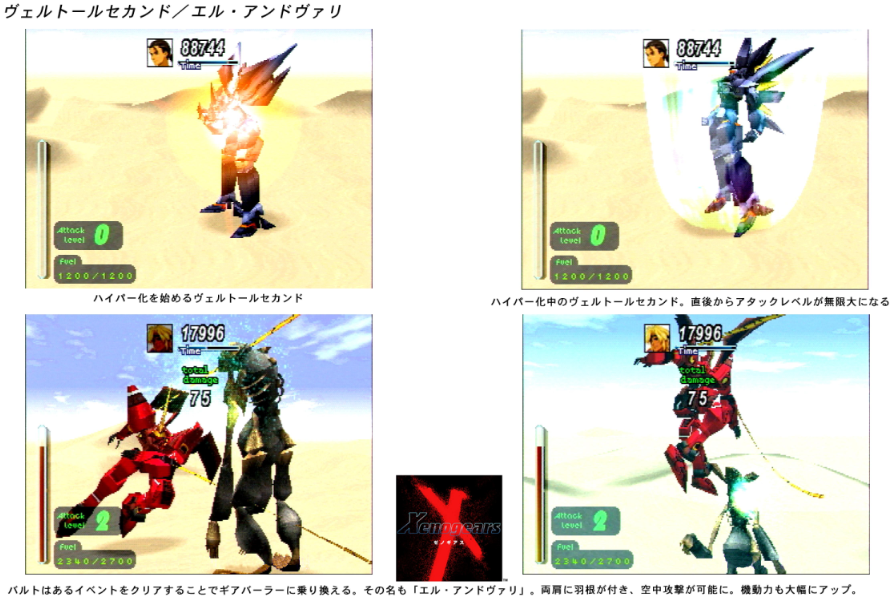
As font is the same as that of the 1997 demo, the screenshots were taken from a prerelease build.
Many screenshots of the Thames are available. 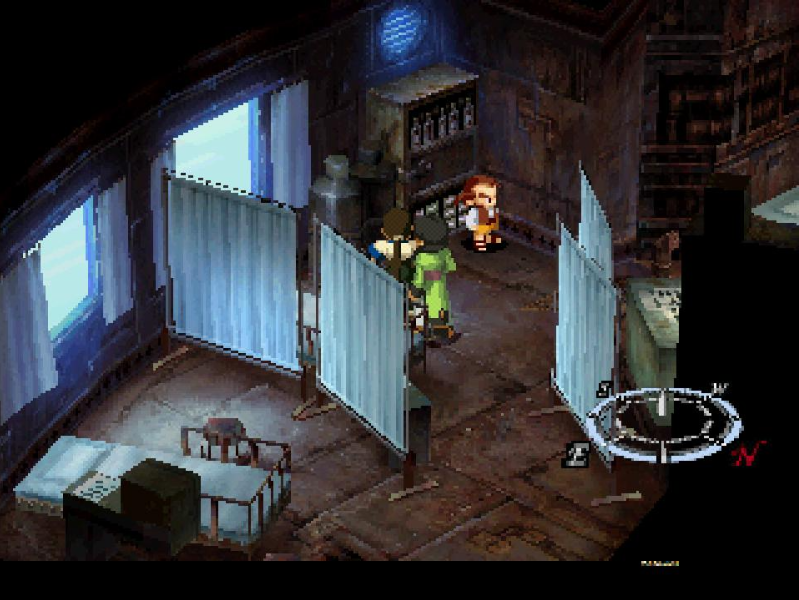
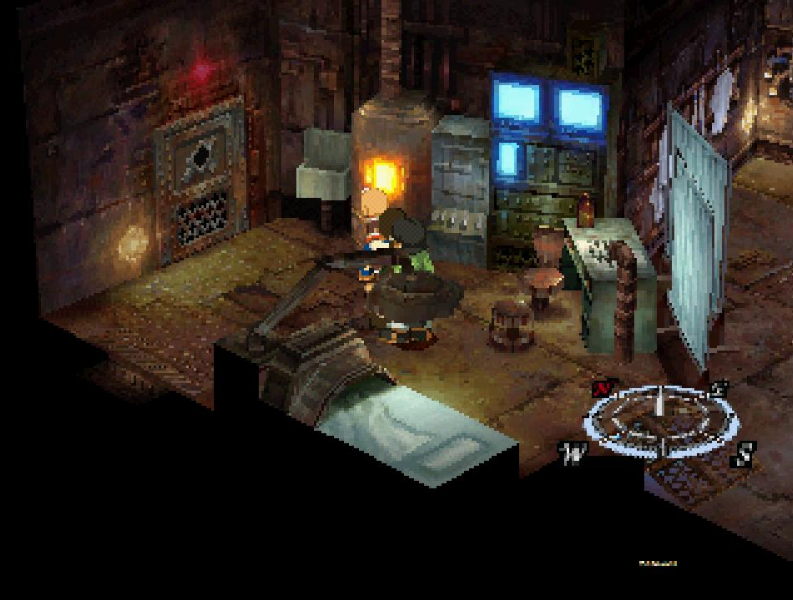
Much like with the use of Yui instead of Miang, Dan and Chief Lee act as placeholders for the NPCs used in the final game.
The final screenshot with notable differences from the final release showcases the Thames overworld map. 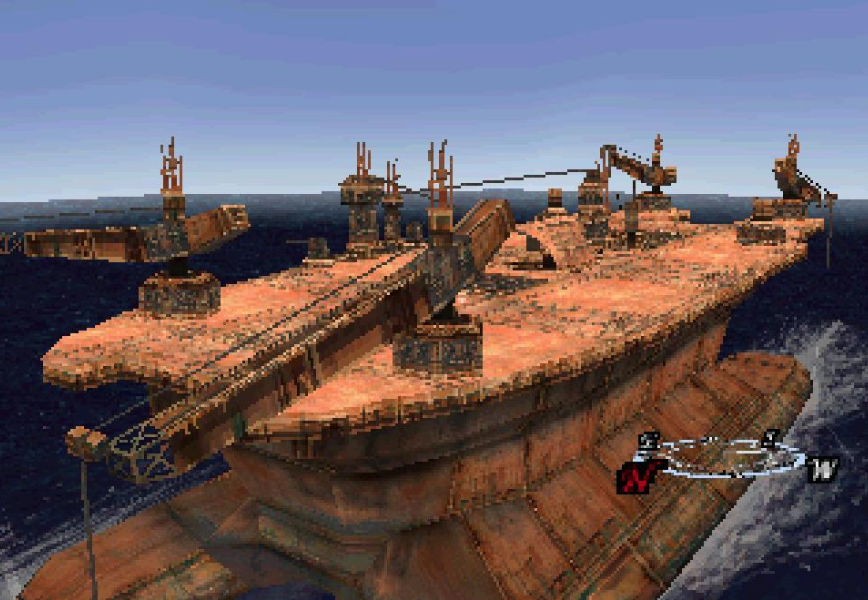
None of the markers or salvager gears are shown, which indicates that the map is in an unfinished state.
(Images: "GamePro" September 1998)
References#
- Les Légendes Xenogears & Xenosaga. Monolithes brisés↩︎
- Soraya's FAQ's from 2005 archived by A.C.↩︎
- Hakoere Vol.20 Special Interview translated by Lugalbranda.↩︎
- Why ‘Xenoblade Chronicles 2’ Has a Character Designed by Tetsuya Nomura.↩︎
- IGN.com - TGS: No Xenogears for US↩︎
- Famitsu #455↩︎
- Xenogears Famitsu advert↩︎
- Battle system patent↩︎
- Field movement patent↩︎
- Screen navigation patent↩︎
- SQUARESOFT.com - Press Release: Title Announcements↩︎
- SQUARESOFT - Press Release: Xenogears Released↩︎
- Xenogears Perfect Works: The Real Thing↩︎
- sorayatokyo↩︎
