 This article has a talk page!
This page details pre-release information and/or media for The Elder Scrolls IV: Oblivion.
Development#
(overview of Oblivion's development goes here)
(commentary on the early map seen at E3 too)
(also touch on technology cut from final game e.g. stencil shadows and radiant AI)
More Intricate Dialogue#
There are many leftover topics that indicate that a lot Oblivion's NPCs were once meant to have more intricate dialogue. Your average NPC in Oblivion has two unique lines of dialogue: one that's set as their greeting, and one that's usually about their place of residence. It's the latter of these two that was meant to go way more in-depth. Instead of just having a single "Imperial City" or "Chorrol" topic to choose from, many NPCs were apparently meant to have 2-4 different questions the player could ask. Only a handful of NPCs in the final game still give the player different options when spoken to about their place of residence, notable examples being Skingrad's Else God-Hater and Bravil's City-Swimmer.
Most of these topics generally revolved around the same content, you could ask innkeepers about the local Count(ess), local trainers or services, and rumors. Although, it does seem that the system wasn't completely limited to innkeepers, as a lot of different NPCs of various professions often have these leftovers. This indicates that either Bethesda just chose who got more dialogue at random, that not all NPCs got this much dialogue before the scale of the system was cut down, or that the majority of the NPCs had these empty topics deleted.
Something of note is that a lot of characters that are known to be "talkative" in the final game, such as Ita Rienus, Tun-Zeeus and Dar Jee now don't really exhibit these qualities. The former two have unused topics showing them rambling on if the player doesn't stop them, and the latter would have a lot more jokes to tell. Also of note is that a majority of the affected NPCs have a response in the final game that lines up perfectly with one of the unused questions, showing that Bethesda just repurposed that dialogue for the generic city topic. A handful of NPCs that don't have leftovers topics also suffer from this, so it's possible that they had their topics completely deleted as well.
Lastly, there are some traces that specific dialogue or events would have an impact on NPCs. gaturnScript, a basically pointless script attached to Gaturn gro-Gonk, has a very intricate mood and activity system set up for him, based on if he won money betting that day. If he won, he would celebrate and even offer the player a drink. If he lost, he would not talk about Chorrol for a day, possibly having replacement dialogue blockers set up. Gaturn's script is very old, and he's the only NPC with such an intricate response set up, even if it doesn't do anything in the final game, it's an interesting look in what was once meant to be.
This more intricate dialogue setup was cut because it inflated the amount of voice files too much, as revealed by a developer comment in a script called NQDAnvilNPCScript. It states: "feature deleted when voice files were reduced" when referring to a commented out value called "DumaniaInsulted". Leftover topics show that it was indeed once possible to insult the local Primate, Dumania Jirich, and it's clear that this was supposed to have some kind of effect on her. It's unclear if the reduction of voice files mentioned here refers to the same event in which most of the arena content was removed, or if this was a separate problem the team encountered earlier on.
The Return of Holidays#
At one point during development, the team wanted to include holidays as a special event in the game world. Holidays first appeared as world events in The Elder Scrolls II: Daggerfall, but would never really make a return in the main series. Concepts were brainstormed on how each city would celebrate their holidays, and even some dialogue was recorded, before the idea was ultimately discarded. In a sneaky move, it seems that the team really wanted to power through and get the concept finished to at least be sold as DLC, before it was put down, once and for all. Pete Hines stated multiple times that holidays were one of the first DLC to come to the game, alongside the horse armor DLC. However, after the latter's release, it was never brought up again. The only trace of something ever being made for it exists in the form of random voice files.
Sutch#
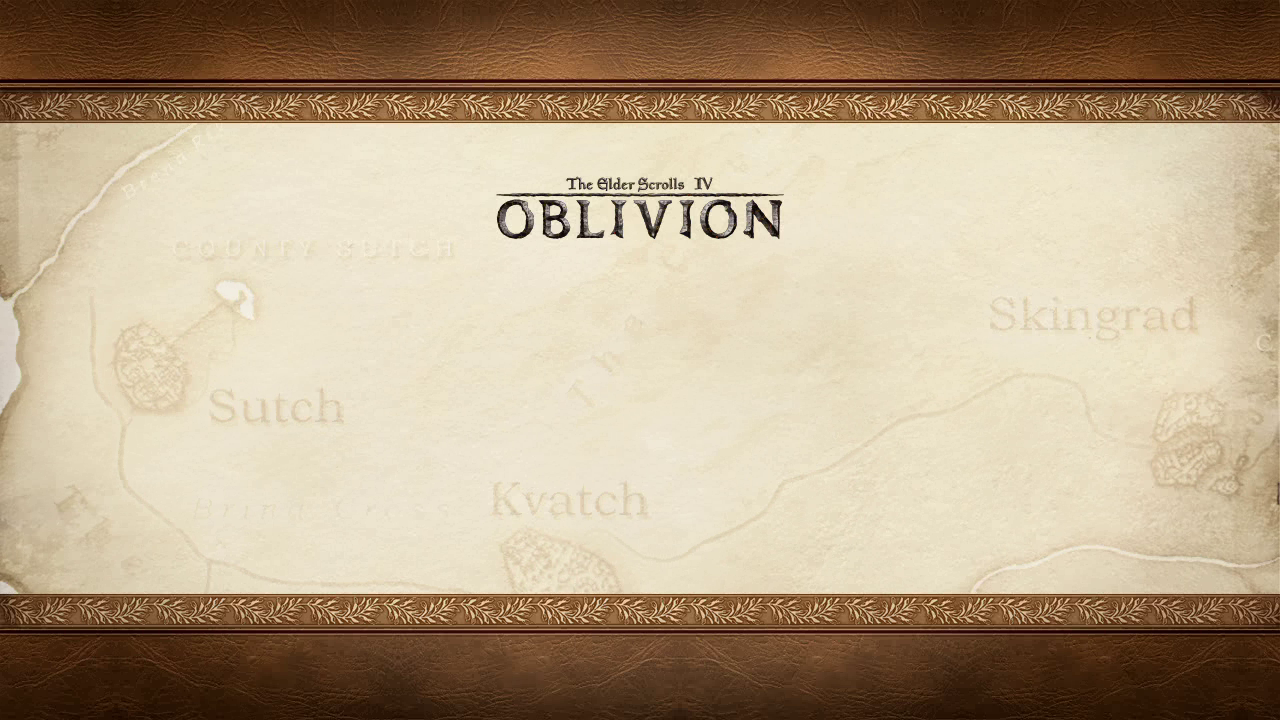
The city of Sutch was meant to be another big city in Cyrodiil, and the seat of power in County Sutch. While it was planned to be included originally, it seems that it was removed rather early on, and very little of its existence actually remains in the game files.
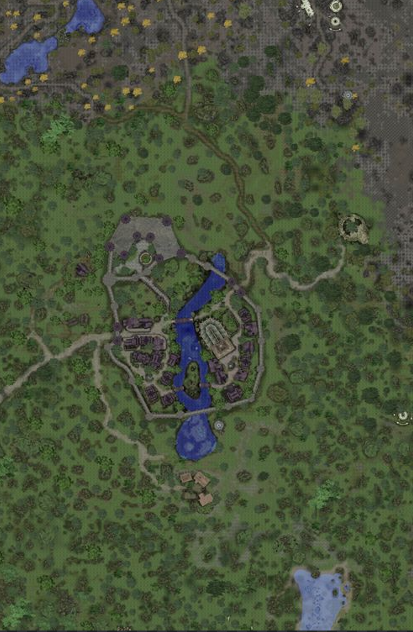
It was first seen during Bethesda's E3 2005 showcase of the game, on the game's main menu. That video can be seen above. The city's representation on maps is basically all we know about how it would've looked. Still, it might have looked different had it been included in the final game, since it seems that Cyrodiil's cities got reduced in size by the time of release. The thing that's the most notable about Sutch is that the city seems to be directly connected to a lake of some sort. In the showcase, Todd Howard also shows off the fast-travel mechanic, which uses the same early map as the menu screen, but now adjusted for gameplay. On this map, multiple map markers are shown, and all the cities shown have the "city" type marker. All cities, except Sutch, which has a "Fort" type marker. While it can only be seen briefly, and doesn't tell us anything concrete, it's highly possible that by the time of this E3 demo, the city had already been removed from the game.
In the game there's only a single cell leftover that still references the city, and that cell is known as "CountySutchDocksExterior". This cell is actually used in the game - though its northwest corner is out of bounds - and it doesn't contain docks of any sort. It does contain a river that leads out to the Abecean Sea, so that's something. The cell is also located to the west of where the city of Sutch was located on the E3 map. It's possible that the walkway with the lake that was northeast of the city on the map was eventually reworked into these docks, with a walkway intended to go from the docks to the city itself.
Speaking of the city, that got replaced by a fort of the same name, Fort Sutch. The usual generic fort in Oblivion has one exterior cell and one interior cell. Fort Sutch has four exterior cells, "FortSutchExterior", then "FortSutchExterior02", which is just an empty space of grasslands in the final game, despite still playing dungeon music. But more interesting are "FortSutchAbbeyExterior" and "FortSutchCastleExterior". While a Fort Sutch Castle is never mentioned, Fort Sutch Abbey can be mentioned by Teinaava during the quest "Bad Medicine". If you ask his advice and he likes you, he will say "Fort Sutch? I am familiar with that place. It is nestled deep in the mountains. It is naturally well defended, but there is a weakness. Not far from from the ruins of Fort Sutch lie the ruins of a tower. That tower was once part of the Fort Sutch Abbey. The two ruins lie apart on the surface. But underground, they're connected by some now-flooded tunnels. Wet and dark, yes... but surely unguarded." Regardless, these cell names indicate that the original Fort Sutch likely was intended to be significantly bigger. The exact dimensions of the city can still be seen if one looks carefully: the area around the fort is barren and flat, indicating something else once stood there. By looking at these leftover borders from the city and compare how close Lord Drad's Estate is located to them, we can get an idea of how much the original Cyrodiil map was compressed.
There is a single person in the final game that we know for certain was meant to reside in Sutch at one point: Azzan, the head of Anvil's Fighters Guild chapter. One of the quests that he gives you, "The Wandering Scholar", has the following journal entry: "Azzan has given me a contract to escort Elante of Alinor, a scholar doing research on Daedra. I am to meet her at the entrance to Brittlerock Cave, northeast of Sutch, and protect her while she explores inside."
Of course, this isn't any definitive proof, but it is odd that Sutch gets mentioned here. But, the next journal entry from a later Fighters Guild quest "Mystery at Harlun's Watch" is more definitive. It reads as follows: "Burz gro-Khash has paid me the balance of the contract. He tells me that he has no further contracts to offer, but I should speak with Azzan in Sutch, if I have not already." This confirms that Azzan was meant to be a Fighters Guild head in Sutch, rather than Anvil. It's possible that other NPCs were similarly moved, but there's no definitive proof for any of them.
We can also make an educated guess that since every divine has a chapel in the final game, Sutch would probably have a chapel of Kynareth, since she's the only divine that doesn't get represented otherwise. A gate next to Fort Sutch, in the cell "MS94OblivionGateExterior", also is guaranteed to open at the same time as those next to each city - indicating it was intended for the city of Sutch. Finally, one other place of note is "Brina Cross". It's a placed that appears marked on the early map, and is seemingly named after the crossroads formed by roads from Sutch, Kvatch and Anvil. In the final game, there is a "Brina Cross Inn", which is a weird hodgepodge of content and was likely placed there to cover up the otherwise barren landscape.

In the Making of Oblivion documentary1 a board with concept art of all of Oblivion's cities can be seen in Lead Artist Matthew Carofano's cubicle. Tantalisingly, he's even seen gesturing at Sutch in the documentary's intro, presumably from an extended interview that was trimmed down. Although small and far from the camera, a basic layout of Sutch can be interpreted, including the chapel on the west side of the city, the arena (maybe) in the southwest corner and the castle covering the north. Most importantly though, contrary to the E3 map, the city was intended to be built on an island or peninsula, with the road/walkway to the lake actually being a bridge over the mouth of a river. The "CountySutchDocksExterior" cell could have been a remnant of Bethesda's original concept for Sutch. For this geography to have existed in-game the city and its environments could only have seen dramatic changes; what's left of Sutch in retail is landlocked. There are several inconsistencies here; in retail Oblivion the distinct outline of the city (as a large, featureless area) can still be seen with rocks placed around it in a manner strongly suggesting the city existed in some form at the time they were placed. Despite this, the lake and northeast bridge out of the city are still present on the E3 map. It's possible that the city saw two iterations before being cut and scaled back in ambition (like other cities e.g. Leyawiin) prior to being cut entirely.
City Concepts#
(overview of city concept art and how they changed in final game, also in-game remnants of original grander vision for cities)
Bethesda originally had a much grander vision for the cities of Oblivion. Firstly, every city (bar likely the Imperial City) was intended to be situated within the main Cyrodiil world rather than a separate instance entered through a loading gate. Many of the early layouts conceptualised relied on the cities being open for rivers, docks etc. and it's plausible that many of the developers' ideas were scaled back as it became apparent what limits the hardware of the time would set.
Secondly, every city in the game was intended to have its own arena. This topic is already covered on this wiki but it's worth mentioning the arenas as they were cut were not the first iteration of arenas in Oblivion; concept art depicts open amphitheatre-style arenas not separated from the streets of their respective cities by a loading barrier.
The earliest known map of Oblivion's game world Cyrodiil seen at E3 and in the unused menu screen uses the original concept art maps for cities.
Anvil
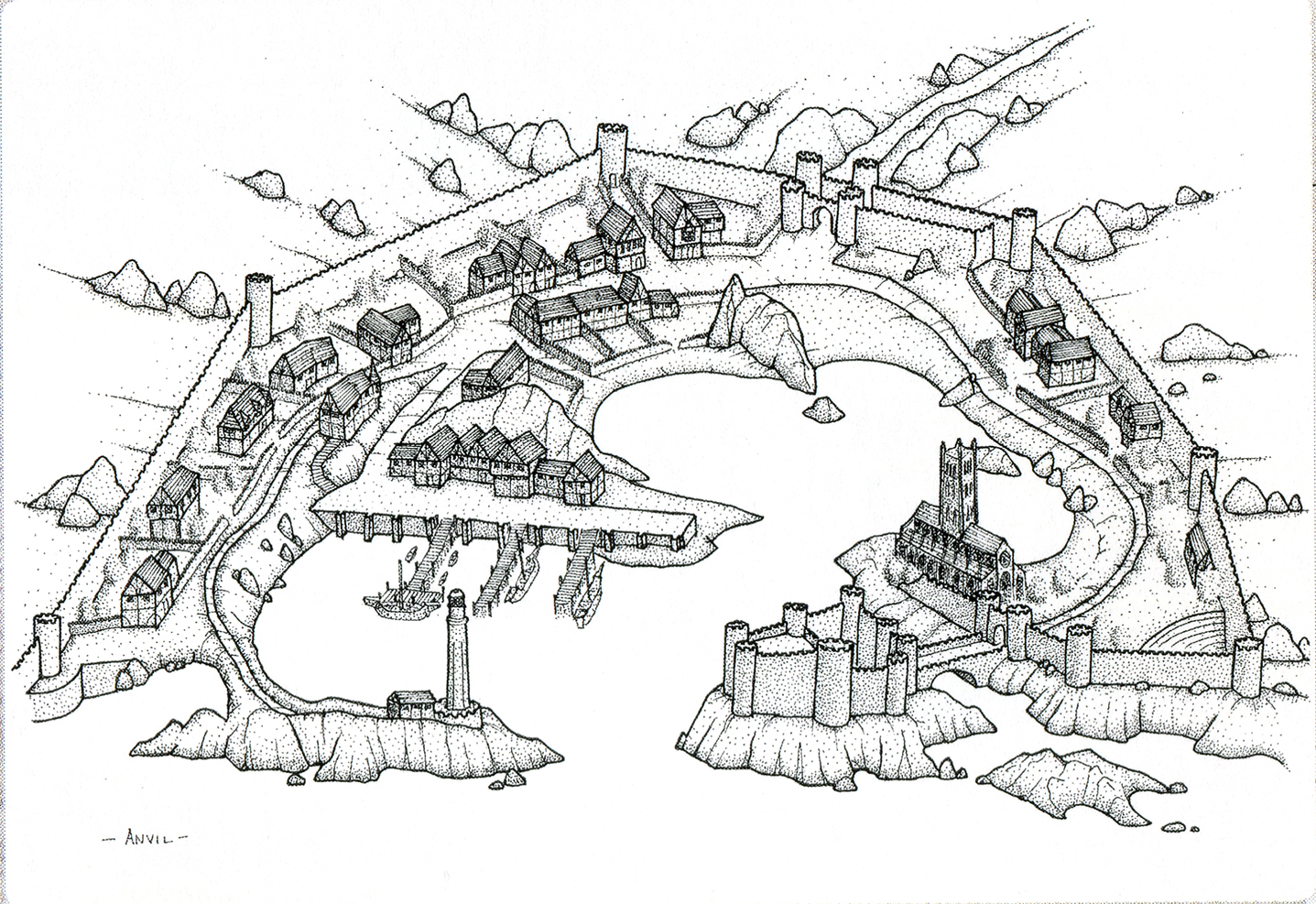
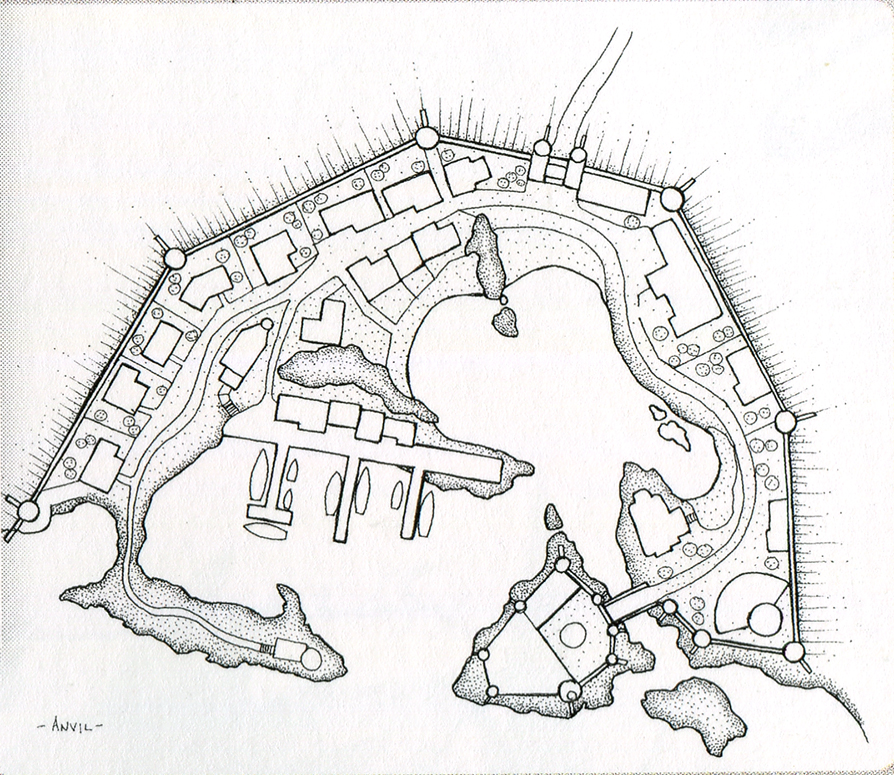
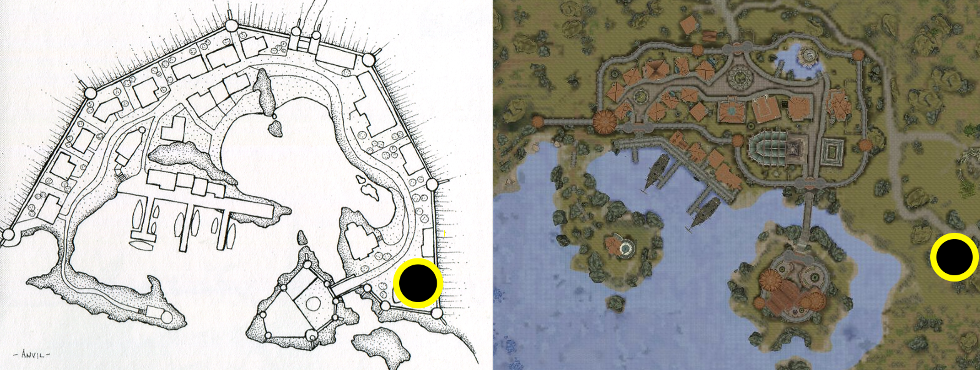
Anvil overall was not radically different from paper to what the player explored in the finished game with the main differences being scale and the relationship between the main street and the waterfront. When the city was in the Cyrodiil world it there wasn't such a distinction between the docks and city proper and the streets wrapped around an enclosed harbour. The retail Anvil seems to have generally been compacted inwards, with the road sweeping south-east with the arena and Chapel absent. The existence of a cell named AnvilExteriorArenaA located roughly where the arena would be per concept art suggests this more open and expansive Anvil was at one point being worked on in-game. This earlier iteration of the arena shouldn't be confused with the final arena that was cut, which would have been where the mermaid statue is.
Cheydinhal
Cheydinhal didn't see any dramatic changes (aside from the arena getting the axe) but concept art does provide an answer to the mystery of its river, which is apparently a tributary of the Corbolo River. In-game it starts and stops immediately outside the city walls with no obvious source. In the cut early menu screen map a low-res rendition of the concept map for Cheydinhal can be seen, with the river's source seemingly being a lake north of the city and the river then flowing south from the city to join the Reed River and eventually exiting into the Niben. Why the river was chopped up is unclear but it might have been down to difficulties with portraying a river that matches changes in terrain elevation. There's another curiosity in Cheydinhal in the cell named CheydinhalExterior13Cathedral outside the city walls in CheydinhalWorld south of the player home, but the concept map available is too indistinct to try and compare.


Chorrol
Leyawiin
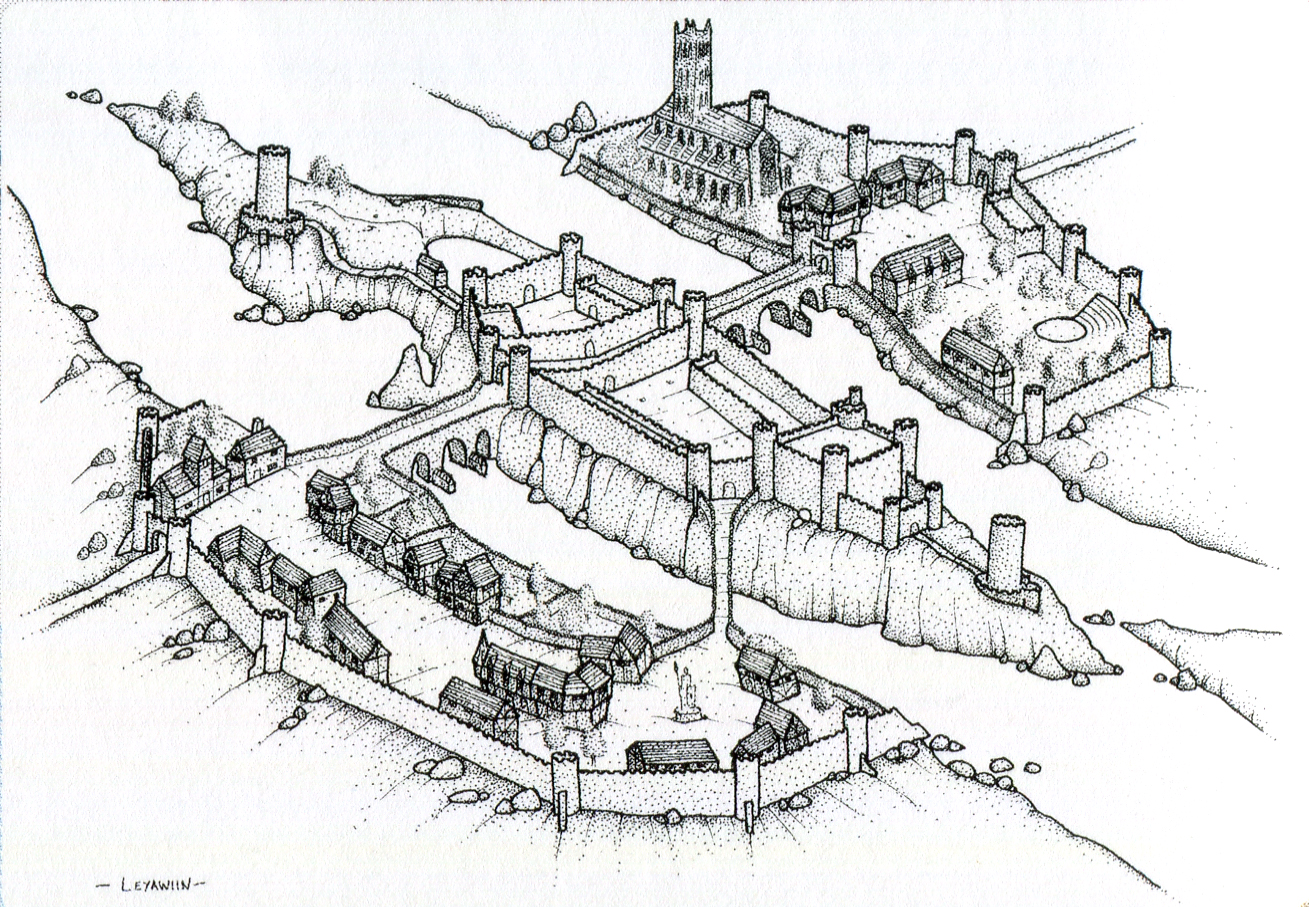
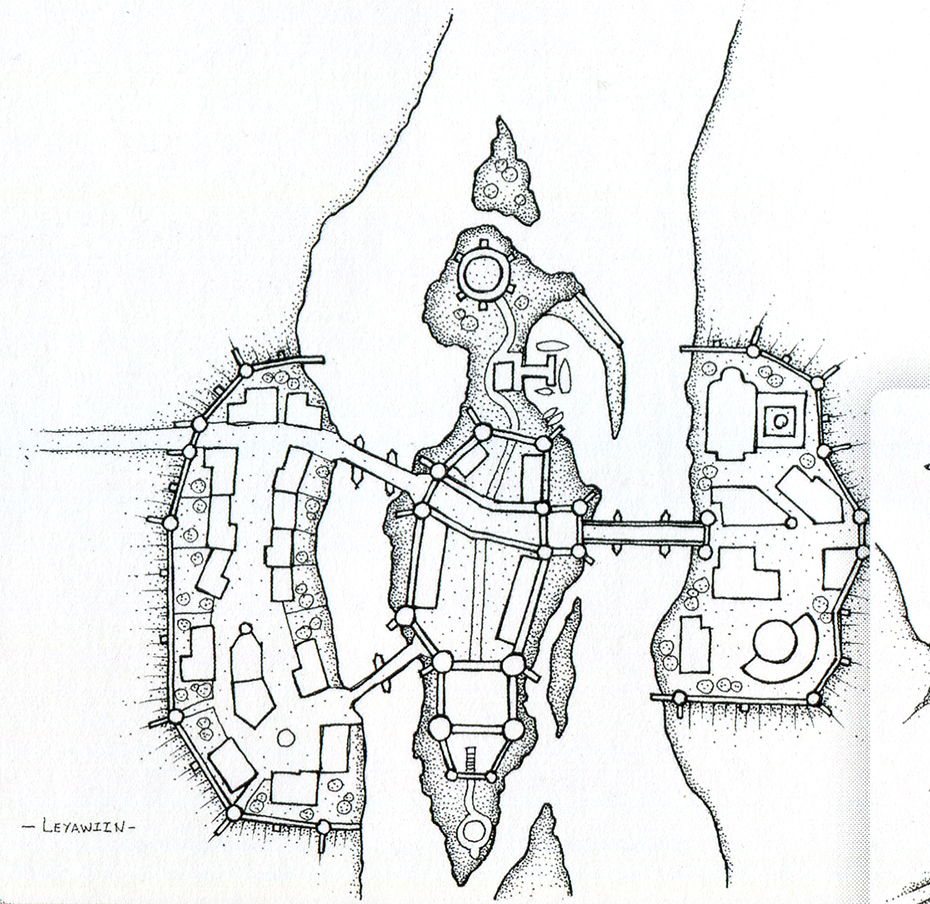
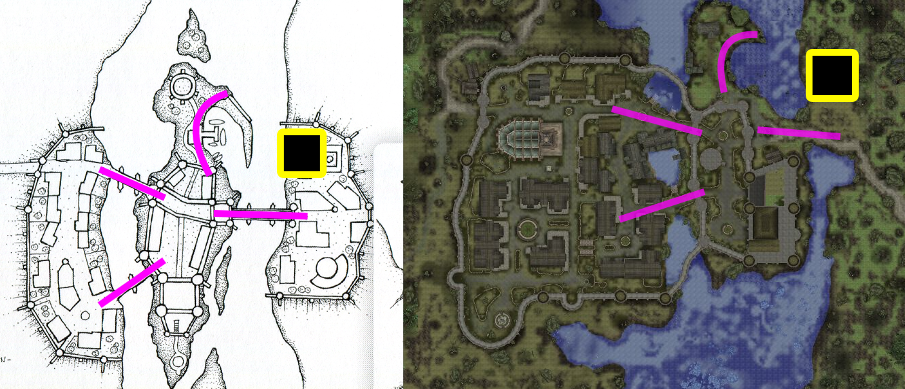
Leyawiin as it appears in-game is strange; it bisects the Niben River in a such a way that passage for ships or the river at all is impossible, seemingly a huge oversight. Concept art shows a layout that makes a lot more sense, with the city split over both banks of the Niben and the castle occupying an island in the middle, connecting them with bridges. This basic layout still exists in-game with "land" bridges taking the place of actual bridges and the planned urban area on the east bank seemingly merged into the west side. There's evidence the concept art layout existed in some form during development with a cell named LeyawiinExterior07Cathedral covering where the Chapel of Zenithar would have been on the cut east side in concept art.
Kvatch
Kvatch was like Skingrad planned to have the Gold Road pass through the city from a north gate and exit through the south. In retail there's only a south gate and the city sits atop a high hill adjacent to the road which probably suited the kind of linear, combat-oriented, story-driven gameplay of Kvatch better. The arena was also at one point moved from west of the entrance street to the centrepiece of a battle in the north-east of the destroyed city. This is suggested by concept art and indeed the cell for the retail arena in KvatchPlaza world is named Kvatchnewarena. Interestingly, the cell with the Oblivion gate outside in the main world is named KvatchOblivionGateNEW implying this wasn't its first location. In the E3 demo the Oblivion gate is sitting in the ruins of the arena but this might not have any significance.


Imperial City
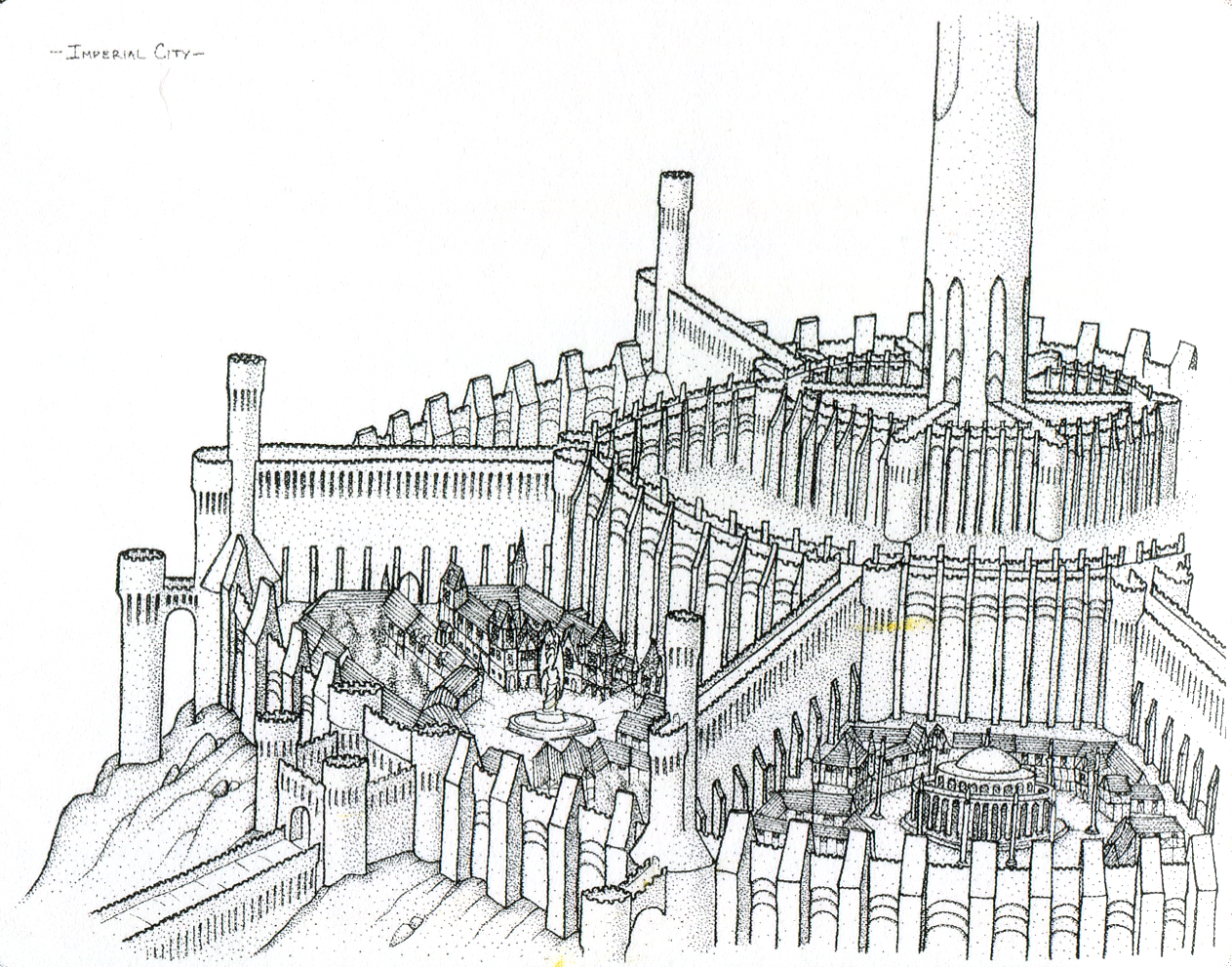
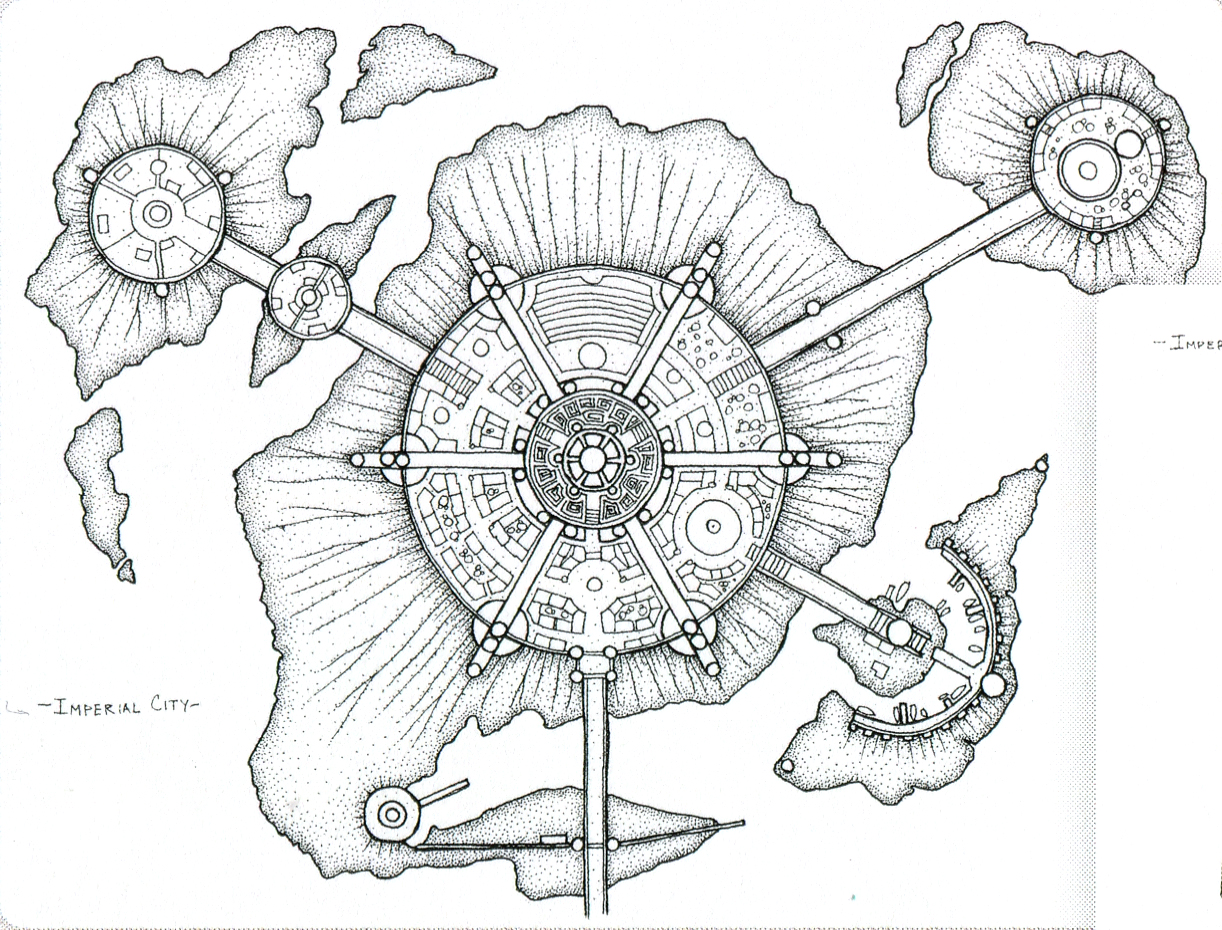
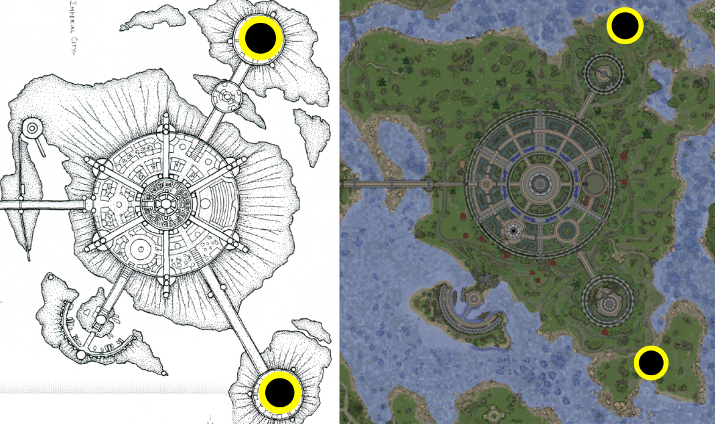
The Imperial City transitioned from concept art to retail release without any dramatic alterations, the most significant change probably being the merging of the Imperial Prison and Imperial Legion Headquarters into a single district. The Arcane University was also much further out from the city proper. There's evidence in the cells ICPrisonEntrance and ICArcaneUniversityEntrance to imply that both of these aspects of the concept art were at least laid out in-game. Furthermore, every cell in the ICImperialPrisonDistrict world has the prefix "ICImperialHQ" rather than say, "ICImperialPrison". Also, the building housing the actual prison is named The Bastion in-game with an EditorID of ICImperialLegionTheBastion
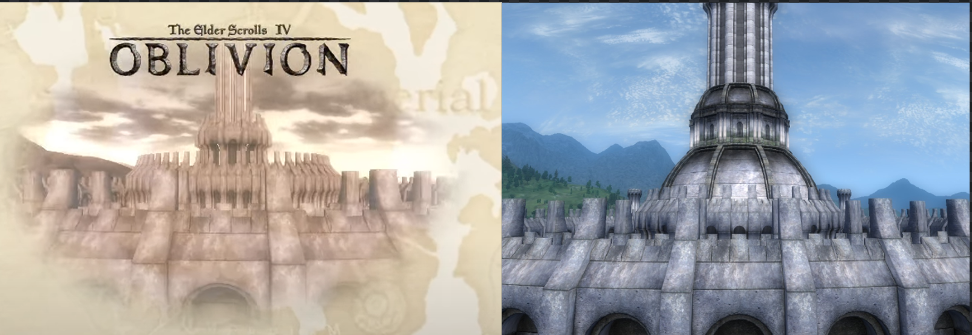
Concept art depicted the White Gold Tower with a narrow base surrounded by an even smaller ring wall enclosed within the inner city wall. In retail White Gold instead sprouts from a domed building containing the Elder Council. This earlier layout can be seen in the E3-era menu screen and might explain why the Elder Council chambers have impossible windows that face into a surrounding corridor. Unrelated, but the the Palace Basement's EditorID is PalaceCrypt.
The concept map depicts some sort of tower and enclosed bay beside the Tiber Septim Bridge, what purpose this served is unclear but the inlet is still visible in the final game.
The Waterfront was connected to the Temple District by a road and this is visible even on final retail fast travel map. Presumably Bethesda decided to spare players the bother and just have a teleporting tunnel instead.
Despite playing such a central role in Oblivion's story the Dragonfires seem to be physically absent in retail, or at least it's not immediately obvious where in the Temple of the One they are. Concept art appears to depict eight fires on tall columns surrounding the Temple.
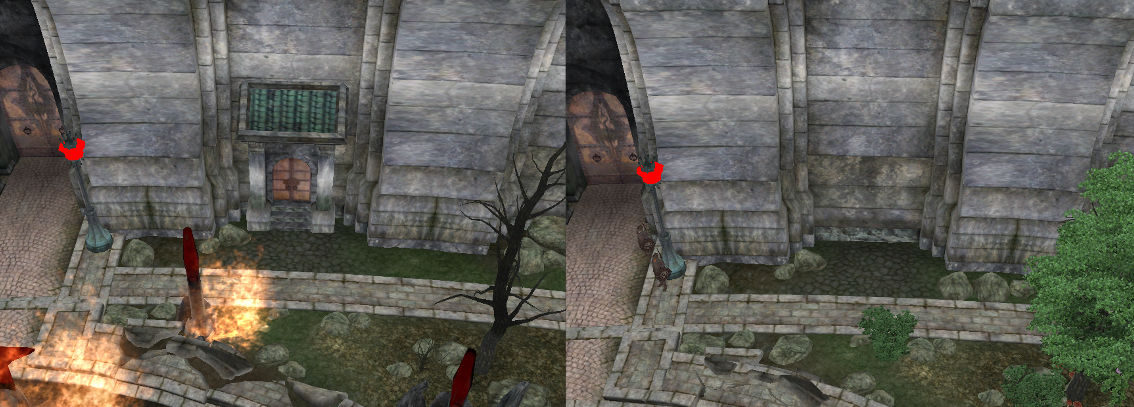
During the final battle in the Temple District there's a door set in the city walls beside the Waterfront gate. This entrance is exactly the same model used for Dareloth's House unlocked after completing the Thieve's Guild quest. Accompanying ground textures for the door are still present in the regular Temple District, suggesting it was a late cut.
Curiously the concept map as drawn is rotated clockwise 90 degrees with the Waterfront closer to the Niben and the Imperial Prison closer to Chorrol, and the city's entrance facing south. If this was intentional there's no trace of it in-game or pre-release materials.
Skingrad
Concept Art#
(gallery of concept art)