This article has a talk page!
This page details pre-release information and/or media for Doubutsu no Mori.

Development Timeline#
2000
- June 5 - Shigeru Miyamoto tells IGN that he is working on a "communication game" for the Nintendo 64.
- August 25 - Doubutsu no Mori is shown off at Spaceworld 2000, with a release date of February 2001.
2001
- April 14 - Doubutsu no Mori is released.
Initial Concepts#
Though many of the ideas like a working clock were thought of early in development, Doubutsu no Mori originally had a lot of RPG elements.
The game was initially developed for the Nintendo 64DD in order to take advantage of the system's memory and real-time clock, but was moved to a standard N64 cartridge due to the add-on's failure. This resulted in many of the intended features and elements having to be reworked or scrapped.
2000#
August#
Doubutsu No Mori was first revealed at Spaceworld 2000 with several differences from the final game:
- The bulletin board was near the Bell Shrine instead of the four houses in which the players live.
- Some of the house exterior colors seem to have been removed.
- Some of the names and phrases for villagers seem to have been changed.
- Kiki: In the early version her name was アンチョビ (Anchovy), whereas in the final game her name is キャビア (Caviar).
- Olivia: In the early version her name was ラメラメ, which could mean "lame lame". In the final version, her name is オリビア, which is her English name in Katakana.
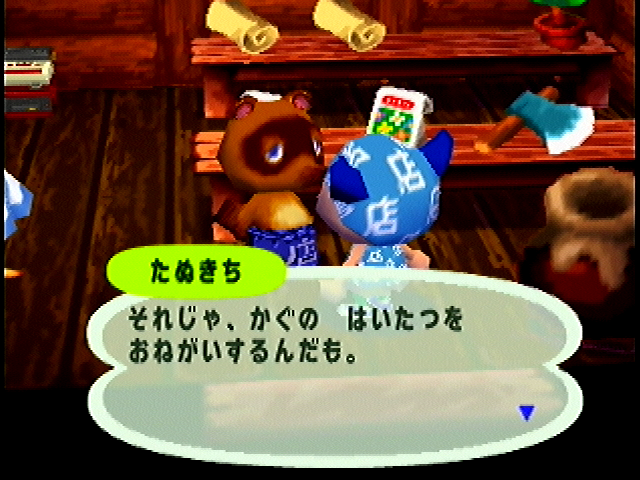
- Nook's Cranny features a different set of wallpaper and flooring, looking similar in style to a log cabin, and the work uniform consists of "店" ("shop") repeatedly written in white atop a sky blue backdrop. A screenshot depicting these differences is included in Nintendo's official press kit for the demo.