 This article has a talk page!
This page details pre-release information and/or media for Donkey Kong 64.

|
To do:
|
Over the course of two-and-a-half years, Donkey Kong 64 transformed from a scrolling platformer into an open-world adventure. Somewhere along the line, a supermarket's worth of collectibles found its way in as well.
Development Timeline#
- Late 1996-Early 1997 - Development begins.
- c. Mid-1998 - Work on the 2.5D version ends in favor of a 3D free-roaming approach.
- 1999
- January - The game is officially announced with a screenshot in Nintendo Power.
- May 12 - Nintendo announces that the Expansion Pak, now a requirement for running DK64, will come bundled with the game.
- May 13-15 - A custom build is shown off at E3.
- August - The E3 build makes a reappearance at Space World.
- September - An in-store demo is released.
- October 1 - Nintendo sends a letter to Rare requesting the removal of Stop 'n' Swop.
- November 22 - The final game is released.
Conception and Early Development (1996-98)#
Work on what would eventually become Donkey Kong 64 started somewhere between late 1996 and early 1997, just after the team had finished Donkey Kong Country 3.123 Following the precedent set by previous titles, the game was originally conceived as a linear, fixed-camera platformer similar to Klonoa or Crash Bandicoot, featuring a mix of sidescrolling and forward-scrolling sections.4 However, the team was still new to 3D development, and "weeks and weeks" of work would result in extremely short levels that could be completed with minimal effort. After about a year and a half, it became apparent that the game in its current form was a lost cause (though lead artist Mark Stevenson asserts that, given it was the N64's early period and there was no common framework yet, the same amount of time would have been spent "getting stuff up and running anyway"). Observing the trend of 2D series going the Super Mario 64 route in 3D, the team decided to scrap what they had and start over with a similar approach.
Contrary to popular belief, the game was never in development for the 64DD add-on. While IGN and Gamespot did report in 1997 that a disk-based Donkey Kong title was being developed for release in 1998 (citing Dengeki Nintendo 64 as their source), artist Carl Tilley (among other developers) deconfirmed this in 2024, stating there were no specific plans for 64DD support and that Rare's management wouldn't have seen any financial benefit to it.567 (In hindsight, the notion of DK64 being a 64DD title also conflicts with Nintendo's desire to use it to sell the Expansion Pak (see below), as the 64DD unit already came bundled with one.)
Donkey Kong World (1998)#
To accommodate the new direction, the game's design and software leads were switched out for Banjo-Kazooie co-designer George Andreas and an unnamed programmer (likely either Blast Corps lead engineer Richard Wilson or Diddy Kong Racing software director Robert Harrison, as both were on the development team and DK64's engine appears to share DNA with both titles).8 Banjo and GoldenEye 007 composer Grant Kirkhope was asked to help DKC3 musician Eveline Novakovic (née Fischer) with the audio work, and eventually took over the music side (with Novakovic providing sound effects).910 He later stated that, while it was perhaps not the best decision in hindsight (with Banjo-Tooie and Perfect Dark also in the pipeline), he did it anyway because he was friends with Andreas and enjoyed working on the series.1112 All three developers had prior N64 experience, which would have made them an asset to this project.
During this time, Rare had already released a successful 3D platformer that carried on some of Donkey Kong Country's traditions in Banjo-Kazooie, and so one of the team's main priorities was distinguishing the Donkey Kong series in a 3D setting. For Rare co-founder Tim Stamper, that meant emphasizing item collection above all else:
"Banjo-Kazooie had a lot of great things about it, so one of the first things [Tim] told me was 'Make sure there's lots to collect'. I'd always go back to him and say 'Here's some' and he'd go 'No, more things'. We had to make it as much of a collect-a-thon as possible to help try and differentiate it."
- George Andreas13
Furthermore, DKC's trademark tag-team gameplay had already been replicated in Banjo to a degree, so the teamwork aspect was dialed up several more notches, utilizing a party of five swappable characters to allow for new approaches to level design and puzzle-solving. (A 2-player co-op mode was known to have been planned at some point, but was cut due to performance issues and generally not working in 3D.)Rarewhere: Bumper Festive Scribes - Rareware.com, Dec. 23rd, 1999
Banjo was also noted for its more laid-back tone, so exploratory segments in DK64 were broken up by grandiose boss battles and what Andreas termed "thrilling moments" - fast-paced challenges, such as minecart rides and slide races, that harkened back to similar gauntlets in the DKC trilogy. For his part, Kirkhope deliberately veered away from the Elfman-esque "oompah" style that characterized Banjo to give the game a more traditional DKC sound (finding a use for some of his scrapped Project Dream compositions in the process):14
"In my head, I had to try and separate Banjo-Tooie from DK64, and I always felt DK64 was a darker game. Dave Wise's soundtracks had some moody parts to them, so I felt like I needed to bring that moodiness back into DK64."
- Grant Kirkhope
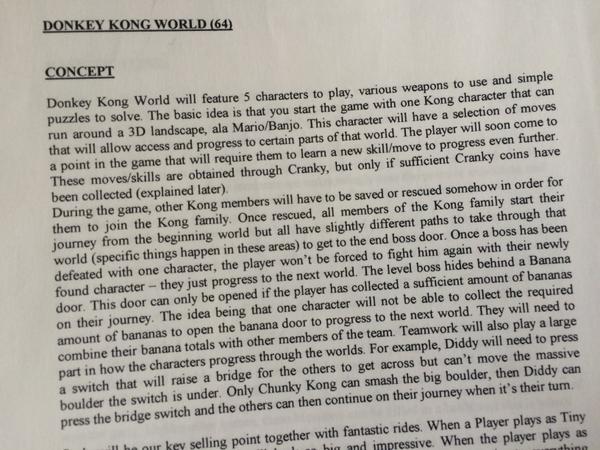
Part of the design document for this iteration was shared by Kameo programmer Nic Makin on Twitter in 2015.15 It describes the final game fairly accurately, aside from a few tweaks:
- The overall structure is a bit more linear, as levels are described as ending with a boss door that each Kong takes a "slightly different" path to. It's possible that the Kong Exit Doors were a remnant of this design.
- Cranky's upgrades are paid for with special "Cranky Coins", rather than the regular Banana Coins.
- There appears to be no distinction between regular and Golden Bananas.
- Bosses hide behind "Banana doors" that are opened by collecting a certain number of bananas (analogous to Troff 'n' Scoff boss doors in the final game, but could also refer to B. Locker's progress gates - see above). Beating these bosses allows direct progress to the next world, with no mention of a go-between such as K. Lumsy.
The DK Rap#
|
|
To do: |
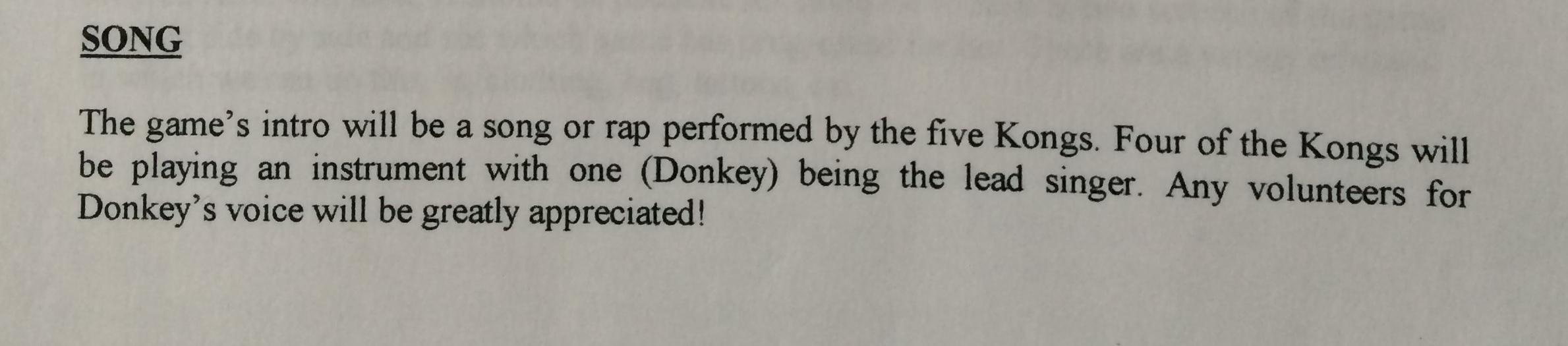
One of Andreas' ideas, said to have stemmed from a lunchtime joke between him, Kirkhope, and DKC/Banjo software lead Chris Sutherland, was to open the game with a musical number that would combine the themes of Donkey Kong Country's opening (the transition from an old platform/generation to a new one) with the tongue-in-cheek humor of Banjo-Kazooie's "hoedown" sequence.1617 Originally this song was to be performed by the Kongs in a band, with Donkey Kong as the lead singer;18 while this aspect would be dropped, the final game has the Kongs make use of weaponized musical instruments, which may have tied into it at one point. Eventually the concept solidified into a rap track, inspired by Jason Nevins' remix of Run-DMC's "It's Like That" (which was topping the charts in Britain at the time).Rare: Scribes - Rareware.com, Mar. 11th, 2005
19 Andreas wrote the lyrics and performed the rap alongside Sutherland, while Kirkhope mixed the backing beat, starting with a basic drum loop and adding various instruments to humorously represent each member of the DK Crew. Additional vocals for the chorus were provided by team members Gregg Mayles, Steve Mayles, Ed Bryan, and Chris Peil. The DK Rap would debut alongside the game at E3 1999, but wouldn't receive wider exposure until release, where it garnered some unexpected criticism:
"[U]nfortunately [the rap received] a barrage of abuse from the reviewers and public alike, who didn't understand it was supposed to be a bit of fun. I think they wanted 'gangsta' rap on the 'streets' and didn't like our jokey effort - so we chalked it up to a British sense of humour that on this occasion didn't work."
- Gregg Mayles
"I thought everyone would get the joke but no one did [...] It was the first time I'd ever had anyone write something negative about my music. I'd been fortunate up until then - people liked my tunes most of the time - and it was supposed to be a joke track about monkeys rapping about bananas and grapes, so I felt a little bit hard done to."- Grant Kirkhope
"I don't think we anticipated any backlash specifically, we just thought we were creating something fun and different, to make the game stand out... I do remember that recording took a while as Grant would have to repeatedly stop the recording to try to get us to understand our rapping was drifting way out of time to the beat! I lost count of the number of times he told us to stop and try again. I'm sure he must have employed a lot of digital trickery to make it all work in the end!"- Chris Sutherland
Aside from some very minor differences (which were changed by the time of the kiosk demo), the rap as seen at E3 is identical to the final version's.
[Nintendo Nation] – There was one little alteration Nintendo made of course; did it annoy you that all the Hells became Hecks [in Smash]?
[Grant Kirkhope] – That was funny actually, I got that all the time with Nintendo [...] And I couldn’t believe they complained about 'one hell of a guy', I just thought that was the most ridiculous thing. Of course with the middle of America, the sort of Bible belt, they don’t want to alienate anybody, and though we got it past in the end we thought it was ridiculous. We knew we were working at a company that made broad appeal games, and we liked making broad appeal games – it was great fun to talk to the kids and all that – so we would never do something to offend. So it was a bit bizarre, but there you go.
"The truth is, we just didn't give ['one hell of a guy'] a second thought, and nowhere along the way did anyone suggest that it might cause problems [...] to be honest we're still amazed at the fuss it's caused."- Leigh Loveday Rarewhere: Scribes - Rareware.com, Feb. 11th, 2000
Characters#
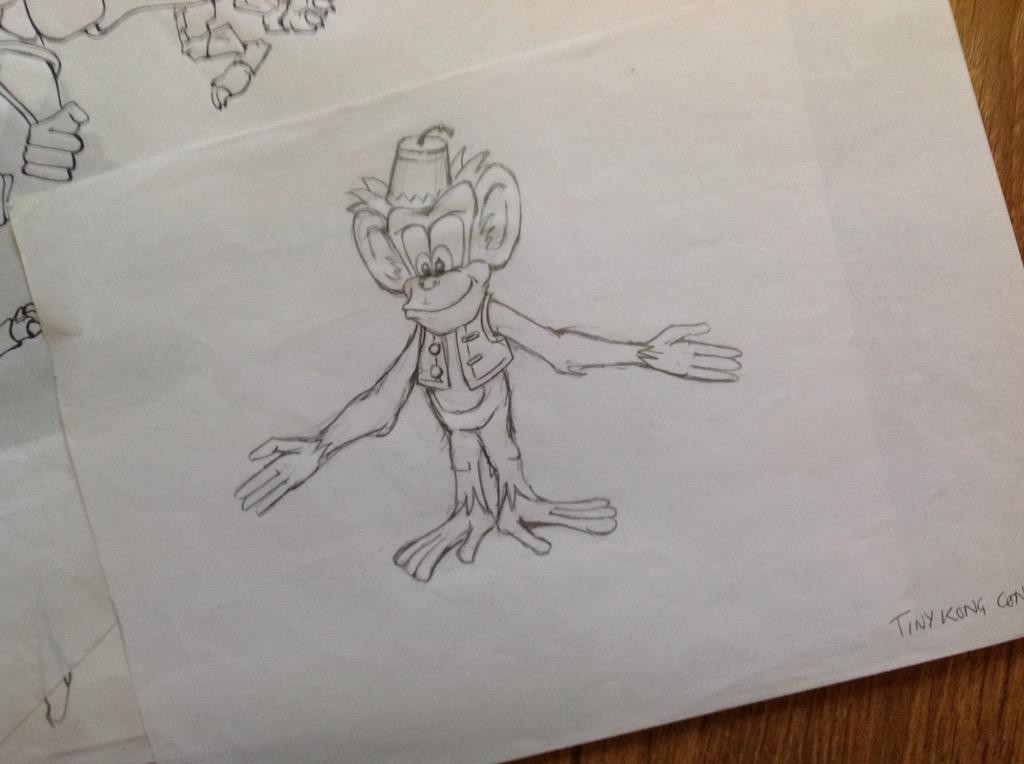
According to Ken Lobb, an early decision was to restrict returning playable characters to those from the original Donkey Kong Country (a claim debunked by Stevenson years later).20 In any case, Lanky started out as an ordinary-looking orangutan lacking the clothes or clown nose (looking something like King Louie from Disney's The Jungle Book).21 Tiny began life as a male ape in a vest and fez (likewise resembling Abu from Aladdin), who later became female to inject some variety into the all-male playable cast.2223 Her final incarnation was (at least as far as Stevenson can remember) designed around the Mini-Monkey ability.24 Wrinkly was brought in (and killed off) when the team "needed a ghost character to pop out of obscure places".Rarewhere: Scribes - Rareware.com, Nov. 10th, 1999
No data relating to her exists in the game's kiosk demo, so the decision may have been made later on.

Technology#
|
|
To do:
|
While the DKCs and DK64 both made creative use of 3D technology, they did so in entirely different ways.
3D Modeling and Animation#
DKC's famous "Advanced Computer Modeling" technique consisted of building and animating 3D models in Alias PowerAnimator, rendering out the individual animation frames as still images, and then drastically shrinking and compressing them to provide the in-game sprites.25 Since PowerAnimator was a NURBS utility and could not work with polygons as used by the N64, another tool named Gamegen was used to create models for DK64, which Stevenson describes as more or less equivalent to "start[ing over] from scratch". Games developed by Rare during the early lifespan of the N64, such as Blast Corps and Killer Instinct, made use of PowerAnimator26 but the models would need to be converted to render them on the N64.27
While the transition away from prerendered graphics meant the game could not achieve the same level of visual quality as the DKCs, the joint-based rigging system of 3D proved to be much more flexible and space-efficient, allowing the team to compensate with more elaborate and expressive animation.
"Animation, I think, became one of the big advantages of 3D over 2D. In the DKC game every animation frame is a separate graphic like traditional cell(sic) animations, so memory could get eaten up pretty quickly. With 3D, the animations are just data used to drive the joints in the models so are much less memory-heavy. So this opened up the scope to do considerably more animation for character than was previously possible, even to the point where this was the first project I worked on where we employed people purely to animate."
- Mark Stevenson
In fact, this approach highlighted one flaw of the ACM system, which was that the models (and their animations) were only designed to be viewed from a fixed perspective (and thus looked awkward from every other angle). This was not workable in a game where the player would have full control of the camera, so all of the DKC-era character animation had to be reworked to compensate.
All that aside, DK64 did still employ prerendering of a sort: many characters (and some environments) use NURBS renders as textures to give them baked-in lighting and a level of detail that would be too memory-intensive to represent with polygons alone. Naturally, this technique would find its way into other games, such as Conker's Bad Fur Day.

|
This page or section needs more images. |
|
Textures |
Model |
|---|---|

|
Donkey Kong 64 (Pre-E3 1999)#
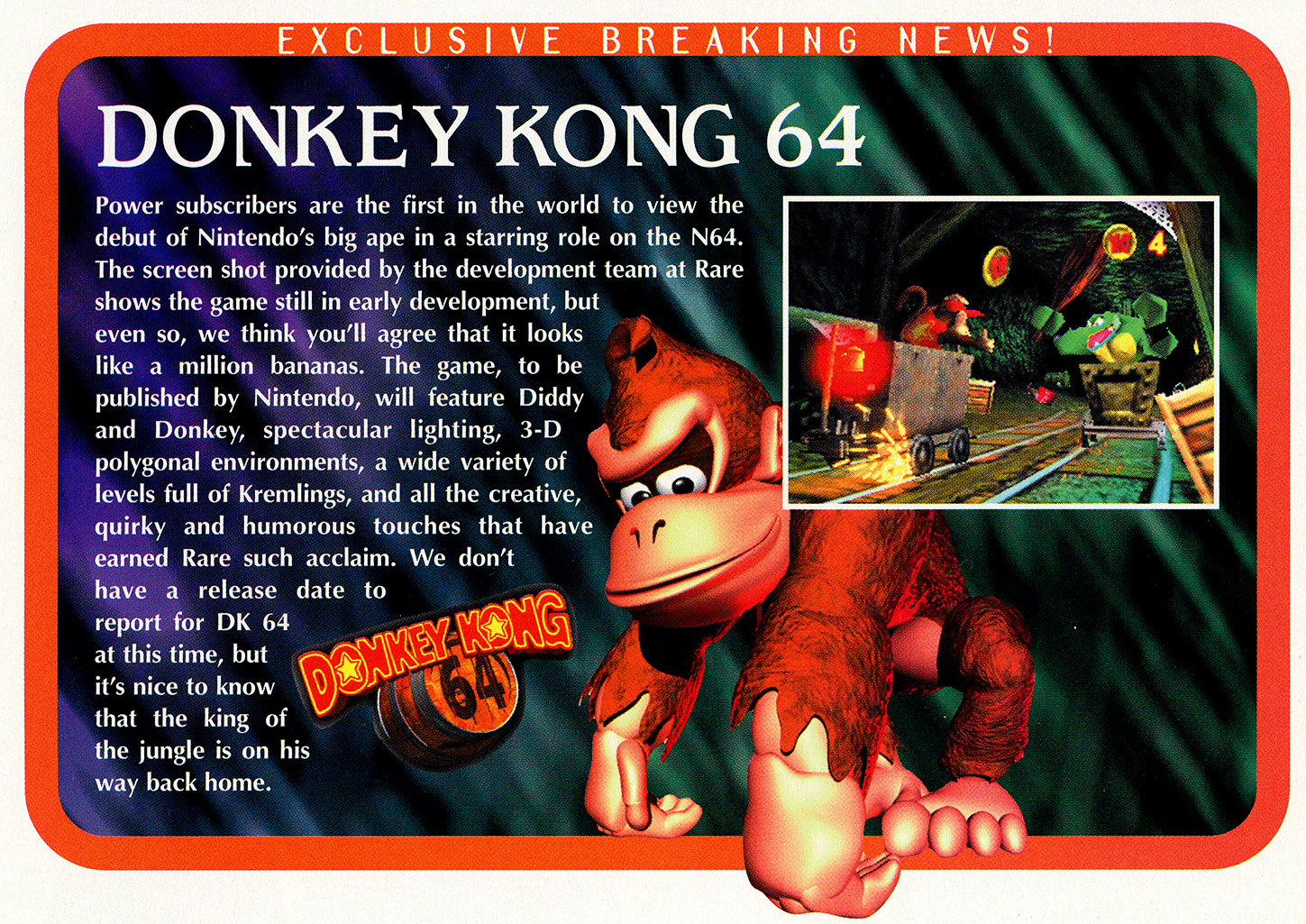
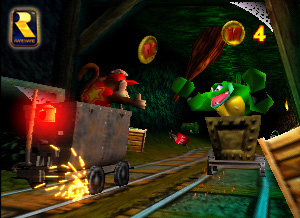
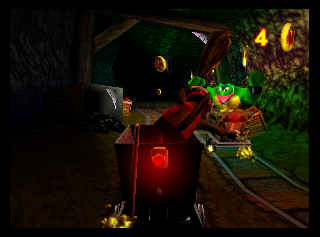
After years of rumor and speculation, DK64 was finally revealed to the public in a Subscriber Bonus supplement included with Nintendo Power #116 (January 1999), followed by Rare's own website a few weeks later.28 The lone screenshot shown depicts Diddy facing off against a Krash in Jungle Japes' minecart course.
|
Prerelease |
Final |
|---|---|
|
|
- The lighting on the tracks is a bit brighter than in the final game.
- There is no red light on the Krash's minecart.
- The sparks appear to be polygonal instead of 2D.
- The DK Coin counter icon is backwards. It would continue to look this way for a number of months.
At some point before April 2629, another two screenshots were released, featuring Chunky in Fungi Forest's minecart course and Donkey in Jungle Japes.
On April 28, Rare put up a DK64 preview on their site.
May 1999#
Expansion Issues#
Just prior to E3, Nintendo announced that Donkey Kong 64 would be the first game to require the Expansion Pak (citing a need for "added visual depth and smoother framerates"), and would even come bundled with it to ensure everyone who owned a copy could play it without issue.3031 This caused a minor stir in the gaming community, particularly among those who already owned an Expansion Pak and were unenthused about buying another.3233 Despite this, Nintendo further stated that they had no plans to release the game without it, claiming that putting out two versions of the same game would "confuse consumers".
14 years after release, Conker programmer Chris Marlow stated that the real reason for the Expansion Pak's inclusion was to hastily work around a game-breaking bug that only happened on the "4-meg-only [i.e. non-Expansion Pak-enabled] build". The story goes that the game would crash at random, and nobody on the team could figure out why, so they were forced to scrap the 4MB build and bundle the Pak with the game at a substantial cost to Rare and Nintendo (who were essentially giving the accessory out for free).34 However, Stevenson clarified in 2019 that, while the bug existed, it was exclusive to a particular N64 hardware revision (not game build), was eventually fixed, and had nothing to do with the Expansion Pak (which, as mentioned above, was an executive mandate; in other words, there was no 4MB build to begin with).
The Pre-E3 Build#
Nearly all the footage shown off at E3 uses a build that predates the playable demo at the event. There are common qualities shared across all the E3 footage that imply that they made use of the same - or a very similar - build.
- Banana color restrictions are not always respected; Kongs are seen picking up wrong-color bananas, for example here.
- The banana pickup jingle is different. The sound effect remains in the final game, unused.
- Exit doors are seen throughout the levels, as part of an earlier version of the level navigation system.
- Helper shops can be seen in full from farther away. In the final, helper shops show an arrow with the NPC's head when far away, and the full buildings pop up when much closer to them, likely in order to save on resources.
Moves and Sounds#
- DK has a realistic double-barrelled shotgun. Likewise, Diddy has realistic pistols. Both of these weapons fire coconuts and peanuts, respectively; the fruit bullets were in play long before the guns were redesigned. Both Diddy's peanut popgun and DK's shotgun use the same, older firing sound.
- Conversely, Lanky's Grape Shooter and Tiny's feather bow are the same as final, and Chunky's Pineapple Launcher is close to final, but the flared ends of the bazooka are more evenly balanced in size in the final.
- No shockwave/echo effect occurs after finishing playing an instrument.
- Lanky's "woohoo!" voice clip for the Baboon Balloon is very high pitched, as if he were huffing helium. Makes sense, but would probably be quite annoying if heard on a regular basis.
- Chunky's jump attack is one somersault long rather than two. (Aztec footage)
- There is no music for the Baboon Balloon.
HUD#
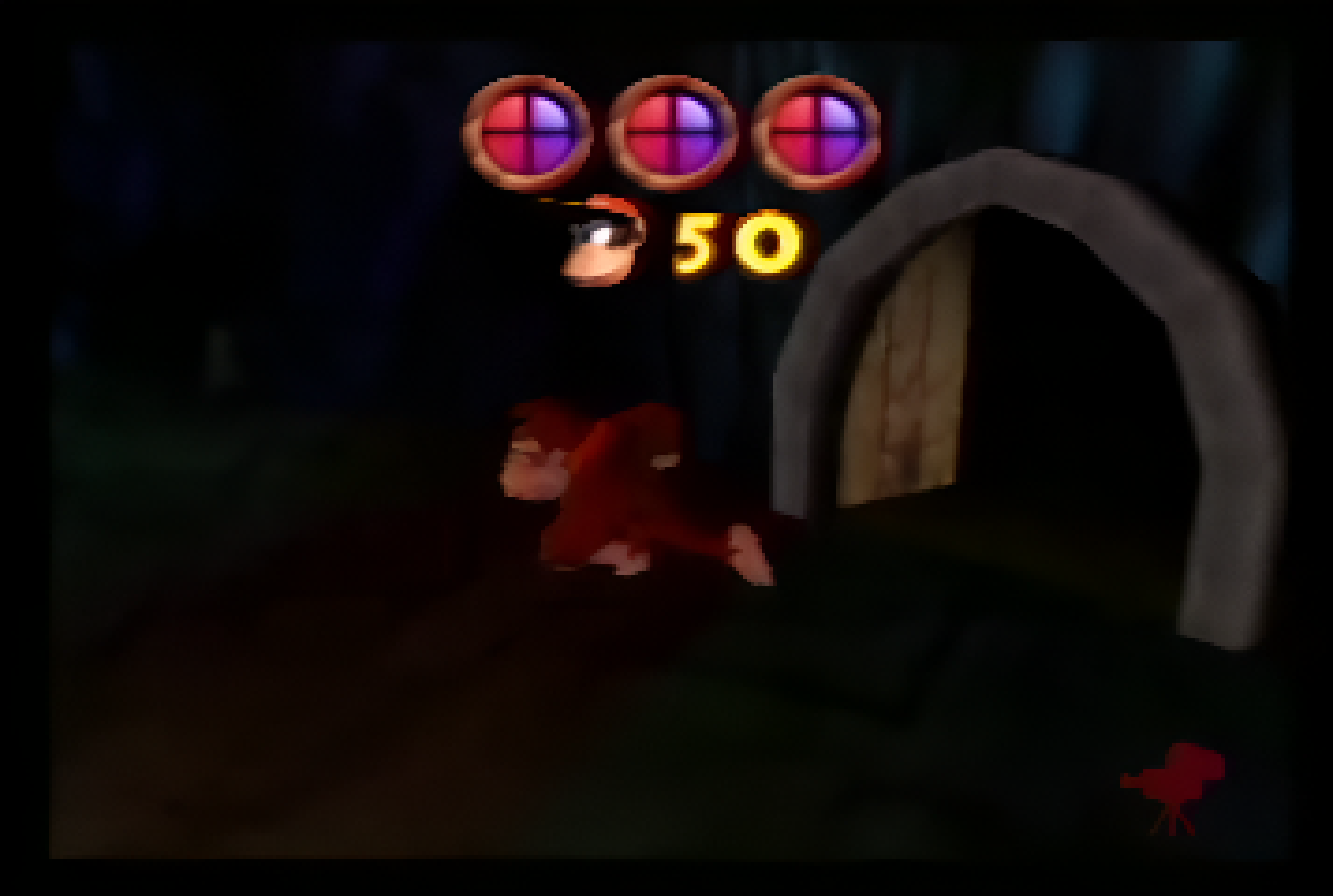
- Instead of watermelons, the health meter is a set of red and purple quartered circles in a wooden frame. These could be barrels viewed from the top down, or simply placeholder graphics. Most enemies already drop watermelon health pickups, though. (For some reason, Kritters don't drop anything, and this wasn't changed until close to the end of development.)
- The life counter was considered part of the health GUI in that it pops up after every hit taken, just like in Banjo-Kazooie. Lives aren't balloons yet in the HUD, instead being represented by a stock render of Diddy's head. The player always has 50 lives. Life balloon pickups do exist in the 3d environment, although footage is scarce - one is seen in the Japes mine room.
- Item icons for counters on the right half of the screen are placed on the left of their counter numbers, instead of to their right.
- Item counters that were meant to express an unlimited supply evolved throughout development, starting with the counter reading "UN" for "Unlimited", then "IN" for "Infinite", before settling on "∞" in the final game.
- The "DK" silhouette shape used for screen transitions is much thinner.
- The fixed camera icon is a static red silhouette instead of a pre-rendered rotating 3D camera. This graphic still exists in the final game, unused.
- The DK Coin counter icon is still rendered backwards.
- The banana medal sprite is not animated, but its counter icon is. Moreover, the medal is a standalone collectible, rather than automatically earned after reaching 75 bananas for a Kong in a single level. This is also the case in the kiosk demo.
- When collecting a golden banana, 5 banana icons are displayed (lighting up when collected) in a vertical stack on the left side of the screen, showing only a single Kong's golden bananas for a level instead of all five Kongs' GB counts at once. The total golden banana counter at the bottom of the screen is the golden banana bunch render that still exists in the kiosk demo.
- No purple sparkles around timers. In the final game, very few timers lack sparkles.
- The DK Coin counter is onscreen constantly when inside the Jungle Japes mine area, which likely has to do with it being connected to the minecart map. When Diddy picks up a red Banana Coin... the two counters overlap each other. The Banana Coin icon gets drawn on top of the DK Coin icon, but the "0" DK Coin counter continues to take priority over the "1" Banana Coin counter.
Troff 'N' Scoff#
- The map is (rather generically) labeled "Level Guardian", with its name displayed on the screen like when entering a level or shop for the first time. The map is otherwise the same as it appears in the kiosk version, including the feeding cutscene.
- The boss door only takes 20 bananas to unlock. In the final game, the lowest total amount of bananas required to enter a boss room is 60.
- Instead of showing the banana counter on the door, Chunky's face is displayed on it, as if the boss had already been unlocked. Any Kong can enter the door in the kiosk version (and other footage), so the Chunky head was likely a placeholder.
- The Troff 'N' Scoff music has either a different flute sample, or the instrument's sample length was shorter.
Jungle Japes#
|
Pre-E3 |
Final |
|---|---|
|
|
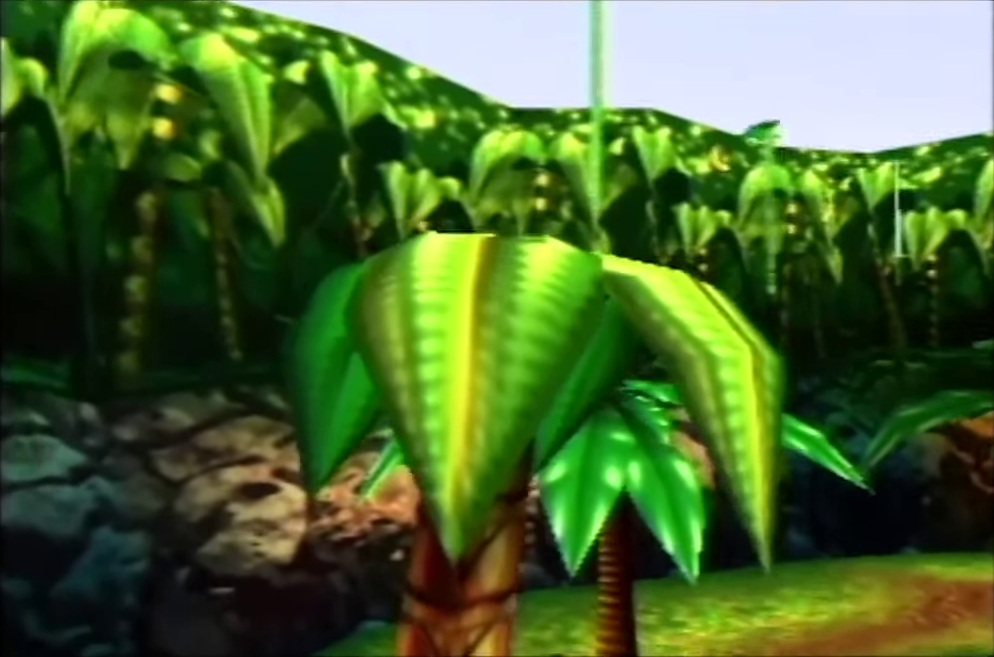
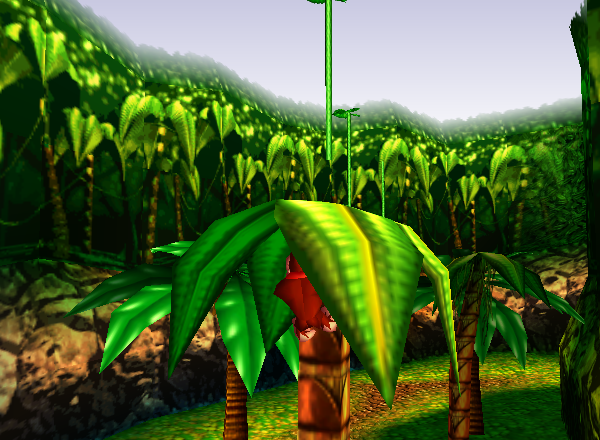
- The tree line texture is cut off at the top instead of fading into the background.
- The vines take a second to get going. In the final game they immediately go into full swing.
- The vines are also higher off the ground, which makes DK hit the upper wall instead of the alcove. in the final game, they were readjusted so that he lands neatly in it.
|
Pre-E3 |
Final |
|---|---|
|
|
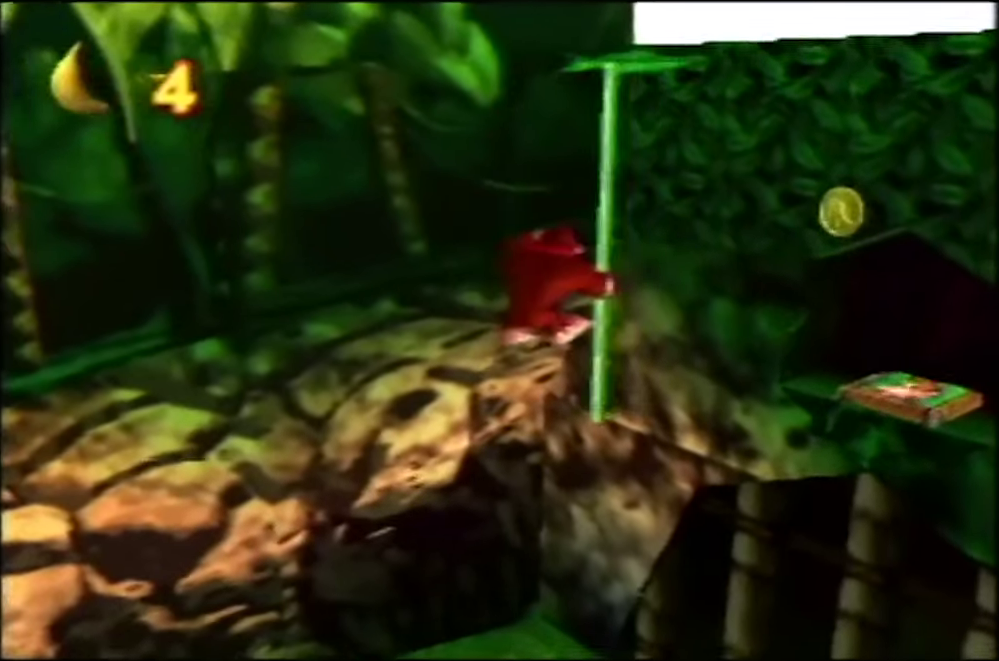
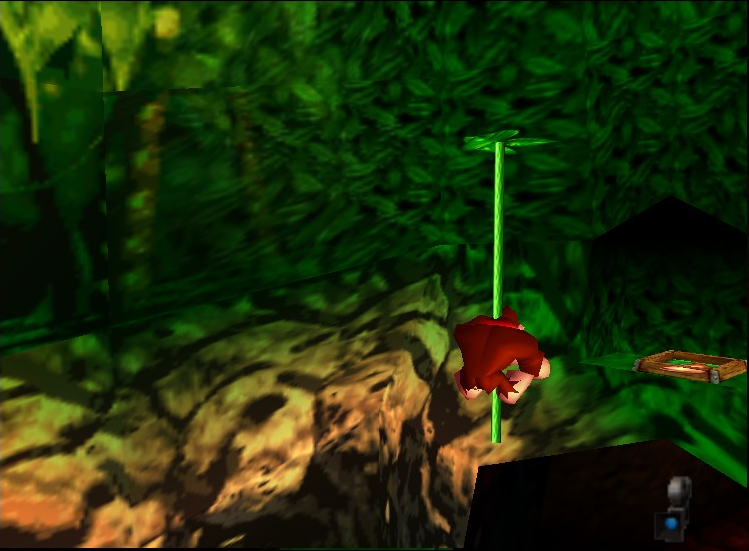
- The back wall of the alcove has rock texturing instead of leaves.
- The rock texturing around the gate is disjointed and was made prettier for the final.
- The tunnel archway is narrower and more sloped. The wall above the alcove has an open seam into the white void, which was filled in with a leaf texture eventually.
- Japes boulder area:
- The textures for this area are entirely different. The "X" patch is also not recessed into the ground.
- The boulder has a different (and rather ugly) texture, also seen in other screenshots and still extant in the kiosk ROM.
- There is a red(?) coin here, where there would normally be green bananas.
- Two ammo crates can be seen next to each other. In the final version of this area, the ammo crates and bananas are interspersed.
- There is an early Golden Banana screen that can also be seen in the kiosk version. This is the first Golden Banana in the whole game file, despite Chunky being active (who requires at least 15 Bananas to unlock), likely due to debug meddling.
(Source: Giant Bomb)
- Cranky's Lab is where Funky's is in the final. Funky's is on the hill across from Cranky's. The early Snide's HQ hut can be seen in its final location on the hill above Cranky's.
(Source: [https://www.youtube.com/watch?v=o19dqdJkFJw&t=1977s French N64 Catalogue Promo VHS)
Jungle Boss#
- Army Dillo is using his Caves boss pattern in Japes, including the missiles. The Japes version of his fight was probably toned down when they elected to reuse him and Dogadon for two different worlds' boss fights.
Angry Aztec#
Much of the area's general textures are different, and there are some layout changes. Some of this layout may either correspond to the kiosk demo's layout or the earlier unused copy in the kiosk demo, but this needs investigation.
- There are no Bananaporters yet.
- Missing billboard blade of grass sticking up in the middle of the path.
- There are no pickups near the Chunky Barrel in the tunnel.
- Chunky wanders out into the outdoor map as Hunky Chunky. In the final game, this is forbidden and will instantly de-transform you.
- The central totem pole is featureless. The ring is not sun-shaped-- in fact, looking carefully at the footage, it appears to have horns instead.
- The ground tile texture is browner and more patchy-looking, with no green vertex color tint to indicate moss. The textures are still there in the kiosk version.
|
Pre-E3/Kiosk |
Final |
|---|---|

|

|
- Interestingly, the stairs to the left are fully modeled rather than just a textured ramp.
- The bananas around the statue are red rather than green.
- The Aztec beetle slide lacks the beetle himself, nor are there any GUI displays to show if you're winning or losing. The GUI elements did exist in this build, though, as they're seen in the other races. This slide may have not originally included an opponent racer at all, similar to the minecart sequences. The player also starts out with 52 coins, probably to ensure an easier win.
|
Pre-E3 |
Final |
|---|---|
|
|
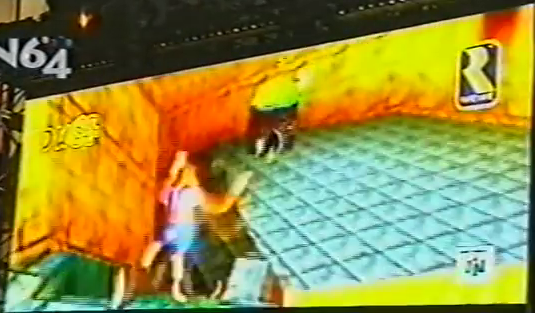
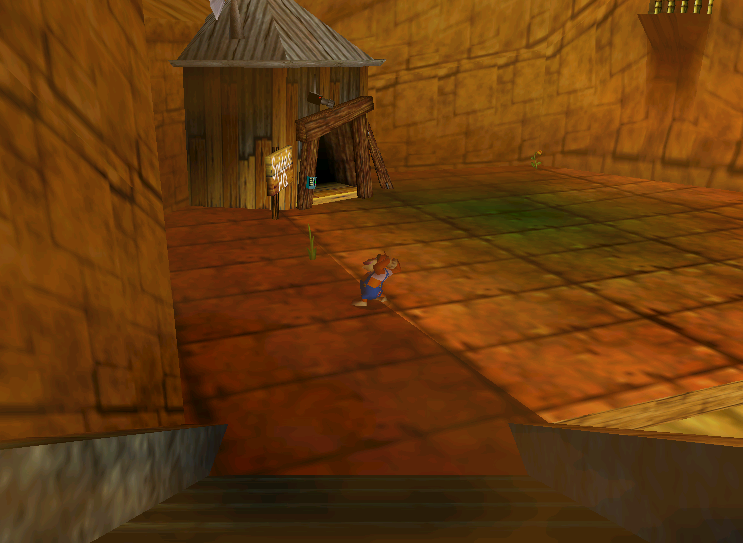
A brief clip of Angry Aztec from the E3 display video has the most complete shot of the early version of Snide's HQ. This area was much larger, square in shape, and had blue floor tiling. Like the rest of Aztec, the space would get massively condensed by the time of release.
- The HQ is dark brown with a green roof.
- There are two large barrels to the right and left of the building. Ordinary barrels are smaller and only appear in boss arenas and the barrel training barrel in the final game.
- An uncollectable (by Lanky) Golden Banana is in front of the door. Interestingly, in the duplicated Aztec map that exists in the kiosk demo, Snide gives you a banana "for free" (the game assumes you already have a blueprint for him).
Aztec Boss#
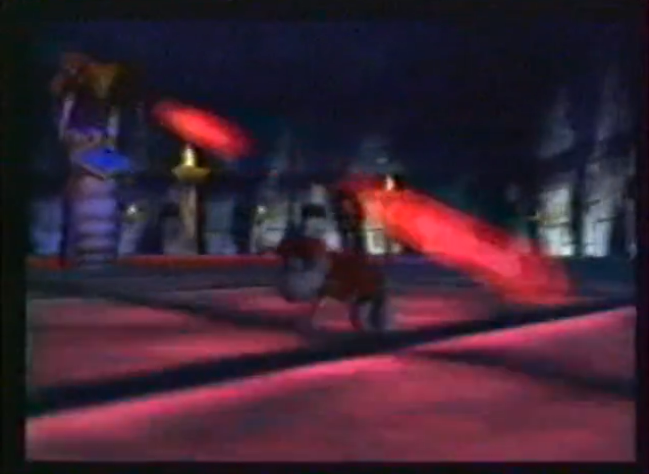
The original Angry Aztec boss, a giant snake with a pendant, can be seen shooting lasers at Diddy in a very brief clip. Both the boss and its arena remain, stripped of their functions, in the kiosk demo. The pendant is blue in some footage, and can appear blue briefly in the kiosk demo, possibly having been an planned boss mechanic.
In the final game, players can see effigies of the Snake Boss on the Scarab Slide in Angry Aztec - the only surviving remnant.
Frantic Factory#
- The music instrumentation is different, and some notes have different effects. This is most obvious in the press conference video where you can hear it clearly.
- No Kong head on the blue switch in front of the time clock.
- One of the clown jack-in-the-box enemies can be | seen in the big machine room.
Factory Boss#
Parts of the original Factory jack-in-the-box boss battle are shown in various bits, including the intro.
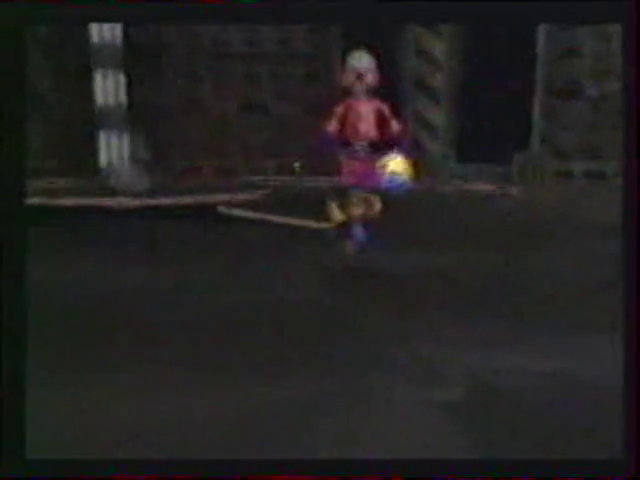
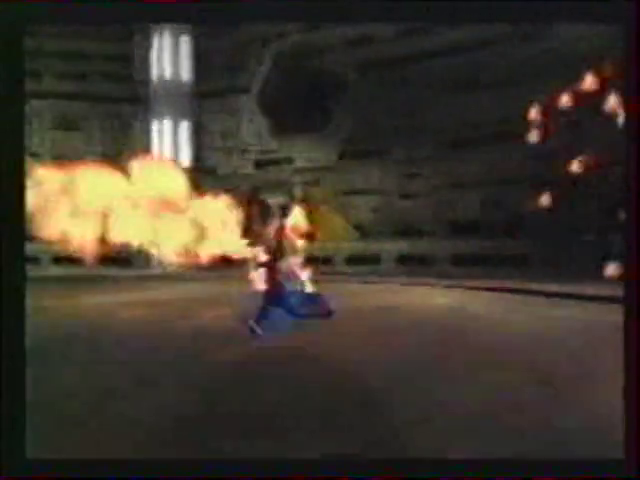
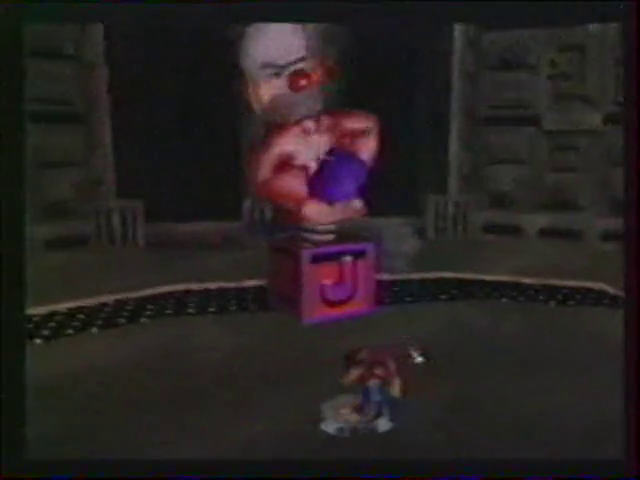
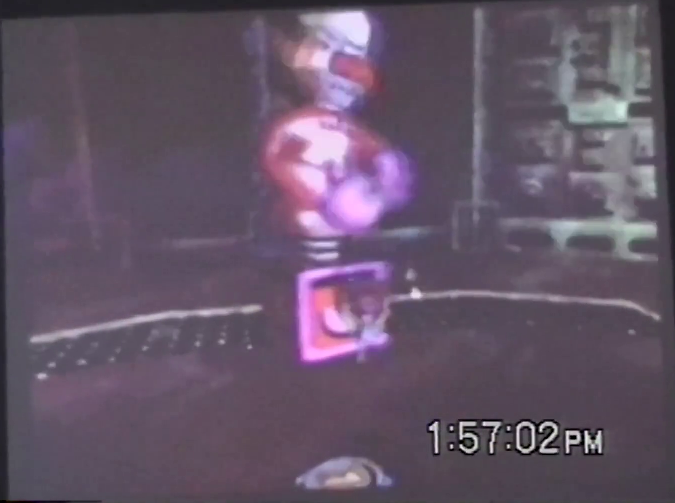
- The boss fight cycle involved dodging the flaming blocks, then throwing a TNT barrel at Jack when he pauses to laugh. At some point, two mini-jack-in-the-boxes come out of holes in the wall, and the player must defeat them. Mad Jack was reworked into a much more complex fight, probably since it was a little too similar to the Army Dillo and Dogadon bosses.
- The arena is circular and has a star-shaped section of latticed transparent mesh in the center. The Factory boss music is hard to hear, but seems to be fairly similar to the final, minus the evil laughter. Jack has some voice clips that play frequently that are far less maniacal in tone than the final Mad Jack.
|
Pre-E3 |
Final |
|---|---|
|
|
- It's difficult to see, but the TNT barrel spawner pad has a a yellow "1" in the center. The final has a yellow star instead.
Gloomy Galleon#
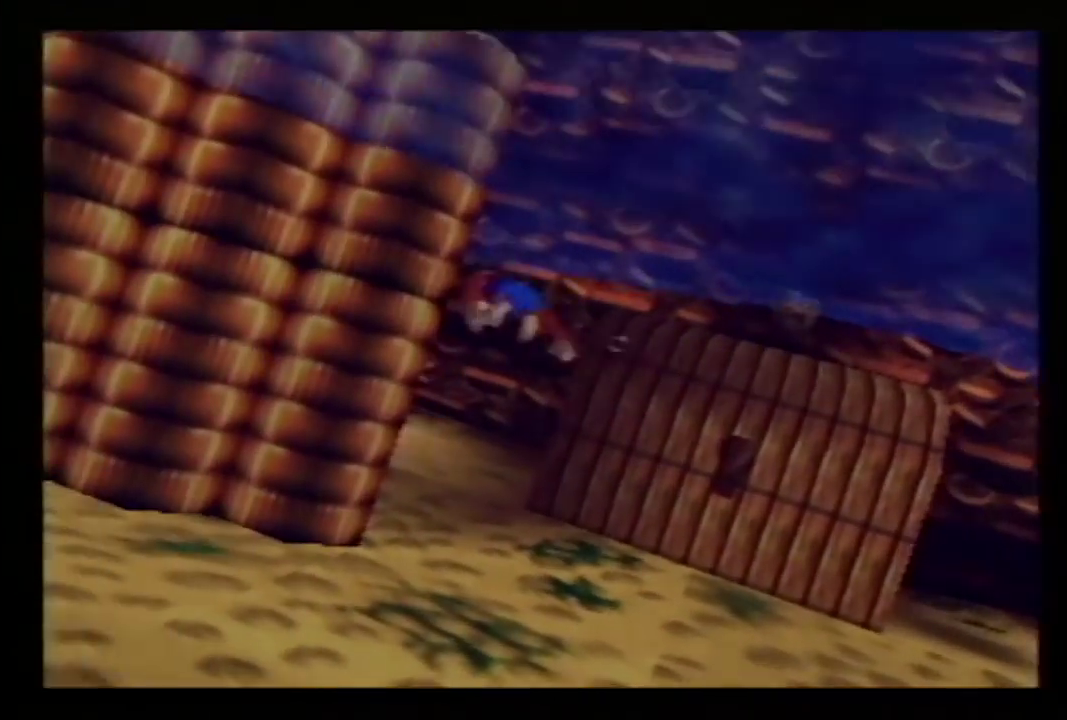
Galleon treasure room:
|
Pre-E3 |
Final |
|---|---|
|
- The treasure chest is much more crudely textured and there is no Tag Barrel. There are also no pickups at all to be seen in this segment, which is in line with the kiosk version.
- The Lanky Pad is higher up than it would normally be at high tide. The ledge's height must have been readjusted.
Unknown Area#
|
|
To do: |
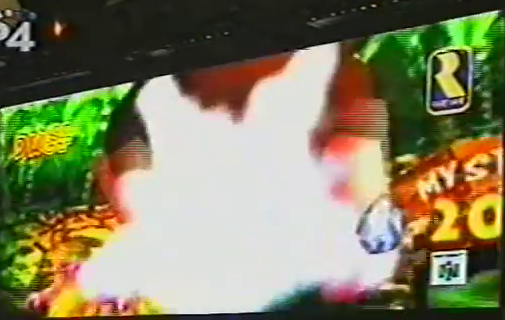
Within the super-wide E3 display video is a very brief shot of Chunky using a Hunky Chunky barrel in a jungle-themed room. The room is vaguely similar to the Army Dillo arena or the Japes beehive area, with a grassy yellow path leading into a tunnel and upwards; a unique border is around the tunnel entrance, with a stone texture at the bottom, and a wooden sign hangs above the entrance that says "MYST-" on one half. The only thing involving "mystery" in the final game is the Mystery Menu, but there's no obvious connection to that here, nor much of a connection to anything else, at all. There is also a climbable tree and two Klumps. Behind one of the Klumps is also what might be a barely noticeable wooden sign with the number "1" on it.
E3 Press Kit Photos#
In addition to the video, the press also got a handful of new screenshots. These were also published on Rare's website, albeit with a Rare logo in the corner of each photo.


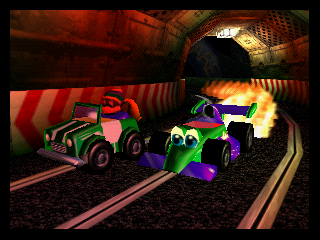
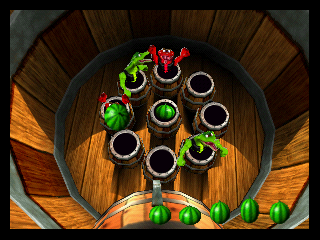
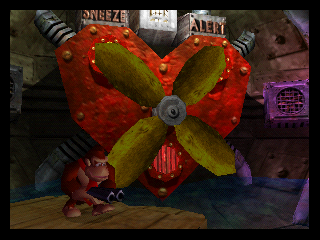
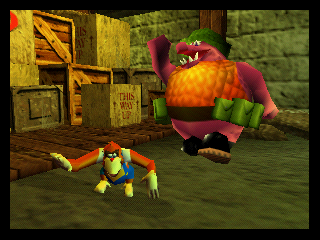
E3 Press Conference Trailer#
Watch on YouTubeThe game's official E3 trailer at the Nintendo E3 press conference. The DK64 trailer starts at around 19:20. For a version directly recorded from a screen (albeit with N64 logo and text overlays), see the Gamestore VHS version (begins at 2:54:31).
- An exit door (Diddy's?) can be seen for a split-second as DK falls down the shaft hole in Frantic Factory. This is part of a longer clip that is continued in other footage.
IGN64 Donkey Kong 64 Gameplay 1999 Trailer#
Watch on YouTubeThe following trailer features a gameplay showcase that was once hosted on IGN64. As a reflection of the era, the original video had been chopped into shorter segments to account for bandwidth and compression. The trailer has attempted to restore the original gameplay showcase, using the background music to arrange the clips in order. The contents are unique and the qualities mostly match the pre-E3 build.
- 00:18 - The original health meter is shown on screen when Tiny is damaged, losing one of the quarter segments. It also displays Diddy's head next to a "50" graphic to indicate that 50 lives remain.
- 00:20 - The original Frantic Factory Boss Fight against the Clown Jack-in-the-box rather than Mad Jack. The Clown throws three flaming blocks before mocking Tiny, allowing an opening to throw the TNT barrel.
- 00:41 - The large door in Gloomy Galleon that opens to allow K. Rool's Ship inside was extensively retextured. The original design featured huge metal slats that were removed entirely.
- 00:57 - The original tile textures for Angry Aztec are seen.
- 01:01 - blink-and-you'll-miss-it: the early design for Snide's HQ is visible for a split second.
- 01:10 - Rambi's hold in Jungle Japes has different textures.
- 01:15 - The "DK" emblem on the coins collected in the Minecart are incorrectly mirrored, as shown in the first promotional image.
- 01:28 - An Extra life balloon can be seen floating above a barrel in the Jungle Japes Mountain, confirming its existence before the E3 demo.
- 01:29 - Diddy pockets a pair of realistic metallic pistols - these would be changed to the Peanut Popguns in the final game.
- 01:30 - Two Kaboom enemies are encountered in the Storage Room in Frantic Factory - in the final game, the Kaboom enemies only appear in Angry Aztec and Gloomy Galleon.
- 01:31 - Donkey Kong brandishes a realistic shotgun prior to its ordered redesign into the Coconut Gun.
- 01:36 - Diddy's Exit Door can be seen on an elevated platform in the Storage Room. In the final game, the door is removed and the platform instead hosts three red Coins for Diddy.
- 01:55 - The original golden design for the Minecart Bell in Fungi Forest is seen. This bell would be replaced by the Red and Green versions in the final game.
- 02:00 - A pair of Kremlings are encountered in the Frantic Factory lobby - these would be replaced with Krobots in the final game.
- 02:23 - A Banana Medal is collected as an object during the Barrel Blast segment. In the final game, Banana Medals are automatically awarded upon collecting 75 Bananas by any Kong, and do not need to obtained physically.
- 02:23 - The original health meter is shown again, this time missing two segments.
E3 Playable Demo#
|
|
To do: |
After spending the previous two years in Atlanta, E3 returned to Los Angeles in 1999, and DK64 was shown off in playable form for the first time alongside Jet Force Gemini and Perfect Dark.
Rather than having attendees wander around and explore a few selected areas of the game on the show floor ala Banjo-Kazooie, the Donkey Kong 64 team had built a custom demo that would allow attendees to dip in and out of several hand-picked challenges. This was accomplished by having a central lobby lined with repurposed exit doors; each exit door would transport players to the challenge indicated above its doorway where completion or failure would have the player character returned to the lobby, where the next challenge could be selected. This custom demo allowed an array of short challenges to be sampled in any order for attendees.

The available challenges at E3 were:
- "Boss II" (Dogadon 2)
- "Light House" (in Gloomy Galleon)
- "[The] Toy Factory" (Frantic Factory)
- "Mine Cart II" (in Fungi Forest)
- "Temper Temple" (Diddy's section of the Maze Temple in Angry Aztec)
- "Jungle" (Japes)
- "Mine Cart I" (in Jungle Japes)
- "Boss I" (Army Dillo (the harder Crystal Caves version, but in Jungle Japes))
- Crystal Caves
- "Race" (the slide race in Angry Aztec)
The E3 lobby's setup and texture data still exists in the September kiosk demo.
General Differences#
Several major updates had been implemented for the demo.
- Melons are used for the health bar, matching the health pickup items.
- Extra lives use the life balloon icon instead of Diddy's head.
- The "DK" silhouette screen transition is now that of the final game.
- The DK Coin icon is facing the correct direction.
- Map and submap names appear every time you enter or return to them, in a manner similar to Ocarina of Time. This includes states such as returning from failed Barrel Blast courses, bonus games, and the like. In the final game, the title display is reserved for the main levels, and they only show up the first time you enter, with a special cutscene.
- Every bonus game is called "Banana Challenge".
- The blast courses, however, have unique names in this version. Jungle Japes' is called "Blast Barrel Blitz".
- The Bananaportation sequence is longer and contains more spinning.
- Grass overhangs have been added on the rock textures bordering the water in Jungle Japes.
- The fixed camera icon is now in its final form.
- The film rolls have a different design, with no "DK" insignia.
- Some alpha texture graphics are overlaid on top of the polaroid. This (generally?) doesn't happen in the final version, but does happen in the kiosk demo when the camera is re-enabled.
Bonus Games#
The demo provides the first comprehensive look at how the bonus games actually worked.
- In the corner of Jungle Japes near the minecart exit, a Bonus Barrel is just sitting out in the open for the player to find. This one has Kremling Kosh, which is normally not in Jungle Japes. It appears to be the hardest variation (map 75), found in the Hideout Helm Lobby and Snide's H.Q. in the final game.
- The time limit is 45 seconds instead of 60, which is tougher than even the kiosk version of this map.
- A Bonus Barrel can be seen floating atop the boxes in the Frantic Factory storage room. This Bonus Barrel also features Kremling Kosh as the Banana Challenge
- Mad Maze Maul map 45, normally done by Diddy in Crystal Caves, is challenged by DK instead.
- Instead of a lever or switch at the top of the Galleon lighthouse, there is a Bonus Barrel containing Stealthy Snoop. This appears to be map 41, which belongs to this level but is instead completed by Diddy in the final game rather than Lanky. Stealthy Snoop is also using the music from Mad Maze Maul.
- The "You were caught!" text uses the early white font instead of the yellow menu lettering.
- Also, Lanky just lies there for a bit before the scene fades out and kicks him back to the lighthouse. In the final game, you're prompted to try again as he's hitting his head.
- More early text in the bonus levels.
- It's possible to take damage and die in Mad Maze Maul, which puts you back at the beginning of the maze. In the final game, you're invincible.
- The baddies actively fight back instead of running away.
RareNet video#
Watch on YouTubeThis footage was taken by Dan and Trevor of now-defunct fansite RareNet on their visit to the expo. While the quality leaves a lot to be desired, it's the most comprehensive look at this build.
- 2:10 - Funky's Armo(u)ry looks the way it does in the kiosk version.
- Funky's idle animation is different.
- The speech bubble appears as he is walking out, rather than after he stops.
- And of course, he has some special E3 text:
HEY DUDE, I'VE ALMOST FINISHED GATHERING THOSE SUPER COOL WEAPONS YOU ASKED FOR! BUT CRANKY'S SPOILING ALL THE FUN, AND SAYS YOU'LL HAVE TO WAIT UNTIL CHRISTMAS TIME BEFORE YOU CAN TRY THEM OUT. BETWEEN YOU AND ME, I THINK THE OLD DUDE'S COMPLETELY LOST HIS BANANA THIS TIME, IF YOU DIG MY MEANING! ANYWAY, I'LL SEE YOU AT CHRISTMAS, KONG DUDE. |
- 2:54 - "Crystal Caves" is missing the plural in the level title, despite it being correctly named on the sign in the E3 lobby.
- 2:56 - There is no ledge with a Tiny Barrel on the wall.
- 3:21 - Lanky is able to pick up the bananas here (and they appear to be blue, though the video is too washed-out to tell for sure). In the final game they're purple, and so only Tiny can pick them up.
- 4:05, 6:57 - Squawks' text here is the same as in the kiosk version.
- 5:13 - There is no short cutscene here.
- The sparks on the minecart wheels are more detailed, as in the kiosk version and early screenshots.
- 7:01 - The "GET OUT" timer is only 10 seconds long, instead of 25 like in the final game.
- 7:18 - The crosshairs' shot is capable of missing the Kongs. In the final game, it always hits no matter what.
- 8:16, 27:35 - Footage of an early pause menu. It uses the plain white font normally reserved for dialogue.
- There are sparkles surrounding the "Are you sure?" text; the A/B prompt uses plain text instead of icons, and replaces the "Are you sure?" line instead of appearing alongside it.
- The pause music appears to be different.
- The background image is not blurred when pausing.
- 8:45 - There is no DK Portal in Frantic Factory, just an ordinary square doorway... with no loading zone in it.
- 8:56 - Factory's bananaporter pad 1 is oddly blank.
- Squawks' bananaporter introduction text is even more provisional than the kiosk version's:
E3 |
Kiosk |
Final |
|---|---|---|
PRESS |
FIND THE OTHER PAD WITH THE SAME NUMBER ON IT TO BANANA PORT BETWEEN THE TWO. PRESS |
FIND A SIMILAR NUMBERED PAD IN THE SAME AREA AND PRESS |


- 9:08 - The Storage Room Bananaporter is positioned in front of the doorway to Chunky's room rather than in the corner under the pipes.
- 9:12 - The lone coin in this corner was replaced with five green coins and a banana bunch surrounding the Bananaporter (intended to stock up the newly freed Chunky).
- 9:18-9:27 - Klobbers exist in Frantic Factory. In the final game, they only show up in Angry Aztec and Gloomy Galleon (bonus stages aside).
- 9:30 - Ammo crates are sitting on the boxes, where there are none in the final game.
- 9:43 - Tiny can pick up the bananas here. In the final they're blue, and thus belong to Lanky.
- 9:46 - As in the kiosk version, only Cranky's Lab is in this room. Several collectibles were added, removed, or rearranged as a result.
- 9:52 - Tiny's ledge climbing animation is slower.
- 21:07 - Blue bananas in the lighthouse, indicating that it was originally Lanky's area and not DK's (in addition to this area being intended for Lanky in the E3 lobby).
- The lighthouse item placement and quantities seem to mirror the kiosk version.
- 24:29 - There appear to be different textures on the cave walls. This is in line with the kiosk version missing the final textures for that area.
- 24:33 - The pad near the boulder alcove in Jungle Japes is a DK Pad. It would become a Bananaporter 1 in the kiosk version, then a Bananaporter 3 in the final game. There are still vines leading up to the ledge where the DK Pad is in the final game, but a Golden Banana is there instead, flanked by oranges.
- The platform itself has yellow stone texturing instead of grass.
- 24:41 - The animation for DK launching up to a Barrel Blast course is just his regular falling animation.
- 24:55 - DK has a different blasting animation, which is used for the initial launch as well.
- There is an extremely out-of-place camera angle from below for a split-second after DK launches up but before entering the barrel targeting screen.
- The palm tree seen in the kiosk demo is present in the barrel course.
- 25:00 - The second item in the Barrel Blast sequence is a coin instead of a banana bunch, making this different from both the kiosk and final versions.
- 25:08 - The Banana Medal is not animated (also seen in the pre-E3 build).
- The collision in the void below the Barrel Blast course is much worse than in the final game, as DK can land, walk around, and jump for a short bit in the nothingness before the screen fades.
- 25:20 - There are coins in this alcove, and in more than one color too. In the final game, there are only bananas.
- 25:44 - The rock's collision box is much smaller, as DK can partially clip through it. It's also the final version of the boulder instead of the "ugly" one from previous builds.
- 26:00 - The Gnawty that DK hits here isn't in the final game.
- 26:56 - The Kritters make a different noise when they appear, which is still in the kiosk version (the implementation, or just the sound effect?).
- 29:11 - Standing on the glowing Troff 'n' Scoff character pads in the back of the room appears to do nothing. Maybe you had to be that particular Kong to see anything? Or perhaps they never really did anything at all...
- 29:48 - The collision in this area is more holey than in the final game; DK rolls right through the ramp into the blackness. (Dan and Trevor unfortunately don't use this to get past the boss door.)
- 33:34 - Chunky does some kind of extra wiggle here (as Dogadon is taking off) that he doesn't do in either the kiosk or final versions.
- 35:05 - For whatever reason, Tiny is not facing straight ahead at the start of the Aztec slide.
- 35:54 - lol the game froze
- 36:28 - The DK Rap is unchanged, save for three things:
- DK and Diddy's guns use the old realistic models and sound effects.
- 39:09 - Chunky does his "seasick walk" instead of tiptoeing. He also does this for a split second in the earlier video above (which?), so it may have actually been his original tiptoe animation.
- 39:24 - In the final game (and the kiosk version), the subtitles stop for the last set of lines. Here, they continue to the very end. This was probably changed to clash less awkwardly with the rap being cut off by Klump.
- 39:36 - The title screen is very different:
- The game's title is abbreviated, with an animated 3D logo. The models for the letters are still in the kiosk version.
- The DKTV demo shows DK inside the Jungle Japes mineshaft (which is normally only accessible by Diddy).
- The copyright info is also different, implying Nintendo and Rare shared the rights to the game (they didn't; the series was always owned by Nintendo, who "loaned" the rights out to Rare):Rarewhere: Scribes - Rareware.com, Jun. 4th, 1999
Prerelease |
Prototype/Final |
|---|---|
©1999 NINTENDO & RARE |
©1999 NINTENDO. GAME BY RARE. |
- 40:18 - A Life Balloon floats in Crystal Caves behind Lanky.
- 41:39 - No transparency on the railings.
- 43:07 - Diddy's tail is not stretched out during his spin attack. He also spins faster.
- 43:37 - DK goads the enemies into falling off the Arena platform. If only it were that easy in the final game.
Other demo videos#
Video 1 - DK64 demo coverage at 13:18. E3 Messevideo - demo coverage begins at 1:30:23.
- In Angry Aztec, there seems to be a crate placed in the middle of the sand pit to allow the player to easily reach Candy's without taking damage from the sand, instead of needing to use the rope vines to get there (which can be notoriously frustrating.)
N64 Magazine (again) - demo coverage begins at 9:11.
- A life balloon is in front of the beehive in Jungle Japes. Also there in kiosk.
June 1999#
|
|
To do: |
Roughly (but not before) June 28, 1999, the Kiosk ROM is built ready for September 1999.35
July 1999#
|
|
To do:
|
According to Electronic Gaming Monthly, the game was around 60% complete by this point. Interestingly, the same article also mentions four-player slot car and boat races, neither of which are possible in the final game. Various in-game leftovers suggest that multiplayer racing was an intended feature that didn't make it in:
- The kiosk version contains text for a multiplayer racing option left over from a much earlier version of the main menu.
- The final game's boat race has three unused spawn points that correspond to other places on the starting line.
- Both versions have text for four possible race positions (winning/2nd/3rd/last), despite all the races in the game being one-on-one.
August 1999#
|
|
To do:
|
Following E3, DK64 made an appearance at Space World 99. According to IGN, however, this was just the same demo as before, complete with "E3 '99" labelling.Rare Brings E3 to Spaceworld - IGN, Aug. 27th, 1999
September 1999#
|
|
To do:
|
As early as September 8, a kiosk demo became available to play at select Toys "R" Us stores.3637 Some screenshots and a promo video were also released at this time.
Hot Newz 64#
Watch on YouTubeAs was typical during the SNES and N64 eras, Nintendo Power sent out a promotional VHS to subscribers and retailers featuring DK64 alongside Jet Force Gemini. Some of this footage is shared with the Nintendo Winter Releases 1999 footage from GameSpot.
"[Rare] got sent a whole load of copies of [this] promo tape, for some reason. We even watched it... and I've never seen so many people stay so utterly straight-faced for so long."
- Leigh LovedayRarewhere: Scribes - Rareware.com, Dec. 22nd, 2000
- 10:45 - The sound of Dogadon falling into the lava is different.
- 10:48 - The sides of the temple still lack several decorations.
- 11:06 - The gravestones pop up much lower to the ground than in the final game.
- 11:11 - DK appears to use Diddy's voice clip when hit.
- 11:15 - The fireballs make a "fwoosh" sound when dropping, instead of the (more obnoxious, but easier to make out) whistle of the final game.
- 12:29 - The domino enemy T-poses after being hit.
- 12:32 - The floor of K. Lumsy's prison is stone instead of metal; the locks are also unnumbered as in the kiosk version.
- 12:37 - Lanky has only one melon in Crystal Caves, which is impossible in normal gameplay. The extra life balloon HUD icon shows up.
September 1999 |
Kiosk |
Final |
|---|---|---|
 |
 |
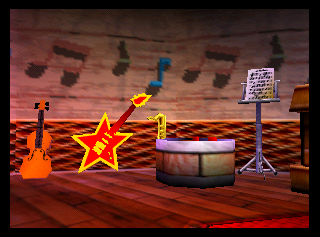 |
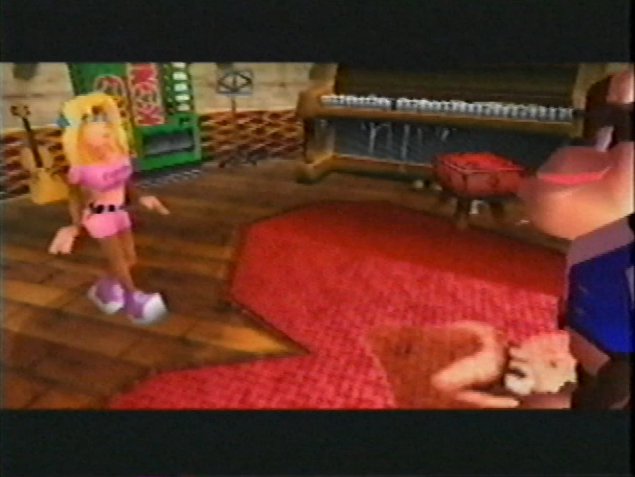
- 12:39 - There is a green "Koko Konga" vending machine behind Candy that was taken out (though the textures for it remain in the kiosk version).
- 13:37 - Mad Jack is now in his final form (but he still throws toy blocks).
- 13:51 - DK enters the Chunky boss door in Troff 'N' Scoff, the same behavior as at E3.
|
Prototype |
Final |
|---|---|
|
|
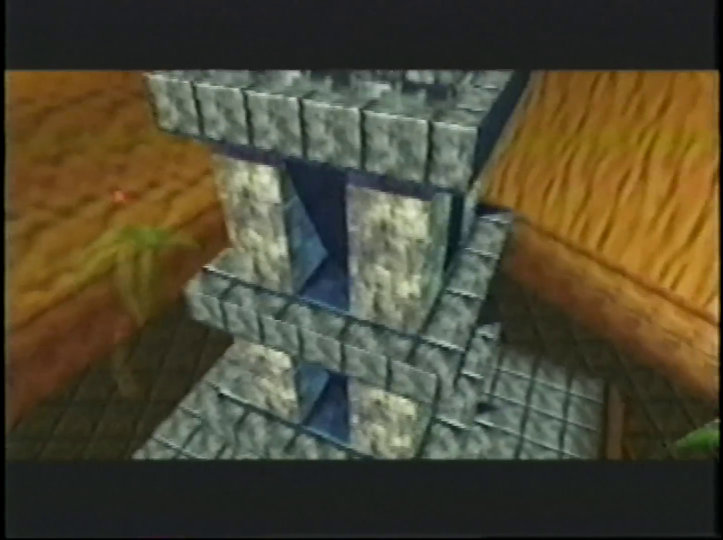
- 12:41 - The slide race tower is all gray; the floor surrounding it also uses the same texture as the roof.
- 13:07 - Bryan Hartmann mentions four-player minigames, which, again, don't exist in the final version.
- 13:21 - The Crystal Caves slide race originally consumed Crystal Coconuts, similarly to the rabbit race. This was probably changed because it would make the race unwinnable if you happened to run out. It can also be seen in footage released for Space World, meaning it dates back to at least August.
9/15-9/16/1999#
|
|
To do: |
This batch of screenshots was released to the press in September 1999.38 RareNet dates this batch to 9/16/99 39 and IGN dates it to 9/15. Rare doesn't seem to have published these screenshots on their own website.
- The Aztec layout is closer to final.
- Shot of Jungle Japes mountains without Funky's Armory. Appears to be the same layout as at E3.
- Exit doors and Wrinkly doors (that still look exactly like the exit doors) can be seen in these screenshots:
- The Donkey Kong exit door in Frantic Factory.
- The five hint doors in the Fungi Forest lobby wheel.
Miyamoto and the Coconut Gun#
On September 10, 1999, Nintendo producer and Mario/Donkey Kong creator Shigeru Miyamoto (along with HAL president Satoru Iwata and Nintendo of America chair Howard Lincoln) traveled to England to attend a European trade show. While there, they also took the opportunity to visit Rare's (then-)new Manor Park headquarters and offer feedback on their projects.40
Later screenshots and video depict DK and Diddy's weapons with their final designs, instead of the realistic metal look seen at E3. Speaking to GamesRadar in 2019, Andreas tells the story of how this change came at Miyamoto's behest:
"We switched on the game, they saw the rap, and then I started running around as DK. I swung on some vines, collected bananas, and they were beginning to really smile. And then I pressed the button to pull out the gun. It wasn't a textured gun that you might expect but a realistic shotgun with bullets flying out and with horrifying sound effects. You get so used to things being in development, even if it is a placeholder, and I completely forgot that it was in there. I'm shooting beavers, turned to my side, and see this look of horror on Miyamoto's face! Then he smiled and, taking some paper and a pencil, drew a coconut gun in front of us. It had leaves on it and he handed it to me. I looked at it and said 'Oh yeah, that's cool, we'll put that in' and the coconut gun was put in after that."
Aside from that, Miyamoto's (and Nintendo's) input on DK64 was described as "negligible", though Stevenson had the general impression that Miyamoto was somewhat dissatisfied with the game being another 3D platformer in a time of market saturation, and would have preferred a more traditional 2D outing. An interview conducted by EarthBound creator Shigesato Itoi shortly after the visit implied Miyamoto's real issue was that the game didn't experiment enough within the 3D platforming genre, calling it "old-fashioned" and "standard":
"I think we've reached a period where 3D action games can't get by just because they’re the new thing. Now it's a matter of making sure that there's a central novelty to your gameplay that's actually fun because it works in 3D. And Rare - they're incredibly good at taking it in the opposite direction. [...] They're really good at reproducing what it is that makes a Nintendo game a Nintendo game, and their directors know what they're doing. I'll go ahead and say it - [Donkey Kong 64 is] definitely a game that players can enjoy, and they will. But [...] it's a 3D action game for better or worse, so whether or not it can attract new users that haven't had any interest in games up until now - I don't think it can based on looks alone. So, this Donkey Kong 64 will certainly carry its weight for what it is, but as far as whether or not it's going to be the thing to energize the 64 market during this Christmas season - I think people that see what I'm saying will think, 'If that's the case, hurry up and put out something newer, fresher.'"
- Shigeru Miyamoto
[Nick Burton]: I want to hear about Diddy Kong being dressed up in that rubber suit, with squeaky noises.
[George Andreas]: I think Brendan was having some fun one day.
[Brendan Gunn]: It wasn't me; I think it was Mr. [Mark] Stephenson(sic). For some reason it was a complete shiny red PVC suit, except for a little brown hole under the tail. [laughs]
GA: We didn't show Miyamoto that.
NB: Good job.41
October 1999#
|
|
To do:
|
Stop 'N' Swop#
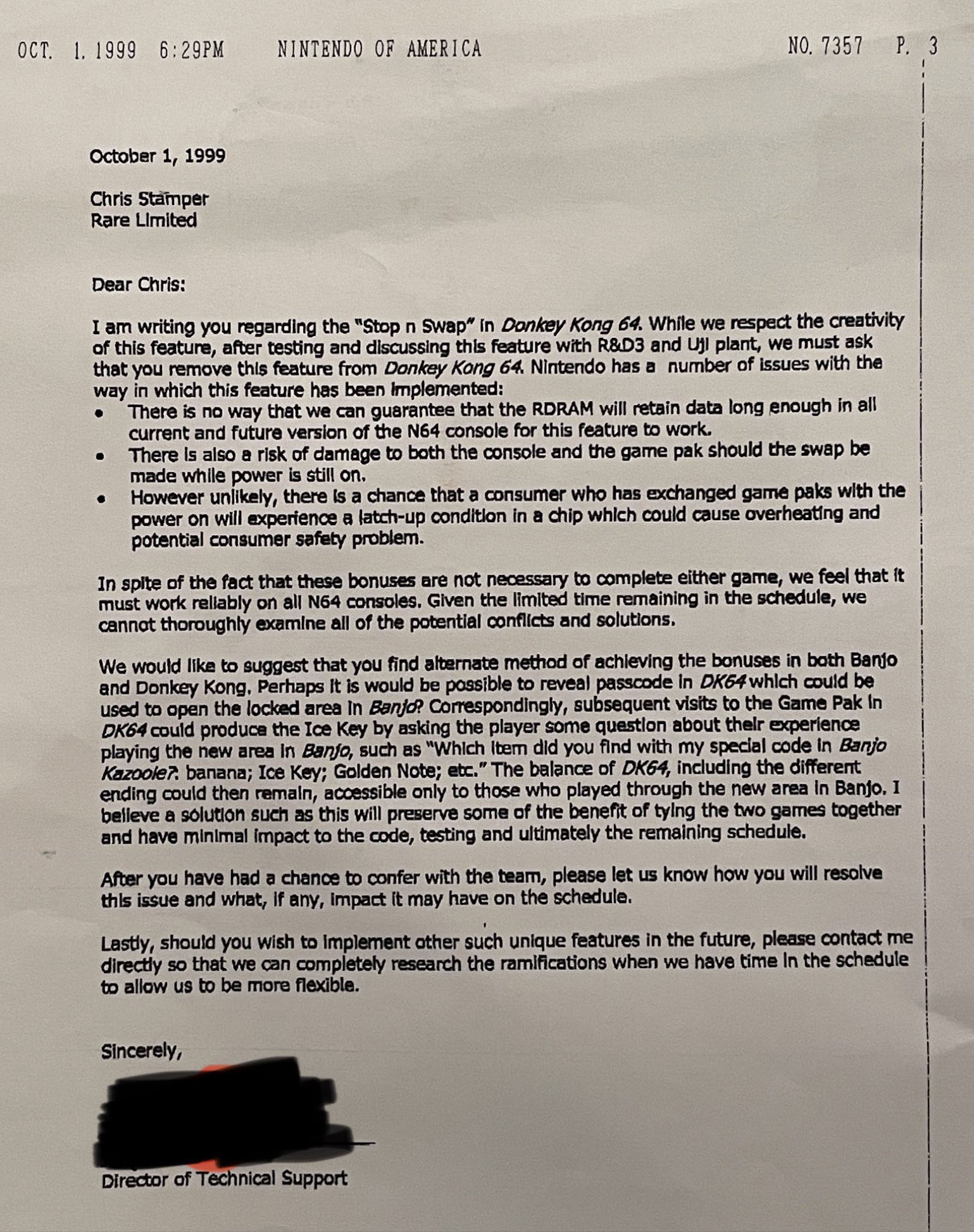
Upon discovering that Rare intended to use a method of cold swapping cartridges to send data between Donkey Kong 64 and their former release Banjo-Kazooie, Nintendo's Director of Technical Support would send a fax on October 1st, 1999, urging that the system be removed entirely.
At this stage in development, Rare had already laid the groundwork for Donkey Kong 64 to enable the collection of the Ice Key within Banjo-Kazooie, and the delivery within Donkey Kong 64 to accept the swapped item, when prompted. Players would then use the Ice Key to unlock a Big Icy Door inside Chunky's Gorilla Gone Room in Crystal Caves for a reward. The Ice Key would then be moved to a Banjo-Kazooie themed freezer inside Donkey Kong's Treehouse, kept on ice until needed by the next game in the Stop 'N' Swop sequence. Per the Banjo-Tooie Coldswap Document, players would also encounter a Golden Donkey Kong Bust inside the Museum in Creepy Castle - this item would remain tantalizingly out of reach until the release of Banjo-Tooie, where cold swapping between the titles would enable players to collect the Bust and deliver it to Banjo-Tooie, where they could select Donkey Kong as a playable character within the multiplayer suite. Delivering the Ice Key from Donkey Kong's freezer to Banjo-Tooie would have allowed players to unlock a large Icy Safe in Hailfire Peaks where they could discover a 101st Jiggy for 101% completion and a bonus 'outtakes' ending.
With the system now coming into question, and without recourse for the remaining time in the schedule, Rare would remove the Stop 'N' Swop functionality entirely from Donkey Kong 64, and make efforts to redact elements added specifically for the feature, such as the Big Icy Door in Crystal Caves, and the Golden Bust from the Museum in Creepy Castle.
Remnants of the feature still persist, however, both in the games code and within promotional materials released prior to this decision, which have been documented on the Donkey Kong 64 Stop 'N' Swop sub-page.
October 1, 1999
I am writing you regarding the "Stop n Swap" in Donkey Kong 64. While we respect the creativity of this feature, after testing and discussing this feature with R&D3 and Uji plant, we must ask that you remove this feature from Donkey Kong 64. Nintendo has a number of issues with the way in which this feature has been implemented:
In spite of the fact that these bonuses are not necessary to complete either game, we feel that it must work reliably on all N64 consoles. Given the limited time remaining in the schedule, we cannot thoroughly examine all of the potential conflicts and solutions. We would like to suggest that you find alternate method of achieving the bonuses in both Banjo and Donkey Kong. Perhaps it is would be possible to reveal passcode in DK64 which could be used to open the locked area in Banjo? Correspondingly, subsequent visits to the Game Pak in DK64 could produce the Ice Key by asking the player some question about their experience playing the new area in Banjo, such as "Which item did you find with my special code in Banjo Kazooie?": banana; Ice Key; Golden Note; etc." The balance ofDK64'', including the different ending could then remain, accessible only to those who played through the new area in Banjo. I believe a solution such as this will preserve some of the benefit of tying the two games together and have minimal impact to the code, testing and ultimately the remaining schedule. After you have had a chance to confer with the team, please let us know how you will resolve this issue and what, if any, impact it may have on the schedule. Lastly, should you wish to implement other such unique features in the future, please contact me directly so that we can completely research the ramifications when we have time in the schedule to allow us to be more flexible.
|
According to Miyamoto, the game was to have gone gold by this point. Timestamps stored within the compressed game files indicate it was finalized in mid-October.
November 1999#
|
|
To do:
|
Watch on YouTubeThe game's North American commercial is comprised almost entirely of footage from an earlier point in development. Most of the differences (i.e. exit doors, red-haired Kasplats, etc) seen there are also in the kiosk version or in other, earlier footage sources, and thus don't warrant an in-depth comparison:
- The DK Door in Jungle Japes (0:09)
- Purple bananas in the cave leading to Jungle Japes' shell area (0:24)
- Blue coins surrounding the Chunky Barrel in Angry Aztec (0:25)
- Mad Jack throwing fiery blocks (0:37)
- The harder Army Dillo fight taking place in Jungle Japes (as evidenced by the jet thrusters and cannon) (0:37)
- Yellow sunlight texture on the Gloomy Galleon lighthouse beacon (0:40)
- The Rambi transformation being timed, as well as the lack of sparkles on the timer (0:45)
The Support Team#
Towards the end of development, eight more people were added to the core team of 16 to help finish the game.42 Among them were:
- DKC/Banjo director Gregg Mayles, who designed the K. Rool battle;Scribes - Rareware.com, Aug. 30th, 2007
- His brother, DKC/Banjo artist Steve Mayles, who designed several enemies, including Klump and Krusha, along with boss characters, Pufftoss and Mad Jack;43
- Banjo artist Ed Bryan, who designed Candy, the mermaid, and the model renders of Lanky and Tiny;44
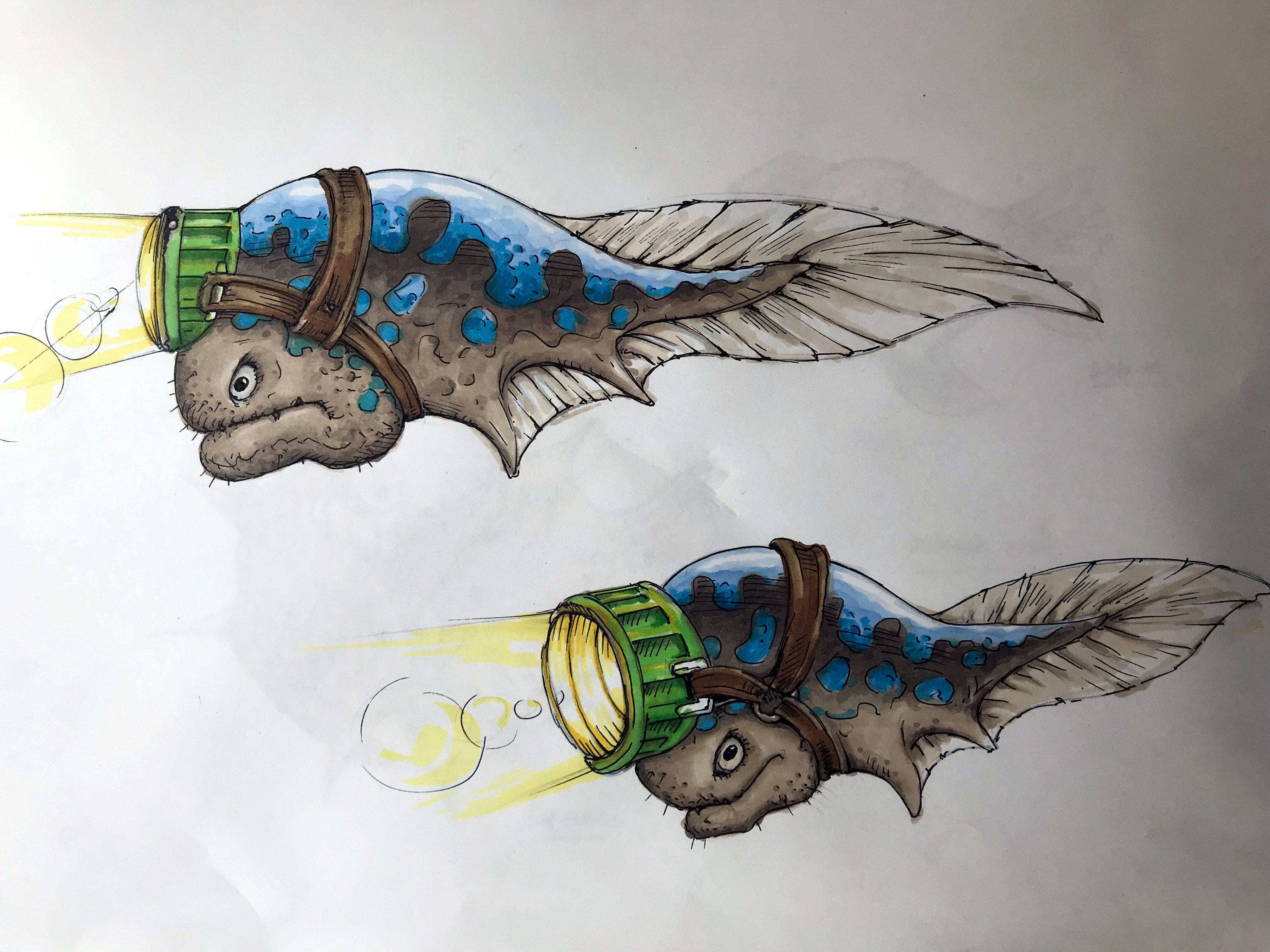
- Conker designer Chris Seavor, who designed two characters (one of which was the "lightfish" that appears in the Gloomy Galleon shipwrecks);4546
- and Sutherland, who provided various character voices in addition to the DK Rap voiceover.
In an interview with Nintendo Life, Gregg Mayles described his thought process behind the game's final battle:
"There were two objectives I set myself - I wanted K.Rool to have yet another new identity (it was his trademark) and I wanted to ensure it felt like all the Kongs were teaming up to beat their nemesis. The boxing idea came from wanting a way for each Kong to have their own dedicated fight with K.Rool, and the round-based nature of boxing was ideal to achieve this. It was also a theme I thought we could have a lot of fun with, parodying the over the top, glitzy world heavyweight boxing that used to regularly come from Las Vegas in the '90s. I think Tiny Kong fighting K.Rool’s toes inside his boot is one of the oddest gameplay experiences I have ever come up with!"
He noted that this somewhat flew in the face of K. Rool's characterization up to that point, as something of a cross between Darth Vader and Ernst Stavro Blofeld, but didn't think that approach would make for a fun boss battle.
Mayles also planned to include compatibility with Banjo-Kazooie's game-connecting Stop 'n' Swop feature; the two games allegedly had a working connection before Nintendo requested the feature be removed due to hardware concerns, leaving only some dummied-out remnants - the only game in the "circle" of six (other than Kazooie) to have any.4748
Undated Content#
|
|
To do: |
Hobby Consolas#
|
|
To do: |
Hobby Consolas #99 An in-depth video that seems to use a combination of footage from both the E3 demo and somewhat later in development (has the final main menu, tag barrels, etc). The later footage is also using the Spanish version of the game.
- E3 demo bits:
- E3 demo title screen, and the DK TV demo is DK in the Japes mineshaft again.
- Loading into the E3 lobby displays "DK 64" as the area title.
- Life balloon in front of Japes beehive.
- Old DK barrel blast launch animation.
- Old banana collect noise.
- DK has his shiny shotgun with E3-era firing sounds.
- Lanky has the earlier version of the grape shooter in the lighthouse area.
- Unclear which build:
- Jungle noises (like that of the kiosk demo) on the N64 logo screen.
- Several of the boxing glove jack-in-the-box enemies in Frantic Factory. Have proper behavior (broken in kiosk?)
- DK can run through the logs in the Japes beehive room?
- Post-E3 bits:
- Sparkles on the timer.
Nintendo Japanese Donkey Kong 64 Site Screenshots#
The promotional Donkey Kong 64 Japanese Site features two unique screenshots that are without dates, they are listed below:
Other unsorted#
- Creepy Castle screenshots showing an earlier moat area with stone texturing, and the early chair area in the dungeon.
Info to be Incorporated#
Screenshots#
- Rare's old DK64 section (some of the screenshot links may be broken, but DKVine's old gallery has copies of them all)
- IGN for any screens that can't be found elsewhere
- RareNet screenshots. The second page might try to force a redirect thanks to an old garbage ad; stop the page from loading completely to prevent this.
Video Footage#
- Nintendo Winter Releases 1999 (18:19-23:22)
All of IGN's prerelease videos can be found on YouTube, though they're missing the proper titles:
- May: These are clips taken from the E3 '99 B-Roll (pre-E3 build).
- July: These clips are sourced from the press conference trailer (pre-E3 build).
- August: Exploring, Boating, Skidding, Flying - this is the E3 demo or later, likely to be a trailer from Spaceworld '99 as the title card for the video is in Japanese. This is the only version available for now (?).
- November: Look At the Size of This Guy!
Other#
Andreas/Mayles/Kirkhope E3 interview(Long gone, doesn't even appear to be on Wayback; left here on the off chance it can still be found somewhere.)- Superjuegos magazine, includes E3 '99 room
- Miyamoto interview circa late September 1999
- Possibly relevant: Jetpac was included because "Diddy's got a jetpack" (being Rare/Ultimate's very first game may have also had something to do with it)
- "Apparently, the whole 'Dolphin auditions' thing was the result of one of the team members "going off on one", which is another way of saying that nobody here really understands it either..."
- GamesRadar's 20th anniversary retrospective
- More details on working in 3D vs 2D
- Nintendo Life's 20th anniversary retrospective
- Difference between polygons and NURBS, "[we] essentially had to start from scratch"
- Believer's 20th anniversary retrospective:
- Clarifies that it was Nintendo who pushed for Expansion Pak support
References#
- Rare Games: An Interview with Ken Lobb - Nintendojo, c. 1999↩︎
- Donkey Kong 64 - IGN, Nov. 24th, 1999↩︎
- DF Retro: Donkey Kong Country + Killer Instinct - A 16-Bit CG Revolution! - Digital Foundry, Dec. 16th, 2017↩︎
- Mark Stevenson on Twitter: @dkvine @NicMakin it was 3D. Main difference was it had a more A to B style level structure, rather than open re-playable levels - Twitter, May 7th, 2015↩︎
- Donkey Kong Swings to 64DD - IGN, Jul. 26th, 1997↩︎
- Donkey Kong 64 Jumps to DD - GameSpot, date unknown↩︎
- Every Cancelled Nintendo 64DD Game Part 2 ft. @hard4games - Did You Know Gaming, Aug. 4th, 2024↩︎
- Feature: Donkey Kong 64 Devs On Bugs, Boxing And 20 Years Of The DK Rap - Nintendo Life, Nov. 22nd, 2019↩︎
- Donkey Kong 64 - Grantkirkhope.com, c. 2010↩︎
- Tepid Seat, December 2004: Rare Music Team - Rareware.com, Dec. 23rd, 2004↩︎
- Banjo-Tooie - Grantkirkhope.com, c. 2010↩︎
- Garbage Collection - Believer Magazine, Nov. 22nd, 2019↩︎
- As Donkey Kong 64 turns 20, the devs reflect on its design, the infamous DK Rap, and how a shocked Shigeru Miyamoto created the Coconut Shooter - GamesRadar, Nov. 22nd, 2019↩︎
- Dream Bully Music Compositions - Grantkirkhope.com, c. 2010↩︎
- Nic Makin on Twitter: #ThrowbackThursday #DK64 #Rareware Found another old Rare concept brief. Donkey Kong World 64 (aka DK64) - Twitter, May 7th, 2015↩︎
- A Rare Breed Part 2 – Nintendo Nation talks to Grant Kirkhope - Nintendo Nation, Sep. 14th, 2012↩︎
- Pg. 23 - Retro Gamer #36, Mar. 2007↩︎
- Nic Makin on Twitter: Who would have thought this short Paragraph would lead @grantkirkhope to create his DKRap masterpiece. #DK64 #tbt - Twitter, May 7th, 2015↩︎
- Special Guest Grant Kirkhope - Guest Grumps - Game Grumps, Mar. 25th, 2013↩︎
- Mark Stevenson on Twitter: @dkvine Never heard of that one myself and I certainly don't recall working to any guidelines like that - Twitter, Jul. 9th, 2015↩︎
- Mark Stevenson on Twitter: @mingellasfella @Kevbayliss @WinkySteve Lanky was closer but didn't... ...have the clothes or clown nose. Tiny was male and like a barrel organ monkey in a fez! - Twitter, Jul. 8th, 2015↩︎
- Mark Stevenson on Twitter: @mingellasfella @Kevbayliss @WinkySteve @dkvine Tiny he before she became she! - Twitter, Jul. 8th, 2015↩︎
- Mark Stevenson on Twitter: @dkvine other than deciding to go with a female to stop it being all male characters, honestly can't remember whether Dixie was considered - Twitter, Jul. 8th, 2015↩︎
- Mark Stevenson on Twitter: Long time ago, can't recall exactly, I guess we just loved creating new Kongs! I would say it would be because we wanted a character that fitted with the shrinking ability. - Twitter, May 9th, 2018↩︎
- "The Making of... Donkey Kong Country" - GamesRadar (originally from Retro Gamer #43, pgs. 68-71), Nov. 2007↩︎
- Nintendo Power Issue 85, June 1996, pages 17-18, 34-37↩︎
- Nintendo Power Issue 86, August 1996↩︎
- Rarewhere: The Outpost, Rareware.com, Jan. 11th & Apr. 28th, 1999↩︎
- Eye On Donkey Kong 64 - IGN, Apr. 26th, 1999↩︎
- Donkey Kong Enforces 4MBs - IGN, May 12th, 1999↩︎
- Kong/Expansion Pak Bundle Absolute - IGN, May 20th, 1999↩︎
- Pgs. 86-87 - Electronic Gaming Monthly #121, Jul. 1999↩︎
- Pgs. 219 & 224 - Electronic Gaming Monthly #125, Dec. 1999↩︎
- CONKER'S BFD : DIRECTORS COMMENTARY PRT 1 - YouTube, May 28th, 2013↩︎
- 1 - Build Date Information↩︎
- News Archive - September 1999 - Donkey Kong 64 Central, Sep. 8th, 1999↩︎
- August-September 1999 Updates - Donkey Kong's Jungle Vine, Sep. 8th, 1999↩︎
- September 1999 GamePro disc↩︎
- Donkey Kong 64 Pictures, page 2 - RareNet↩︎
- Shigeru Miyamoto Speaks: An Interview Between Itoi and Miyamoto from 1999 - Nintendo World Report, Jan. 20th, 2014↩︎
- Pg. 36 - Retro Gamer #84, Dec. 2010↩︎
- Pgs. 219 & 224 - Electronic Gaming Monthly #125, Dec. 1999↩︎
- Steve Mayles on Twitter: "Last year was my 25th creating characters and animation for games. You might even have played a couple of the games? Now, on with the next 25!" - Twitter, Jan. 18th, 2018↩︎
- Ed Bryan on Twitter: "@Kevbayliss @gabdesbiens11 @WinkySteve @PlaytonicGames I made the hi-res models of Lanky and Tiny. I must have had drawings to work from??" "And of course I was responsible for the DK64 incarnation of Candy ..." "@dkvine @Kevbayliss @WinkySteve No [render]. I think the in game model was enough! I need to go back and check the mermaid from DC64 ..." - Twitter, Jul. 8th, 2015↩︎
- Chris Seavor: "Nowadays, Conker would be impossible." - Gamikia, Jan. 18th, 2012↩︎
- Chris Seavor on Twitter: "Some fish thing with a lamp on its head..and. erm... can't remember the other one. Long time ago.." - Twitter, Jul. 9th, 2021↩︎
- Gregg Mayles on Twitter: "@eddzw all [future Rare] games! We had it working between Banjo and DK64, I think Jet Force would have been next." - Twitter, Jul. 26th, 2015↩︎
- Letter/fax to Chris Stamper from Nintendo rejecting Stop 'n' Swop (originally from this tweet chain by Paul Machacek)↩︎
- Chris Seavor on X: "Here's my original sketch...." - Twitter/X, Aug. 9th, 2023↩︎
