 This article has a talk page!
This page details development materials of The Elder Scrolls III: Morrowind.

|
To do:
|
"Fate had not hitherto marked him for distinction. Of humble birth, he entered the Emperor's service in the lowly status of Courier. Dispatched to Balmora in the waning years of the Third Era, he arrived in Morrowind, ignorant of the role he was to play in that nation's history...."
— An early draft of Morrowind's introduction.
Development#

Morrowind was originally conceived during development of Daggerfall. It was to be called Tribunal and set in Summerset Isle. It was then redesigned after Daggerfall to use a new SVGA version of the XnGine (later used in Battlespire) and feature the entire province of Morrowind, not just the subsection of Vvardenfell where the final game actually takes place. The original story featured all 5 houses of the Dark Elves, including your ability to join House Indoril and House Dres. The original design also featured the progressive expansion of the Blight, cities being destroyed, armies marching, along with the return of Dagoth-Ur. Overall, it was much closer to Daggerfall in scope, setup, and gameplay style. We decided it was simply too much to create and that the technology was too akin to Daggerfall, so the project was put on hold in 1997.
With the completion of Redguard at the end of 1998, it was clear to us that we needed to return to Morrowind, and that our audience wanted the grandeur and scope of the main Elder Scrolls' chapters. It had been several years since we had developed one of our big RPGs, and technology and gameplay in the market had grown by leaps and bounds with the arrival of 3D acceleration and the proliferation of first-person games. We knew we had to exceed the visual polish of the other games on the market, and we made it our goal to put The Elder Scrolls back into the forefront of game innovation.
We immediately focused the game on the story of Dagoth-Ur's return and on a much smaller land area than the original design. We had the goal of creating it all by hand, using similar techniques that we used on Redguard, which most of the team had just finished. Both Arena and Daggerfall had been created using algorithms that randomly built the world's areas. Doing this by hand was an enormous task that took us close to 100 man-years to create. Two things were needed to accomplish this.
First, we tripled our staff by hiring many new faces. Morrowind for us was not just about building a game, but building a new development team. Second, we spent the first full year of the project creating The Elder Scrolls Construction Set. It's often said amongst our team that The Construction Set is the best product we ever made, and it just may be. This tool made Morrowind possible, not just for creating it, but playing and modifying it. The file system, which stores any change to the game in small plug-ins, allowed us to rebalance the game and really make it fun. The Construction Set shipped with the PC version of Morrowind and has spawned thousands of mods and millions of plug-in downloads -- giving Morrowind never-ending life.
Morrowind also marked our first major foray into the world of console games, as we also developed it for the Xbox. We saw Xbox as a great opportunity for us to bring our style of RPG to an even bigger audience. It also spawned two expansion packs, Bloodmoon and Tribunal. These were released separately on the PC and put together with the original to be sold on Xbox as Morrowind: Game of the Year Edition.
— An article on the old Elderscrolls.com website, celebrating 10 years of Elder Scrolls
(Source: The Elder Scrolls - 10th Anniversary)
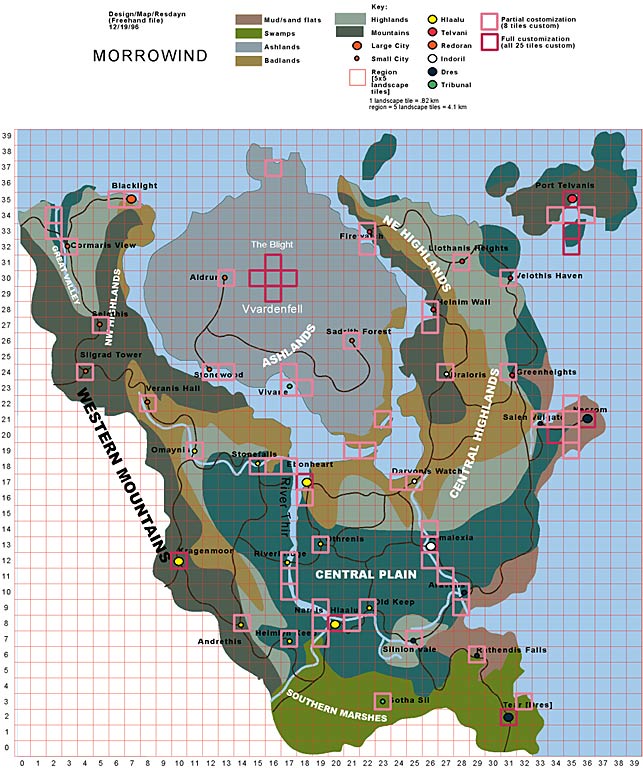
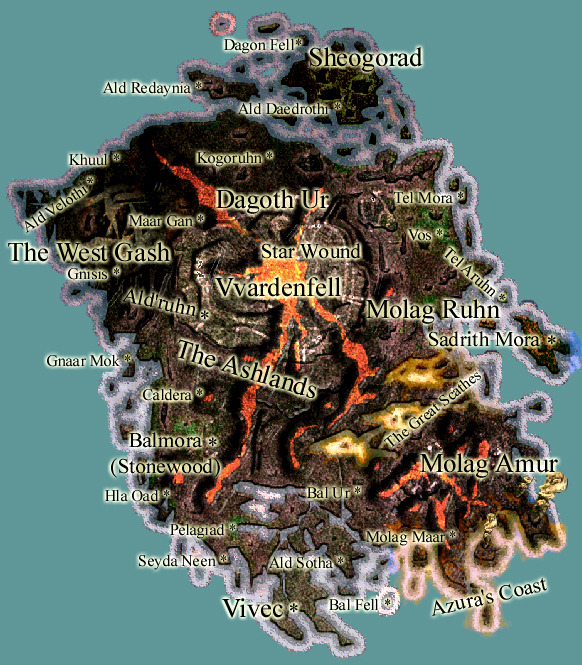
 This concept map was also shown alongside the above text. It is dated 12/19/1996 and features both the Morrowind mainland and the island of Vvardenfell, as well as another island with a city by the name of "Port Telvannis". It shows the types of environments, scale, locations of big and small cities, as well as who holds said cities. Places such as Firewatch, Helnim Wall, Greenheights, Necrom, Old Keep, Narsis, Heimlyn Keep, Ebonheart, Riverbridge, Stonefalls, Silgrad Tower, Kragenmoor and Blacklight were directly carried over from Arena.
Other places were seemingly created from tweaking existing places from Arena. A settlement called "Veranis Hall" appears on the map where a settlement called "Verarchen Hall" appeared in Arena. A settlement called "Llothanis Heights" roughly appears where a settlement known as "Karththor Heights" appeared in Arena. "Darvonis Watch" (or "Daryonis Watch") replaces "Darnim Watch", "Salen Vulgate" replaces "Sailen Vulgate, "Silnion Vale" replaces "Silnim Dale" and "Cormaris View" replaces "Cormar View". The Arena town of "Stoneforest" had become "Stonewood" by now, but it would get renamed to "Balmora" for the final release. Balmora meaning "Stoneforest" in Dunmeris.
Original places would also receive some name changes such as "Aldrun" becoming "Ald'ruhn". The name "Aldrun" may come from the Arena location "Old Run" which was located on Vvardenfell, but wasn't in the same location. "Sadrith Forest" became "Sadrith Mora", which means "Mushroom Forest" in Dunmeris. An early name for the city of Vivec can also be seen seen, although it isn't fully legible.
And finally, there are also a multitude of other original settlements that don't appear in the final game. These include "Selethis", "Omaynia", "Andrethis", "Othrenis", "Rathendis Falls", "Draloris, "Velothis Haven" and the aforementioned "Port Telvannis". Of all these places, Velothis Haven would be the only one to even get a single reference in the final game. Sotha Sil and Almalexia (the cities, not the gods) would later make appearances in Morrowind's Tribunal DLC. Underneath the city of Almalexia, there appears to be another original settlement on the map, although its name isn't legible.
In the game's credits, three people get credited under "Writing & Quest Design": Douglas Goodall, Mark E. Nelson and Ken Rolston. Another five get credited under "Additional Writing & Quest Design": Bill Burcham, Todd Howard, Michael Kirkbride, Ted Peterson, and Todd Vaughn. Goodall worked on quests for House Redoran, House Hlaalu, House Telvanni, the Mages Guild, the Fighters Guild, the Thieves Guild, the Imperial Legion, the Tribunal Temple, the Morag Tong, "and a couple of random things here and there". Ken Rolston worked worked on the main quest, Imperial Cult quests and other random things as well. Mark Nelson worked on most of the non-faction quests, as well as the Quarra, Aundae and Berne vampire clans. Todd Howard took over the Imperial Legion quests from Goodall after he got behind on schedule due to the amount of factions he was working on. Most of the quests were already written and put into the editor, but Todd "added a lot of detail to the Imperial Legion". A note by Todd, confirming his involvement, is still attached to the Imperial Legion quest "Talos Cult Conspiracy" in the Construction Set. Bill Burcham also helped Goodall with his quests, particularly with testing. Burcham is responsible for the Fighters Guild quest "Battle at Nchurdamz". It's not clearly known as to what exactly the members of the additional contributed, and some minor contributers might not have been named. In an interview, Goodall stated that "Lots of people worked in more areas than the credits suggest, and there's no way I could remember all the details now."
(Source: 2005 Douglas Goodall Interview)
Prototype Movie#
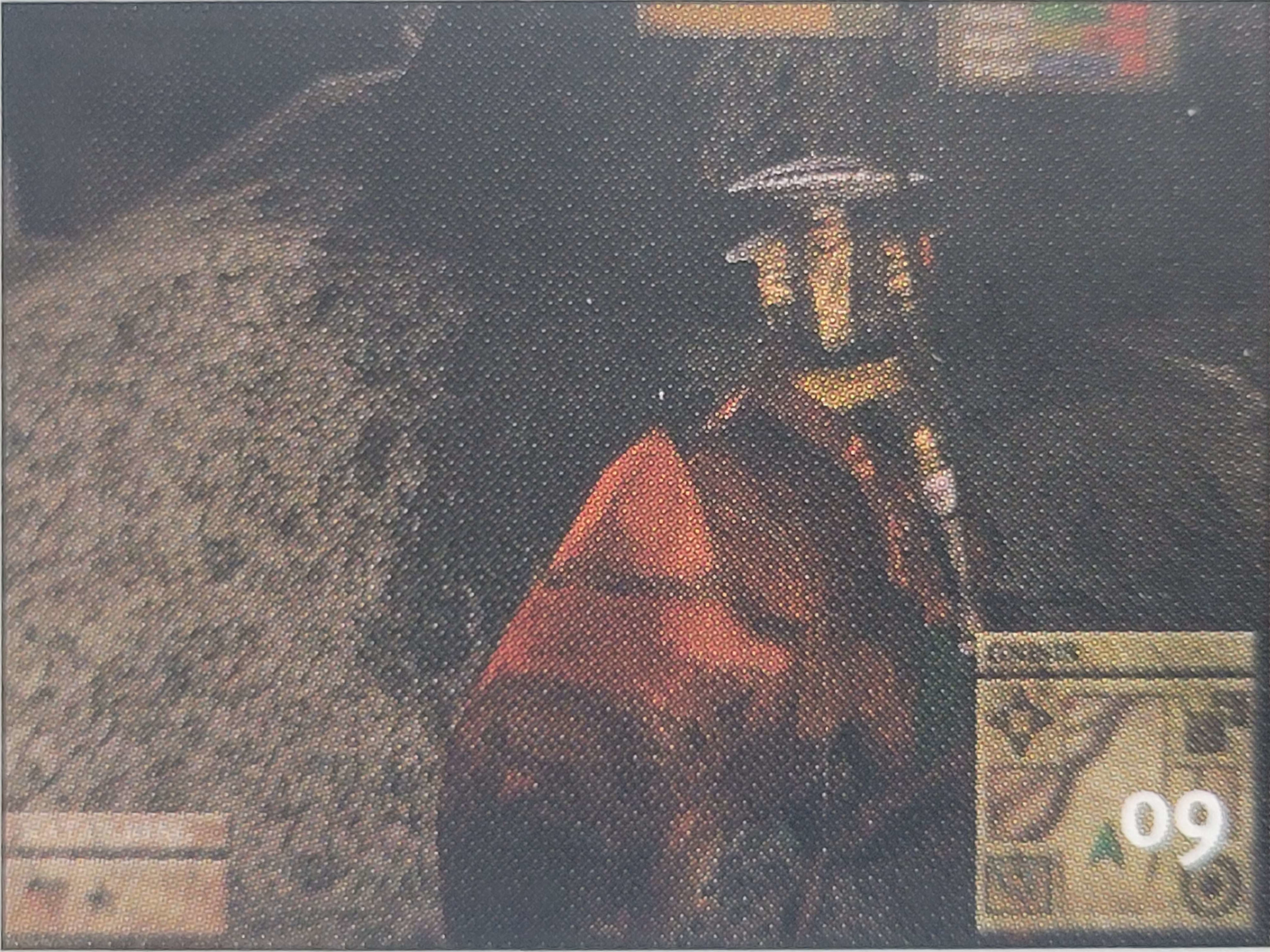
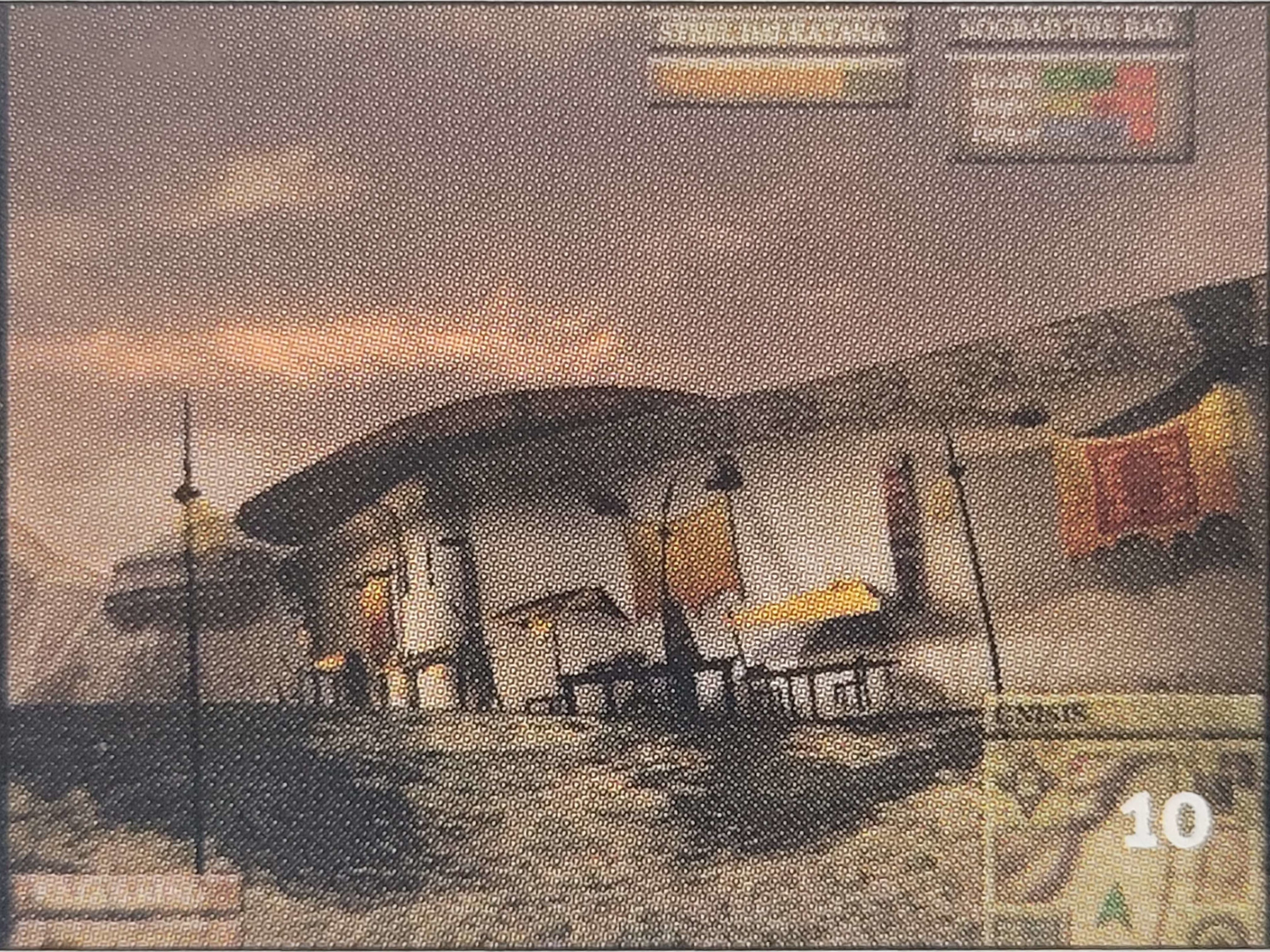
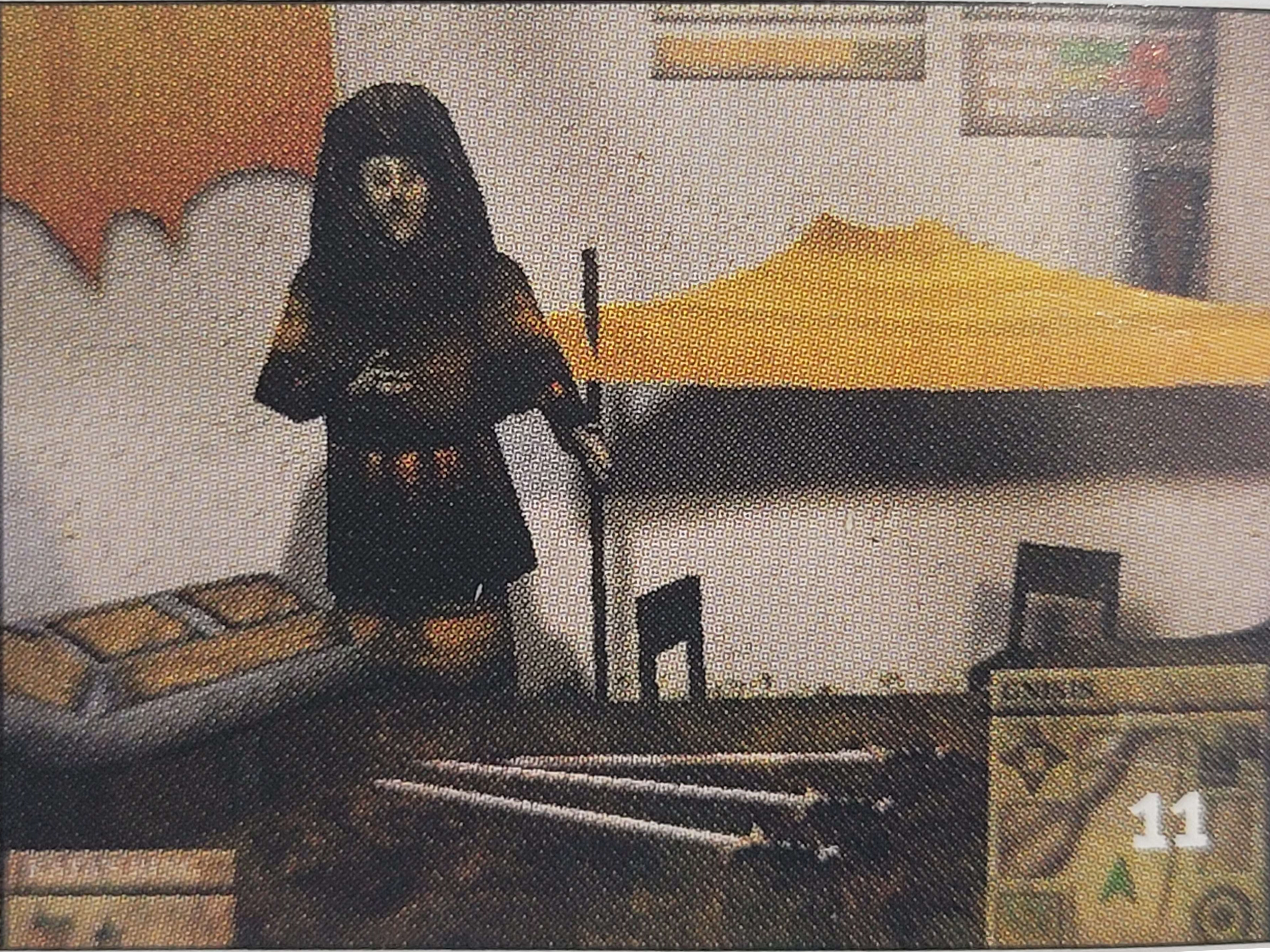
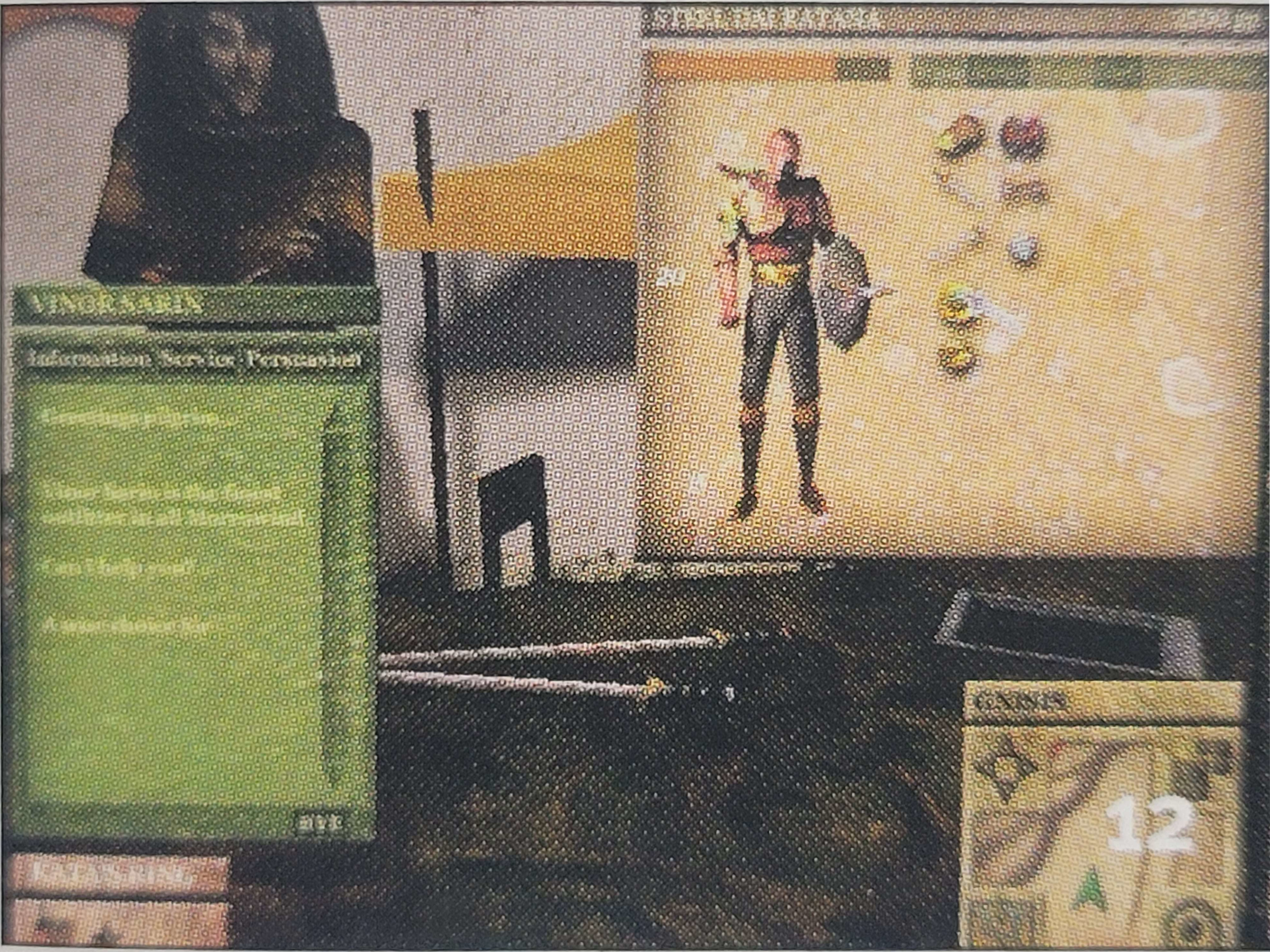
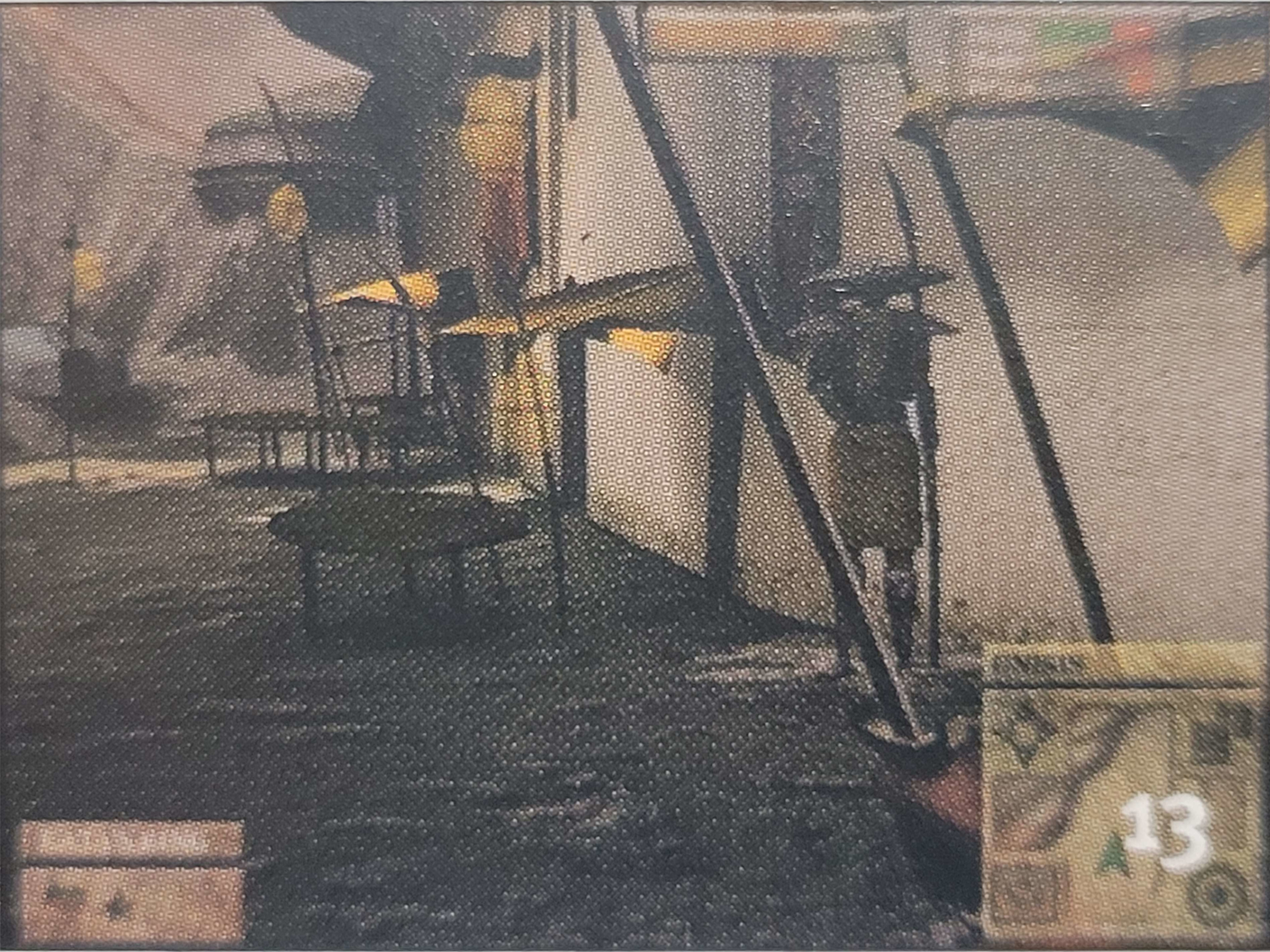
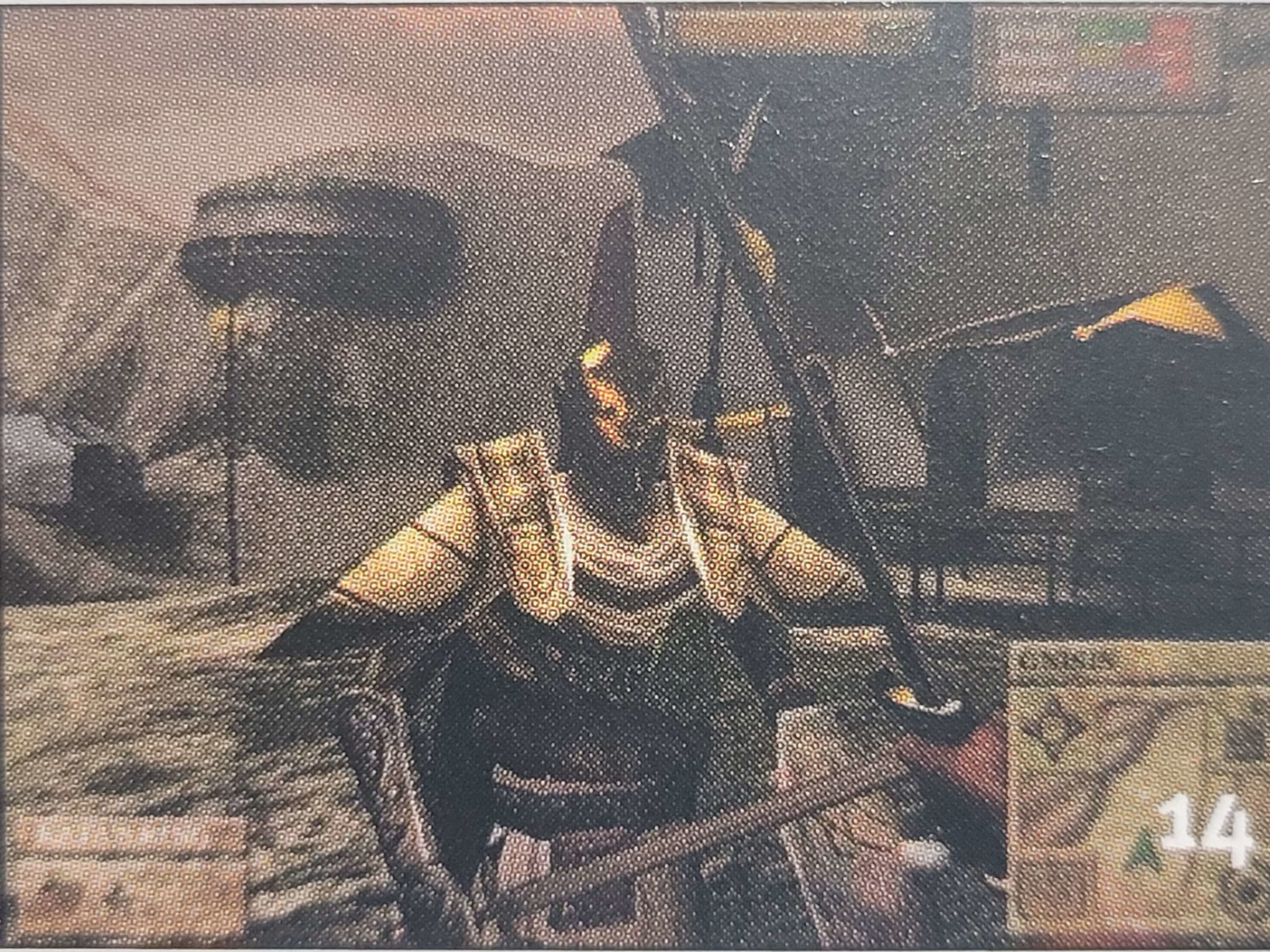
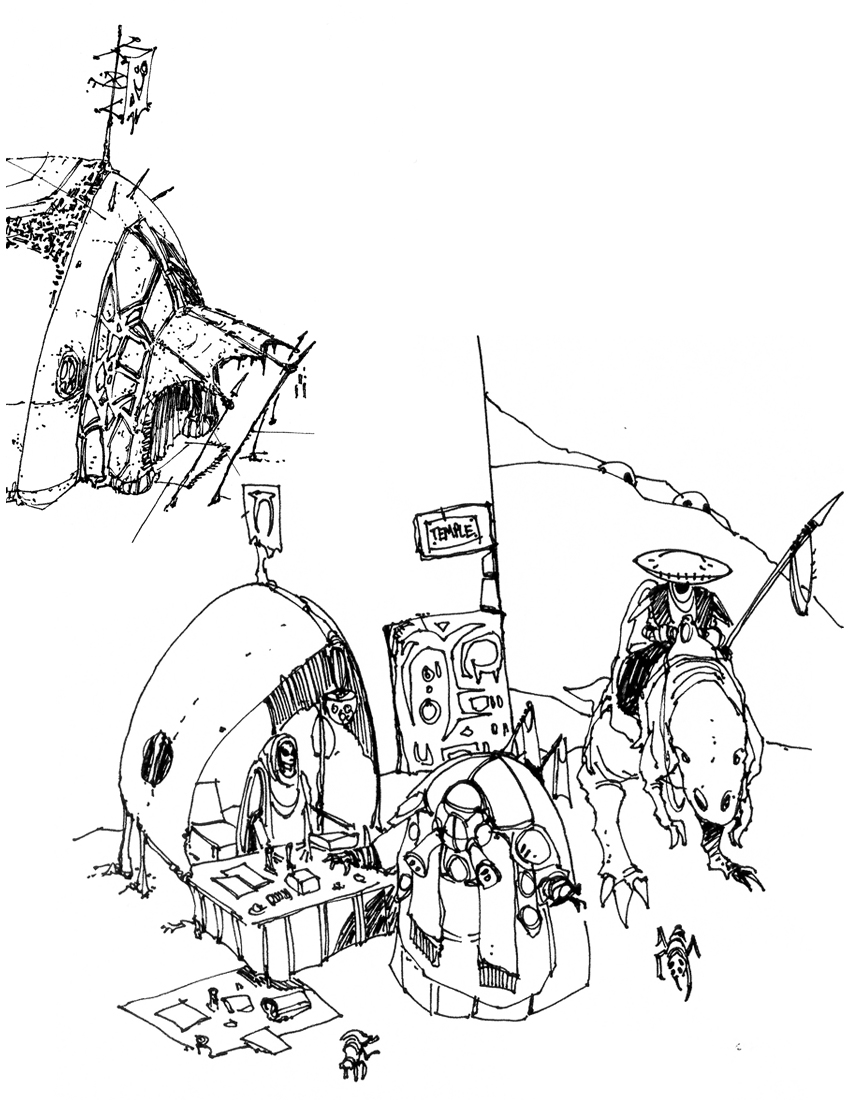
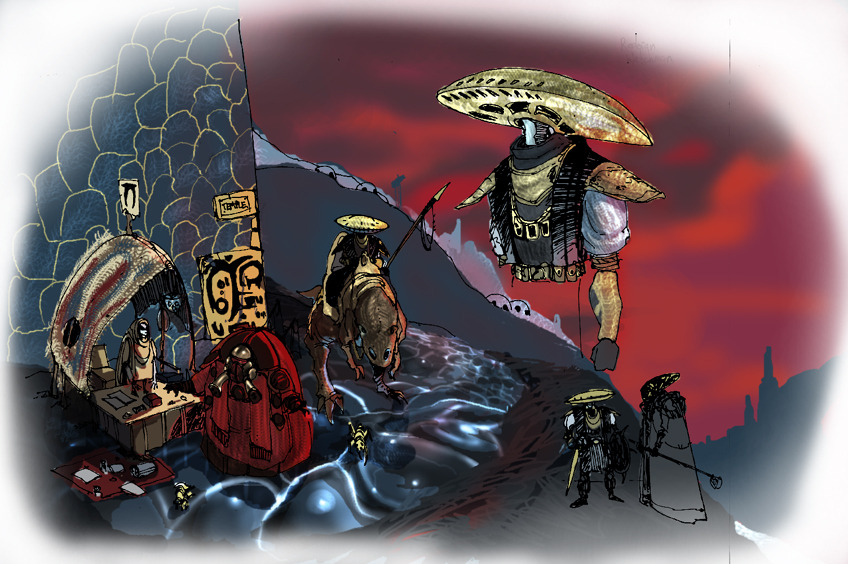
In The Art of Morrowind, there are six small screenshots shown that come from a "prototype movie created to capture the look of the game and the movement of the interface." The images, which include an early HUD and many early assets, date back to at least March 2000.The video hasn't been known to survive to present day and was not released publicly. This prototype movie seemingly had concept art drawn for it, depicting a Sload customer making a purchase at the Gnisis Temple marketplace.
The sequence of the images depicts the player firstly looking at a guard mounted on a guar before turning around and looking at the Gnisis Temple and it's marketplace. The player then approaches the merchant Vinor Sarin for a small chat and presumably purchases, and equips, a sword. Afterwards, the player turns to their left and sees a market guard while they pull out their sword from it's sheath. The last image shows a heavily armored person/elf approach the player with their weapon drawn.
Developer Portfolio Screenshots#
Two developmental images of the game were uploaded to "legalalien" the online portfolio of then-Bethesda dev, Hugh Riley. These two early screenshots showcase both a mock-up and very early work on the game's inventory system. The first image appears to showcase an even earlier version of the prototype movie than the one shown in the art book. Legible text in the first image includes "Steel Dai-Katana", "Skills", "Tower", and "Gnisis". The second image showcases an early inventory menu with multiple unused menu borders, additionally the player is named "Steely Dan", the text "Merryweather" can be seen above the Level progress meter, and the inventory icons reuse items Hugh created for The Elder Scrolls Adventures: Redguard as placeholders.


(Source: Hugh Riley - legalalien)